ISRO: India's Premier Space Agency - Achievements & Future
News• April 14, 2026• Global Edition
The Indian Space Research Organisation, widely known as ISRO, stands today as one of the world's most respected space agencies. What began as a modest endeavour in the 1960s has transformed into a powerhouse of innovation, delivering cost-effective solutions that rival much larger programmes. Headquartered in Bengaluru, ISRO has not only placed India on the global space map but also inspired millions through its string of successes—from the first Mars orbit on a maiden attempt to a historic soft landing near the lunar south pole.
As of April 2026, under the leadership of Chairman Dr. V. Narayanan (who assumed charge in January 2025 succeeding Dr. S. Somanath), ISRO continues to push boundaries. This article explores ISRO's headquarters and functions, its landmark victories, recent developments that have accelerated its growth, upcoming launches including Gaganyaan milestones, astronaut training efforts, key collaborations such as space medicine research with AIIMS Delhi, and the commercial triumph of the BlueBird satellite launch via NSIL. Written for educational purposes and drawn from verified official sources like isro.gov.in and government releases, it offers a clear, structured overview for students, enthusiasts, and professionals alike.
ISRO was established on 15 August 1969, evolving from the Indian National Committee for Space Research (INCOSPAR) formed in 1962 under the visionary leadership of Dr. Vikram Sarabhai. The organisation operates under the Department of Space (DoS), directly reporting to the Prime Minister of India. Its headquarters, Antariksh Bhavan, is located on New BEL Road in Bengaluru, Karnataka—a hub that coordinates national space policy, mission planning, and international cooperation.
The choice of Bengaluru was strategic. The city's ecosystem of research institutions and industrial base supported early satellite and propulsion work. Today, the headquarters houses programme offices for satellite communication, Earth observation, launch vehicles, and human spaceflight. Supporting centres spread across India include the Vikram Sarabhai Space Centre (VSSC) in Thiruvananthapuram for launch vehicle development, the Liquid Propulsion Systems Centre (LPSC) for propulsion technologies, the U R Rao Satellite Centre (URSC) in Bengaluru for satellite assembly, and the Satish Dhawan Space Centre (SDSC-SHAR) in Sriharikota for launches.
This decentralised yet tightly coordinated structure allows ISRO to manage complex projects efficiently. Autonomous bodies like the Physical Research Laboratory (PRL) in Ahmedabad, National Atmospheric Research Laboratory (NARL), North Eastern-Space Applications Centre (NE-SAC), and Indian Institute of Space Science and Technology (IIST) further strengthen research capabilities.
Organizational Structure and Core Functions
ISRO's structure is matrix-based, blending technical expertise with project management. The Space Commission provides policy guidance, while the Department of Space oversees implementation through ISRO and its grant-in-aid institutions. NewSpace India Limited (NSIL), the commercial arm, handles satellite launches, technology transfer, and international partnerships, enabling revenue generation and private sector involvement.
Core functions include:
Launch Vehicle Development: Designing reliable rockets like the Polar Satellite Launch Vehicle (PSLV), Geosynchronous Satellite Launch Vehicle (GSLV), LVM3 (formerly GSLV Mk III), and the Small Satellite Launch Vehicle (SSLV).
Satellite Systems: Building communication satellites (INSAT/GSAT series), Earth observation satellites (EOS/IRS series), navigation (NavIC), and scientific missions.
Space Applications: Supporting disaster management, agriculture, urban planning, and climate studies through remote sensing and data products.
Human Spaceflight and Exploration: Leading the Gaganyaan programme and future lunar and interplanetary missions.
Research and Innovation: Advancing propulsion, materials, robotics, and space medicine.
IN-SPACe (Indian National Space Promotion and Authorisation Centre) has opened doors for private players, fostering a vibrant ecosystem. This shift has been pivotal in ISRO's recent growth, allowing the agency to focus on high-end R&D while industry handles routine manufacturing and launches.
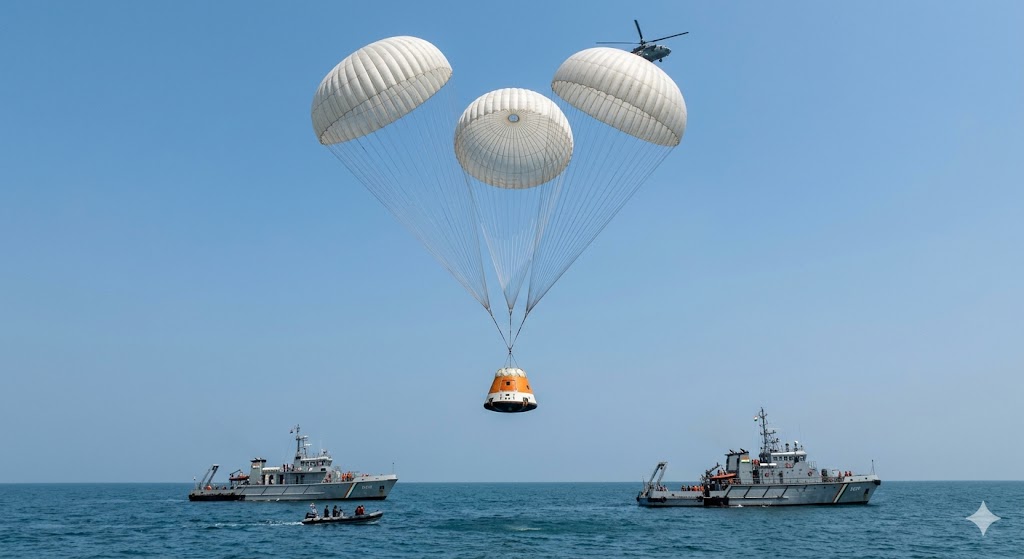
A successful IADT-02 (Integrated Air Drop Test) recovery near Sriharikota on April 10, 2026. The 5.7-tonne simulated Gaganyaan Crew Module is suspended under massive parachutes as Indian Navy vessels and IAF assets approach for retrieval, confirming parachute and recovery system validation.
Landmark Victories and Success Stories
ISRO's success stories highlight ingenuity and frugality. The Mars Orbiter Mission (Mangalyaan), launched in 2013 and entering Mars orbit in 2014, made India the first Asian nation—and the only one on its first attempt—to reach the Red Planet. At a fraction of global costs, it demonstrated India's engineering prowess and returned valuable atmospheric data.
Lunar exploration reached new heights with the Chandrayaan series. Chandrayaan-1 (2008) confirmed water molecules on the Moon. Chandrayaan-3 (July 2023) achieved the world's first soft landing near the lunar south pole with the Vikram lander and Pragyan rover, conducting in-situ experiments and elevating India's global standing.
Solar science advanced with Aditya-L1 (September 2023), India's first dedicated mission to study the Sun from the L1 point. Other milestones include Astrosat (India's first multi-wavelength space observatory), XPoSat for X-ray polarimetry, and consistent PSLV successes that have launched hundreds of satellites for India and international clients.
These victories are educational goldmines. They show how rigorous testing, indigenous technology, and mission-specific innovations can overcome resource constraints. ISRO's low-cost model—often cited in textbooks—proves that strategic planning and teamwork yield extraordinary results.
Recent Developments: ISRO's Evolution in Recent Years
The past decade has seen ISRO evolve rapidly. Under previous leadership, including Dr. S. Somanath, and now Dr. V. Narayanan, the agency has embraced reforms. Private sector participation, enabled by IN-SPACe, has accelerated satellite production and launch services. NSIL's commercial launches, such as the record-breaking BlueBird-6 (Block-2) mission in December 2025—the heaviest US commercial satellite at over 6,100 kg—placed via LVM3-M6, underscore this growth. Managed by NSIL, it marked a milestone in India-US space cooperation for direct-to-cell broadband.
Launch cadence has increased, with plans for 50 missions in the next five years. Reusable launch vehicle (RLV) tests and small satellite capabilities via SSLV demonstrate technological maturity. The space economy, currently around USD 8-10 billion, targets significant expansion, aiming for a 10% global share through upstream, midstream, and downstream segments.
ISRO has also strengthened international ties and domestic applications. From disaster warning systems to precision agriculture, its satellites impact daily life. Recent focus on software-driven reliability and electric propulsion systems reflects adaptation to emerging challenges like space debris and sustainable operations.
Upcoming Missions and Launches in 2026 and Beyond
2026 is a landmark year for ISRO. The agency has lined up seven launches by March 2026, including critical Gaganyaan tests. Key highlights:
Gaganyaan Uncrewed Flights: The first orbital test (G1) with humanoid robot Vyommitra aboard a human-rated LVM3 is targeted for early-to-mid 2026. Follow-on G2 and G3 missions will complete rehearsals before the crewed flight in 2027.
Satellite Missions: PSLV variants will deploy EOS series satellites for oceanography and Earth observation. GSLV missions include navigation satellites like NVS-03.
SSLV Commercial Debut: SSLV-L1 will mark private sector involvement in small satellite launches.
Chandrayaan-4: The lunar sample return mission, now slated for 2028, will involve orbital docking and advanced lander-rover systems using upgraded LVM3 capabilities.
Technology Demonstrations: Tests of quantum key distribution, electric propulsion, and reusable technologies.
Recent milestones include the successful second Integrated Air Drop Test (IADT-02) on 10 April 2026 at Sriharikota. A 5.7-tonne simulated Crew Module was dropped from 3 km by an IAF Chinook helicopter, validating parachutes and recovery systems in coordination with the Indian Navy and DRDO. Earlier TV-D1 (Test Vehicle-D1) abort demonstrations paved the way for crew safety.
These missions align with India's Space Vision 2047, including an indigenous space station by 2035.
Gaganyaan: Astronaut Training and Mission Preparation
Gaganyaan, India's first human spaceflight programme, is the pinnacle of current efforts. Four astronaut candidates (Gaganyatris) underwent rigorous selection and training in India and Russia, covering microgravity physiology, spacecraft systems, and emergency procedures.
Preparation involves:
Ground Simulations: Centrifuge training, isolation tests, and mission-specific rehearsals at the Human Space Flight Centre.
Uncrewed Tests: Vyommitra, the humanoid robot, will fly on G1 to test life-support systems, voice commands, and crew module performance.
Parachute and Recovery Validation: IADT-01 and IADT-02 successfully demonstrated splashdown and recovery, critical for safe Earth return.
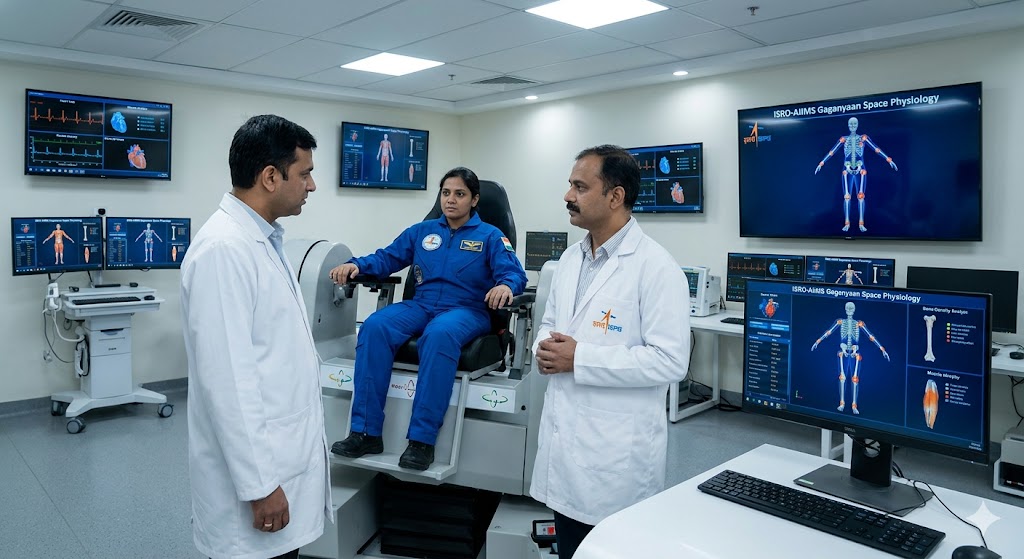
Space Medicine Integration: Ongoing studies address bone loss, muscle atrophy, radiation exposure, and cardiovascular changes.
The crew module, weighing around 5.7 tonnes in test configurations, is designed for three astronauts in low-Earth orbit for up to seven days initially. These steps ensure India is ready for crewed missions, building self-reliance in human spaceflight.
Key Collaborations: Space Medicine with AIIMS Delhi and Commercial Successes
ISRO recognises that human spaceflight demands interdisciplinary expertise. In March 2026, ISRO signed a Framework MoU with the All India Institute of Medical Sciences (AIIMS), New Delhi, for cooperation in space medicine and research. The partnership focuses on ground- and space-based studies of microgravity effects on human physiology, immunity, and performance—vital for Gaganyaan and future long-duration missions.
Joint research will enhance astronaut selection, health monitoring, and countermeasures, blending ISRO's engineering with AIIMS's clinical expertise. This collaboration exemplifies how ISRO leverages national institutions for holistic mission success.
On the commercial front, the BlueBird-6 launch via NSIL in December 2025 highlighted growing global partnerships. The AST SpaceMobile satellite enables direct smartphone connectivity from space, showcasing ISRO's reliability for heavy payloads and strengthening India's role in the global space economy.
Inside the joint ISRO-AIIMS Delhi space medicine and research laboratory in early 2026. A medical researcher observes an astronaut in a centrifuge simulator while analyzing complex physiological data on microgravity effects, vital for the upcoming crewed Gaganyaan missions.
The Road Ahead: Future of ISRO and India's Space Ambitions
ISRO's trajectory points toward greater self-reliance and global leadership. With reusable technologies, private industry scaling, and ambitious goals like Chandrayaan-4 and the Indian Space Station, the organisation is poised to contribute to humanity's space exploration while addressing Earth's challenges through applications.
For students and aspiring scientists, ISRO offers pathways via IIST, YUVIKA internships, and the growing private space sector. Its story teaches perseverance, innovation under constraints, and the power of collective effort.
In conclusion, ISRO's journey from a fledgling organisation to a globally admired space research powerhouse reflects India's scientific temper and determination. As upcoming 2026 launches and Gaganyaan milestones unfold, ISRO continues to inspire the next generation. For the latest updates, refer to official sources at isro.gov.in. The stars are within reach—and ISRO is leading the way.
Frequently Asked Questions
What is the primary significance of ISRO: India's Premier Space Agency - Achievements & Future?
The Indian Space Research Organisation, widely known as ISRO, stands today as one of the world's most respected space agencies. What began as a modest endeavour in the 1960s has transformed into a powerhouse of innovation, delivering cost-effective solutions that rival much larger programmes.
How does this development impact News?
Headquartered in Bengaluru, ISRO has not only placed India on the global space map but also inspired millions through its string of successes—from the first Mars orbit on a maiden attempt to a historic soft landing near the lunar south pole.As of April 2026, under the leadership of Chairman Dr. V.
What are the key future projections to monitor?
Narayanan (who assumed charge in January 2025 succeeding Dr.