NASA – The World’s Highest-Energy Space Organization
In 2026, NASA continues to define the frontiers of human knowledge as the undisputed leader in space exploration. Often described as the world’s highest-energy space organization, NASA drives innovation with unmatched ambition, scientific rigor, and international collaboration. From its humble origins in the midst of the Cold War to its record-breaking achievements this year, the agency has transformed our understanding of the cosmos while delivering substantial economic benefits to the United States and the global community.
The recent success of the NASA Artemis II mission exemplifies this leadership. Launched on April 1, 2026, and safely splashing down on April 10 after a historic 10-day journey around the Moon, Artemis II marked humanity’s return to deep space after more than five decades. With four astronauts aboard—NASA’s Reid Wiseman, Victor Glover, and Christina Koch, along with CSA astronaut Jeremy Hansen—the mission shattered distance records and provided unprecedented views of the lunar far side. NASA live stream coverage drew millions worldwide, highlighting the agency’s commitment to public engagement.
This article examines NASA’s formation, its profound economic contributions, its status as the greatest space research organization by 2026, and the array of groundbreaking events unfolding this year, including Mars organics studies, solar activity monitoring, asteroid defense initiatives, and ongoing partnerships with SpaceX.
The Formation and Origins of NASA
NASA’s story begins on July 29, 1958, when President Dwight D. Eisenhower signed the National Aeronautics and Space Act into law. The agency emerged directly from the National Advisory Committee for Aeronautics (NACA), a U.S. research organization established in 1915 to advance aviation technology. The catalyst was the Soviet Union’s launch of Sputnik 1 in 1957, which ignited the Space Race and underscored the need for a dedicated civilian space program.
Unlike military-focused efforts, NASA was designed as a civilian agency to pursue peaceful exploration while advancing scientific discovery. Its origins are firmly rooted in the United States, though international partnerships have been integral from the start. Early collaborations with nations such as Canada, the United Kingdom, and later European countries laid the foundation for today’s global endeavors.
The agency’s early years focused on human spaceflight. Project Mercury put the first American in orbit in 1962, followed by Gemini’s rendezvous and docking tests. The Apollo program culminated in the historic Moon landing of Apollo 11 in 1969. These milestones not only fulfilled President John F. Kennedy’s 1961 challenge but also spurred technological advancements that rippled across industries.
By the 1970s and 1980s, NASA shifted toward reusable spacecraft with the Space Shuttle program and established the International Space Station (ISS) framework through partnerships with Russia, Europe, Japan, and Canada. The Hubble Space Telescope, launched in 1990, and robotic missions to Mars, Venus, and the outer planets further cemented NASA’s reputation.
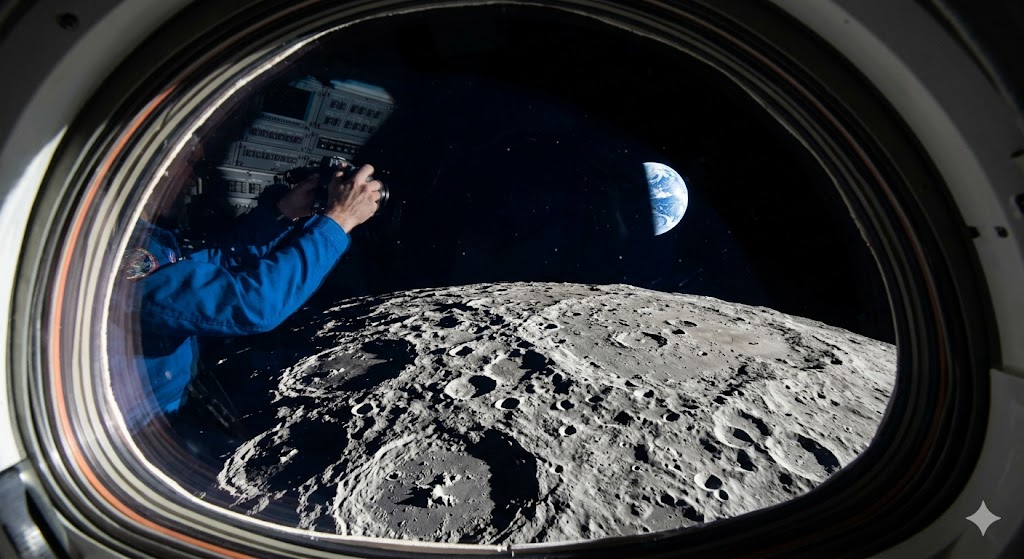
A breathtaking view from the Orion spacecraft's porthole during the Artemis II mission’s closest approach on April 6, 2026. The cratered lunar far side fills the lower view, sharply defined against deep space, while a brilliant, crescent Earth hangs in the distance
While NASA operates as a government agency without direct profit motives, its activities generate enormous economic returns. According to NASA’s latest economic impact studies, the agency contributed approximately $75.6 billion to the U.S. economy in fiscal year 2023 alone, sustaining hundreds of thousands of jobs nationwide. For every dollar invested, NASA returns multiple times that value through technology spin-offs, workforce development, and industrial growth.
Key sectors benefiting include aerospace manufacturing, electronics, materials science, and software engineering. Innovations from NASA—such as memory foam, cordless tools, water purification systems, and advancements in GPS and satellite communications—have created billions in commercial revenue. The Moon to Mars (M2M) campaign, central to Artemis, accounts for a significant portion of these impacts, driving private-sector involvement from companies like SpaceX and Blue Origin.
In 2026, with Artemis II successfully completed, economic analyses project even greater returns. The mission’s technologies, including the Space Launch System (SLS) rocket and Orion spacecraft, are paving the way for sustainable lunar infrastructure, which analysts estimate could add tens of billions more to the U.S. GDP over the coming decade through contracts, tourism potential, and resource utilization research.
Internationally, NASA’s partnerships amplify these benefits. Collaborations on the ISS and Artemis Accords have fostered a global space economy valued in the trillions, with NASA at the helm.
Why NASA Remains the Greatest Space Research Organization in 2026
By April 2026, NASA has solidified its position as the world’s preeminent space research organization through a combination of operational excellence, scientific output, and visionary leadership. Unlike emerging players focused primarily on commercial launches, NASA integrates crewed exploration, robotic science, Earth observation, and astrophysics under one umbrella.
The agency’s fleet of spacecraft—including the Perseverance and Curiosity rovers on Mars, the James Webb Space Telescope, and solar observatories—continues to deliver discoveries that reshape textbooks. Its rigorous safety standards, peer-reviewed research, and transparent NASA live stream broadcasts set the global benchmark.
Artemis II’s flawless execution in early April 2026 underscores this supremacy. The crew traveled farther from Earth than any humans since Apollo 13, reaching a record 252,760 miles. They conducted manual piloting tests, captured high-resolution lunar imagery, and gathered data critical for future landings. Post-mission analysis confirms all systems performed beyond expectations, validating Orion’s deep-space capabilities.
NASA’s international leadership further distinguishes it. Through the Artemis program, the agency coordinates with partners from 40+ nations, ensuring inclusive exploration. This collaborative model contrasts with unilateral approaches elsewhere, fostering shared scientific progress and peaceful space governance.
The Ultimate Success of NASA’s 2026 Moon Mission: Artemis II
The NASA moon mission 2026—Artemis II—stands as one of the year’s crowning achievements. Launched atop the SLS rocket from Kennedy Space Center on April 1, the Orion spacecraft carried its international crew on a 10-day voyage that included a precise lunar flyby on April 6.
Key milestones included breaking the Apollo 13 distance record, executing a flawless translunar injection burn, and navigating communications blackouts behind the Moon. The astronauts returned with stunning visuals of Earth’s crescent and the lunar far side, data that will refine models for radiation exposure and spacecraft performance.
NASA live stream coverage allowed global audiences to follow every phase, from launch to splashdown off San Diego on April 10. Recovery teams confirmed the crew’s excellent health, paving the way for Artemis III and eventual lunar surface missions.
This success validates years of development and positions NASA to lead sustainable lunar presence, including potential resource extraction and scientific outposts.
Advancing Science: Mars Organics Study, Solar Activity, and ISS Operations
Parallel to lunar efforts, NASA’s Mars exploration yields tantalizing insights. In early 2026, Curiosity rover data revealed the largest organic molecules yet detected on the Red Planet. A February study published in *Astrobiology* concluded that non-biological processes cannot fully explain the abundance of these compounds, strengthening the case for further investigation into potential ancient microbial life.
Perseverance rover continues collecting samples in Jezero Crater, including rocks with possible biosignatures from ancient lakebeds. These efforts support the Mars Sample Return campaign, promising laboratory analysis on Earth that could answer whether life ever existed on Mars.
Solar activity monitoring remains critical. Solar Cycle 25 remains active in 2026, with multiple strong flares observed in March. During Artemis II, NASA teams tracked space weather in real time to protect the crew, demonstrating the agency’s integrated approach to human safety and heliophysics.
The International Space Station operates at full capacity. SpaceX’s Crew-12 mission, launched in February 2026, delivered NASA astronauts Jessica Meir and Jack Hathaway, ESA’s Sophie Adenot, and Roscosmos’ Andrey Fedyaev. The crew conducts research on microgravity effects, technology demonstrations, and Earth observation, ensuring continuous human presence in low Earth orbit.
Upcoming Events: Asteroid Defense, SpaceX Collaborations, and Beyond
Looking ahead in 2026, NASA’s calendar brims with ambition. The European Space Agency’s Hera mission, arriving at the Didymos-Dimorphos asteroid system in November, will follow up on NASA’s 2022 DART impact. This joint effort enhances planetary defense capabilities against potential Earth-threatening objects.
Additional near-Earth asteroid flybys are tracked daily by NASA’s Center for Near Earth Object Studies, with several small objects passing safely in April 2026.
SpaceX partnerships accelerate progress. Beyond Crew-12, the company supports ISS resupply and Artemis hardware development. Future crew rotations and commercial lunar landers will rely on these synergies.
Other highlights include continued Perseverance operations, potential new cosmic discoveries from Webb telescope data releases, and expanded Earth science missions studying climate and natural disasters.
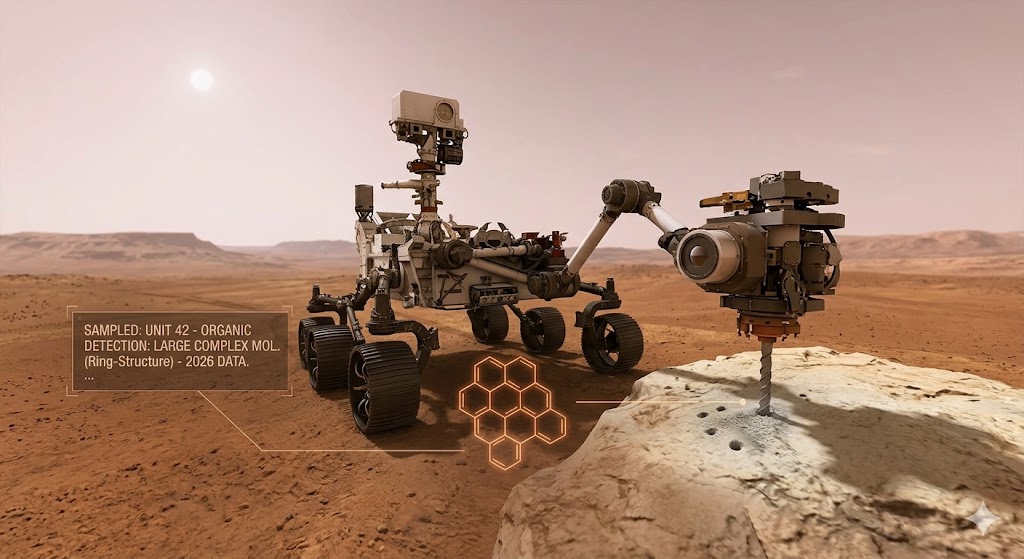
The Perseverance rover investigates a rock outcrop in Jezero Crater. A subtle orange graphic overlay highlights the structure of large, complex organic molecules detected by the rover in early 2026, reinforcing the Mars organics study.
Conclusion: NASA’s Enduring Legacy and Future Horizons
As 2026 unfolds, NASA reaffirms its role as the world’s highest-energy and most accomplished space organization. From its 1958 founding to the triumphant Artemis II NASA moon mission 2026, the agency has delivered scientific breakthroughs, economic prosperity, and inspiration to billions.
Its leadership in crewed lunar exploration, Mars organics study, solar activity research, ISS operations, and asteroid monitoring ensures humanity’s future beyond Earth. Through transparent NASA live stream events and global partnerships, NASA democratizes discovery.
The coming months promise even more: refined Artemis plans, sample returns, and deeper cosmic insights. NASA does not merely explore space—it expands what it means to be human in an infinite universe. For anyone passionate about science, technology, or humanity’s destiny, following NASA’s journey remains essential.
Frequently Asked Questions
What is the primary significance of "NASA: Leading Global Space Exploration in 2026"?
NASA – The World’s Highest-Energy Space OrganizationIn 2026, NASA continues to define the frontiers of human knowledge as the undisputed leader in space exploration. Often described as the world’s highest-energy space organization, NASA drives innovation with unmatched ambition, scientific rigor, and international collaboration.
How does this development impact News?
From its humble origins in the midst of the Cold War to its record-breaking achievements this year, the agency has transformed our understanding of the cosmos while delivering substantial economic benefits to the United States and the global community.The recent success of the NASA Artemis II mission exemplifies this leadership. Launched on April 1, 2026, and safely splashing down on April 10 after a historic 10-day journey around the Moon, Artemis II marked humanity’s return to deep space after more than five decades.
What are the key future projections to monitor?
With four astronauts aboard—NASA’s Reid Wiseman, Victor Glover, and Christina Koch, along with CSA astronaut Jeremy Hansen—the mission shattered distance records and provided unprecedented views of the lunar far side.