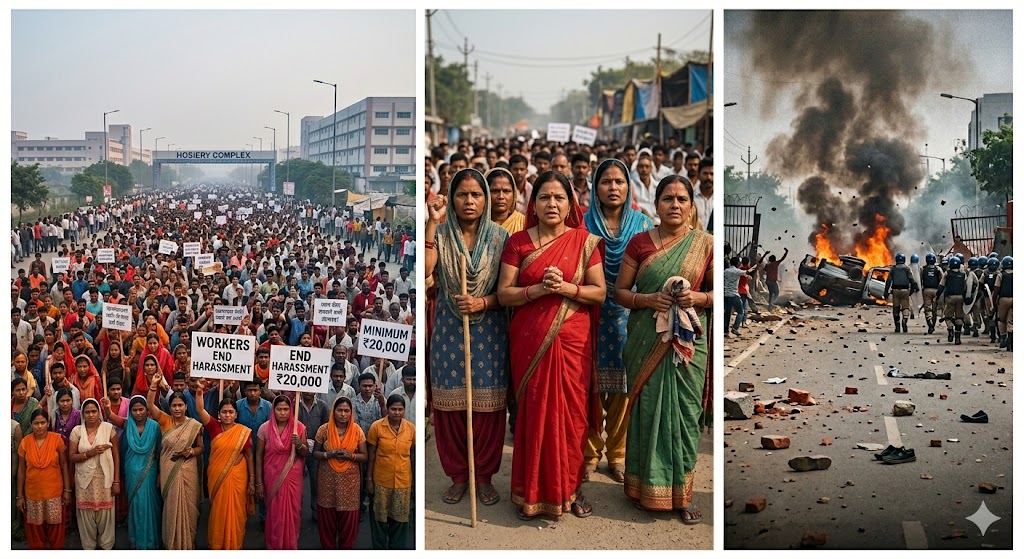
The Noida protest 2026 has gripped the industrial heart of Uttar Pradesh, drawing national attention to long-simmering labor issues. What began as peaceful demonstrations by thousands of factory workers quickly escalated into clashes, road blockades, and property damage across key areas like Phase 2 and Sector 84. At the core of the Noida workers protest lie urgent demands for wage hikes, improved working conditions, and mechanisms to address workplace grievances—including the formation of internal committees to tackle sexual harassment.
As of April 14, 2026, the situation remains fluid. Over 40,000 workers from garment, hosiery, and manufacturing units took to the streets, citing stagnant salaries that no longer match soaring living costs. The unrest spilled into Greater Noida and affected major traffic arteries linking Delhi-NCR, leaving commuters stranded for hours. Police responded with tear gas and “minimum force,” while authorities made over 300 arrests. Yet the Uttar Pradesh government has moved swiftly, announcing a minimum wage hike effective retrospectively from April 1.
This article provides a complete, detailed overview of the Noida protest, its triggers, the workers’ specific requirements, the violence that unfolded, and the current position vis-à-vis the UP government’s actions. We examine how these events reflect broader labor challenges in India’s industrial belts.
Background: Why the Noida Workers Protest Erupted in 2026
Noida’s industrial zones—particularly Phase 2, Sector 60, Sector 62, Sector 84, and parts of the Hosiery Complex—have long been hubs for export-oriented manufacturing. Factories here employ a large migrant workforce, many of them women from Bihar, Uttar Pradesh, and neighboring states. For years, these workers have operated under tight margins, with monthly salaries hovering between ₹13,000 and ₹15,000 for 10-12 hour shifts.
The immediate spark for the Noida protest 2026 came from Haryana’s recent 35% minimum wage increase, raising pay to around ₹19,000. Workers in Noida saw this as a clear disparity. They argued that similar revisions were overdue in Uttar Pradesh, especially amid inflation driven by global factors like the US-Israel conflict with Iran, which disrupted fuel supplies and pushed living costs higher.
But the grievances run deeper. Workers spoke of unpaid overtime, lack of weekly offs, delayed salaries, and missing proper pay slips. Many highlighted safety concerns inside factories. A recurring demand was the creation of internal committees to handle complaints of sexual harassment and ensure workplace dignity—particularly important in units with a high proportion of female employees. These demands were not afterthoughts; they formed part of a six-point charter that included bonuses, enforcement of labor laws, and grievance redressal systems.
The Noida labor protest gained momentum over several days before exploding on April 13. Organizers coordinated across 80 locations within the Gautam Buddh Nagar commissionerate, turning what could have remained a contained sit-in into a region-wide agitation. By morning, roads were blocked, including stretches of NH-9 and approaches to the Delhi-NCR border.
Core Demands: Wage Hikes, Workplace Safety, and Redressal Against Harassment
At the heart of every slogan during the Noida workers protest was a simple plea for fair pay. Workers demanded a minimum monthly salary of at least ₹20,000, aligning with current living expenses in the NCR. They pointed out that stagnant wages had left families struggling with rent, food, and education costs.
Equally pressing were non-monetary demands. Protesters called for:
Strict adherence to an 8-hour workday with proper overtime compensation.
Mandatory weekly off days and paid leave.
Timely salary disbursal and issuance of formal pay slips.
Formation of internal complaints committees specifically to address sexual harassment at workplaces, as mandated under Indian law but often poorly implemented in smaller units.
Workplace safety committees and grievance cells to prevent exploitation.
Women workers, who form a significant part of the garment and hosiery workforce, were particularly vocal about the need for these harassment redressal mechanisms. They described environments where complaints often went unheeded, leading to a sense of vulnerability. The call for sexual harassment committees was not symbolic—it reflected daily realities that many had endured silently for years.
These demands resonated because they touched on both economic survival and basic human dignity. As one group of protesters noted during the early peaceful phase, “We are not asking for charity; we are asking for what is rightfully ours under labor laws.”
Female workers in Noida became a significant and vocal part of the 2026 protests, holding signs demanding a minimum wage hike to ₹20,000 and the establishment of safe, harassment-free workplaces
How the Peaceful Noida Protest Turned Violent
The Noida protest began calmly on the morning of April 13, with workers gathering in Phase 2 near the Hosiery Complex. Slogans filled the air as marchers moved toward Sector 62 and Sector 84. By midday, however, the mood shifted. Some groups allegedly entered factories, leading to vandalism. Stones were pelted at police and security personnel. Vehicles, including private cars and at least one government van, were overturned and set ablaze. Thick smoke rose from multiple spots in Sector 84 and Phase 2.
Police deployed heavy contingents, including the PAC, and used tear gas to disperse crowds. Visuals from the scene—widely shared as Noida protest video clips—showed chaotic scenes: burnt vehicles, damaged factory gates, and protesters clashing with officers in riot gear. Traffic came to a standstill on the Noida Expressway, DND Flyway, and key routes toward Delhi. Commuters reported delays of several hours.
Similar unrest was reported in Greater Noida and pockets of Faridabad, suggesting a spillover effect from earlier agitations in Haryana’s Manesar and Gurugram. By evening, authorities had detained over 300 individuals and registered multiple FIRs. A fresh flare-up occurred on April 14 in Sector 80, where workers clashed again with police and threw stones.
The violence, while condemned by many, underscored the depth of frustration. Officials maintained that “minimum force” was used, but images of damaged property and injured personnel highlighted how quickly industrial discontent can boil over.
UP Government’s Response and CM Yogi Adityanath’s Stance
The Uttar Pradesh government acted with notable speed. On April 14, authorities announced a hike in minimum wages across all worker categories. The revised rates, effective retrospectively from April 1, 2026, aim to bridge the gap with neighboring states and provide immediate relief.
Chief Minister Yogi Adityanath addressed the Noida protest directly. In statements issued after high-level reviews, he urged workers to remain calm and not fall prey to “conspiratorial elements” seeking to disturb law and order. He described the unrest as a possible “larger conspiracy” aimed at hampering Uttar Pradesh’s growth and even referenced probes into potential anti-national links, including a Pakistan angle mentioned by some ministers. At the same time, the CM directed the formation of a high-powered committee under the labor department to engage directly with workers, industry bodies, and factory managements within 24 hours.
The committee has already begun discussions, focusing on wage disparities, working conditions, and implementation of safety and harassment redressal mechanisms. The government has also promised stricter enforcement of labor laws and has appealed to employers to cooperate in resolving arrears and overtime issues.
Opposition leaders, including Samajwadi Party chief Akhilesh Yadav, criticized the CM’s conspiracy narrative, calling instead for immediate focus on genuine worker grievances. Yet the wage hike announcement appears to have de-escalated tensions in several pockets.
Current Position of the Noida Protest and Outlook
As of April 14, 2026, the **Noida protest** has entered its second day with reduced intensity in some areas but fresh incidents in Sector 80. Police presence remains high across industrial zones. Traffic advisories are still in effect, though major highways have partially reopened.
The government’s wage revision and committee formation mark a significant step toward resolution. Many workers have welcomed the announcement, though some unions insist on written assurances regarding harassment committees and other non-wage demands. Industry associations have expressed safety concerns after attacks on factories and have called for stronger security.
The broader impact is already visible: disrupted supply chains, halted production in dozens of units, and economic losses estimated in crores. For the workers, the Noida protest 2026 has spotlighted issues that were long ignored. For the UP government, it has become a test of balancing industrial growth with labor welfare.
Looking ahead, sustained dialogue through the newly formed committee will be crucial. If the wage hike is implemented smoothly and harassment redressal mechanisms are strengthened, the unrest could subside quickly. Failure to follow through, however, risks renewed protests.
Broader Implications for Labor Rights in Uttar Pradesh
The Noida workers protest is not an isolated event. It mirrors growing discontent in industrial corridors across India, where rapid urbanization clashes with outdated wage structures. The spillover from Haryana’s wage revision shows how interconnected the NCR economy has become.
By addressing the demands head-on—through both immediate wage relief and long-term structural changes—the UP government has signaled a willingness to engage. The inclusion of workplace safety and sexual harassment committees in the discussions is particularly noteworthy, as it acknowledges the vulnerabilities faced by women workers.
Yet challenges remain. Ensuring that small and medium enterprises can absorb the wage hike without layoffs or closures will require targeted support. Strengthening labor enforcement mechanisms and building trust between workers, employers, and authorities will take time.
Conclusion: A Turning Point for Noida’s Industrial Future
The Noida protest 2026 has laid bare the urgent need for equitable labor policies in one of India’s fastest-growing regions. Workers demanded—and largely received—attention to wage hikes, but their calls for dignity, safety, and protection from harassment remain central to any lasting solution.
As the situation evolves, all eyes remain on the high-level committee’s progress and the effective rollout of the new minimum wages. For now, the Noida protest serves as a reminder that economic growth must walk hand in hand with worker welfare. The coming days will determine whether this unrest becomes a catalyst for meaningful reform or merely another chapter in India’s labor history.
Frequently Asked Questions
What is the primary significance of "Noida Protest April 2026: Workers Demand Wage Hikes"?
Noida Protest 2026: Workers Demand Wage Hikes Amid Rising TensionsThe Noida protest 2026 has gripped the industrial heart of Uttar Pradesh, drawing national attention to long-simmering labor issues. What began as peaceful demonstrations by thousands of factory workers quickly escalated into clashes, road blockades, and property damage across key areas like Phase 2 and Sector 84.
How does this development impact News?
At the core of the Noida workers protest lie urgent demands for wage hikes, improved working conditions, and mechanisms to address workplace grievances—including the formation of internal committees to tackle sexual harassment.As of April 14, 2026, the situation remains fluid. Over 40,000 workers from garment, hosiery, and manufacturing units took to the streets, citing stagnant salaries that no longer match soaring living costs.
What are the key future projections to monitor?
The unrest spilled into Greater Noida and affected major traffic arteries linking Delhi-NCR, leaving commuters stranded for hours.