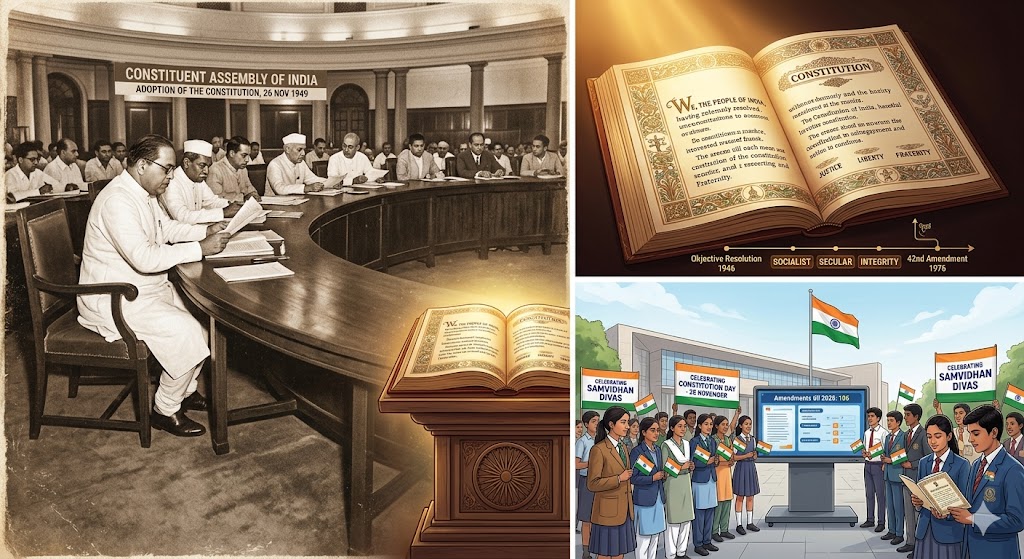
The Indian Constitution stands as the supreme law of the land, guiding the world's largest democracy. For students preparing for competitive exams like Kerala PSC or UPSC, or anyone seeking a clear understanding, this comprehensive guide covers everything from its making to its current structure. Enacted on 26 January 1950, the Indian Constitution is not just a legal document but a living framework that reflects India's aspirations for justice, liberty, equality, and fraternity.
Originally drafted with 395 articles in 22 parts and 8 schedules, the Indian Constitution has evolved through 106 amendments. Today, it encompasses approximately 448 articles (with some counts reaching 470 due to insertions and sub-clauses), organized into 25 parts and 12 schedules. This detailed overview draws from verified government and constitutional resources, making it ideal for educational purposes, quick revision, or an "Indian Constitution one shot" study session.
The story of the Indian Constitution begins in the turbulent years leading to independence. The Constituent Assembly, formed under the Cabinet Mission Plan of 1946, first met on 9 December 1946. It comprised 389 members initially (reduced to 299 after Partition), representing diverse regions, communities, and ideologies. Dr. Rajendra Prasad served as its President.
Key milestones shaped its creation:
13 December 1946: Jawaharlal Nehru moved the Objective Resolution, which later formed the basis of the Preamble.
29 August 1947: The Drafting Committee was formed with seven members, chaired by Dr. B.R. Ambedkar, often called the "Father of the Indian Constitution."
The Committee worked for 141 days, scrutinizing drafts prepared by constitutional advisor B.N. Rau.
The Draft Constitution was introduced on 4 November 1948. After extensive debates over 165 days across 11 sessions, the Constituent Assembly adopted the Constitution on 26 November 1949. It came into force on 26 January 1950, chosen to honor the 1930 Purna Swaraj declaration. This date marks Republic Day, while 26 November is now celebrated as Constitution Day.
The making of the Indian Constitution was a monumental task, involving input from over 2,000 amendments proposed by members. It drew from India's freedom struggle, ancient traditions, and global best practices, ensuring it suited a diverse nation.
The Preamble of the Indian Constitution
The Preamble is the soul of the Indian Constitution. It declares India a "Sovereign Socialist Secular Democratic Republic" and aims to secure justice, liberty, equality, and fraternity for all citizens.
Originally based on Nehru's Objective Resolution, the words "socialist," "secular," and "integrity" were added by the 42nd Amendment in 1976. The Preamble reads:
"We, the people of India, having solemnly resolved to constitute India into a Sovereign Socialist Secular Democratic Republic and to secure to all its citizens: Justice, social, economic and political; Liberty of thought, expression, belief, faith and worship; Equality of status and of opportunity; and to promote among them all Fraternity assuring the dignity of the individual and the unity and integrity of the Nation..."
It is not enforceable in courts but guides interpretation of the Indian Constitution articles. For Kerala PSC aspirants, remember: the Preamble reflects the philosophy behind fundamental rights and DPSP.
Why the Indian Constitution is Called a "Bag of Borrowings"
The Indian Constitution is often termed a "bag of borrowings" because its framers wisely adapted the best features from various global constitutions rather than inventing everything from scratch. Dr. Ambedkar emphasized this pragmatic approach.
Key borrowings include:
Parliamentary system, rule of law, and single citizenship from the United Kingdom.
Fundamental Rights, judicial review, and impeachment of the President from the United States.
Directive Principles of State Policy (DPSP) from Ireland.
Federal structure with strong center and residuary powers from Canada.
Emergency provisions from the Weimar Constitution of Germany.
Concurrent List and joint sitting from Australia.
Other influences from France (liberty, equality, fraternity), Japan (procedure established by law), and South Africa (amendment procedure).
Far from being a mere copy, these features were adapted to India's unique socio-cultural context, historical struggles, and diversity. This makes the Indian Constitution the longest written constitution in the world, blending borrowed ideas with indigenous wisdom.
Parts of the Indian Constitution
The Indian Constitution is systematically divided into 25 parts (originally 22), each addressing specific aspects of governance. This structure makes it easy to study for exams.
Here is a clear overview:
Part I: The Union and its Territory (Articles 1-4)
Part II: Citizenship (Articles 5-11)
Part III: Fundamental Rights (Articles 12-35)
Part IV: Directive Principles of State Policy (Articles 36-51)
Part IVA: Fundamental Duties (Article 51A, added by 42nd Amendment)
Part V: The Union (Articles 52-151) – Executive, Parliament, etc.
Part VI: The States (Articles 152-237)
Part VII: Repealed (States in Part B of First Schedule)
Part VIII: The Union Territories (Articles 239-242)
Part IX: The Panchayats (Articles 243-243O, added by 73rd Amendment)
Part IXA: The Municipalities (Articles 243P-243ZG, added by 74th Amendment)
Part IXB: The Co-operative Societies (Articles 243ZH-243ZT, added by 97th Amendment)
Part X: Scheduled and Tribal Areas (Articles 244-244A)
Part XI: Relations between Union and States (Articles 245-263)
Part XII: Finance, Property, Contracts and Suits (Articles 264-300A)
Part XIII: Trade, Commerce and Intercourse (Articles 301-307)
Part XIV: Services under the Union and States (Articles 308-323)
Part XIVA: Tribunals (Articles 323A-323B)
Part XV: Elections (Articles 324-329A)
Part XVI: Special Provisions for Certain Classes (Articles 330-342)
Part XVII: Official Language (Articles 343-351)
Part XVIII: Emergency Provisions (Articles 352-360)
Part XIX: Miscellaneous (Articles 361-367)
Part XX: Amendment of the Constitution (Article 368)
Part XXI: Temporary, Transitional and Special Provisions (Articles 369-392)
Part XXII: Short Title, Commencement, Authoritative Text in Hindi and Repeals (Articles 393-395)
These parts provide a logical flow from basic structure to detailed governance.
The constituent Assembly: Adoption of the Indian constitution on 26 nov 1949
Schedules of the Indian Constitution
The 12 schedules (originally 8) contain administrative details:
1. First: States and Union Territories.
2. Second: Salaries and allowances.
3. Third: Oaths and affirmations.
4. Fourth: Rajya Sabha seats.
5. Fifth: Scheduled Areas administration.
6. Sixth: Tribal Areas in Northeast.
7. Seventh: Union, State, and Concurrent Lists.
8. Eighth: Official languages.
9. Ninth: Laws protected from judicial review (added by 1st Amendment).
10. Tenth: Anti-defection provisions (added by 52nd).
Article 368: Power of Parliament to amend the Constitution.
Article 370 (abrogated): Special status of Jammu and Kashmir (via 2019 order, upheld by Supreme Court).
These articles ensure balance between rights, duties, and governance. For "Indian Constitution GK" or one-shot revision, focus on Parts III, IV, and V.
Fundamental Rights in the Indian Constitution
Enshrined in Part III (Articles 12-35), Fundamental Rights are justiciable guarantees protecting individual liberties. Originally seven, the right to property was removed by the 44th Amendment and made a legal right under Article 300A.
Key rights:
Right to Equality (14-18): Equality before law, no discrimination.
Right to Freedom (19-22): Speech, assembly, movement, etc.
Right against Exploitation (23-24): Bans forced labor and child labor.
Right to Freedom of Religion (25-28).
Cultural and Educational Rights (29-30): For minorities.
Right to Constitutional Remedies (32): Writs for enforcement.
These are not absolute and can face reasonable restrictions. Supreme Court judgments like Kesavananda Bharati (1973) made them part of the basic structure.
Directive Principles of State Policy (DPSP)
Part IV (Articles 36-51) outlines non-justiciable guidelines for the state to promote social and economic justice. Inspired by Ireland, DPSP complement Fundamental Rights by aiming for a welfare state.
Key principles:
Article 38: Promote welfare and minimize inequalities.
Article 39: Equal pay, resource distribution.
Article 41: Right to work, education, and public assistance.
Article 45: Early childhood care and education (now fundamental via 86th Amendment).
Article 48A: Environmental protection.
Courts have harmonized DPSP with Fundamental Rights, as in Minerva Mills case, calling them complementary. For Kerala PSC Indian Constitution questions, DPSP often tests policy linkages.
The Judiciary in the Indian Constitution
The Indian Constitution establishes an independent judiciary as guardian of the Constitution.
Supreme Court (Part V, Articles 124-147): Apex court with original, appellate, and advisory jurisdiction.
High Courts (Part VI): State-level oversight.
Integrated judicial system ensures uniformity.
Landmark features include judicial review and public interest litigation. The judiciary has upheld the basic structure doctrine, limiting amendments that alter core features.
Amendments to the Indian Constitution (Till 2026)
Article 368 empowers Parliament to amend the Constitution, but the basic structure cannot be altered (Kesavananda Bharati case). There have been 106 amendments as of April 2026.
Major ones include:
1st (1951): Added Ninth Schedule for land reforms.
7th (1956): States reorganization on linguistic basis.
42nd (1976): "Mini-Constitution" during Emergency; added socialist, secular.
44th (1978): Restored many rights post-Emergency.
73rd & 74rd (1992): Panchayats and Municipalities.
86th (2002): Right to Education as fundamental.
101st (2016): GST.
103rd (2019): 10% EWS reservation.
106th (2023): Women's reservation in legislatures (one-third seats).
No new amendments have been enacted since 2023 as per latest records up to April 2026. Amendments reflect evolving needs while preserving core values.
Constitution Day: Why We Celebrate on 26 November
Constitution Day, or Samvidhan Divas, is observed annually on 26 November since 2015 (notified by the Ministry of Social Justice and Empowerment). It commemorates the adoption of the Indian Constitution in 1949.
Significance:
Honors the vision of Dr. Ambedkar and the Constituent Assembly.
Promotes constitutional literacy and values among citizens.
In schools and offices, it involves reading the Preamble and discussions.
It reminds us that "We the People" are the ultimate sovereigns. For educational programs, it serves as a perfect day for "Indian Constitution one shot" sessions.
Conclusion
The Indian Constitution remains a dynamic document—flexible yet firm in its principles. From its historic making to detailed parts, articles, fundamental rights, DPSP, and judiciary, it continues to shape India's democracy. Whether preparing for Kerala PSC, seeking Indian Constitution GK, or simply understanding its evolution through amendments till 2026, this framework empowers every citizen.
As Dr. Ambedkar noted, the Constitution's success depends on those who work it. Let us uphold its spirit for a just and inclusive India.
Frequently Asked Questions
What is the primary significance of Indian Constitution: History, Parts & Amendments?
The Indian Constitution stands as the supreme law of the land, guiding the world's largest democracy. For students preparing for competitive exams like Kerala PSC or UPSC, or anyone seeking a clear understanding, this comprehensive guide covers everything from its making to its current structure.
How does this development impact News?
Enacted on 26 January 1950, the Indian Constitution is not just a legal document but a living framework that reflects India's aspirations for justice, liberty, equality, and fraternity.Originally drafted with 395 articles in 22 parts and 8 schedules, the Indian Constitution has evolved through 106 amendments. Today, it encompasses approximately 448 articles (with some counts reaching 470 due to insertions and sub-clauses), organized into 25 parts and 12 schedules.
What are the key future projections to monitor?
This detailed overview draws from verified government and constitutional resources, making it ideal for educational purposes, quick revision, or an "Indian Constitution one shot" study session.History and Making of the Indian ConstitutionThe story of the Indian Constitution begins in the turbulent years leading to independence.