Dr. B.R. Ambedkar: The Father of the Indian Constitution
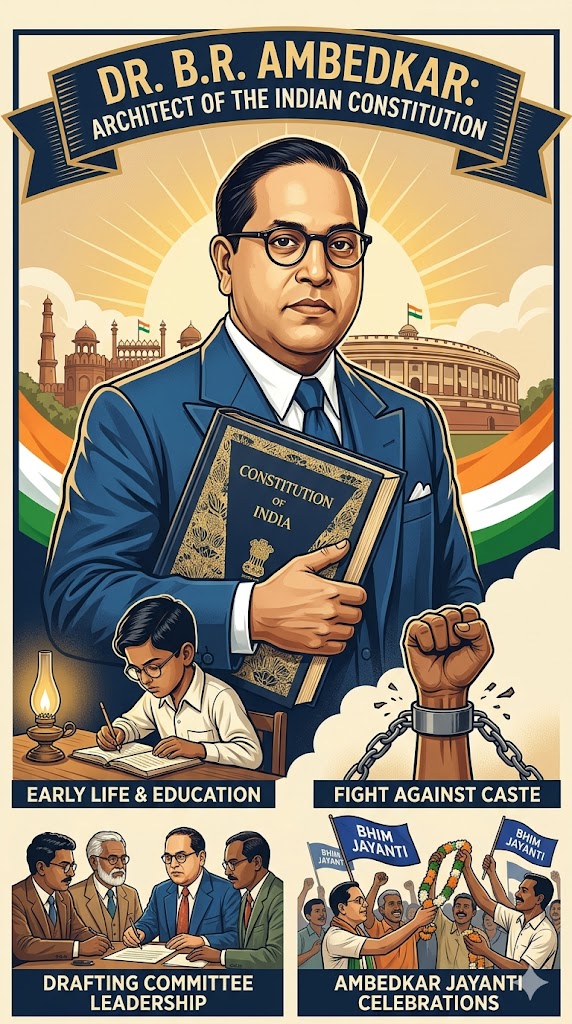
Dr. B.R. Ambedkar: Father of the Indian Constitution
Dr. B.R. Ambedkar stands as one of the most towering figures in modern Indian history. Born into hardship yet rising to shape the destiny of a nation, he is revered as the chief architect of the Indian Constitution and a relentless crusader against social injustice. Often called Babasaheb or the Father of the Indian Constitution, Dr. B.R. Ambedkar transformed personal struggle into a national movement for equality. His vision continues to guide India’s democratic framework more than seven decades after its adoption. This article delves deep into the life of Dr. B.R. Ambedkar—from his humble beginnings to his enduring legacy—highlighting how he became one of the most educated and influential leaders of his time, his pivotal role in framing a Constitution that remains relevant today, and the way the nation honors him through Ambedkar Jayanti celebrations.
Early Life and Formative Years of Dr. B.R. Ambedkar
Dr. B.R. Ambedkar was born on 14 April 1891 in Mhow, a cantonment town in what is now Madhya Pradesh. The fourteenth child of Ramji Maloji Sakpal, a Subedar in the British Indian Army, and Bhimabai, young Bhimrao belonged to the Mahar community, considered “untouchable” under the rigid caste hierarchy of the time. From his earliest days, Dr. B.R. Ambedkar faced discrimination that would later fuel his life’s mission. Schoolteachers forced him to sit outside the classroom. Water was poured into his cupped hands from a distance to avoid “pollution.” Even basic human dignity was denied.
Yet these experiences did not break him. Instead, they sharpened his resolve. His father, a man of progressive views despite his own background, encouraged education. The family moved to Bombay (now Mumbai), where Bhimrao attended Elphinstone High School. The discrimination persisted, but so did his academic brilliance. These early humiliations planted the seeds of a lifelong battle against the caste system that Dr. B.R. Ambedkar would wage with intellectual rigor and moral courage. His childhood taught him that education was not just a personal achievement but a weapon for collective emancipation.
Pursuit of Education: Becoming One of India’s Most Learned Minds
Despite overwhelming odds, Dr. B.R. Ambedkar pursued knowledge with extraordinary determination. He completed his matriculation and joined Elphinstone College, becoming one of the first Dalit students there. A scholarship from the progressive Gaekwar ruler of Baroda enabled him to travel abroad in 1913. He earned a Bachelor of Arts from Bombay University in 1912, followed by a Master’s and PhD in Economics from Columbia University in New York in 1927. He later obtained an MSc and DSc from the London School of Economics and was called to the Bar at Gray’s Inn in London.
Dr. B.R. Ambedkar’s academic journey was groundbreaking. He became one of the earliest Indians to earn doctorates from prestigious Western universities. His thesis on the evolution of provincial finance in British India remains a classic in economic studies. Yet upon returning home, high-caste colleagues in Baroda’s public service treated him with contempt, forcing him to resign. This rejection only strengthened his commitment. Dr. B.R. Ambedkar turned to teaching, legal practice, and social activism. His education equipped him not just with degrees but with the intellectual tools to dismantle centuries-old oppression. He often remarked that knowledge was the foundation of a meaningful life, urging the marginalized to “educate, agitate, and organize.”
Dr. B.R. Ambedkar’s Relentless Fight Against the Caste System
The caste system, which Dr. B.R. Ambedkar described as “not merely a division of labour but also a division of labourers,” became the central target of his reformist zeal. He founded journals like Mooknaya and Bahishkrit Bharat to amplify the voices of the oppressed. In 1927, he led the historic Mahad Satyagraha, where thousands of Dalits asserted their right to draw water from a public tank—a bold challenge to untouchability.
Dr. B.R. Ambedkar’s clash with Mahatma Gandhi over separate electorates for Dalits culminated in the 1932 Poona Pact. While he initially supported reserved seats to ensure political representation, he compromised to save Gandhi’s life during a fast. The pact secured more reserved seats within the Hindu electorate but fell short of his demand for full autonomy. Undeterred, Dr. B.R. Ambedkar formed the Independent Labour Party in 1936 and authored seminal works like Annihilation of Caste and Who Were the Shudras? These writings dissected the historical and social roots of caste with scholarly precision.
His conversion to Buddhism in 1956, along with lakhs of followers in Nagpur, marked the ultimate rejection of a system he believed perpetuated inequality. Dr. B.R. Ambedkar’s fight was never merely symbolic; it was a practical movement for dignity, rights, and self-respect that continues to inspire millions.
Political Journey and Rise as a Prominent National Figure
Dr. B.R. Ambedkar’s prominence extended far beyond social reform. As a member of the Viceroy’s Executive Council during World War II and later as independent India’s first Law Minister, he brought scholarly depth to governance. His Labour Party and Scheduled Castes Federation gave political voice to the marginalized. By the time India gained independence in 1947, Dr. B.R. Ambedkar had earned respect across ideological lines for his erudition and integrity.
What made Dr. B.R. Ambedkar unique was his ability to combine radical critique with pragmatic statesmanship. He understood that political freedom without social equality would remain hollow. This conviction led Jawaharlal Nehru to appoint him Chairman of the Drafting Committee of the Constituent Assembly on 29 August 1947.
The Drafting Committee: Dr. B.R. Ambedkar’s Leadership in Framing the Constitution
The Constituent Assembly appointed a seven-member Drafting Committee to prepare the Constitution. Dr. B.R. Ambedkar was unanimously elected Chairman. The other members included N. Gopalaswami Ayyangar, Alladi Krishnaswami Ayyar, K.M. Munshi, Syed Mohammad Saadulla, B.L. Mitter (later replaced by N. Madhava Rau due to ill health), and D.P. Khaitan (later replaced by T.T. Krishnamachari after his death in 1948).
Over nearly two years and eleven sessions, the Committee met 141 times. Dr. B.R. Ambedkar shouldered the heaviest burden. Several members faced illness or other commitments, yet he patiently explained every clause during Assembly debates spanning 165 days. On 4 November 1948, he introduced the Draft Constitution, defending its provisions with clarity and conviction. The final document, adopted on 26 November 1949 and effective from 26 January 1950, reflected his vision of justice, liberty, equality, and fraternity.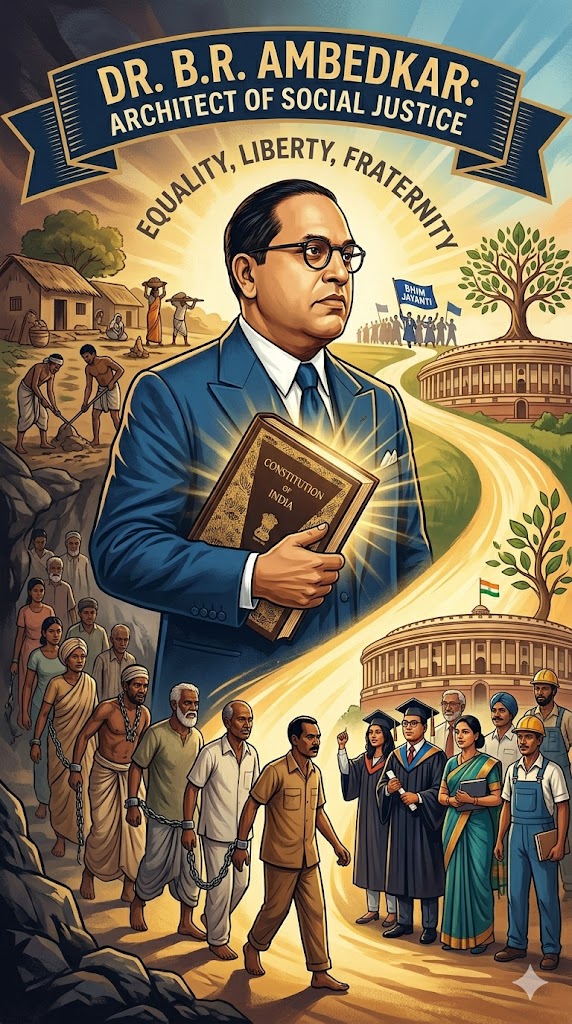
DR. B.R. AMBEDKAR: ARCHITECT OF SOCIAL JUSTICE"
Collaboration with Drafting Committee Members and Key Contributions
Despite differing backgrounds—five of the seven members came from upper-caste or elite circles—Dr. B.R. Ambedkar fostered collaborative spirit. Alladi Krishnaswami Ayyar brought legal expertise, K.M. Munshi contributed on fundamental rights, and N. Gopalaswami Ayyangar focused on administrative details. T.T. Krishnamachari later acknowledged that the “burden of drafting” largely fell on Ambedkar.
Dr. B.R. Ambedkar ensured the inclusion of Article 17 abolishing untouchability, reservations for Scheduled Castes and Tribes in education and jobs, and robust Fundamental Rights. He championed Directive Principles of State Policy to guide social and economic justice. The Constitution’s federal structure with a strong center, independent judiciary, and provisions for amendments balanced rigidity with flexibility. His insistence on “constitutional morality” reminded citizens that democracy required more than mere laws—it demanded ethical commitment to equality.
Why the Constitution Remains Relevant: Dr. B.R. Ambedkar’s Enduring Vision
Dr. B.R. Ambedkar described the Constitution as “a vehicle of life” whose spirit must reflect the age. Its adaptability has allowed over 100 amendments while preserving the basic structure, as affirmed by the Supreme Court. Provisions for reservations have uplifted millions. Fundamental rights protect against discrimination. The emphasis on secularism and fraternity counters divisive forces even today.
In spite of challenges, Indians continue to depend on this document because Dr. B.R. Ambedkar designed it to evolve with society. He warned against misusing it but believed in its power to foster genuine democracy grounded in social justice.
Dr. B.R. Ambedkar’s Broader Legacy as a Social Reformer
Beyond the Constitution, Dr. B.R. Ambedkar’s legacy encompasses economics, labor rights, women’s empowerment, and religious reform. He established the People’s Education Society and advocated for gender equality and workers’ rights. His conversion to Buddhism offered Dalits a dignified alternative to caste-ridden Hinduism. Posthumously awarded the Bharat Ratna in 1990, Dr. B.R. Ambedkar remains a symbol of hope for the oppressed worldwide.
How India Celebrates Ambedkar Jayanti
Every year on 14 April, the nation observes Ambedkar Jayanti, also known as Bhim Jayanti or Equality Day. Processions, garlanding of statues, seminars, and cultural programs mark the occasion. The President, Prime Minister, and leaders across parties pay homage at his memorial in Delhi. Schools and colleges hold essay competitions and debates on his teachings. Millions reaffirm their commitment to his ideals of liberty and justice. These celebrations remind us that Dr. B.R. Ambedkar’s struggle is ongoing.
Conclusion: A Timeless Beacon in Indian History
Dr. B.R. Ambedkar rose from the depths of caste oppression to become the principal architect of the world’s largest democracy. His life—from facing water poured from a height to steering the Constitution through stormy debates—embodies resilience and vision. Through his leadership in the Drafting Committee, collaboration with fellow members, and unyielding fight against caste, he crafted a document that continues to bind and uplift India. As we celebrate Ambedkar Jayanti and reflect on his speeches and biography, one truth stands clear: Dr. B.R. Ambedkar is not merely a historical figure but a living inspiration for equality and justice.
His words still resonate: “Be educated, be organised and be agitated.” In honoring Dr. B.R. Ambedkar, India honors the best of its democratic spirit.