Sustainable Development in India: NITI Aayog & SDGs
News• April 13, 2026• Global Edition
Sustainable Development in India: NITI Aayog & SDGs
India stands at a pivotal moment in its journey toward sustainable development. As the world's most populous nation and a rapidly growing economy, the country has embraced the United Nations' 2030 Agenda for Sustainable Development with remarkable determination. Through the stewardship of NITI Aayog, India is not only tracking progress on the 17 Sustainable Development Goals (SDGs) but also integrating them into national planning, state-level policies, and long-term economic strategies. The latest NITI Aayog SDG Index 2023-24 underscores this momentum, showing the nation's composite score rising to 71 from 66 in 2020-21 and 57 in the 2018 baseline.
This article explores sustainable development in India, with a special focus on NITI Aayog's role, gender equality under SDG 5 in the 2023 framework, India's global SDG ranking, and the critical interplay of energy, coal, electricity, and climate change. We examine the steps taken over the past 10-20 years, future perspectives, and how these efforts position India as a leader in balanced, inclusive growth. Written for educational purposes—including UPSC and UGC NET aspirants—this piece draws from verified official sources like NITI Aayog reports, the Sustainable Development Report (SDR), and government data.
Understanding Sustainable Development and the SDGs
Sustainable development is development that meets the needs of the present without compromising the ability of future generations to meet their own needs. Coined in the 1987 Brundtland Report, it rests on three pillars: economic growth, social inclusion, and environmental protection.
The UN SDGs, adopted in 2015, provide a universal blueprint with 17 goals and 169 targets. For India, these goals align perfectly with national priorities like poverty eradication, clean energy, and climate resilience. Sustainable development India is not just policy rhetoric—it drives everything from rural electrification to urban green infrastructure.
NITI Aayog, established in 2015 as the successor to the Planning Commission, has localized the SDGs. It monitors progress through the NITI Aayog SDG Index, fostering competitive and cooperative federalism among states and union territories. This makes sustainable development goals NITI Aayog a cornerstone of India's governance model.
Released on July 12, 2024, the fourth edition of the NITI Aayog SDG Index 2023-24 marks a significant milestone. India's overall score improved to 71, reflecting steady advancement despite global headwinds like economic disruptions and climate events. All states and UTs recorded gains, showcasing broad-based progress.
Key highlights include:
Major improvements in SDG 1 (No Poverty), SDG 8 (Decent Work and Economic Growth), SDG 13 (Climate Action), and SDG 15 (Life on Land).
Top performers: Uttarakhand and Kerala (score 79), followed by Tamil Nadu (78) and Goa (77).
Front-runners and performers: Most states moved into higher categories.
Challenges remain: Bihar (57) lags, highlighting the need for targeted interventions.
The Index tracks 113 indicators across 16 SDGs (SDG 17 focuses on partnerships). It aligns with the National Indicator Framework and supports localization, making it an invaluable tool for policymakers, UPSC aspirants, and researchers studying sustainable development goals.
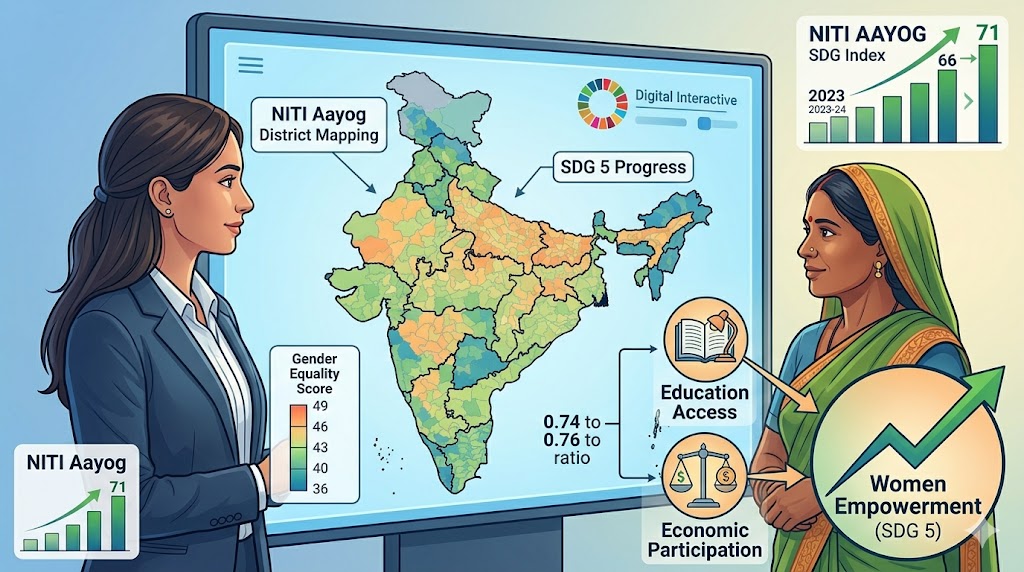
A focused digital visualization highlighting NITI Aayog's localization of SDG 5 (Gender Equality). The interactive map displays district-level progress in India, charting metrics like the female labor force participation ratio and earnings ratio.
NITI Aayog Gender 2023: Progress on SDG 5 Gender Equality
A key focus of the NITI Aayog SDG Index 2023-24 is gender equality under SDG 5. While overall SDG scores have risen, SDG 5 remains the lowest-scoring goal nationally (around 48-49), with only moderate improvement from 36 in 2018. Yet, specific indicators show encouraging trends: sex ratio at birth improved to 929 females per 1,000 males; the female-to-male earnings ratio rose from 0.74 to 0.76; and the labor force participation rate ratio jumped from 0.33 to 0.48 between 2018-19 and 2022-23.
NITI Aayog, in collaboration with the Ministry of Women and Child Development, is now mapping gender equality progress district-wise. This "NITI Aayog gender 2023" emphasis integrates women's empowerment across multiple SDGs—linking it to poverty reduction, health, education, and clean energy access. Initiatives like Beti Bachao Beti Padhao, Mahila Shakti Kendras, and self-help groups have empowered millions, directly supporting sustainable development and climate change resilience by ensuring women participate in decision-making on resource use and adaptation.
For UPSC and UGC NET candidates, understanding SDG 5 through the NITI lens highlights how gender mainstreaming is central to India's inclusive sustainable development model.
India's Global Ranking in the Sustainable Development Report
Internationally, India has made notable strides. In the Sustainable Development Report 2025 by the UN Sustainable Development Solutions Network (SDSN), India ranks 99th out of 167 countries with a score of 67—entering the top 100 for the first time (up from 109th in 2024). This places India ahead of many South Asian peers while trailing some neighbors like Bhutan.
East and South Asia have shown the fastest regional progress since 2015. India's performance reflects strong gains in poverty reduction and renewable energy, though challenges persist in areas like sustainable consumption and inequality.
Sustainable Development and the Indian Economy
Sustainable development India is inextricably linked to economic growth. With GDP expanding rapidly, the country has reduced multidimensional poverty significantly, aligning with SDG 1 and 8. NITI Aayog's efforts ensure that growth is green and inclusive, avoiding the pitfalls of unchecked industrialization seen elsewhere.
The Indian economy benefits from SDG localization through schemes like PM-KISAN, MGNREGA, and Skill India, which promote decent work while protecting the environment. This balanced approach positions India as a model for emerging economies pursuit sustainable development goals.
Energy, Coal, Electricity, Climate Change, and Sustainable Development
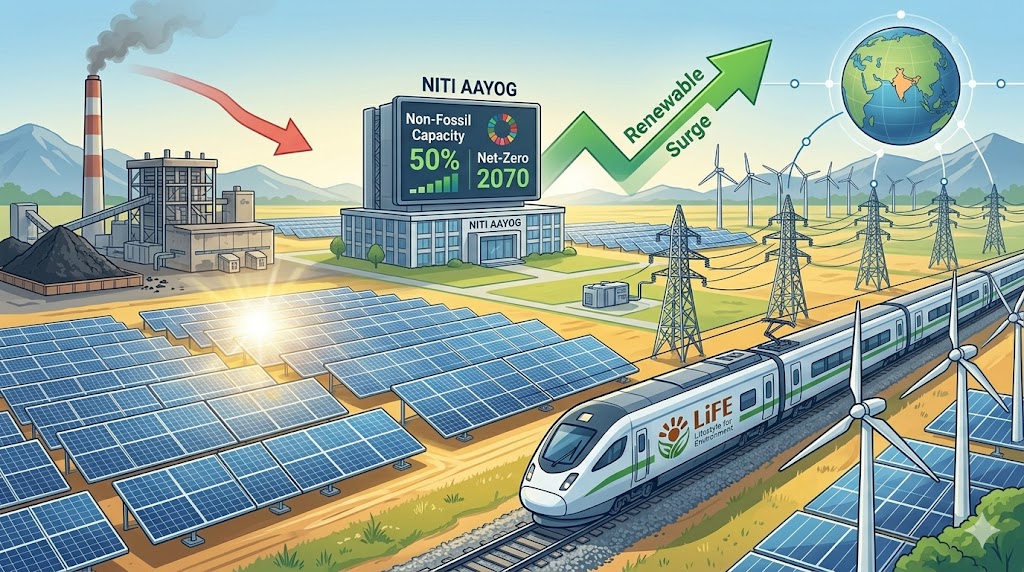
India's energy landscape is at the heart of its sustainable development story. Coal remains dominant in electricity generation (around 70-75%), powering industries and households. However, the transition is accelerating. Non-fossil fuel capacity has surged, with renewables (solar, wind, hydro, and bio-energy) now contributing substantially.
Key facts on India renewable energy climate change:
Renewable energy capacity has grown over five-fold since 2014-15, crossing significant milestones.
India achieved its 50% non-fossil installed capacity target well ahead of the 2030 NDC deadline.
Universal household electricity access has been realized, with per capita consumption rising steadily.
Climate Action (SDG 13) has seen strong Index gains. India submitted its Long-Term Low-Carbon Development Strategy, targeting net-zero emissions by 2070. The Panchamrit pledges at COP26—500 GW non-fossil capacity by 2030, 50% renewable energy, and the LiFE movement—guide this shift. Emissions intensity of GDP has already declined over 40% from 2005 levels, exceeding interim targets.
Despite coal's role in energy security, policies promote efficiency, carbon capture, and a gradual phase-down. Green hydrogen, EV adoption, and energy storage are reshaping the grid. Sustainable development and climate change in India thus balance immediate needs with long-term planetary health.
Steps India Has Taken in the Past 10-20 Years
India's commitment to sustainable development spans two decades:
2008: Launch of the National Action Plan on Climate Change (NAPCC) with eight missions covering solar, energy efficiency, and sustainable agriculture.
2015: Paris Agreement ratification and initial NDCs; launch of the International Solar Alliance.
2014-2024: Explosive renewable growth under successive governments, aided by schemes like PM-KUSUM and Green Energy Corridors.
2021-2022: Updated NDCs with enhanced targets; net-zero by 2070 announcement.
Ongoing: National Electricity Plan emphasizing RE integration, EV policy, and forest cover expansion for carbon sinks.
These steps have not only met but often exceeded targets, demonstrating pragmatic sustainable development India.
Future Perspective: Energy, Climate, and India's Leadership Role
Looking ahead, India's future presence in global sustainable development is bright. By 2030, non-fossil capacity is projected to dominate, with 500 GW renewables transforming the energy mix. Coal will continue as a bridge fuel but with cleaner technologies. Electricity demand will rise with economic growth, met sustainably through smart grids and storage.
Climate resilience—via adaptive agriculture, coastal protection, and disaster management—will safeguard development gains. Sustainable development goals will drive a $10 trillion economy that is low-carbon and equitable. India is poised to export green technologies, lead Global South climate diplomacy, and inspire others through initiatives like the World Sustainable Development Summit.
Key Meetings and Conferences Under SDG Goals
NITI Aayog has convened several high-level forums:
National Conference on Accelerating Progress on SDGs (March 2024, Jaipur) brought together states, UTs, and ministries for knowledge sharing.
Annual Governing Council meetings review SDG localization.
Voluntary National Reviews at the UN High-Level Political Forum.
The World Sustainable Development Summit (organized by TERI) serves as India's premier global platform, with its 2026 Silver Jubilee edition focusing on "Transformations" for sustainable futures.
These gatherings foster collaboration essential for achieving the goals.
Challenges and the Road Ahead
Challenges include financing gaps, climate vulnerability, and uneven state-level progress—particularly in gender equality and eastern states. However, with robust policy frameworks, digital monitoring, and international partnerships, India is well-equipped.
A landscape of energy transition in India, visualizing the pivot from coal-dependence toward a sustainable future. Modern renewable energy infrastructure (solar fields and wind farms) dominates the foreground, integrated into a smart grid with electric transport.
Conclusion: A Sustainable Future for India and the World
India's story of sustainable development is one of transformation—from policy intent to measurable impact. Through NITI Aayog's visionary guidance, the SDG India Index, and focused efforts on gender, energy, and climate, the nation is rapidly advancing. As it balances coal-based realities with renewable ambitions, India exemplifies how emerging economies can lead on sustainable development goals while securing a prosperous, equitable, and climate-resilient future.
For students, policymakers, and citizens alike, this journey offers invaluable lessons in resilience and innovation. India's progress is not just national—it contributes to a more sustainable planet.
Frequently Asked Questions
What is the primary significance of Sustainable Development in India: NITI Aayog & SDGs?
Sustainable Development in India: NITI Aayog & SDGsIndia stands at a pivotal moment in its journey toward sustainable development. As the world's most populous nation and a rapidly growing economy, the country has embraced the United Nations' 2030 Agenda for Sustainable Development with remarkable determination.
How does this development impact News?
Through the stewardship of NITI Aayog, India is not only tracking progress on the 17 Sustainable Development Goals (SDGs) but also integrating them into national planning, state-level policies, and long-term economic strategies. The latest NITI Aayog SDG Index 2023-24 underscores this momentum, showing the nation's composite score rising to 71 from 66 in 2020-21 and 57 in the 2018 baseline.This article explores sustainable development in India, with a special focus on NITI Aayog's role, gender equality under SDG 5 in the 2023 framework, India's global SDG ranking, and the critical interplay of energy, coal, electricity, and climate change.
What are the key future projections to monitor?
We examine the steps taken over the past 10-20 years, future perspectives, and how these efforts position India as a leader in balanced, inclusive growth.