UGC Equity Regulations 2026: Controversy Explained
News• April 13, 2026• Global Edition
In January 2026, the University Grants Commission (UGC) quietly notified a set of regulations that would soon ignite one of the most heated debates in Indian higher education. Officially titled the University Grants Commission (Promotion of Equity in Higher Education Institutions) Regulations, 2026, these rules—commonly known as the UGC Equity Regulations 2026—replaced the earlier 2012 framework with far stricter, enforceable measures aimed at curbing discrimination on campuses.
What was intended as a progressive step toward inclusion quickly became a flashpoint. Protests erupted across universities, social media exploded with claims of reverse discrimination, political leaders resigned in solidarity with demonstrators, and within weeks the Supreme Court stepped in, staying the regulations. As of April 2026, the 2012 rules remain in force while the new framework sits in legal limbo.
This article offers a clear, balanced, and thoroughly researched examination of the UGC regulations 2026. We explore what the rules actually say, why they sparked such fierce opposition, the role of social media in amplifying incomplete information, the Supreme Court’s intervention, and the broader questions they raise about equity, governance, and the future of the UGC itself. Written for students, educators, parents, and policymakers, this analysis draws from official notifications, court orders, and credible news reports to separate fact from frenzy.
Notified on 13 January 2026 under the powers granted by the UGC Act, 1956, these regulations are not a new “UGC Act 2026” passed by Parliament. They are subordinate legislation—binding rules that every higher education institution (HEI) in India must follow.
The core objective, as stated in the notification, is “to eradicate discrimination only on the basis of religion, race, gender, place of birth, caste, or disability, particularly against the members of scheduled castes and scheduled tribes, socially and educationally backward classes, economically weaker sections, persons with disabilities, or any of them, and to promote full equity and inclusion amongst the stakeholders in higher education institutions.”
Key mandatory provisions include:
Equal Opportunity Centre (EOC): Every college and university must establish a dedicated EOC to handle discrimination complaints and run awareness programmes.
Equity Committee: A standing committee that includes representatives from SC, ST, OBC, PwD, and women categories to monitor compliance and investigate grievances.
Online Portal and Helpline: Institutions must provide an accessible online complaint mechanism and a dedicated equity helpline.
Binding Compliance: Unlike the advisory 2012 guidelines, non-compliance can now attract regulatory penalties, including loss of grants or recognition.
Definition of Caste-Based Discrimination: The rules explicitly define it as unfair treatment directed at members of SC, ST, and OBC communities.
The regulations were framed after the Supreme Court had earlier directed the UGC to strengthen its anti-discrimination machinery following high-profile campus tragedies and a documented rise in complaints (UGC data showed a 118% increase in caste-related grievances over the previous decade).
On paper, the UGC equity regulations 2026 represent a genuine attempt to move from symbolic gestures to institutional accountability. Yet their wording and one-sided focus on protecting only certain groups triggered immediate alarm.
The Controversy: Why These Rules Ignited a Storm
Critics—primarily students and organisations representing general category (often upper-caste) communities—argued that the regulations were inherently unbalanced. Regulation 3(1)(c), in particular, defined caste-based discrimination narrowly as actions against SC/ST/OBC students, offering no parallel safeguards for complaints filed by general category students against reserved-category individuals or institutional bias in the opposite direction.
Protesters contended that:
The rules created a climate of fear where any disagreement or tough academic feedback could be labelled “caste discrimination.”
There was no penalty prescribed for frivolous or malicious complaints, potentially opening the door to misuse.
By making equity committees mandatory and compositionally skewed toward reserved categories, the framework risked institutional capture and reverse discrimination.
In an already hyper-competitive higher education landscape—with limited seats, high fees, and intense pressure—the new rules could further polarise campuses.
Supporters, including student bodies representing Dalit and Bahujan communities, countered that the backlash itself proved why stronger rules were needed. They pointed to persistent caste-based exclusion in hostels, classrooms, and faculty interactions, citing cases like Rohith Vemula and Dr. Payal Tadvi as evidence that the 2012 guidelines had failed.
The debate quickly spilled beyond campuses. Political parties in Uttar Pradesh saw resignations from local leaders who joined student protests. Hashtags such as “No to UGC Discrimination” and “Save General Category Students” trended nationally. What began as policy criticism soon morphed into accusations that the regulations were a political tool to appease one vote bank at the expense of another.
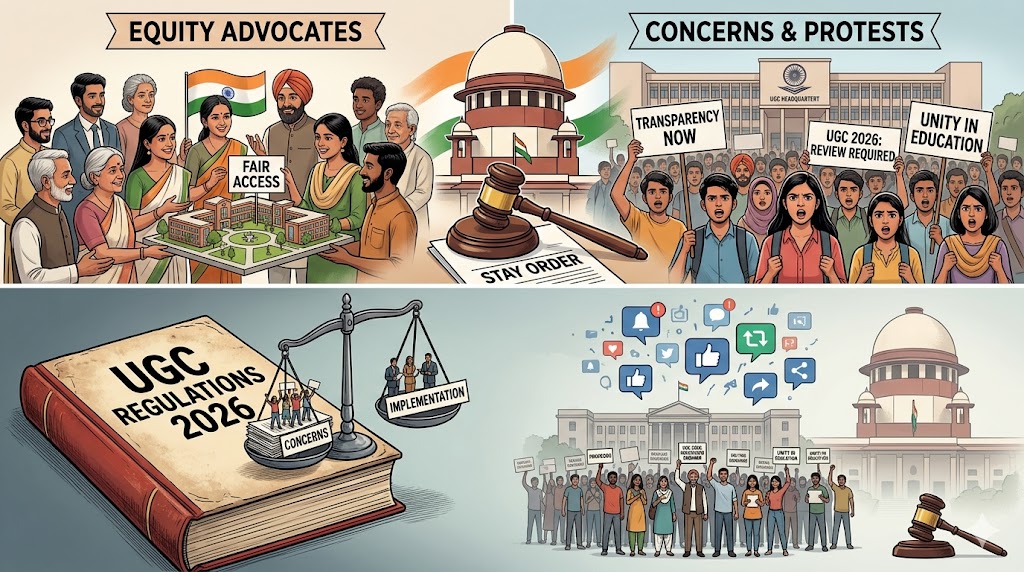
"A Visual Overview of the UGC Equity Regulations 2026 Controversy in Indian Higher Education"
Protests, Public Reaction, and Efforts to Halt Implementation
Within days of notification, students gathered outside UGC headquarters in Delhi under the banner of groups like “Savarna Sena.” Similar sit-ins occurred at Lucknow University and other state campuses. Demonstrators carried placards warning of “caste conflict on campus” and “academic terrorism.”
Parents joined the fray, fearing that their children—already navigating NEET, JEE, and CUET cut-throat competition—would now face additional bureaucratic hurdles and the constant threat of complaints. Some faculty members privately expressed concern that the rules could chill open classroom discussion.
Critics attempted multiple routes to stop the regulations:
Campus agitations: and signature campaigns demanding immediate withdrawal.
Petitions to the President and Education Minister: urging intervention.
Legal challenges: in the Supreme Court, framing the rules as violative of Article 14 (equality before law) and Article 15 (prohibition of discrimination).
Although the regulations did not require parliamentary approval (as they are executive rules under the UGC Act), protesters framed their campaign as an effort to “stop this act from being enforced,” pressuring the government to direct the UGC to amend or scrap them before full rollout.
Social media played a decisive amplifying role. Viral videos and memes often presented partial excerpts of the regulations—omitting the broader anti-discrimination clauses covering gender, disability, and religion—creating the impression that only general category students could be perpetrators. Incomplete knowledge, stripped of context, fuelled outrage and mobilised thousands who had never read the full 20-page document.
Supreme Court Intervention: The Stay Order and Its Reasoning
On 29 January 2026, a two-judge bench headed by Chief Justice Surya Kant and Justice Joymalya Bagchi heard urgent petitions challenging the regulations. In a strongly worded interim order, the Court placed the 2026 regulations “in abeyance” and directed that the 2012 framework would continue until further notice.
The bench observed that the regulations suffered from “complete vagueness” and were “capable of misuse.” Chief Justice Kant reportedly remarked that unchecked implementation could have “sweeping consequences which will divide society.” The Court exercised its extraordinary powers under Article 142 to restore the status quo and issued notice to the UGC and Union Government, scheduling the next hearing for March 2026.
Legal experts described the stay as both a relief for protesters and a setback for those who saw the rules as constitutionally mandated affirmative action. The order did not strike down the regulations outright but signalled that any redrafted version must be inclusive, procedurally fair, and free from one-sided presumptions.
As of April 2026, the stay remains in effect. The 2012 regulations—largely advisory and lacking teeth—continue to govern campus equity mechanisms.
Why Critics Argue the Regulations Are Not Good for All Students
Beyond the legal technicalities, many students and parents worry about practical fallout:
Chilling Effect on Academic Freedom: Faculty might hesitate to give critical feedback or enforce discipline for fear of being accused of bias.
Erosion of Merit: In an already reservation-heavy system, additional equity oversight could be perceived as another layer penalising high-merit general category candidates.
Campus Polarisation: Mandatory equity committees with fixed demographic quotas risk turning every dispute into a caste issue rather than a merit or conduct issue.
Administrative Burden: Small colleges with limited resources could struggle to comply, diverting funds from academics to paperwork.
Supporters maintain that these fears are exaggerated and that robust safeguards against false complaints already exist under general service rules and natural justice principles. Yet the absence of explicit symmetric protections in the original draft lent credence to the “one-sided” narrative.
The Role of Social Media and Incomplete Knowledge
Much of the heat stemmed not from the regulations themselves but from how they were communicated—or rather, miscommunicated. Screenshots of isolated clauses circulated without the preamble or the full list of prohibited grounds. Influencers and opposition voices framed the rules as “anti-general category legislation,” ignoring UGC data on actual discrimination cases.
This phenomenon highlights a deeper challenge in Indian public discourse: complex policy filtered through 280-character outrage cycles. Educational institutions and the government failed to mount an effective pre-notification awareness campaign, leaving the field open to misinformation. The UGC equity regulations 2026 controversy thus became a textbook case of how incomplete knowledge can transform a well-intentioned reform into a national flashpoint.
Future Prospects: Can the Regulations Still Pass, and in What Form?
The Supreme Court’s stay does not kill the idea; it demands refinement. Possible pathways forward include:
1. Redrafting with Symmetric Safeguards: Adding explicit provisions protecting general category students from reverse discrimination and prescribing penalties for false complaints.
2. Stakeholder Consultation: Broad-based consultations with student unions across caste lines before re-notification.
3. Pilot Implementation: Testing the framework in a few central universities to gather empirical data on efficacy and misuse.
4. Legislative Backing: Converting key elements into amendments to the UGC Act itself, requiring parliamentary debate and greater democratic scrutiny.
If the government chooses to push a revised version, it could still face mass protests unless it addresses the core perception of unfairness. Conversely, abandoning the reforms entirely would signal that institutional resistance can defeat constitutional equity goals—a dangerous precedent.
The episode has also revived long-standing calls to replace or radically reform the UGC. Critics argue that a body empowered to issue sweeping regulations without adequate checks has outlived its utility in an era of NEP 2020 and multiple regulatory bodies (HECI proposals). A more independent, transparent, and balanced higher education regulator—perhaps with judicial oversight on equity matters—may be the lasting institutional lesson from the UGC regulations 2026 saga.
Broader Implications for Indian Higher Education
At its heart, the controversy reflects deeper fault lines: the tension between historical social justice and contemporary demands for merit and equal treatment; between central regulation and institutional autonomy; and between evidence-based policy and emotionally charged public perception.
Rising caste discrimination complaints are real. Normalising exclusion in the name of tradition is unacceptable. Yet creating a parallel system of justice that appears to presume guilt on the basis of caste is equally problematic in a constitutional democracy that promises equality to all.
The UGC equity regulations 2026, even in stayed form, have forced a national conversation. Whether that conversation leads to genuine reform or further polarisation depends on how policymakers, courts, and civil society respond in the coming months.
Conclusion
The UGC Equity Regulations 2026 were born from a legitimate desire to make Indian campuses more inclusive. Yet poor drafting, one-sided framing, and inadequate public communication turned them into a lightning rod for caste anxieties. The Supreme Court’s timely stay has bought breathing space for calmer reflection.
For students from every background, the goal remains the same: campuses free from fear, bias, and discrimination—where merit and dignity coexist. Achieving that balance will require nuance, not slogans; evidence, not outrage; and policies that protect the vulnerable without alienating the majority.
As India’s higher education system expands, the lessons from this controversy must guide future regulation. Only then can equity move from regulation to reality—and from controversy to consensus.
Frequently Asked Questions
What is the primary significance of UGC Equity Regulations 2026: Controversy Explained?
In January 2026, the University Grants Commission (UGC) quietly notified a set of regulations that would soon ignite one of the most heated debates in Indian higher education. Officially titled the University Grants Commission (Promotion of Equity in Higher Education Institutions) Regulations, 2026, these rules—commonly known as the UGC Equity Regulations 2026—replaced the earlier 2012 framework with far stricter, enforceable measures aimed at curbing discrimination on campuses.What was intended as a progressive step toward inclusion quickly became a flashpoint.
How does this development impact News?
Protests erupted across universities, social media exploded with claims of reverse discrimination, political leaders resigned in solidarity with demonstrators, and within weeks the Supreme Court stepped in, staying the regulations. As of April 2026, the 2012 rules remain in force while the new framework sits in legal limbo.This article offers a clear, balanced, and thoroughly researched examination of the UGC regulations 2026.
What are the key future projections to monitor?
We explore what the rules actually say, why they sparked such fierce opposition, the role of social media in amplifying incomplete information, the Supreme Court’s intervention, and the broader questions they raise about equity, governance, and the future of the UGC itself.