International Affairs• April 14, 2026• Global Edition
As of April 14, 2026, the US-Iran war remains in a precarious phase of heightened tensions rather than full-scale direct combat. A fragile two-week ceasefire, brokered by Pakistan and effective since April 8, holds tenuously between the United States, Israel, and Iran. However, the situation escalated sharply over the weekend when US-Iran peace talks in Islamabad collapsed, prompting President Donald Trump to order a naval blockade of all Iranian ports and the Strait of Hormuz.
This US Iran war update reflects a complex mix of military pressure, diplomatic maneuvering, and regional spillover. Vice President JD Vance has publicly accused Iran of economic terrorism, while Tehran has warned that the blockade could destabilize global energy routes. Israel continues targeted strikes in Lebanon against Hezbollah positions, further straining the ceasefire. Oil prices have surged above $100 per barrel, sending ripples through global markets.
In this comprehensive US Iran war 2026 analysis, we examine today's key developments, the Vance accusations, Iran's response on port blockades, ongoing Israeli operations, prospects for renewed talks in Pakistan or Geneva, economic fallout, and forward-looking predictions. The goal is to provide a clear, balanced overview of the US vs Iran war dynamics as they unfold in real time.
The most significant development in today's Iran war 14 April news is the full implementation of the US naval blockade. On April 13, President Trump announced that US forces would begin blocking vessels entering or leaving Iranian ports, with the Strait of Hormuz—the world's most critical oil chokepoint—now under effective US oversight. The blockade went live early on April 14, allowing only non-Iran-bound traffic to pass.
US Central Command (CENTCOM) is coordinating the operation, deploying naval assets to enforce restrictions. This move follows the breakdown of marathon negotiations in Islamabad, Pakistan, where US and Iranian delegations spent over 21 hours in face-to-face discussions without reaching a deal. Vice President JD Vance, leading the US team, stated that Iran refused core American demands, including verifiable limits on nuclear activities and reopening the Strait of Hormuz.
Iran has not engaged in direct kinetic retaliation against US forces as of April 14, preserving the ceasefire framework. However, Iranian military spokespersons have labeled the blockade an “act of piracy” and vowed proportionate responses if Iranian sovereignty is further challenged. No confirmed US Iran war footage of clashes has emerged today, but regional shipping has already begun rerouting, contributing to supply chain disruptions.
This US Iran naval war escalation marks a shift from airstrikes to economic coercion. Analysts note that while the ceasefire technically holds on direct US-Iran exchanges, the blockade represents a new front in the US Iran war tensions.
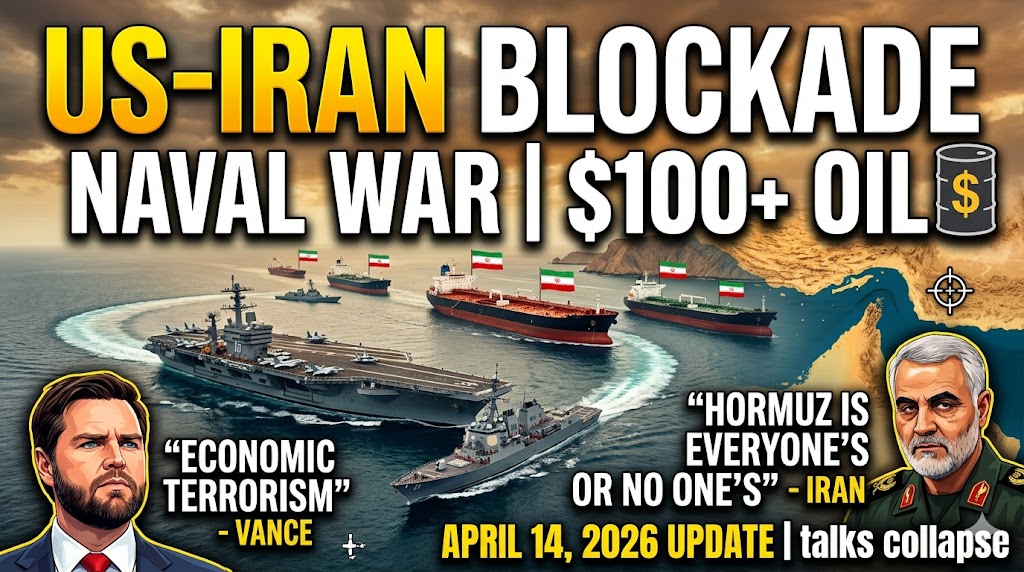
A depiction of the US Navy enforcing the maritime blockade near the Strait of Hormuz on April 14, 2026, as global oil markets react to the closure of Iranian trade routes.
JD Vance Accuses Iran of Economic Terrorism
In a series of high-profile statements on April 13-14, US Vice President JD Vance sharply criticized Iran, accusing the regime of “economic terrorism” through its earlier closure of the Strait of Hormuz. Speaking to Fox News and in follow-up remarks, Vance emphasized that Iran’s actions disrupted global energy flows and harmed economies worldwide.
Vance declared, “If the Iranians engage in economic terrorism, then we will follow the principle that no Iranian ships are getting out either.” He framed the US blockade as a measured response, noting that “two can play that game.” The Vice President also reiterated that the “ball is in Iran’s court,” signaling Washington’s willingness to return to diplomacy if Tehran shows flexibility on key issues like nuclear non-proliferation and regional de-escalation.
This rhetoric aligns with the broader Trump administration stance in the US Iran war scenario. Vance stressed that Iran had not been defeated militarily but had resorted to economic pressure as its primary lever. The accusations come amid reports that Iranian forces had previously imposed tolls on oil shipments in yuan, further irking US allies.
The comments have drawn mixed international reactions. Gulf states, while concerned about escalation, quietly support pressure on Iran. Meanwhile, China and Russia have urged restraint, with Beijing reportedly accelerating air defense deliveries to Tehran.
Iran’s Response: “Ports Are for Everyone or No One”
Iran has responded defiantly to the US blockade, issuing strong warnings that echo the user-noted phrasing of contentment with containing the pressure while keeping options open for deals. Iranian military officials stated that the Persian Gulf and Strait of Hormuz are “either for everyone or for no one.” They warned that any threat to Iranian ports would render “no port in the Gulf or Gulf of Oman safe.”
Tehran has rejected the blockade as an “internationally wrongful act” and placed full responsibility on the United States for any consequences to regional peace and energy security. Iranian diplomats have informed the United Nations that proportionate measures remain on the table to protect sovereignty.
Despite the tough talk, Iranian state media has left the door open to further negotiations. Officials described the Islamabad talks as a first round and expressed no surprise at the lack of immediate agreement. This aligns with reports that Pakistan has proposed a second round of US-Iran talks, potentially in Islamabad or Geneva, Switzerland, as early as this week. Iran has signaled it could engage if the US demonstrates good faith and eases certain pressures.
In essence, Iran appears content to weather the US blockade in the short term while positioning itself for diplomatic leverage—the “ball is in the US court” dynamic reversed in Tehran’s narrative.
Israeli Government Continues Strikes in Lebanon
Parallel to the US Iran war updates, Israel has maintained intense operations in Lebanon, targeting Hezbollah infrastructure despite the broader regional ceasefire. On April 14, Israeli strikes continued across southern Lebanon and parts of Beirut’s southern suburbs, focusing on rocket launchers, command centers, and weapons caches.
The Israeli government has justified these actions as necessary to create a security zone and neutralize threats from Iranian-backed Hezbollah. Lebanese health authorities report the death toll in Lebanon surpassing 2,000 since the latest escalation, with recent strikes killing dozens more. Israel and Lebanese officials are scheduled for direct talks in Washington on April 14 to discuss a potential ceasefire, though Israel has made clear it will not negotiate directly with Hezbollah.
These ongoing strikes have strained the US-brokered Iran ceasefire, with Tehran citing them as justification for maintaining pressure on the Hormuz route. The situation underscores the interconnected nature of the US Israel Iran war dynamics.
Economic Impacts: Stock Market Reactions and Government Advisories
The US Iran war 2026 has triggered significant economic volatility. Oil prices climbed above $100 per barrel following the blockade announcement, prompting governments worldwide to issue cautions on market exposure. In the United States and allied nations, financial authorities have advised retail investors and institutions to reassess holdings in energy-sensitive stocks and consider defensive positioning—effectively encouraging a measured “pull-out” from high-risk positions amid uncertainty.
US military commands, including CENTCOM, continue to oversee the blockade while monitoring for escalation risks that could affect global shipping. No large-scale civilian evacuations have been ordered, but expatriates in the Gulf region have received heightened travel advisories.
Stock markets in Asia and Europe opened lower, with energy and defense sectors gaining while broader indices reflected caution. Governments in the region have kept banks and essential services operational at reduced capacity, closing schools in some areas as a precautionary measure.
Predictions for the Coming Days
Looking ahead on April 14, several scenarios appear plausible in the US Iran war outlook:
1. Diplomatic Breakthrough: Pakistan’s proposal for renewed talks could lead to a second round in Geneva or Islamabad within days. If Iran offers concessions on nuclear issues and Hormuz access, the blockade may be eased, stabilizing oil markets.
2. Controlled Escalation: Iran may test the blockade with limited naval maneuvers or proxy actions through allies, prompting measured US responses without full war resumption. Israel’s Lebanon operations could intensify if Hezbollah responds.
3. Economic Pressure Mounts: Prolonged blockade could push oil toward $120+, forcing Gulf allies to urge de-escalation. China and Russia may increase mediation efforts.
4. Ceasefire Extension: With the current truce expiring soon, successful follow-up talks could extend it, shifting focus to long-term US Iran war resolution.
Experts assess a 60-70% chance of diplomatic progress within the week, given mutual economic incentives to avoid wider conflict. However, miscalculation remains a risk, particularly around Lebanon.
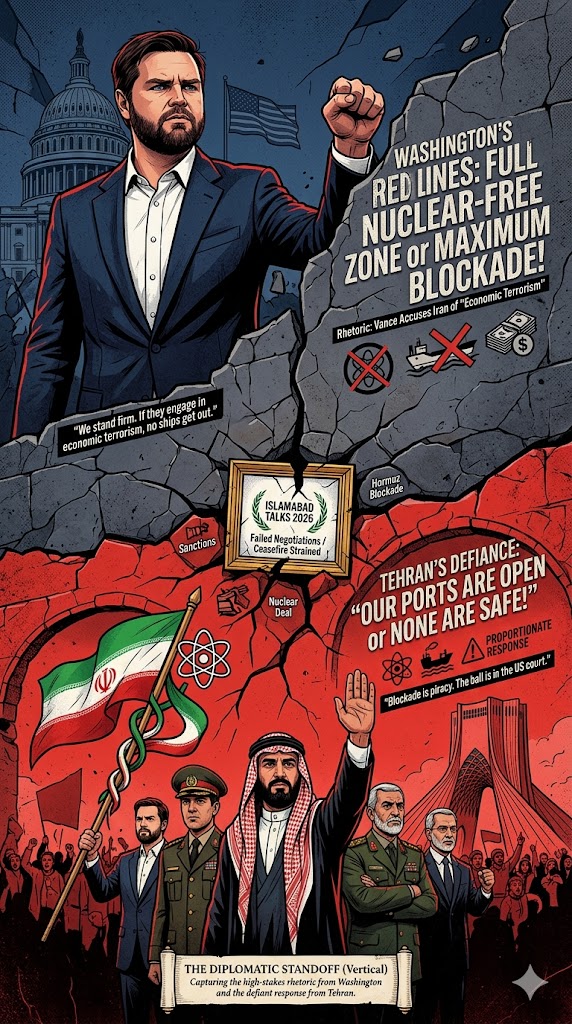
Vice President JD Vance and Iranian officials remain at a stalemate following the Islamabad talks; the image captures the tension between economic sanctions and the push for a nuclear-free regional deal.
Conclusion
Today’s US Iran war update paints a picture of strategic maneuvering rather than outright battlefield clashes. The US naval blockade, JD Vance’s firm accusations of economic terrorism, Iran’s resolute warnings, and persistent Israeli actions in Lebanon define the current landscape. Yet the door to dialogue—potentially in Pakistan or Geneva—remains open, as both sides recognize the high stakes for global stability.
As the situation evolves, staying informed through reliable US Iran war news sources is essential. The coming days will determine whether pressure yields progress or pushes the region toward deeper crisis. For now, the ball remains in motion, with diplomacy offering the clearest path forward.
Frequently Asked Questions
What is the primary significance of "US-Iran War Update: April 14, 2026 Developments"?
As of April 14, 2026, the US-Iran war remains in a precarious phase of heightened tensions rather than full-scale direct combat. A fragile two-week ceasefire, brokered by Pakistan and effective since April 8, holds tenuously between the United States, Israel, and Iran.
How does this development impact International Affairs?
However, the situation escalated sharply over the weekend when US-Iran peace talks in Islamabad collapsed, prompting President Donald Trump to order a naval blockade of all Iranian ports and the Strait of Hormuz.This US Iran war update reflects a complex mix of military pressure, diplomatic maneuvering, and regional spillover. Vice President JD Vance has publicly accused Iran of economic terrorism, while Tehran has warned that the blockade could destabilize global energy routes.
What are the key future projections to monitor?
Israel continues targeted strikes in Lebanon against Hezbollah positions, further straining the ceasefire.