The Mahabharata stands as one of humanity’s greatest literary treasures, and its opening chapter, the Adi Parva—literally “the Book of the Beginning”—sets the stage for everything that follows. As the first of the epic’s 18 parvas, the Adi Parva of Mahabharata weaves together cosmology, genealogy, divine interventions, and human drama in a narrative so rich that it feels like the very seed of faith itself taking root. Composed by sage Vyasa and transcribed by Lord Ganesha, this parva doesn’t merely recount events; it plants the moral and spiritual foundations that will bloom across the entire epic.
Spanning roughly 236 chapters in traditional editions (225 in the critical edition), the Adi Parva introduces the Kuru dynasty, the miraculous births of the Pandavas and Kauravas, the early rivalries that foreshadow the great war, and profound reflections on dharma, geography, and the Hindu cosmos. Whether you’re drawn to the Adi Parva story for its mythological depth or its timeless lessons on jealousy, loyalty, and resilience, this parva remains the gateway to understanding the Mahabharata’s exploration of human nature and divine will. In the pages that follow, we journey through every major and minor incident, tracing how faith grows from the fertile soil of ancient Bharatvarsha.
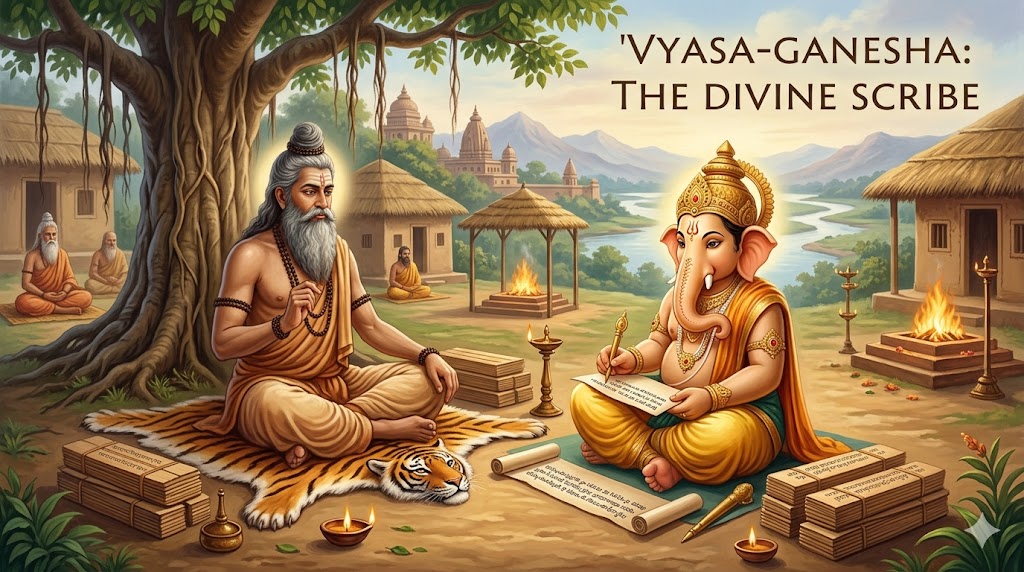
The Adi Parva opens with its own creation story, establishing the Mahabharata’s authority as a sacred text. Sage Krishna-Dwaipayana Vyasa, after years of tapas and study, composes the epic in his mind. Realizing the enormity of his work, he approaches Lord Ganesha, the remover of obstacles, to serve as scribe. Ganesha agrees on one condition: he will write without pause. Vyasa counters cleverly—he will dictate verses so profound that Ganesha must pause to grasp their meaning, giving the sage time to compose the next. This divine collaboration, detailed in the Anukramanika Parva (Chapter 1), symbolizes the perfect union of intellect and devotion. No jealousy mars their partnership; instead, it becomes a model of harmonious creation.
The epic is first narrated by Vaishampayana at King Janamejaya’s snake sacrifice in Takshashila. Later, the bard Ugrashrava Sauti (Suta) recites it to assembled rishis in Naimisharanya forest during a 12-year sacrifice led by Shaunaka. These frame narratives in the Adi Parva of Mahabharata underscore the text’s oral tradition and its role in preserving dharma across generations.
The Sacred Recitation: This traditional miniature-style illustration visualizes Sage Vyasa dictating the Mahabharata to Lord Ganesha in the Naimisharanya forest, establishing the epic's divine origins.
Early Sub-Parvas: Cosmology, Curses, and the Snake Sacrifice
The first five sub-parvas—Anukramanika, Sangraha, Paushya, Pauloma, and Astika—lay the cosmic groundwork. The Sangraha Parva provides a concise outline of all 18 parvas and defines military units like the akshauhini. Paushya Parva, unusually in prose, recounts guru-shishya devotion through stories of Aruni, Upamanyu, and Uttanka, while introducing King Janamejaya’s vow to avenge his father Parikshit’s death by snakebite from Takshaka.
Pauloma and Astika Parvas delve into the Bhrigu lineage and the primordial conflict between snakes and birds. We hear of Kadru and Vinata’s wager on the divine horse Ucchaishravas, born during the churning of the ocean (samudra manthan)—a tale that includes the emergence of amrita, Lakshmi, and the poison Halahala swallowed by Shiva. Curses fly freely: Kadru curses her serpent sons, leading to the great snake sacrifice. Yet compassion triumphs when young Astika, born of sage Jaratkaru and Vasuki’s sister, halts the yajna, saving the nagas. These incidents illustrate how dharma balances justice and mercy, sowing the seed of faith that even the mightiest curse can yield to wisdom.
Genealogy of the Kuru Dynasty and the Descent of Heroes
In the Adivansavatarana (Amshavatarana) and Sambhava Parvas—the heart of the Adi Parva Mahabharata—we trace the lunar dynasty from Manu and Bharata (son of Dushyanta and Shakuntala) through Yayati, Puru, and the Pauravas. Key episodes include the romantic yet contentious union of Dushyanta and Shakuntala, Yayati’s exchange of youth with Puru, and the celestial births of gods and demons to relieve Earth’s burden.
Shantanu’s story unfolds: his marriage to Ganga produces Bhishma, who takes the terrible vow of celibacy to please his father. Satyavati’s sons Chitrangada and Vichitravirya die childless. Bhishma abducts Amba, Ambika, and Ambalika for Vichitravirya; when the king dies, Vyasa fathers Dhritarashtra (blind), Pandu (pale), and Vidura (wise from a maid) through niyoga. These births carry curses and boons that shape destinies—Vidura’s wisdom stems from the curse on Mandavya, while Pandu’s impotence leads to Kunti’s secret boon from Durvasa.
Miraculous Births: Pandavas, Kauravas, and the Seeds of Rivalry
The Adi Parva meticulously details the births that drive the epic’s central conflict. Kunti, granted a mantra by Durvasa, invokes Dharma to birth Yudhishthira, Vayu for the mighty Bhima, and Indra for Arjuna. Madri, using the same boon, calls the Ashvins for twins Nakula and Sahadeva. These divine births highlight themes of dharma (righteousness in Yudhishthira), strength (Bhima), and prowess (Arjuna), while underscoring Kunti’s quiet faith amid hardship.
Gandhari, granted a boon for 100 sons, endures a two-year pregnancy and delivers a lump of flesh. Vyasa divides it into 100 pots, from which 100 Kauravas emerge—Duryodhana first, born on the same day as Bhima. A daughter, Dushala, completes the family. Omens at Duryodhana’s birth—jackals howling, storms—signal future strife. Karna’s birth as Kunti’s abandoned son by Surya adds another layer of hidden lineage and destined rivalry. These events mark the jealous emergence among cousins: Duryodhana’s envy of the Pandavas’ prowess begins subtly here, fueled by palace intrigues and Vidura’s warnings.
Childhood Trials, Persecutions, and Escapes
As the princes grow, Drona arrives to train them alongside Kripa and Ashwatthama. The Pandavas excel, igniting Duryodhana’s jealousy. The lac house (Jatugriha-daha Parva) plot unfolds: Purochana builds a flammable palace at Varanavata. Vidura warns Yudhishthira in coded language. The brothers escape through a tunnel with Kunti, while a Nishada woman and her sons perish in the fire. This incident cements the Kauravas’ treachery and the Pandavas’ resourcefulness.
In the forests, Hidimba and Hidimbi appear. Bhima slays the rakshasa Hidimba and marries his sister, fathering Ghatotkacha. Later, in Ekachakra, Bhima kills the cannibal Baka, protecting a Brahmin family. These minor yet pivotal adventures showcase Bhima’s strength and the family’s growing reliance on dharma amid exile.
Draupadi’s Swayamvara and the Polyandrous Marriage
The Swayamvara Parva brings the Pandavas to Panchala, disguised as Brahmins. King Drupada’s daughter Draupadi emerges from the sacrificial fire, destined for Arjuna. At her swayamvara, suitors fail to string the mighty bow and pierce the target. Arjuna succeeds, revealing his identity after a fierce battle. Kunti’s unwitting command—“share what you have brought”—leads to Draupadi marrying all five brothers, justified later by the story of five Indras cursed to share one wife. Krishna recognizes them, strengthening alliances. The Vaivahika Parva solemnizes the marriage, while Drupada rejoices at gaining powerful sons-in-law.
This union, controversial yet divinely ordained, sows further jealousy in Hastinapura. Vidura’s diplomacy (Viduragamana Parva) brings partial reconciliation; the Pandavas receive half the kingdom and found Indraprastha.
Later Incidents: Exile, Marriage, and the Burning of Khandava
Arjuna’s self-imposed exile (Arjuna-vanavasa Parva) for violating dharma by entering Draupadi’s chamber with Yudhishthira leads to marriages with Ulupi (naga princess) and Chitrangada (Manipur princess), plus rescue of apsaras. In Dwarka, he elopes with Subhadra (Krishna’s sister) in the Subhadra-harana Parva, producing Abhimanyu. The five Upapandavas—Draupadi’s sons—are born.
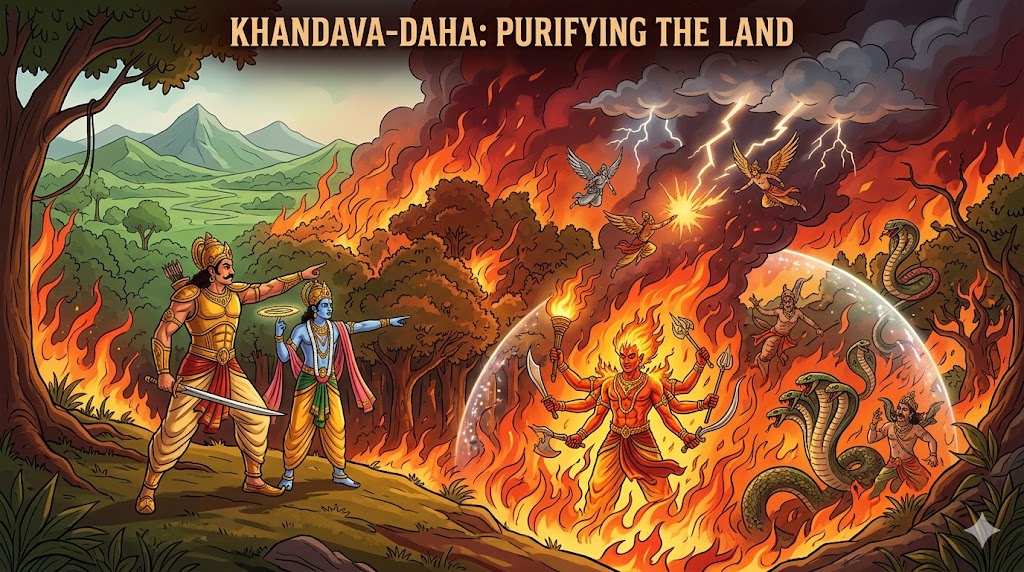
The final Khandava-daha Parva sees Krishna and Arjuna aid Agni in burning the Khandava forest, defeating Indra and gaining divine weapons. This victory cements their friendship and prepares the stage for future wars.
The Purging of Khandava: This dramatic illustration depicts the conclusion of the Khandava-daha Parva. Krishna and Arjuna observe the desolate, charred forest after assisting Agni in purifying the land and defeating the forces of Indra and the Nagas.
Geography of Bharatvarsha: The Sacred Land of Dharma
Throughout the Adi Parva, especially in cosmological passages of the Astika and Sambhava Parvas, we glimpse ancient Hindu geography. Bharatvarsha is depicted as the southernmost of seven varshas in Jambudvipa, shaped like a hare, bounded by the Himalayas to the north and the ocean to the south. Seven kulaparvatas (Mahendra, Malaya, Sahya, Suktimat, Riksha, Vindhya, Paripatra) and countless rivers define its sacred landscape. Meru, the golden mountain, stands at its center, with regions like Gandhamadana and Pushkara hosting sages and celestials. This portrayal of Bharatvarsha as the land where dharma flourishes underscores the epic’s Hindu ethos— a realm where karma, tapas, and righteous rule intersect.
Themes of Faith, Dharma, and Lasting Legacy
As the Adi Parva unfolds, the seed of faith grows through every curse turned to blessing, every rivalry tempered by wisdom, and every act of devotion. Vyasa’s composition reminds us that the Mahabharata is not mere history but a mirror for the soul. Minor incidents—like Uttanka’s guru service or Ruru’s compassion—teach humility; major ones, such as the births and swayamvara, reveal destiny’s intricate weave.
The Adi Parva of Mahabharata closes with the Pandavas secure in Indraprastha, yet the undercurrents of jealousy and dharma’s test linger. It is here, in this first parva, that the epic’s profound exploration of human frailty and divine grace truly begins.
Frequently Asked Questions
What is the primary significance of "Adi Parva: Mahabharata's Book of the Beginning"?
The Mahabharata stands as one of humanity’s greatest literary treasures, and its opening chapter, the Adi Parva—literally “the Book of the Beginning”—sets the stage for everything that follows. As the first of the epic’s 18 parvas, the Adi Parva of Mahabharata weaves together cosmology, genealogy, divine interventions, and human drama in a narrative so rich that it feels like the very seed of faith itself taking root.
How does this development impact Dharma?
Composed by sage Vyasa and transcribed by Lord Ganesha, this parva doesn’t merely recount events; it plants the moral and spiritual foundations that will bloom across the entire epic.Spanning roughly 236 chapters in traditional editions (225 in the critical edition), the Adi Parva introduces the Kuru dynasty, the miraculous births of the Pandavas and Kauravas, the early rivalries that foreshadow the great war, and profound reflections on dharma, geography, and the Hindu cosmos. Whether you’re drawn to the Adi Parva story for its mythological depth or its timeless lessons on jealousy, loyalty, and resilience, this parva remains the gateway to understanding the Mahabharata’s exploration of human nature and divine will.
What are the key future projections to monitor?
In the pages that follow, we journey through every major and minor incident, tracing how faith grows from the fertile soil of ancient Bharatvarsha.The Epic’s Origins: Vyasa, Ganesha, and the RecitationThe Adi Parva opens with its own creation story, establishing the Mahabharata’s authority as a sacred text.