The Bhagavad Gita stands as one of the most revered scriptures in Sanatan Dharma. Often called the Bhagwat Geeta or Shrimad Bhagavad Gita, this sacred text is far more than a religious book—it is a complete guide to living a purposeful life. Delivered by Lord Krishna to Arjuna on the battlefield of Kurukshetra, the Bhagavad Gita encapsulates the essence of Sanatan Dharma’s eternal principles. It is widely regarded as the most beautiful Upanishad of life conduction, offering practical wisdom that transcends time, culture, and circumstance.
In today’s fast-paced world, people search for “Bhagwad Geeta,” “Krishna Bhagwad Geeta,” or “Bhagwat Geeta pravachan in Hindi” seeking answers to inner turmoil. The Gita provides those answers with clarity and compassion. It is the greatest remembrance of Lord Krishna, preserving His divine discourse that continues to inspire millions. This article explores the Bhagavad Gita as Sanatan Dharma’s foundational book, its profound beauty, the life lessons Lord Krishna imparted to Arjuna, and—most importantly—its unmatched relevance in empowering individuals today.
Sanatan Dharma, the world’s oldest living spiritual tradition, finds one of its most complete expressions in the Bhagavad Gita. Known also as the Shrimad Bhagwat Geeta or Bhagawad Geeta Amritwani, it is not merely a chapter of the Mahabharata but a standalone philosophical masterpiece. Scholars often describe it as the Sanatan Dharmshala book—the abode of dharma—because it houses the core values of righteousness, duty, and self-realization that define Sanatan Dharma.
Unlike rigid commandments, the Bhagavad Gita presents flexible yet profound paths suited to every temperament. It is considered one of the most beautiful books ever written because it speaks directly to the human heart. Lord Krishna does not preach from a distance; He becomes the charioteer, the friend, and the guide. Through this intimate conversation, the Gita becomes the ultimate Upanishad of life conduction, teaching how to navigate existence with grace, courage, and detachment.
Its status as the greatest remembrance of Lord Krishna is undisputed. Every verse carries the divine energy of Krishna’s presence. When devotees recite “Bhagwad Geeta shlok in Sanskrit” or listen to “Bhagwad Geeta by Shailendra Bharti,” they feel Krishna’s living voice guiding them across centuries.
The Historic Context: Lord Krishna’s Advice to Arjuna
The setting is dramatic. On the eve of the great Mahabharata war, Arjuna, the greatest warrior of his time, is overcome by grief and doubt. Facing his own relatives, teachers, and friends across the battlefield, he lays down his bow. “How can I fight my own kith and kin?” he asks in despair.
It is here that Lord Krishna delivers the immortal discourse known as the Bhagavad Gita. In eighteen chapters and 700 verses, Krishna addresses every aspect of human struggle. He explains the immortal nature of the soul, the importance of performing one’s duty (dharma), and the futility of attachment to results. The Bhagwat Geeta saar—its essence—lies in this single truth: act with full responsibility, but surrender the outcome to the Divine.
Krishna does not simply console Arjuna; He equips him with practical rules and life lessons. He outlines four primary paths—Karma Yoga (path of selfless action), Bhakti Yoga (path of devotion), Jnana Yoga (path of knowledge), and Raja Yoga (path of meditation). Each path is tailored for different personalities, yet all lead to the same goal: liberation from the cycle of birth and death.
The Gita’s beauty lies in its universality. Whether one seeks “Bhagwat Geeta gyan” for intellectual satisfaction or emotional solace through “Bhagwad Geeta amritvani,” the text meets every seeker at their level.
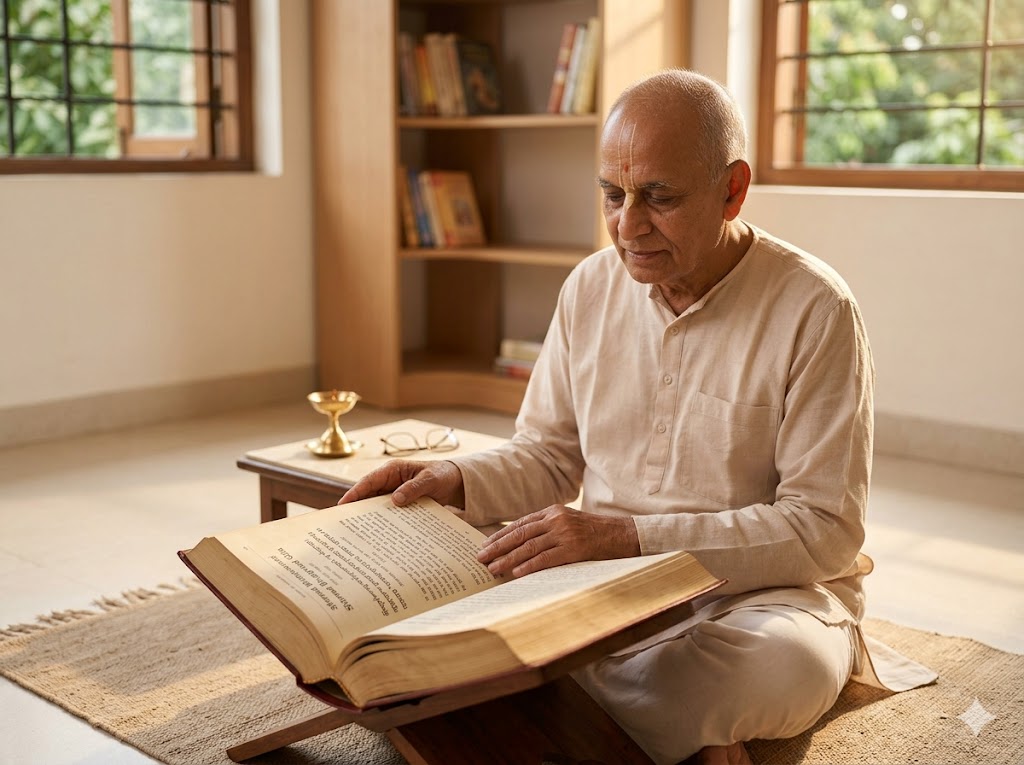
A student of wisdom in quiet contemplation, internalizing the eternal principles of dharma from the Shrimad Bhagavad Gita.
Profound Life Lessons from Lord Krishna
Lord Krishna’s teachings form the heart of the Bhagavad Gita. Chapter 2, Sankhya Yoga, is particularly powerful. Krishna explains that the soul is eternal: “For the soul there is neither birth nor death at any time… it is unborn, eternal, ever-existing and primeval.” This single teaching has the power to dissolve grief instantly.
In Karma Yoga (Chapter 3), Krishna teaches: “You have a right to perform your prescribed duty, but you are not entitled to the fruits of action.” This verse, one of the most quoted Bhagwad Geeta shlok in Hindi and Sanskrit, frees us from anxiety over outcomes. It encourages excellence without ego.
Bhakti Yoga (Chapter 12) reveals the path of love. Krishna assures that even the most ordinary person can reach Him through sincere devotion. In today’s materialistic age, this message resonates deeply—success is not measured by wealth but by the purity of heart.
Jnana Yoga dismantles ignorance, while Raja Yoga offers meditation techniques for mental mastery. Together, these form the complete Bhagwat Geeta gyan that has guided saints, leaders, and common people alike.
Overcoming Grief and Building Emotional Strength
One of the Gita’s greatest gifts is its ability to heal grief. Arjuna’s despondency mirrors the emotional crises many face today—loss, failure, broken relationships. Krishna’s response is transformative. He teaches equanimity: remain balanced in pleasure and pain, success and failure.
By understanding the impermanence of the body and the eternity of the soul, one learns to detach from sorrow without becoming indifferent. This mindful approach empowers us emotionally. Regular reflection on Gita verses cultivates resilience. Practitioners report reduced anxiety, clearer decision-making, and a powerful inner calm—the very essence of a “powerful mindfully emotionally” state that modern psychology now validates.
The Bhagavad Gita does not ask us to suppress emotions; it teaches us to transcend them through wisdom. This is why it remains the most beautiful book for life conduction even after 5,000 years.
Standing for Righteousness – Even Against Family
Perhaps the most challenging yet liberating lesson comes when Krishna urges Arjuna to fight. The Kauravas were Arjuna’s cousins, teachers, and elders. Yet Krishna declares that when dharma is at stake, one must stand for what is right, regardless of personal relationships.
This teaching holds immense importance in today’s life. In family disputes, workplace politics, or societal injustice, the Gita empowers us to choose principle over comfort. It does not promote hatred but insists on detached action. “Perform your duty without attachment,” Krishna says. We learn to act with love in our hearts while refusing to compromise on truth.
The Bhagavad Gita thus becomes a moral compass. It teaches that true strength lies in upholding righteousness, even when family stands against us. This message is profoundly relevant in an era of moral relativism.
The Bhagavad Gita’s Importance in Today’s Life
In our hyper-connected yet emotionally fragmented world, the Bhagavad Gita’s relevance has only grown. Professionals battling burnout, students facing pressure, parents navigating complex relationships—all find solace in its pages.
Its teachings on stress management through detachment, leadership through selfless service, and happiness through inner fulfillment address modern challenges directly. Corporate leaders study Karma Yoga for ethical decision-making. Mental health experts recommend Gita meditation for mindfulness. Parents introduce “Bhagwat Geeta shlok in Hindi” to children to build character.
The Gita shows us how to remain centered amid chaos. It empowers us to overcome grief, develop emotional intelligence, and cultivate a powerful mind. By internalizing its wisdom, anyone can transform ordinary life into a spiritual journey.
Practical Ways to Apply Bhagavad Gita Teachings Daily
Incorporating the Gita need not be complicated. Start with daily reading of even one shloka. Many prefer “Bhagwad Geeta pravachan in Hindi” by revered speakers for deeper understanding. Practice Karma Yoga by performing duties sincerely without expectation of reward. Cultivate Bhakti through prayer or chanting. Study Jnana to question limiting beliefs. Meditate as per Raja Yoga for mental clarity.
Join study groups or listen to authentic narrations. The key is consistency. Over time, these practices make us emotionally stronger, more decisive, and aligned with dharma.
Conclusion
The Bhagavad Gita is not just a book—it is a living guru. As Sanatan Dharma’s most precious gift, it continues to illuminate the path of righteousness, self-discovery, and liberation. Lord Krishna’s advice to Arjuna remains the ultimate guide for conducting life with purpose and peace.
In embracing the Bhagavad Gita, we honor our Sanatan heritage while gaining tools to thrive in the modern world. It teaches us to overcome grief, stand for truth even against family, and build a powerful, mindful, and emotionally resilient self. Whether you seek “Bhagwat Geeta saar,” “Shrimad Bhagwat Geeta path,” or simple daily inspiration, the Gita welcomes every seeker with open arms.
May the divine wisdom of Lord Krishna, enshrined in the Bhagavad Gita, guide your life toward eternal peace and fulfillment. Pick up this sacred text today. Its pages hold the answers you have been searching for.
Frequently Asked Questions
What is the primary significance of "Bhagavad Gita: Eternal Wisdom of Sanatan Dharma"?
The Bhagavad Gita stands as one of the most revered scriptures in Sanatan Dharma. Often called the Bhagwat Geeta or Shrimad Bhagavad Gita, this sacred text is far more than a religious book—it is a complete guide to living a purposeful life.
How does this development impact Dharma?
Delivered by Lord Krishna to Arjuna on the battlefield of Kurukshetra, the Bhagavad Gita encapsulates the essence of Sanatan Dharma’s eternal principles. It is widely regarded as the most beautiful Upanishad of life conduction, offering practical wisdom that transcends time, culture, and circumstance.In today’s fast-paced world, people search for “Bhagwad Geeta,” “Krishna Bhagwad Geeta,” or “Bhagwat Geeta pravachan in Hindi” seeking answers to inner turmoil.
What are the key future projections to monitor?
The Gita provides those answers with clarity and compassion.