The Middle East stands on a knife-edge this Thursday morning as the Israel-Iran war enters a perilous new phase. Just 24 hours after a two-week ceasefire between the United States and Iran was announced, Israeli airstrikes have hammered Lebanon with unprecedented ferocity. The death toll is climbing by the hour, and diplomatic channels are buzzing with urgent warnings. Iran has drawn a firm line: stop the Lebanon strikes immediately or watch the fragile truce shatter. Israel, meanwhile, has made its position crystal clear—it will not pause its campaign against Hezbollah. What began as a pause in direct US-Iran hostilities now threatens to reignite full-scale escalation across multiple fronts.
This article examines the situation as it unfolded on April 9, 2026, drawing on the latest reports from Beirut, Tehran, Tel Aviv, and Washington. We break down the human cost in Lebanon, Iran’s explicit threats, Israel’s unwavering resolve, and the very real possibility that this “pause” could collapse within 48 hours.
The Ceasefire That Wasn’t: What Happened on April 8
On Tuesday, April 8, a surprise two-week ceasefire was brokered between the US and Iran, with Israel’s backing. Mediated in part by Pakistan, the deal aimed to halt more than five weeks of intense hostilities that had drawn in US forces, Iranian proxies, and direct strikes between Tehran and Israeli targets. For a few brief hours, the region breathed a cautious sigh of relief. No major US or Iranian strikes were reported overnight.
But the agreement contained a critical ambiguity—one that has now exploded into open confrontation. Israel and the United States insist the truce applies only to direct Iran-US exchanges and explicitly excludes Lebanon. Iranian officials and Pakistani mediators counter that Lebanon was always meant to be included as an “inseparable part” of the deal. That disagreement has proven fatal to the ceasefire’s credibility.
By Wednesday afternoon, Israeli jets were already in the air. In what the Israeli military itself described as “the largest coordinated wave of strikes” since the current round of fighting began, more than 100 Hezbollah targets were hit across central Beirut, southern Lebanon, and the Bekaa Valley—all within roughly ten minutes. No advance warnings were issued to civilians in densely populated areas. The result was immediate and devastating.
Lebanon’s Nightmare: Continuous Strikes and Soaring Death Toll
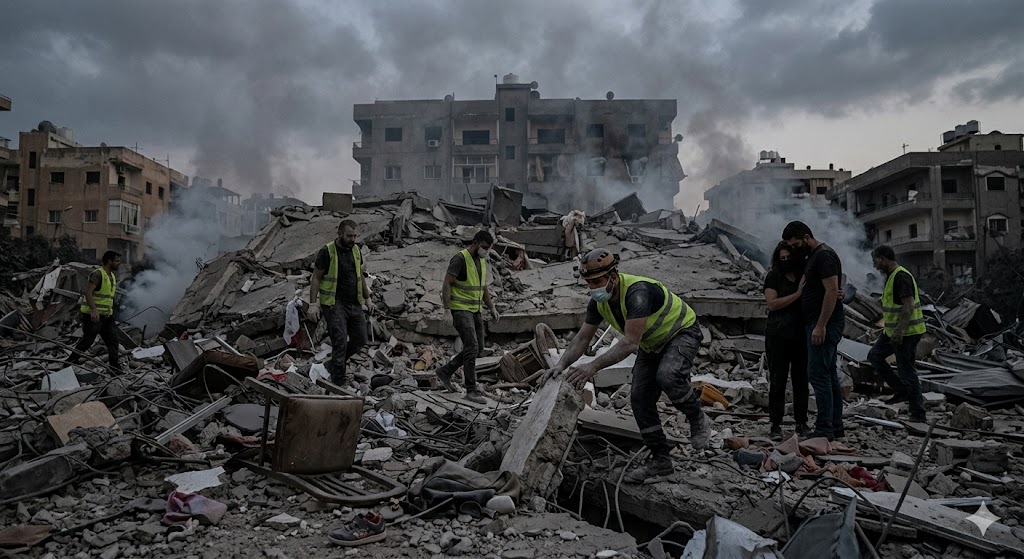
Lebanon has borne the brunt of the violence for weeks, but April 8 marked a grim new record. Lebanese health authorities and civil defense teams report at least 203 to 254 people killed in a single day—the highest single-day toll since the 2026 Lebanon war intensified in late February. More than 1,000 others were wounded, many critically. Hospitals in Beirut and beyond issued urgent calls for blood donations as emergency rooms overflowed.
Strikes targeted not only suspected Hezbollah positions but also struck commercial districts and residential neighborhoods in central Beirut without prior evacuation orders. Rescue workers pulled victims from collapsed apartment buildings late into the night. Families who had only recently returned to their homes after earlier displacements found themselves fleeing once again.
Lebanon’s government declared a national day of mourning on April 9. Prime Minister Najib Mikati described the attacks as “a devastating setback” and appealed for international intervention. The United Nations and several European capitals, including London, have echoed those calls, urging that Lebanon be folded into the ceasefire framework before it is too late. Yet the strikes have not stopped. Sporadic reports of follow-up operations continued into the early hours of April 9, keeping the death toll on an upward trajectory.
For ordinary Lebanese citizens, the situation feels eerily familiar—and utterly exhausting. Over a million people remain displaced nationwide. Infrastructure damage from weeks of bombardment has left entire communities without reliable power or clean water. Aid organizations warn that the humanitarian crisis is spiraling, with hospitals operating at breaking point and civilian casualties mounting faster than medical teams can respond.
Emergency responders and civilians search through the debris of a collapsed apartment building in central Beirut following a massive Israeli airstrike on April 8, 2026. The continuous strikes have resulted in a devastating human toll, with over 200 reported dead in a single day, pushing local rescue services to their absolute limit
Iran’s Stark Warning: Stop Lebanon Strikes or the Ceasefire Breaks
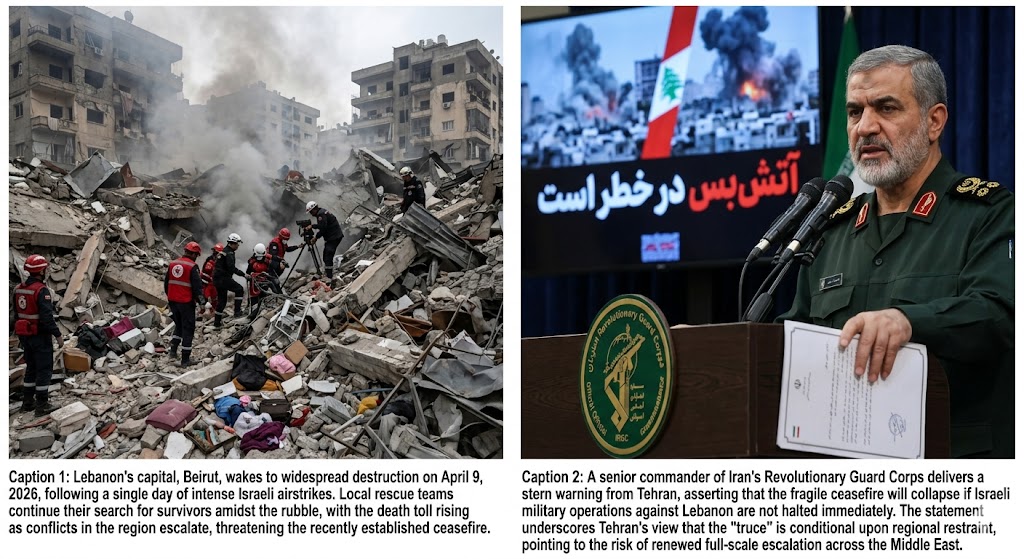
Tehran has wasted no time in responding to the Lebanon strikes. Iranian officials, including Foreign Minister Abbas Araghchi and Parliament Speaker Mohammad Bagher Ghalibaf, have publicly accused the US and Israel of violating the spirit—and possibly the letter—of the ceasefire agreement. In a pointed statement circulated on state media and social platforms, Iran declared that “aggression towards Lebanon is aggression towards Iran.”
The message is unambiguous: if Israel does not halt its strikes on Lebanon immediately, the fragile ceasefire will collapse. Iranian Revolutionary Guard commanders have gone further, promising a “regret-inducing response” and confirming that forces are already preparing for potential escalation. Tehran has also reimposed restrictions on shipping through the Strait of Hormuz, sending oil prices spiking and global markets into renewed volatility.
Crucially, Iranian leaders have acknowledged what many analysts have suspected all along: this is not the end of the war, merely a pause. “The world sees the massacres in Lebanon,” Araghchi posted. “The ball is in the US court.” By framing the current lull as temporary and conditional, Iran is signaling readiness to resume hostilities if its core demands—particularly an end to Israeli operations in Lebanon—are not met.
This position aligns with Hezbollah’s own statements. The group paused rocket fire briefly after the ceasefire announcement but resumed attacks on northern Israel early on April 9, citing Israeli “ceasefire violations.” Around 30 rockets were reported launched, triggering sirens across the Galilee. Hezbollah framed its response as defensive and proportionate, yet the move underscores how quickly the pause can turn into renewed escalation.
Israel’s Firm Stance: No End to the War Against Hezbollah
Prime Minister Benjamin Netanyahu addressed the nation on Wednesday evening and again on Thursday morning. His message was unequivocal: the ceasefire with Iran does not—and will not—apply to Israel’s operations in Lebanon. “We will continue to strike Hezbollah wherever necessary until full security is restored to the residents of the north,” Netanyahu stated.
Israeli military spokespersons echoed this line, emphasizing that the April 8 strikes were “targeted and necessary” to degrade Hezbollah’s capabilities. Defense officials point to intelligence indicating ongoing rocket stockpiles and command structures still active in Lebanon. From Israel’s perspective, allowing Hezbollah to regroup under any ceasefire umbrella would simply invite future attacks on Israeli civilians.
The US administration has backed this interpretation. White House officials, including Vice President JD Vance, have reiterated that Lebanon was never part of the US-Iran deal. President Trump’s team has described the agreement as narrowly focused on preventing direct superpower-level confrontation, leaving Israel free to handle its northern border security independently.
This hardline position has drawn sharp criticism from allies and adversaries alike. The United Kingdom’s Foreign Secretary called Israel’s actions “damaging” and urged inclusion of Lebanon in the truce. Human rights groups, including Amnesty International, have condemned the scale of civilian harm and demanded immediate de-escalation.
Could the Current Situation Last Longer Than 48 Hours?
Analysts across the region are asking the same urgent question: how long can this fragile pause possibly hold? Many give it less than 48 hours before full breakdown.
The combination of rising Lebanese casualties, Iranian threats, Hezbollah rocket fire, and Israel’s refusal to back down creates a classic escalatory spiral. Diplomatic talks scheduled for Islamabad this weekend—led by US Vice President Vance—now face an uphill battle. If Israel continues strikes and Iran follows through on its warnings, the two-week ceasefire could unravel before negotiators even sit down.
Oil markets are already reacting. The brief reopening of the Strait of Hormuz was reversed, and shipping insurance rates have jumped. Global powers from Europe to China are watching closely, fearful that a renewed Israel-Iran war could spill into a broader conflict involving the US directly.
Yet history offers a sobering lesson. Previous ceasefires in the Israel-Hezbollah arena have collapsed under similar pressures. The 2024-2025 rounds saw repeated violations followed by rapid re-escalation. Today’s situation carries even higher stakes because of the direct US-Iran dimension and the involvement of multiple proxy networks.
The United States finds itself in a delicate balancing act. On one hand, the Trump administration wants credit for brokering a pause that averted wider war. On the other, Washington must navigate its ironclad alliance with Israel while managing relations with Gulf partners and avoiding entanglement in Lebanon’s quagmire.
European diplomats are pushing for a more inclusive ceasefire that explicitly covers Hezbollah operations. Russia and China have issued statements urging restraint, though their influence remains limited.
For the people of Lebanon, the abstract debate over ceasefire terms feels painfully distant. Every new strike report brings fresh grief. Families search for missing loved ones amid rubble. Schools remain closed. The economy, already battered, faces further collapse.
Iran’s acceptance that “the war is not over yet—it is just a pause” reflects a cold realism shared by many observers. Without swift diplomatic breakthroughs—particularly a verifiable halt to Israeli strikes in Lebanon—the escalation risks becoming unstoppable.
Looking Ahead: Paths to De-escalation or Renewed Conflict
As April 9 draws to a close, several scenarios are possible:
1. Rapid Diplomatic Intervention: US-led talks in Islamabad produce a side agreement that temporarily freezes Israeli operations in exchange for Hezbollah restraint. Iran reopens the Strait fully and the ceasefire gains breathing room.
2. Controlled Escalation: Israel limits further strikes to specific military targets while Iran holds back from direct involvement, buying time for negotiations.
3. Full Breakdown: Continued Lebanese casualties prompt Iranian retaliation—either through proxies or limited direct action—triggering Israeli counter-strikes and pulling the US back into active hostilities.
Against a backdrop of the planned diplomatic venue in Islamabad, Pakistan, symbolic representations of the United States, Iran, and Israel remain deadlocked. Negotiators face an uphill battle as the two-week ceasefire, intended to pause direct hostilities, threatens to collapse within 48 hours due to the intensifying conflict in Lebanon.
The next 48 hours will likely determine which path the region takes. Right now, the momentum favors escalation. Death tolls in Lebanon continue to rise. Iranian warnings grow louder. Israel shows no sign of relenting.
The Israel-Iran war, intertwined with the Lebanon front, remains far from resolved. What began as a hopeful pause has become a dangerous test of wills. For civilians caught in the crossfire—especially in Lebanon—the cost is already unbearably high. The world is watching, but whether leaders can translate concern into concrete action remains the decisive question of the hour.
Frequently Asked Questions
What is the primary significance of Israel-Iran War: Lebanon Strikes Risk Ceasefire Collapse?
Israel-Iran War: Lebanon Strikes Risk Ceasefire CollapseApril 9, 2026The Middle East stands on a knife-edge this Thursday morning as the Israel-Iran war enters a perilous new phase. Just 24 hours after a two-week ceasefire between the United States and Iran was announced, Israeli airstrikes have hammered Lebanon with unprecedented ferocity.
How does this development impact International Affairs?
The death toll is climbing by the hour, and diplomatic channels are buzzing with urgent warnings. Iran has drawn a firm line: stop the Lebanon strikes immediately or watch the fragile truce shatter.
What are the key future projections to monitor?
Israel, meanwhile, has made its position crystal clear—it will not pause its campaign against Hezbollah.