US-Iran War: April 8-9 Escalation, Hormuz & Global Fallout
International Affairs • April 09, 2026 • Global Edition

The fragile two-week ceasefire between the United States, Iran, and Israel, announced on April 7-8, 2026, faced immediate and severe tests during the midnight hours of April 8 and into April 9. What began as a diplomatic breakthrough brokered by Pakistan quickly unraveled amid renewed Israeli airstrikes on Lebanon, Iranian threats to the Strait of Hormuz, and a web of conflicting interpretations over the deal’s scope. This article examines the critical 48-hour period, the human and strategic costs, and the broader ripple effects on global energy security, diplomacy, and regional powers.
As of April 9, the conflict—sparked on February 28 by joint US-Israeli operations against Iran—has already claimed thousands of lives and disrupted one-fifth of the world’s oil trade. Yet the latest escalation highlights how proxy battles in Lebanon and maritime chokepoints could derail even temporary peace. From Mumbai’s Jawaharlal Nehru Port Trust (JNPT) to Islamabad’s negotiating table, the world is watching closely.
Midnight Escalation: April 8-9 Timeline
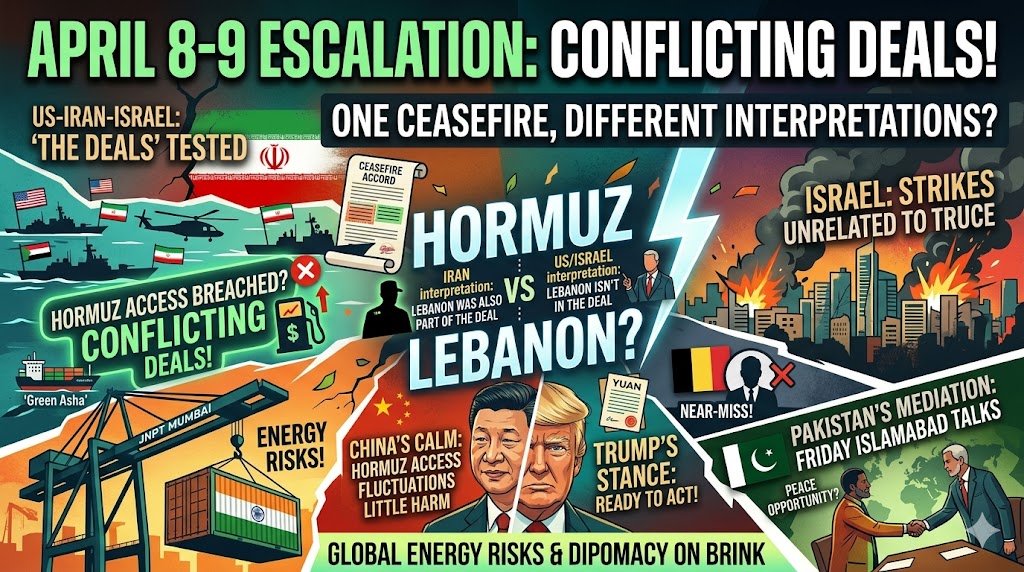
The ceasefire, which included provisions for reopening the Strait of Hormuz, was barely hours old when Israel launched its largest single-day operation against Hezbollah targets in Lebanon on April 8. Dubbed by some Israeli sources as “Operation Eternal Darkness,” the strikes hit over 100 sites across Beirut, southern Lebanon, and the Bekaa Valley within minutes. Lebanese health authorities reported at least 182 killed and hundreds wounded, marking the deadliest day in the latest phase of the Israel-Hezbollah conflict.
Iran immediately condemned the action, insisting Lebanon fell under the ceasefire umbrella as part of its 10-point proposal. Tehran’s state media announced the re-closure of the Strait of Hormuz late on April 8, halting tanker traffic in retaliation. US officials, including Vice President JD Vance, countered that Lebanon was explicitly excluded, framing Israeli operations as a “separate skirmish” unrelated to the Iran truce. By midnight into April 9, Iranian Revolutionary Guard Corps statements confirmed shipping had “completely stopped,” while the White House demanded immediate reopening.
This back-and-forth created a tense overnight standoff. Ballistic missile alerts sounded in northern Israel as Hezbollah claimed limited retaliatory launches, underscoring that even a pause in direct US-Iran fighting did little to quiet the broader battlefield.
Iran’s Renewed Push Toward Strait of Hormuz Closure
The Strait of Hormuz—through which nearly 20% of global oil and significant LNG volumes pass—has been Iran’s most potent leverage point throughout the war. Following the April 8 strikes on Lebanon, Iran signaled it was once again “close to the state of Hormuz” closure, reversing the partial reopening that accompanied the ceasefire announcement.
Analysts note this move was not impulsive. Iranian officials had conditioned any lasting truce on halting Israeli actions against its regional allies, including Hezbollah. When those conditions appeared unmet, Tehran invoked its earlier warnings. Shipping data showed tankers diverting or idling, sending oil prices spiking above $95 per barrel before partial stabilization.
The closure threat carries massive economic weight. For Iran, it pressures the US and its partners; for the world, it risks prolonged supply disruptions. Yet Tehran has repeatedly framed the action as defensive, tied directly to what it calls Israeli violations.
Lebanon’s Agony: Continuous Israeli Strikes Amid Ceasefire Disputes
While the US-Iran deal dominated headlines, Lebanon bore the brunt of April 8’s violence. Israeli forces struck densely populated areas in central Beirut without prior warning, targeting what the IDF described as Hezbollah command centers embedded in civilian zones. Rescue workers pulled bodies from rubble late into the night, with scenes of devastation broadcast globally.
Iran maintained that “Lebanon was also the part of 2 weeks ceasefire,” a position echoed by Pakistani mediators. Israel and the US disagreed, allowing operations to continue. The result: hundreds of Lebanese civilians and militants killed, infrastructure damaged, and a humanitarian crisis deepening in a country already strained by years of conflict.
Belgium Foreign Minister’s Harrowing Near-Miss
In a striking personal account that underscored the indiscriminate nature of the Beirut strikes, Belgian Foreign Minister Maxime Prevot revealed he was just a few hundred meters from the impact zone. Visiting the Lebanese capital to reaffirm support for local authorities, Prevot and his delegation were at the Belgian embassy when missiles struck nearby.
“We were at the embassy with my delegation, just a few hundred metres from where the missiles struck,” Prevot posted on social media. “This must stop. The ceasefire between the US, Israel and Iran must include Lebanon!” His statement, issued hours after the attacks, called for an immediate expansion of the truce and highlighted Belgium’s firm stance against civilian targeting. The incident brought European diplomatic urgency to the forefront, amplifying calls for restraint.
US Response: Iran “Broke the Deals,” Readiness for Action
Washington’s position remained resolute. US officials accused Iran of breaching the spirit of the ceasefire by linking Hormuz access to Lebanese developments. President Donald Trump, who had earlier threatened severe consequences if the strait remained closed, reiterated America’s readiness “to do anything” to protect global shipping lanes.
Vice President JD Vance is set to lead negotiations in Pakistan, signaling continued US engagement even amid tensions. The White House briefing on April 8 emphasized that the truce was conditional on full, safe passage through Hormuz. “Iran broke the deals,” one senior official noted privately, reflecting frustration over perceived bad faith. Yet the administration stopped short of immediate military escalation, opting instead for diplomatic pressure through upcoming Islamabad talks.
Lebanon Declares National Mourning: April 9 Holiday Honors the Fallen
In response to the bloodshed, Lebanese Prime Minister Nawaf Salam declared April 9, 2026, a national day of mourning. Flags flew at half-mast, public offices closed, and citizens gathered for prayers and memorials honoring the victims. The move transformed the morning into a somber holiday, with streets quieter than usual as families grieved and leaders called for unity.
Despite the pain, Lebanese resilience shone through. Hezbollah sources indicated no immediate large-scale retaliation but vowed continued resistance. The day of mourning served as both tribute and subtle pressure on international actors to enforce a broader ceasefire.
Defiance Persists: Ballistic Missile Activity and Unyielding Stances
Even on April 9, neither side appeared fully cowed. Reports emerged of limited ballistic missile activity from Iranian-backed groups, though details remained unconfirmed by independent sources. Hezbollah claimed strikes on northern Israel, while Israeli defenses intercepted threats. This pattern of measured defiance illustrates the challenge of any short-term truce: underlying grievances and proxy networks remain active.
The whole scenario has exposed fractures in the ceasefire framework. What diplomats hailed as a “big day for world peace” now risks collapsing under the weight of unresolved proxy conflicts.
Global Ramifications: Energy, Diplomacy, and Economic Strain
The April 8-9 developments have far-reaching consequences. Energy markets jittered as Hormuz uncertainty returned. Asian importers, in particular, face supply risks that could drive inflation and slow growth.
India’s Energy Lifeline: LPG Supplies via JNPT Mumbai
India, the world’s second-largest LPG importer, relies heavily on Middle Eastern routes passing through the Strait of Hormuz. Nearly 90% of its imports transit the chokepoint, with the Jawaharlal Nehru Port Trust (JNPT) in Mumbai serving as the primary gateway for refineries and distribution.
Recent weeks saw Indian-flagged vessels like the Green Asha successfully crossing despite tensions, delivering critical cargoes. On April 9, JNPT operations continued normally, but officials monitor the situation closely. Any prolonged closure could disrupt household cooking fuel supplies, affecting millions. India has quietly resumed limited Iranian imports after a seven-year hiatus to diversify risks, underscoring the strategic balancing act New Delhi must perform.
Pakistan’s Pivotal Role: Friday Talks and Diplomatic Momentum
Pakistan emerged as the unlikely hero of the ceasefire, with Prime Minister Shehbaz Sharif mediating the initial deal. Islamabad has invited US and Iranian delegations for talks on Friday, April 10, in the capital. Reports suggest Pakistani authorities coordinated logistics smoothly, including preparatory measures that some local observers likened to a focused “two-day leave” window around Friday prayers and high-level meetings to ensure uninterrupted diplomacy.
The talks represent a rare diplomatic win for Islamabad, positioning it as a bridge between adversaries. Success could stabilize the region; failure risks renewed escalation.
Trump’s Likely Reaction to Hormuz Closure
President Trump has historically taken a hard line on the strait. His earlier ultimatums and social media statements left little doubt: any closure would prompt strong measures. With the April 8-9 re-closure, expect Trump to frame it as Iranian bad faith while praising the ceasefire’s initial achievements. His administration’s emphasis on VP Vance’s role suggests calibrated pressure rather than immediate confrontation, but the president’s rhetoric remains unpredictable.
China’s Calculated Calm: Little Harm from Hormuz Fluctuations
Beijing has navigated the crisis with strategic detachment. China vetoed a UN resolution aimed at forcing Hormuz reopening, aligning with Russia in criticizing unilateral US pressure. While reliant on Gulf energy, China benefits from yuan-denominated trade deals with Iran and diversified suppliers. Analysts assess minimal direct harm to Chinese interests from short-term closures, viewing the situation as an opportunity to advance de-dollarization goals without overt involvement.
Gulf States in the Middle: Saudi Arabia, UAE, and Cautious Neutrality
Saudi Arabia and the UAE, key US partners, welcomed the ceasefire but stopped short of full endorsement. Riyadh urged a “comprehensive sustainable pacification” and full Hormuz reopening, while Abu Dhabi’s advisers emphasized long-term security beyond temporary pauses. Both nations have absorbed Iranian strikes yet continue advocating de-escalation, positioning themselves in the “middle way” — supporting Western efforts against Iranian proxies while avoiding deeper entanglement.
Other Gulf Cooperation Council members echo this balanced stance, prioritizing economic stability over confrontation. Their restraint highlights the region’s desire for calm amid superpower maneuvering.
Analysis: What the Scenario Reveals and What Lies Ahead
The events of April 8-9 reveal a ceasefire built on shaky foundations: differing interpretations, proxy entanglements, and high-stakes economic leverage. Iran’s Hormuz gambit, Israel’s Lebanese campaign, and the human tragedy in Beirut illustrate how interconnected conflicts remain.
For the broader world, the scenario affects everything from fuel prices to diplomatic alliances. India’s port operations, Pakistan’s mediation, Trump’s brinkmanship, China’s quiet gains, and Gulf caution paint a complex tapestry. Lasting peace requires addressing root causes—nuclear concerns, missile programs, and territorial disputes—beyond two-week pauses.
Yet glimmers of hope exist. Friday’s Islamabad talks offer a narrow window for dialogue. Global pressure, including from Europe and Asia, may yet compel restraint.
Conclusion
As April 9’s mourning unfolds in Lebanon and Hormuz tankers idle, the US-Iran-Israel war stands at a precarious crossroads. The midnight actions of April 8 exposed the truce’s fragility, but they also underscored the high costs of continued fighting. From JNPT Mumbai to Beijing’s boardrooms, stakeholders share a vested interest in stability.
The coming days will test whether diplomacy or defiance prevails. For now, the world holds its breath, watching as leaders navigate one of the most volatile chapters in modern Middle Eastern history. Peace remains possible—but only if all parties honor the spirit, not just the letter, of their agreements.
Frequently Asked Questions
What is the primary significance of US-Iran War: April 8-9 Escalation, Hormuz & Global Fallout?
The fragile two-week ceasefire between the United States, Iran, and Israel, announced on April 7-8, 2026, faced immediate and severe tests during the midnight hours of April 8 and into April 9. What began as a diplomatic breakthrough brokered by Pakistan quickly unraveled amid renewed Israeli airstrikes on Lebanon, Iranian threats to the Strait of Hormuz, and a web of conflicting interpretations over the deal’s scope.
How does this development impact International Affairs?
This article examines the critical 48-hour period, the human and strategic costs, and the broader ripple effects on global energy security, diplomacy, and regional powers.As of April 9, the conflict—sparked on February 28 by joint US-Israeli operations against Iran—has already claimed thousands of lives and disrupted one-fifth of the world’s oil trade. Yet the latest escalation highlights how proxy battles in Lebanon and maritime chokepoints could derail even temporary peace.
What are the key future projections to monitor?
From Mumbai’s Jawaharlal Nehru Port Trust (JNPT) to Islamabad’s negotiating table, the world is watching closely.Midnight Escalation: April 8-9 TimelineThe ceasefire, which included provisions for reopening the Strait of Hormuz, was barely hours old when Israel launched its largest single-day operation against Hezbollah targets in Lebanon on April 8.