In the rapidly evolving landscape of geopolitics current affairs, few developments have captured global attention like the fragile US-Iran ceasefire and President Donald Trump’s bold economic maneuvers. As of April 8, 2026, the Middle East stands at a pivotal crossroads. Trump’s announcement of immediate 50% tariffs on any nation supplying military weapons to Iran has sent shockwaves through international trade. At the same time, a two-week ceasefire—brokered with quiet but decisive Chinese and Pakistani involvement—offers a momentary pause in what could have escalated into a broader regional war.
This article provides a professional, in-depth analysis of the current geopolitics scenario. It examines the interplay of geopolitical risk, economic pressures on Pakistan, ongoing Israeli operations in Lebanon, disruptions to Saudi oil infrastructure, and Trump’s visionary proposals for the Strait of Hormuz. For policymakers, investors, and analysts tracking geopolitical news analysis, these events underscore the intricate links between military strategy, economic leverage, and energy security. We explore why Pakistan is so deeply invested in halting escalation, the human and strategic costs in Lebanon, and the broader implications for geopolitical risks in project management worldwide.
The Spark: Trump’s 50% Tariff Threat and Its Geopolitical Weight
On April 8, 2026, President Trump posted on Truth Social: “A Country supplying Military Weapons to Iran will be immediately tariffed, on any and all goods sold to the United States of America, 50%, effective immediately. There will be no exclusions or exemptions.” This move, framed as enforcement of the nascent ceasefire, represents a classic application of geopolitical strategy through secondary sanctions.
The tariff targets not just direct suppliers but any nation facilitating arms flows to Tehran. Legal experts note Trump is invoking Section 338 of the Tariff Act of 1930, granting broad presidential authority for up to 50% duties. In the context of Middle East geopolitics, this serves dual purposes: deterring rearmament of Iran and signaling to allies and adversaries alike that Washington will wield economic power aggressively.
For global supply chains, the geopolitical risk is immediate. Nations like Russia or China, historically linked to Iranian defense procurement, now face potential market exclusion from the US. Oil-importing economies in Asia, already grappling with disrupted flows through the Strait of Hormuz, must recalibrate. This tariff announcement elevates geopolitical tensions precisely when de-escalation seemed possible, reminding observers that in geopolitics current affairs, economic tools often prove more enduring than military ones.
The Ceasefire Breakthrough: China’s Role and Pakistan’s Mediation
Trump publicly credited China with helping bring Iran to the negotiating table. In a call with AFP, he affirmed Beijing’s influence in persuading Tehran toward a two-week truce. The deal, announced late April 7, halts US and Iranian direct hostilities, conditional on safe reopening of the Strait of Hormuz for international shipping.
Pakistan’s Prime Minister Shehbaz Sharif played a pivotal back-channel role. Islamabad hosted indirect talks and leveraged ties with both Tehran and Washington. This mediation aligns with Pakistan’s national interests amid acute Pakistan economic crisis .The country faces a critical repayment deadline to the UAE: approximately $3.5 billion due in tranches on April 11, 17, and 23. UAE demands for early repayment, reportedly tied to Pakistan’s perceived proximity to Iran during the conflict, have intensified pressure.
Pakistan’s economy, already strained by high energy costs, declining exports, and global shocks from the conflict, cannot afford further instability. Oil prices spiked during the fighting, exacerbating inflation and reserve depletion. By pushing for ceasefire, Islamabad buys breathing room—not just diplomatically but financially. This obsession with stopping the US-Iran war reflects raw economic survival: a stable region means steadier remittances, potential Gulf investment rollovers, and reduced risk premiums on sovereign debt. In geopolitics current affairs, Pakistan’s role illustrates how middle powers can wield influence when great-power fatigue creates openings.
Pakistan’s Economic Crisis: Why Stopping the War Is Existential
Pakistan’s Pakistan economic crisis is no abstract headline. Foreign reserves hover at precarious levels. The April UAE repayments alone could wipe out buffers, forcing emergency borrowing or austerity. The war’s ripple effects—disrupted trade routes, higher shipping insurance, and volatile geopolitics oil prices—have stalled recovery.
Analysts note that without the ceasefire, Pakistan risked being drawn into proxy dynamics or facing secondary sanctions itself. By mediating, Islamabad not only averts regional spillover but also positions itself as an indispensable diplomatic player. This move could unlock fresh support from Saudi Arabia, the UAE, and even China via CPEC extensions. Yet the clock ticks: failure to stabilize the neighborhood by mid-April could trigger default risks, currency devaluation, and social unrest.
For project managers tracking geopolitical risks in project management, Pakistan’s plight offers a case study. Infrastructure initiatives, energy projects, and Belt-and-Road investments now carry elevated country-risk premiums. Delays in payments or force-majeure claims tied to regional instability could cascade across portfolios.
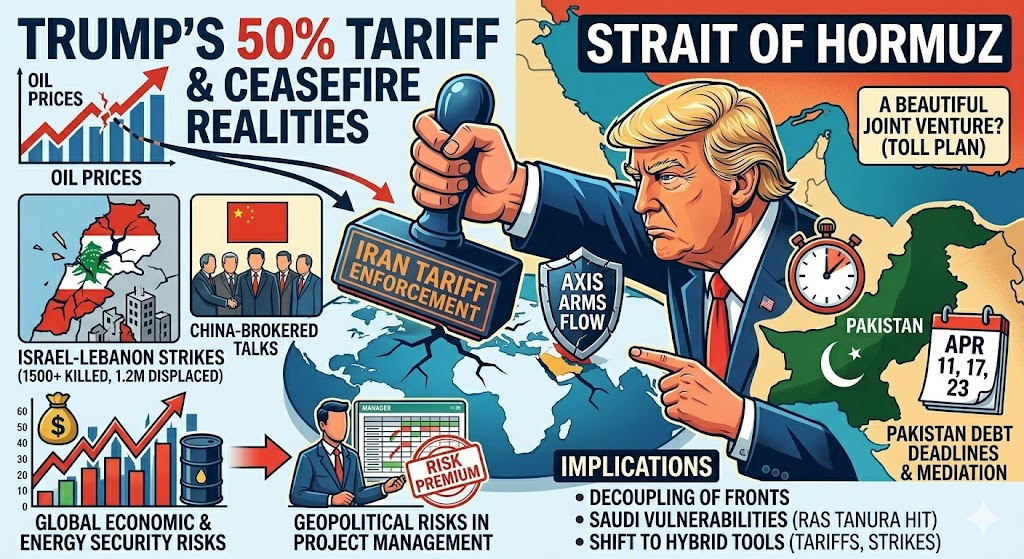
A complex infographic summarizing Trump's proposed geopolitical strategy for the Middle East, including a 50% tariff on Iranian arm suppliers, the China-brokered ceasefire, and a potential joint venture to secure the Strait of Hormuz. The graphic illustrates connected global economic and energy security risks, alongside regional implications for Saudi oil infrastructure and Pakistan's mediation role
Israel’s Persistent Strikes on Lebanon: A Separate Front
While the US-Iran ceasefire holds tenuously, Israel continues operations against Hezbollah in Lebanon. Since March 2, 2026, Israeli strikes have killed over 1,500 people and injured nearly 5,000, displacing more than 1.2 million—roughly one-fifth of Lebanon’s population. Beirut’s southern suburbs and southern border regions have borne the brunt.
Iran has warned that continued Israeli actions in Lebanon could prompt it to reconsider the truce. Tehran views Hezbollah as a core asset in its “Axis of Resistance.” Israeli officials counter that Lebanon is not merely a Tehran proxy in the context of the US-brokered deal; operations target imminent threats independent of the Hormuz-focused agreement. US statements reinforce this: the ceasefire addresses direct bilateral hostilities but does not constrain Israel’s self-defense rights against Hezbollah rockets or infrastructure.
The human toll is staggering. Lebanese health authorities report families wiped out in single strikes, hospitals overwhelmed, and a humanitarian crisis rivaling earlier conflicts. For geopolitical analysis, this decoupling of fronts highlights fragmented diplomacy. Iran’s threat to “break the deal” if strikes persist adds volatility. Markets watch nervously: renewed escalation could spike geopolitics oil prices anew.
Saudi Arabia’s Oil Vulnerabilities and Regional Energy Shock
Iranian retaliatory strikes early in the conflict hit Saudi infrastructure, notably shutting the Ras Tanura refinery—the kingdom’s largest domestic facility. Additional drone attacks targeted Red Sea refineries and Gulf energy hubs. While no catastrophic pipeline rupture occurred, precautionary shutdowns across Saudi, Iraqi Kurdish, and Israeli fields throttled supply.
These disruptions, combined with Hormuz restrictions, drove oil prices to multi-year highs before the ceasefire. Saudi Arabia, a key OPEC+ player, now balances reconstruction with production ramp-up. The kingdom’s pivot to western export routes proved partially effective but exposed new chokepoints. In Middle East geopolitics, energy remains the ultimate leverage. Trump’s tariff policy indirectly protects Gulf allies by starving Iran of arms revenue that could fund further proxy attacks.
Trump’s Strait of Hormuz Vision: Joint Venture and Toll Plan
Amid the ceasefire, Trump floated an ambitious concept: US involvement in a “joint venture” for Strait of Hormuz security, potentially including toll mechanisms. He described the idea as “beautiful,” suggesting America could charge for safe passage rather than allow Iran unilateral control. The proposal envisions international guarantees for free oil flow, with revenue possibly funding regional stabilization or reparations.
This mercantilist approach aligns with Trump’s “America First” doctrine. By controlling or co-managing the waterway—through which 20% of global oil passes—Washington could offset war costs and deter future Iranian mining or harassment. Iran, for its part, insists on sovereignty over the strait but has agreed to safe passage under the truce terms.
Critics warn of escalation risks if perceived as occupation. Supporters see it as pragmatic geopolitical strategy. For geopolitical forecast models, success here could redefine energy geopolitics, reducing dependence on volatile chokepoints and integrating economic incentives into security pacts.
Broader Economic and Geopolitical Risks
The current geopolitics scenario carries profound implications beyond the Middle East. Geopolitics oil prices remain sensitive; even a two-week truce has eased some pressure, but underlying fragilities persist. Global investors face heightened geopolitical risks in project management—supply-chain disruptions, contract renegotiations, and insurance hikes for energy and infrastructure projects.
India, a major energy importer, monitors closely. Its strategic partnerships with Gulf states and Israel position it advantageously, yet rising costs could strain budgets. Europe and Asia, still recovering from earlier shocks, confront inflation risks if Hormuz traffic falters again.
In political science terms, these events signal a shift: great-power competition increasingly plays out through hybrid tools—tariffs, mediation, and targeted strikes—rather than total war. China’s quiet facilitation of the ceasefire demonstrates sophisticated geopolitical insight, preserving ties with Iran while avoiding direct confrontation with the US.
Looking Ahead: Forecasts and Strategic Imperatives
Short-term, the two-week ceasefire offers a window for negotiations in Pakistan. Success could yield a more durable framework, including Hezbollah disarmament elements and Hormuz governance. Failure risks rapid resumption, with Iran potentially breaking terms over Lebanon.
Longer-term geopolitical forecast suggests realignment: a weakened but resilient Iran, empowered Gulf monarchies, and assertive US economic diplomacy. Pakistan’s economic survival hinges on sustained peace. Saudi Arabia must accelerate diversification beyond oil.
For businesses, the message is clear: embed geopolitical risk assessments into every decision. Scenario planning for oil shocks, tariff cascades, and proxy flare-ups is no longer optional.
Conclusion: Navigating an Era of Calculated Tension
The current geopolitics scenario—marked by Trump’s 50% Iran tariff, the China-assisted ceasefire, Pakistan’s debt-driven mediation, Israel’s Lebanon campaign, Saudi energy hits, and the Strait of Hormuz gamble—encapsulates the complexity of modern geopolitics. Tensions simmer beneath the surface, yet diplomatic creativity and economic pressure have averted immediate catastrophe.
As stakeholders monitor geopolitical news analysis daily, one truth endures: in today’s interconnected world, no conflict is truly isolated. From project boardrooms to foreign ministries, understanding these dynamics is essential for resilience. The coming weeks will test whether this pause becomes a pivot toward stability or merely a prelude to renewed geopolitical tensions.
Frequently Asked Questions
What is the primary significance of Trump’s Iran Tariff: Geopolitics, Ceasefire & Risks?
Trump’s Iran Tariff: Geopolitics, Ceasefire & RisksIn the rapidly evolving landscape of geopolitics current affairs, few developments have captured global attention like the fragile US-Iran ceasefire and President Donald Trump’s bold economic maneuvers. As of April 8, 2026, the Middle East stands at a pivotal crossroads.
How does this development impact International Affairs?
Trump’s announcement of immediate 50% tariffs on any nation supplying military weapons to Iran has sent shockwaves through international trade. At the same time, a two-week ceasefire—brokered with quiet but decisive Chinese and Pakistani involvement—offers a momentary pause in what could have escalated into a broader regional war.This article provides a professional, in-depth analysis of the current geopolitics scenario.
What are the key future projections to monitor?
It examines the interplay of geopolitical risk, economic pressures on Pakistan, ongoing Israeli operations in Lebanon, disruptions to Saudi oil infrastructure, and Trump’s visionary proposals for the Strait of Hormuz.