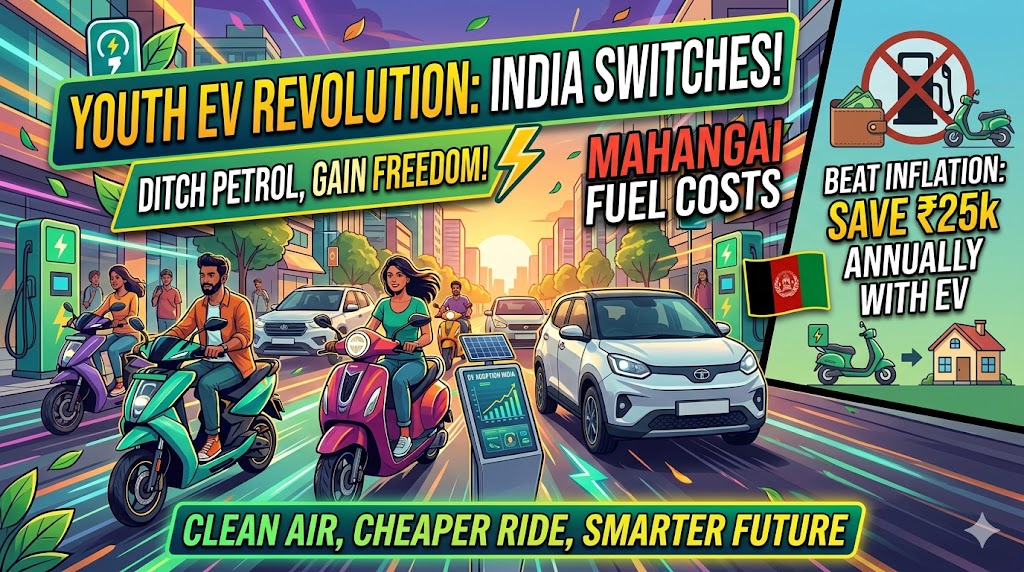
India's Youth EV Shift: Ditching Petrol for Electric
Technology• April 09, 2026• Global Edition
India's Youth EV Shift: Ditching Petrol for Electric
In the bustling streets of Mumbai, Delhi, and Bengaluru, a quiet revolution is unfolding. Young professionals and first-time buyers, often in their 20s and 30s, are increasingly opting for electric scooters and cars instead of traditional petrol or diesel vehicles. This shift isn't a fleeting trend—it's a calculated move driven by economics, environmental awareness, and smart policy support. As India navigates 2025 and enters 2026, data shows electric vehicles (EVs) gaining ground rapidly, with models like the Tata Punch EV making headlines alongside stalwarts such as the Maruti Suzuki Baleno.
This article explores the dynamics of EV adoption in India, focusing on how the upcoming generation is leading the charge. We'll examine 2025-2026 sales figures, the role of economic challenges like job market pressures and rising inflation (mahangai), aggressive government promotions, and the long-term outlook for EVs overtaking petrol and diesel vehicles. Structured for clarity, this analysis draws on the latest industry reports to paint a comprehensive picture.
2025 Sales Snapshot: Baleno, Punch, and the Emerging EV Wave
The year 2025 marked a pivotal chapter in India's automotive story. While internal combustion engine (ICE) vehicles still dominated overall volumes, EVs carved out a growing slice. Maruti Suzuki's Baleno frequently topped monthly charts as the best-selling car, with strong demand for its fuel-efficient petrol variant. In December 2025 alone, the Baleno registered over 22,000 units, outpacing competitors.
Close behind was the Tata Punch, a compact SUV that appealed to urban buyers seeking safety and versatility. Combined ICE and EV variants of the Punch consistently ranked in the top 7-10, with the Punch EV variant alone selling 16,763 units across 2025. Tata's Nexon (ICE + EV) also shone, crossing 19,000 units in key months.
Full-year 2025 passenger vehicle sales highlighted a clear pattern: petrol cars lost market share (dropping to around 53%), while EVs doubled their penetration to approximately 4.6% in the car segment. Tata Motors led EV car sales with 70,004 units, underscoring the brand's stronghold in affordable electric options.
Two-wheelers told an even more compelling story. Electric scooters surged, contributing massively to the overall EV adoption in India. By the end of 2025, the segment had laid the foundation for even stronger growth into 2026.
Early 2026 Trends: Punch and Baleno Hold Strong as EVs Accelerate
Entering 2026, the momentum continued. Monthly data from late 2025 into early 2026 showed the Baleno and Punch battling for supremacy. In December 2025, Baleno led with 22,108 units, followed by Tata's Nexon and Punch (around 16,000 combined). The Punch EV's popularity grew thanks to its five-star safety rating and competitive pricing starting at ₹9.99 lakh.
EV passenger vehicles (e-PVs) recorded a remarkable 84% year-on-year jump in FY2026 (April 2025-March 2026), reaching a record 199,590 units. This pushed their market share to 8% within the broader EV ecosystem. Two-wheelers remained the powerhouse, with 1.4 million electric scooters sold in FY2026 alone—a 22% increase—commanding 57% of all EV sales.
Brands like TVS Motor emerged as leaders in the electric scooter space, overtaking earlier frontrunners such as Ola Electric, which saw a sales dip but still contributed to the segment's vibrancy. Ather Energy and Bajaj's Chetak also gained traction among young commuters seeking stylish, low-maintenance rides.
These figures reveal a dual narrative: established ICE models like Baleno and Punch continue to dominate monthly tallies due to brand trust and affordability, yet their EV counterparts are eroding market share month by month.
Why the Youth Are Choosing EV Scooters and Cars
The upcoming generation—Gen Z and young millennials—views mobility differently. For them, a vehicle isn't just transport; it's an extension of values like sustainability, tech integration, and cost efficiency.
Electric scooters have become the entry point. Models from TVS, Ather, and others offer running costs as low as ₹0.5-1 per km, compared to ₹2-3 for petrol equivalents. In a country where daily commutes can exceed 50 km, this translates to massive savings. Young buyers, often juggling entry-level jobs or gig economy roles, appreciate the instant torque, silent operation, and app-based features like battery health monitoring.
Cars follow suit. The Tata Punch EV, with its rugged design and proven safety, appeals to first-time car buyers who want SUV-like presence without diesel guzzling. Baleno buyers, meanwhile, are increasingly eyeing hybrid or future EV variants as awareness grows.
Social media amplifies this shift. Influencers showcase zero-emission rides, while urban youth cite "range anxiety" myths as outdated—improved infrastructure and real-world ranges of 200+ km make EVs practical.
“As India battles rising fuel costs and pollution, the younger generation is leading a green revolution. Young professionals are increasingly ditching petrol vehicles for electric scooters and cars like the Tata Punch EV, drawn by massive annual savings, government schemes, and a commitment to a cleaner, smarter, and sustainable future for cities like Delhi by 2030.”
Economic Realities: Job Pressures and Mahangai Pushing the EV Edge
India's economic landscape in 2025-2026 added fuel to the EV fire. "Mahangai"—rising inflation—hit household budgets hard, particularly fuel costs. Although domestic petrol prices remained relatively stable at times, global oil volatility created anxiety, prompting buyers to seek alternatives.
Compounding this was a perceived "work crisis"—stagnant job growth in certain sectors, coupled with high living costs, made every rupee count. Petrol and diesel vehicles, with their ongoing fuel and maintenance expenses, felt burdensome. EVs, powered by cheaper electricity and fewer moving parts, offered lower total cost of ownership (TCO). A typical EV scooter could save owners ₹20,000-30,000 annually in running costs alone.
Young buyers, many supporting families or funding education loans, calculated these savings meticulously. Government data and dealer reports confirm inquiries spiked whenever fuel prices hinted at upward movement. In essence, EV adoption in India became not just green but financially prudent.
Government Push: Schemes, TV Campaigns, and Delhi's Bold Vision
No discussion on electric vehicles India is complete without acknowledging policy support. The central government continued incentives under schemes like PM E-DRIVE, offering subsidies, tax rebates, and charging infrastructure rollout.
State-level initiatives shone brightly. Delhi's EV Policy and Air Pollution Mitigation Action Plan 2026 stand out. From November 2026, goods vehicles entering the capital must be BS-VI compliant, CNG, or electric. The government plans 32,000 new charging points over four years, prioritizes e-buses (targeting 13,760 by 2028-29), and introduces scrappage-linked incentives to retire old polluting vehicles.
Television campaigns flooded prime-time slots, showcasing "Switch to EV" stories—happy families on electric scooters, professionals charging at home, and reduced hospital visits from cleaner air. Delhi's focus on two-wheelers, commercial fleets, and government vehicle electrification resonated with urban audiences.
These measures aren't isolated. Similar promotions across states, combined with FAME-style subsidies, lowered the entry barrier. Buyers reported easy access to loans and doorstep demos, making the switch seamless.
Environmental Impact: Clearing the Air in Polluted Cities
Vehicular emissions remain a major contributor to India's air quality woes, especially in Delhi-NCR. EVs directly address this by producing zero tailpipe emissions. Delhi's policies explicitly link EV adoption to PM2.5 and PM10 reduction targets.
As more youth opt for electric scooters and cars, cumulative impact grows. Projections suggest that if current trends hold, EVs could help cut transport-related pollution by significant margins by 2030. Young buyers proudly cite this as a personal contribution to cleaner cities.
Technological Leap and Future-Proof Appeal
Modern EVs come loaded with features that resonate with tech-savvy youth: over-the-air updates, regenerative braking, and seamless smartphone integration. Fast-charging networks are expanding, and battery technology improvements promise longer ranges at lower costs.
In 2026, new launches further bridge the gap. Tata's updated Punch EV and competitors' offerings make electric options competitive on price and performance.
Projections: EVs Overtaking Petrol and Diesel by 2035?
Data paints an optimistic picture. By 2035, EVs could capture 36% of the mobility market, with hybrids and CNG adding another 33%, pushing petrol-diesel below 50%. In the near term, two-wheelers already show 6-7% penetration, while passenger EVs crossed 4% in 2025 and aim higher.
Full overtake in cars may take longer due to infrastructure needs, but the trajectory is clear. FY2026's 2.45 million total EV sales (up 25%) signal acceleration.
Challenges on the Horizon
Despite progress, hurdles remain: charging infrastructure in smaller cities, initial purchase price (though subsidies help), and battery recycling concerns. Consistent policy support and private investment will be key.
The upcoming generation's pivot toward EV scooters, cars, and vehicles over petrol and diesel reflects a perfect storm of economics, policy, and values. From Baleno and Punch dominating 2025-2026 charts to the explosive growth of electric two-wheelers, India stands at the cusp of a mobility transformation.
As mahangai pressures mount and governments amplify schemes—from Delhi's pollution crackdown to national incentives—the shift isn't optional; it's inevitable. For young Indians, choosing electric isn't just buying a vehicle—it's investing in a cleaner, cheaper, and smarter tomorrow.
By 2030 and beyond, EVs won't just compete; they will define the roads we travel. The question isn't if petrol and diesel will fade—it's how quickly the next generation will make it happen.
Frequently Asked Questions
What is the primary significance of India's Youth EV Shift: Ditching Petrol for Electric?
India's Youth EV Shift: Ditching Petrol for ElectricIn the bustling streets of Mumbai, Delhi, and Bengaluru, a quiet revolution is unfolding. Young professionals and first-time buyers, often in their 20s and 30s, are increasingly opting for electric scooters and cars instead of traditional petrol or diesel vehicles.
How does this development impact Technology?
This shift isn't a fleeting trend—it's a calculated move driven by economics, environmental awareness, and smart policy support. As India navigates 2025 and enters 2026, data shows electric vehicles (EVs) gaining ground rapidly, with models like the Tata Punch EV making headlines alongside stalwarts such as the Maruti Suzuki Baleno.This article explores the dynamics of EV adoption in India, focusing on how the upcoming generation is leading the charge.
What are the key future projections to monitor?
We'll examine 2025-2026 sales figures, the role of economic challenges like job market pressures and rising inflation (mahangai), aggressive government promotions, and the long-term outlook for EVs overtaking petrol and diesel vehicles.