International Affairs• April 07, 2026• Global Edition
A Ceasefire That Barely Began
On the evening of April 7, 2026, US President Donald Trump announced a two-week ceasefire with Iran, describing it as a “double-sided” pause in hostilities. The deal, mediated in part by Pakistan and backed quietly by China, hinged on Iran immediately reopening the Strait of Hormuz to international shipping. Trump stated the United States would suspend all bombing and attacks on Iran for the full two weeks, giving negotiators time to hammer out a longer-term agreement. Israel publicly signaled support, albeit with conditions.
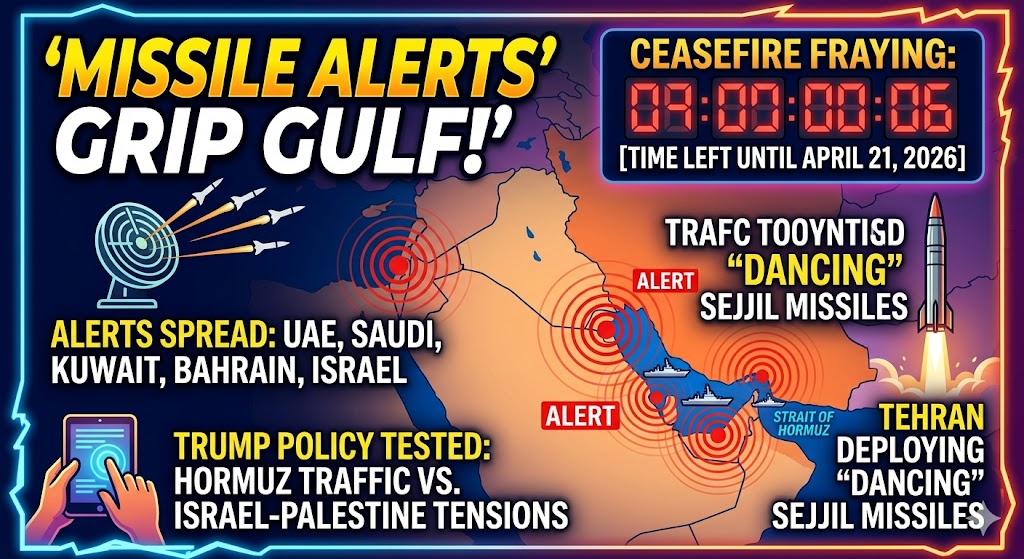
Yet within hours—literally minutes in some reports—missile alerts blared across the Gulf. Sirens wailed in the UAE, Saudi Arabia, Kuwait, and Bahrain. Israel’s Home Front Command issued fresh warnings as Iranian projectiles streaked toward its cities. Air defense systems lit up the night sky from Abu Dhabi to Riyadh. The US-Iran ceasefire, hailed as a breakthrough just hours earlier, appeared to be unraveling on the ground before it could even take full effect.
This article examines the current situation after the ceasefire in exhaustive detail. It explores why, despite the US and Iran agreeing to pause fighting, missile alerts continue to sound in the UAE, Kuwait, Bahrain, and Saudi Arabia. We analyze whether the two-week truce is a genuine de-escalation or merely a diplomatic maneuver, why Israel shows little appetite for a complete halt, and what the reopening of the Strait of Hormuz means for global energy markets. Drawing on the latest developments as of April 8, 2026, this piece provides a clear-eyed assessment of a conflict that refuses to quiet down.
Background: How the US-Israel-Iran War Escalated
To understand the fragility of today’s ceasefire, one must revisit the war’s rapid and devastating arc. The conflict ignited in late February 2026 when coordinated US and Israeli strikes targeted Iranian nuclear and military sites. Iran responded by closing the Strait of Hormuz—the narrow chokepoint through which roughly 20% of global oil passes—effectively weaponizing one of the world’s most critical energy arteries.
Tehran launched wave after wave of ballistic and cruise missiles, many featuring advanced maneuverability. The Sejjil solid-fuel missile, nicknamed the “dancing missile” for its mid-flight zigzags that confound radar systems, became a symbol of Iran’s indigenous capabilities. These strikes reached not only Israel but also US bases and oil infrastructure in the Gulf, prompting defensive responses from Saudi Arabia, the UAE, Kuwait, and Bahrain.
By early April, the toll was staggering: thousands dead across the region, oil prices spiking, and global supply chains strained. Trump’s repeated ultimatums—culminating in threats of devastating strikes on Iranian infrastructure—set the stage for the April 7 deadline. Iran countered with a 10-point proposal that included sanctions relief, US troop withdrawals, and a protocol for safe passage through the Strait of Hormuz. Trump initially called parts of it “fraudulent” but ultimately accepted a two-week pause, citing progress toward a “definitive agreement” on long-term peace.
Throughout this period, the Israel-Palestine issue and Lebanon’s Hezbollah added layers of complexity. Hezbollah ceasefire violations had persisted since the 2024 agreement, with Israel conducting near-daily operations to prevent rearmament. These tensions spilled into the broader Iran-led axis, complicating any narrow US-Iran deal.
The Ceasefire Announcement: Terms and Immediate Hopes
Trump’s Truth Social post on April 7 was succinct yet dramatic. He agreed to “suspend the bombing and attack of Iran for a period of two weeks” provided Tehran ensured the “COMPLETE, IMMEDIATE, and SAFE OPENING” of the Strait of Hormuz. The US president added that Washington would assist with managing the expected surge in shipping traffic through the waterway once reopened.
Iran’s Supreme National Security Council confirmed acceptance, framing the pause as a victory that preserved its core demands. Israeli Prime Minister Benjamin Netanyahu’s office stated support for the two-week suspension, conditional on Iran halting all attacks on the US, Israel, and regional partners.
Analysts initially breathed a cautious sigh of relief. A two-week window would allow high-level talks, possibly in Islamabad, while oil tankers could resume safer passage. Global markets reacted positively at first, with crude prices easing slightly. Yet the optimism proved short-lived.
The dynamic split design captures the urgency with a prominent title "MISSILE ALERTS GRIP GULF!".
Why Missile Alerts Continue: The Ground Reality on April 8
As April 8 dawned, the picture on the ground told a different story. Missile alerts sounded in Bahrain shortly after midnight, followed by similar warnings in the UAE, Saudi Arabia, Kuwait, and Qatar. The UAE Ministry of Defence confirmed its systems were actively intercepting ballistic missiles, cruise missiles, and drones originating from Iran. Saudi Civil Defense issued “potential danger” alerts across Riyadh and eastern provinces. Kuwait’s military reported repelling incoming threats, while Bahrain advised residents to seek shelter.
In Israel, the Home Front Command detected an Iranian missile barrage, triggering sirens in central and southern areas. Reports emerged of cluster munitions and “dancing” Sejjil missiles attempting to evade interception. Israeli air defenses engaged successfully in most cases, but the very fact of launches so soon after the ceasefire announcement raised immediate doubts about compliance.
Iran has not claimed responsibility for these specific post-ceasefire salvos in official statements, yet the pattern mirrors earlier waves. Gulf states, long wary of Iran’s missile program, activated defenses without waiting for clarification. The rapid sequence—ceasefire declared, then alerts—suggests either a deliberate test of the truce’s limits or a lag in command-and-control on the Iranian side. Either way, the two-week ceasefire Iran appeared to be unraveling within its first hours.
Analysis: Is the Ceasefire Merely Diplomatic Theater?
The persistence of missile alerts points to several uncomfortable realities. First, trust between the parties is virtually nonexistent. Iran views the pause as a breathing space to regroup and extract concessions on sanctions and reconstruction. The US and Israel see it as a tactical timeout to reopen Hormuz and prevent an immediate oil crisis, while maintaining pressure.
Trump’s policy explicitly frames the two weeks as non-negotiable only if Iran honors the strait’s reopening. He has repeatedly signaled that failure to comply would restart strikes with even greater force. Yet by pausing, Washington buys time for diplomacy without appearing to escalate further—an approach critics label as “kicking the can.”
For Iran, continued low-level strikes—possibly through proxies or delayed launches—serve multiple purposes. They demonstrate that Tehran retains offensive options despite US-Israeli pressure. They also keep Gulf states on edge, reminding them of vulnerability. The Sejjil missile’s maneuverability underscores Iran’s indigenous technological edge, a point of national pride broadcast on state media.
Israel’s position is perhaps the most revealing. Netanyahu’s government has made clear that its campaign aims not merely to reopen shipping lanes but to degrade Iran’s missile production, nuclear ambitions, and proxy network permanently. A temporary ceasefire does little to address these strategic threats. Israeli officials have privately expressed skepticism that two weeks will yield meaningful Iranian concessions. Some reports indicate Israeli forces continued limited strikes even after Trump’s announcement, underscoring Jerusalem’s reluctance to fully stand down.
The Lebanon angle adds further strain. Hezbollah ceasefire violations have been ongoing for over a year, with Israel enforcing demilitarization through repeated operations. Any US-Iran deal that ignores this theater risks emboldening the broader “axis of resistance.” Iran’s insistence on a “regional” ceasefire in its 10-point plan likely encompassed Hezbollah, yet the current agreement appears narrower—focused on direct US-Iran and Hormuz issues.
In short, the two-week ceasefire functions more as a diplomatic off-ramp than a genuine cessation. It allows Trump to claim progress on energy security while avoiding an all-out war that could spiral into higher oil prices and domestic political costs. For Iran, it prevents immediate catastrophe. For Israel, it buys time but falls short of the decisive victory sought.
Economic and Strategic Stakes: Hormuz, Oil, and Reconstruction
The Strait of Hormuz remains the conflict’s economic heart. Iran’s closure had already disrupted global energy flows, driving up prices and forcing rerouting of tankers. Trump’s explicit pledge that the US will “help with the traffic buildup” signals American naval and logistical support once passage resumes. This assistance could include minesweeping, escort vessels, and coordination with Gulf partners—steps that effectively internationalize security of the waterway.
Longer-term, any lasting deal may involve reconstruction aid for damaged Iranian infrastructure, though details remain vague. Tehran has demanded support for rebuilding as part of its 10-point plan, framing it as compensation for strikes on petrochemical plants and energy facilities. Whether the US or Gulf states would fund such efforts remains uncertain and politically charged.
For Gulf monarchies, the missile alerts are a stark reminder of their exposure. Despite advanced defense systems purchased from the West, the sheer volume of Iranian projectiles tests interception limits. Saudi Arabia, the UAE, Kuwait, and Bahrain have all borne the brunt of debris and occasional impacts on oil and desalination facilities. Their unified alerts reflect shared vulnerability and a collective demand for stronger guarantees in any final agreement.
Outlook: Will the Truce Hold or Collapse?
As of April 8, 2026, the ceasefire is holding in the narrowest sense: major US and Israeli bombing campaigns remain paused. Yet the missile exchanges indicate that “ceasefire” means different things to different actors. Negotiations are scheduled to intensify, possibly in Pakistan, but the clock is ticking. If Iran fails to fully secure Hormuz shipping or if attacks persist, Trump has left little doubt that strikes will resume.
Israel shows no inclination to halt operations completely until it judges Iranian capabilities sufficiently neutralized. The Sejjil “dancing missiles” and ongoing proxy activity through Hezbollah only reinforce Jerusalem’s hardline stance. Meanwhile, Gulf states are reinforcing defenses and quietly urging Washington to extract firmer commitments from Tehran.
The broader Israel-Palestine dynamic and Lebanon’s fragile truce add volatility. Any spillover could derail the two-week window entirely.
The US-Iran ceasefire of April 7, 2026, offered a momentary de-escalation after weeks of intense conflict. Yet the immediate eruption of missile alerts across the UAE, Kuwait, Bahrain, Saudi Arabia, and Israel reveals its precarious nature. This is not yet peace—it is a carefully calibrated pause shaped by economic necessity, military realities, and deep mutual distrust.
Whether the two weeks become a bridge to genuine negotiations or simply another chapter in the Israel-Iran shadow war remains to be seen. Trump’s policy of conditional restraint, Iran’s insistence on leverage through the Strait of Hormuz, and Israel’s determination to eliminate long-term threats all collide in real time. For now, the sirens continue, a sobering reminder that in the Middle East, even ceasefires come under fire.
The coming days will test whether diplomacy can outpace missiles—or whether the region hurtles toward renewed escalation. Global markets, energy security, and millions of lives hang in the balance.
Frequently Asked Questions
What is the primary significance of "Missile Alerts Grip Gulf Despite US-Iran Ceasefire"?
A Ceasefire That Barely BeganOn the evening of April 7, 2026, US President Donald Trump announced a two-week ceasefire with Iran, describing it as a “double-sided” pause in hostilities. The deal, mediated in part by Pakistan and backed quietly by China, hinged on Iran immediately reopening the Strait of Hormuz to international shipping.
How does this development impact International Affairs?
Trump stated the United States would suspend all bombing and attacks on Iran for the full two weeks, giving negotiators time to hammer out a longer-term agreement. Israel publicly signaled support, albeit with conditions.Yet within hours—literally minutes in some reports—missile alerts blared across the Gulf.
What are the key future projections to monitor?
Sirens wailed in the UAE, Saudi Arabia, Kuwait, and Bahrain.