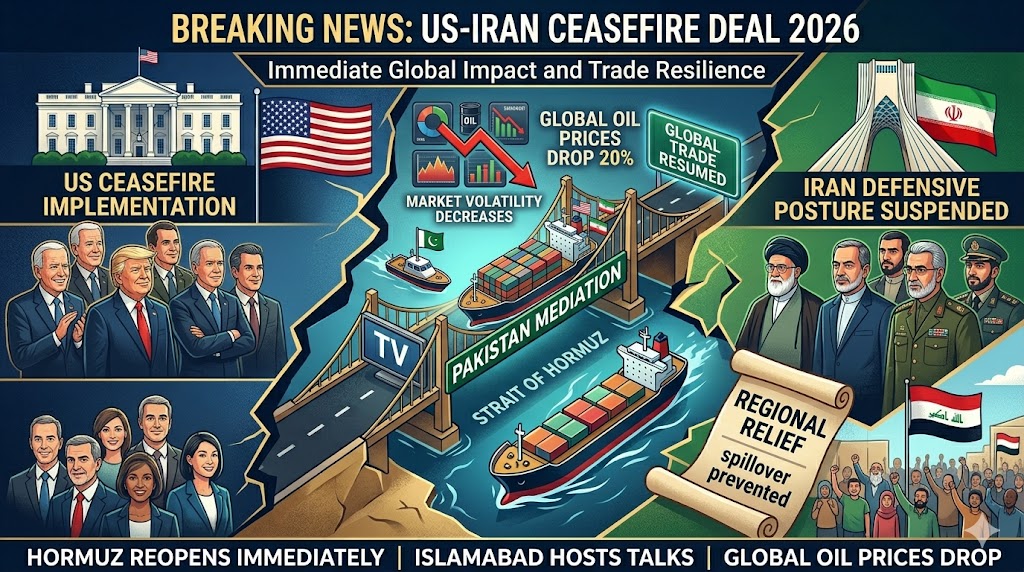
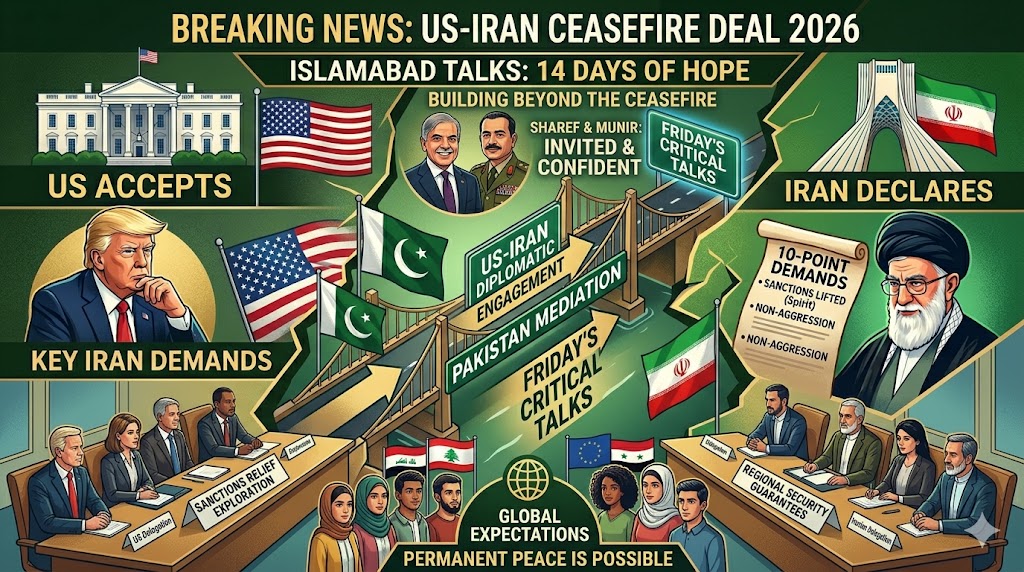
In a stunning diplomatic reversal that has reshaped the immediate trajectory of the Middle East conflict, the United States has accepted key elements of Iran's long-standing 10-point demand list. The breakthrough paves the way for a two-week ceasefire and the reopening of the Strait of Hormuz. Announced late on April 7, 2026, the agreement highlights the pivotal behind-the-scenes efforts of Pakistan's leadership in preventing what could have been a catastrophic escalation.
President Donald Trump explicitly credited Pakistan's Prime Minister Shehbaz Sharif and Army Chief Field Marshal Asim Munir for the deal. Iran, for its part, has framed the outcome as a clear victory, stating that its core conditions have been met without compromising its sovereignty. As both sides prepare for high-level talks in Islamabad this Friday, the world is watching to see whether this temporary pause can evolve into something more permanent.
The 10-Point Demand List That Changed Everything
At the heart of yesterday's US-Iran ceasefire lies Iran's carefully crafted 10-point response, which Tehran originally presented as a rejection of any short-term truce in favor of a comprehensive and lasting resolution. The list, conveyed through Pakistani mediators, outlined non-negotiable demands including a formal US commitment to non-aggression, Iran's continued control over the Strait of Hormuz, acceptance of its uranium enrichment program, the lifting of all primary and secondary sanctions, and reparations for war-related reconstruction.
What began as Iran's firm stance against a temporary ceasefire has now become the foundation for the two-week agreement. By agreeing to suspend all bombing and offensive operations for 14 days in exchange for the safe and immediate opening of the Strait of Hormuz, the United States has, in effect, conceded to the spirit and several specific pillars of Iran's 10-point plan. Analysts note that this marks a significant shift from earlier US positions, where the 10-point list was initially dismissed as "maximalist."
Iranian officials had made clear that any reopening of the strategic waterway would require concrete assurances on sanctions relief and an end to hostilities. The fact that the US moved forward under these terms signals a pragmatic acceptance of Iran's red lines, even if framed publicly as a limited tactical pause.
Pakistan's Relentless Diplomacy: The True Architect of the Ceasefire
No discussion of the US-Iran ceasefire would be complete without acknowledging the extraordinary and continuous efforts of Pakistan's leadership. Prime Minister Shehbaz Sharif and Field Marshal Asim Munir have been working tirelessly for weeks to bridge the divide between Washington and Tehran. Their involvement was not a last-minute intervention but the culmination of sustained, high-level shuttle diplomacy that kept communication channels open even at the height of tensions.
President Trump himself confirmed this in his Truth Social announcement on April 7. He wrote that, based on direct conversations with Prime Minister Sharif and Field Marshal Munir—who had personally requested a hold on planned US strikes—the United States would suspend attacks for two weeks, subject to Iran's agreement on the Strait of Hormuz. This public acknowledgment underscores how Pakistan's neutral yet influential position proved decisive when other mediation attempts had stalled.
Prime Minister Sharif has consistently positioned Pakistan as a voice of reason in the region. From the outset of the conflict, he emphasized dialogue over confrontation, repeatedly urging both sides to step back from the brink. His government facilitated multiple rounds of indirect talks, including the exchange of Iran's 10-point proposal. Even when earlier efforts for a 45-day ceasefire collapsed, Sharif and Munir refused to abandon the process. Their persistence in the face of repeated setbacks has earned quiet praise from diplomats across the globe.
Field Marshal Asim Munir's role has been equally critical. As Pakistan's top military figure, he maintained direct lines of communication with US counterparts, including Vice President JD Vance and special envoy Steve Witkoff, as well as Iranian Foreign Minister Abbas Araghchi. Sources familiar with the negotiations describe Munir's all-night sessions as instrumental in narrowing differences on the final wording of the ceasefire terms.
Pakistan's behavior throughout this crisis has been one of principled consistency. Rather than aligning strictly with any single party, Islamabad has acted as an honest broker, prioritizing regional stability and the prevention of wider war. This approach has not only elevated Pakistan's diplomatic stature but also demonstrated its commitment to peace even when domestic and international pressures mounted.
Global Impact of the US-Iran Ceasefire Deal 2026
How the Ceasefire Terms Were Finalized
The terms of the two-week US-Iran ceasefire are straightforward yet carefully balanced to address immediate concerns while leaving room for deeper negotiations. Iran has committed to the complete, immediate, and safe opening of the Strait of Hormuz, with passage coordinated directly with its armed forces to ensure security. In return, the United States has agreed to halt all attacks and bombing operations against Iranian targets for the full 14-day period.
Both sides have emphasized that this is not merely a pause but a structured de-escalation tied explicitly to Iran's 10-point framework. US officials have described the arrangement as building on the "workable basis" provided by Iran's proposals, while Tehran maintains that its demands for a permanent end to aggression remain on the table for Friday's talks.
The acceptance of these terms came after intense last-minute deliberations. Iran had previously rejected shorter-term proposals, insisting that any concession on the Strait of Hormuz must come with tangible movement toward its broader demands. The fact that the US proceeded under these conditions reflects a clear recognition that continued escalation served neither side's interests.
Iran's Statement: A Declaration of Victory
Iranian leaders have wasted no time in portraying the ceasefire as a strategic triumph. Foreign Minister Abbas Araghchi, speaking on behalf of the Supreme National Security Council, stated that "if attacks against Iran are halted, our powerful armed forces will cease their defensive operations." He further noted that the agreement validates Iran's longstanding position that any resolution must respect Iranian sovereignty and address the root causes of the conflict.
In official statements broadcast across Iranian media, Tehran described the outcome as the direct result of its firm adherence to the 10-point plan. Officials highlighted that the US decision to suspend strikes and engage in talks on Iran's terms demonstrates the effectiveness of Iran's defensive posture and diplomatic resolve. "This is not a concession," one senior Iranian source told state media. "It is the international community recognizing the justice of our demands."
The Iranian narrative emphasizes that by securing the temporary opening of the Strait of Hormuz on its own schedule and under its security protocols, Tehran has protected its strategic interests while forcing the US to step back from threats of wider destruction. Celebrations in parts of Tehran and allied capitals reflect this sense of achievement.
The Road to Islamabad: What Friday's Talks Will Entail
With the two-week ceasefire now in effect, attention turns to the high-level negotiations scheduled for Friday in Islamabad. Pakistan will once again host the talks, providing a neutral venue where US and Iranian delegations can build directly on the momentum of the Hormuz agreement.
Expected agenda items include extending the ceasefire into a more permanent framework, addressing remaining elements of Iran's 10-point list—particularly sanctions relief and reconstruction commitments—and exploring regional security guarantees. Both sides have signaled willingness to engage seriously, though the path ahead remains complex.
Prime Minister Sharif has already extended invitations and expressed confidence that the same spirit of cooperation that produced the ceasefire will guide the upcoming discussions. His continued personal involvement sends a strong message that Pakistan remains committed to seeing the process through to a successful conclusion.
Broader Implications of the US-Iran Ceasefire
The economic ripple effects of the agreement are already being felt. Oil prices dropped sharply in early trading on April 8 as markets reacted positively to the news that the Strait of Hormuz—one of the world's most vital energy chokepoints—would reopen safely. Global shipping and energy sectors stand to benefit immediately from reduced uncertainty.
Regionally, the ceasefire has been greeted with relief. In Iraq, citizens took to the streets in celebration, viewing the pause as a chance to avoid further spillover from the conflict. European allies and Asian partners have welcomed the development, urging both Washington and Tehran to use the two-week window productively.
For the United States, the decision to accept elements of Iran's 10-point framework represents a calculated move to de-escalate without appearing weak. President Trump has framed it as a demonstration of strength through negotiation rather than endless confrontation.
Iran, meanwhile, emerges with enhanced diplomatic leverage. Its victory statement reinforces domestic support while signaling to the international community that Tehran negotiates from a position of resilience.
Pakistan's Ongoing Commitment to Regional Peace
Throughout the crisis, Pakistan has exemplified responsible statesmanship. Prime Minister Sharif's repeated calls for restraint, combined with Field Marshal Munir's tireless engagement, prevented the situation from spiraling out of control. Their efforts were not opportunistic but rooted in a genuine belief that dialogue remains the only viable path forward in one of the world's most volatile regions.
Even as the two-week ceasefire takes hold, Pakistani officials have indicated they will continue supporting the process. This unwavering dedication has not gone unnoticed. By hosting Friday's talks and maintaining open channels, Pakistan is positioning itself as an indispensable partner in Middle East diplomacy.
Preparation for Islamabad Talks: 14 Days of Hope
Looking Ahead: From Temporary Pause to Lasting Stability
As the clock starts on the two-week US-Iran ceasefire, the central question is whether this agreement—born from Iran's 10-point demands and Pakistan's persistent mediation—can serve as the foundation for enduring peace. The coming days will test the sincerity and flexibility of all parties involved.
What is clear is that yesterday's breakthrough would not have occurred without the extraordinary contributions of Pakistan's Prime Minister and Army Chief. Their continuous efforts to stop the war have bought precious time for diplomacy. Iran has articulated its victory in clear terms, while the United States has shown willingness to engage on terms it once viewed as overly ambitious.
The eyes of the world now turn to Islamabad. If the same determination that secured this ceasefire prevails in the coming talks, the region may yet find a path away from conflict toward stability. For now, the two-week pause offers a rare moment of hope in a landscape long defined by tension.
The story of this US-Iran ceasefire is still being written, but one chapter is already complete: through patience, persistence, and principled mediation, a dangerous escalation was averted, and the door to meaningful dialogue has been reopened.
Frequently Asked Questions
What is the primary significance of US Accepts Iran's 10-Point Demands in Two-Week ceasefire?
US Accepts Iran's 10-Point Demands in Landmark Two-Week Ceasefire Agreement In a stunning diplomatic reversal that has reshaped the immediate trajectory of the Middle East conflict, the United States has accepted key elements of Iran's long-standing 10-point demand list. The breakthrough paves the way for a two-week ceasefire and the reopening of the Strait of Hormuz.
How does this development impact International Affairs?
Announced late on April 7, 2026, the agreement highlights the pivotal behind-the-scenes efforts of Pakistan's leadership in preventing what could have been a catastrophic escalation. President Donald Trump explicitly credited Pakistan's Prime Minister Shehbaz Sharif and Army Chief Field Marshal Asim Munir for the deal. Iran, for its part, has framed the outcome as a clear victory, stating that its core conditions have been met without compromising its sovereignty.
What are the key future projections to monitor?
As both sides prepare for high-level talks in Islamabad this Friday, the world is watching to see whether this temporary pause can evolve into something more permanent. The 10-Point Demand List That Changed Everything At the heart of yesterday's US-Iran ceasefire lies Iran's carefully crafted 10-point response, which Tehran originally presented as a rejection of any short-term truce in favor of a comprehensive and lasting resolution.