The Devastating World War II: Causes, Impact, and Legacy
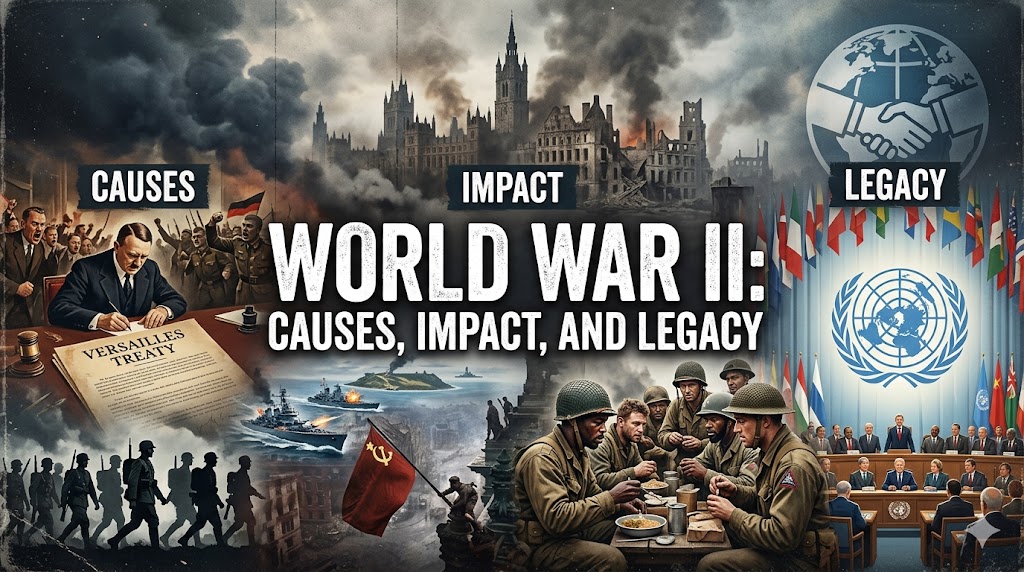
The Second World War stands as the most destructive conflict in human history. From 1939 to 1945, it engulfed every continent and claimed an estimated 70 to 85 million lives. This article examines World War II in full detail: its roots in the unresolved tensions of World War I, the precise reasons it erupted, the major alliances and battles, the scale of destruction, the economic crises that followed, the creation of the United Nations, and the profound shifts in global power that still shape international relations today. Written for clarity and depth, this comprehensive overview provides the context needed to understand why World War II remains a turning point in modern history and why its lessons continue to inform discussions about potential future conflicts.
A Brief Summary of World War I
To understand World War II, one must first look back at the Great War of 1914–1918. World War I began with the assassination of Archduke Franz Ferdinand of Austria-Hungary in Sarajevo on June 28, 1914. A complex web of alliances pulled the major European powers into conflict: the Triple Entente (Britain, France, Russia) faced the Central Powers (Germany, Austria-Hungary, Ottoman Empire).
The war introduced industrialized slaughter—machine guns, poison gas, tanks, and trench warfare—resulting in over 16 million deaths and 21 million wounded. It ended with the Armistice on November 11, 1918, and the Treaty of Versailles in 1919. Germany faced severe reparations, territorial losses, military restrictions, and a “war guilt” clause that humiliated the nation. The Austro-Hungarian and Ottoman empires collapsed, new nations emerged in Eastern Europe, and the League of Nations was created to prevent future wars. However, the treaty’s harsh terms, combined with the 1929 Great Depression, created fertile ground for resentment and extremism. Economic instability, hyperinflation in Germany, and political instability across Europe set the stage for the next global catastrophe. World War I did not resolve underlying issues of nationalism, imperialism, and economic competition; instead, it planted the seeds for World War II.
Origins and Causes of World War II
The reasons behind World War II were numerous and interconnected. The Treaty of Versailles left Germany economically crippled and politically unstable. By the early 1930s, Adolf Hitler and the Nazi Party exploited this discontent, promising to restore German pride and overturn the treaty’s restrictions. Hitler’s aggressive foreign policy—rearming Germany, remilitarizing the Rhineland in 1936, annexing Austria in 1938 (Anschluss), and seizing the Sudetenland via the Munich Agreement—went largely unchecked due to the policy of appeasement pursued by Britain and France.
Economic factors played a critical role. The Great Depression devastated global trade and fueled extremism. In Italy, Benito Mussolini’s Fascist regime sought to revive Roman glory through conquest in Ethiopia (1935) and Albania (1939). Japan, facing resource shortages, invaded Manchuria in 1931 and launched a full-scale war against China in 1937, establishing the puppet state of Manchukuo. Imperial Japan’s expansionist ideology mirrored the European dictators’ ambitions.
Ideological clashes also contributed. The rise of totalitarianism—Nazism in Germany, Fascism in Italy, and militarism in Japan—rejected democracy and promoted racial superiority and territorial expansion. The failure of the League of Nations to enforce collective security, demonstrated by its inability to stop Japan’s invasion of Manchuria or Italy’s attack on Ethiopia, further emboldened aggressors.
The immediate trigger came on September 1, 1939, when Germany invaded Poland using blitzkrieg tactics. Britain and France declared war on Germany two days later. How World War II began was thus the culmination of two decades of unresolved grievances, economic hardship, and unchecked aggression. Historians often describe these origins of World War II as a “perfect storm” where political miscalculations, economic despair, and ideological fervor converged.
Key Players, Alliances, and Teams in World War II
World War II featured two primary opposing alliances. The Axis Powers included Nazi Germany, Fascist Italy, and Imperial Japan, later joined by smaller states such as Hungary, Romania, and Bulgaria. Adolf Hitler, Benito Mussolini, and Emperor Hirohito (with military leaders like Hideki Tojo) led the Axis. Their goals centered on territorial expansion, resource acquisition, and ideological dominance.
Opposing them were the Allied Powers, initially Britain and France, later joined by the Soviet Union after Germany’s invasion in June 1941 (Operation Barbarossa) and the United States after Japan’s attack on Pearl Harbor on December 7, 1941. Key Allied leaders included Winston Churchill (Britain), Franklin D. Roosevelt and later Harry S. Truman (United States), and Joseph Stalin (Soviet Union). China, under Chiang Kai-shek, fought Japan from 1937 onward. Other nations such as Canada, Australia, Poland (government-in-exile), and Free French forces under Charles de Gaulle contributed significantly.
The alliances were pragmatic rather than ideological. The Soviet Union and Western democracies cooperated despite mutual distrust, while the Axis shared expansionist aims but coordinated poorly. This “teams” dynamic shaped strategy: the Allies ultimately coordinated global efforts through conferences like Tehran, Yalta, and Potsdam, whereas the Axis operated more independently.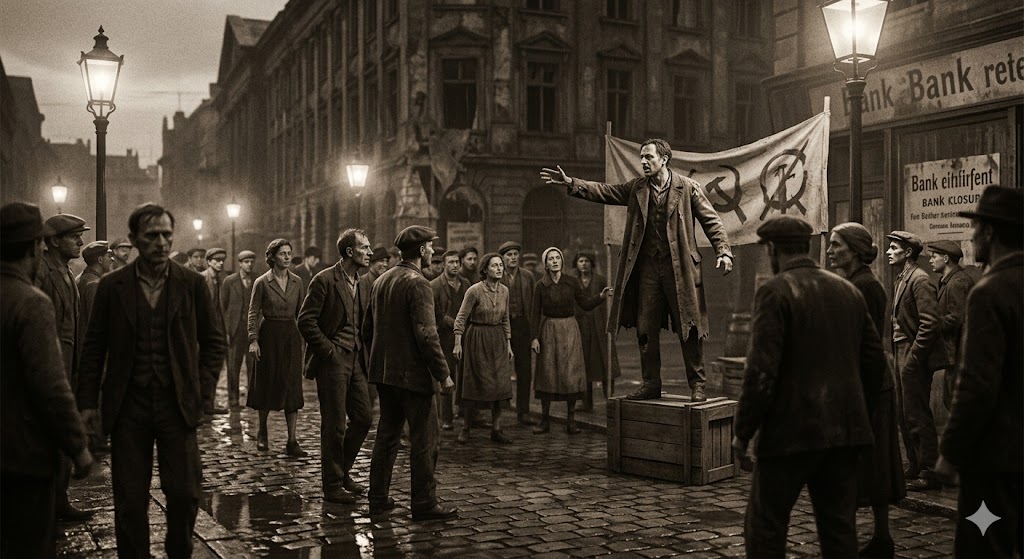
The Origins of Instability. This original image evokes the political and economic chaos that consumed Europe in the 1930s. The convergence of the Great Depression, simmering resentment from World War I, and the rise of totalitarian ideologies—promising order amidst the ruin—is visualized here, illustrating the precise origins of World War II.
Major Events and Detailed Course of World War II
World War II unfolded across multiple theaters. In Europe, Germany’s blitzkrieg conquered Poland, Denmark, Norway, the Low Countries, and France by mid-1940. The Battle of Britain (1940) prevented a German invasion of the United Kingdom. Hitler then turned east, invading the Soviet Union in 1941. The Eastern Front became the war’s bloodiest theater, with battles like Stalingrad (1942–1943) and Kursk (1943) marking turning points. Soviet forces eventually pushed back to Berlin by 1945.
In North Africa, the campaign pitted German and Italian forces under Erwin Rommel against British and Commonwealth troops, ending with Allied victory in 1943. The Italian campaign began with the invasion of Sicily in 1943, leading to Mussolini’s fall.
In the Pacific, Japan’s surprise attack on Pearl Harbor brought the United States into the war. Japan rapidly conquered Southeast Asia and the Pacific islands. Key naval battles—Midway (1942), Guadalcanal, and Leyte Gulf—shifted momentum to the Allies. Island-hopping campaigns brought American forces closer to Japan, culminating in the bloody battles of Iwo Jima and Okinawa in 1945.
The war also featured the Holocaust, the systematic genocide of six million Jews and millions of others (Roma, disabled people, political dissidents) in Nazi concentration and extermination camps such as Auschwitz. This atrocity remains one of the darkest chapters in human history and illustrates the full horror of Nazi ideology.
Technological advancements defined the conflict: radar, jet aircraft, V-2 rockets, aircraft carriers, and ultimately nuclear weapons. World War II footage from these campaigns—available in countless documentaries—reveals both the strategic brilliance and the human cost. Military rations, such as the American C-ration or British compo packs, sustained soldiers in harsh conditions, while bunkers like the Atlantic Wall or USA World War II bunkers in the Pacific underscored defensive strategies.
The End of World War II: Results and Surrender
By early 1945, the Allies closed in. In Europe, Soviet troops captured Berlin in May 1945; Hitler committed suicide on April 30. Germany surrendered unconditionally on May 8, 1945 (VE Day). In the Pacific, the United States dropped atomic bombs on Hiroshima (August 6) and Nagasaki (August 9), 1945. Japan surrendered on September 2, 1945 (VJ Day), formally ending World War II.
The results were staggering. Europe lay in ruins. Borders were redrawn, with Poland shifted westward and Germany divided into occupation zones. The war dismantled the Axis empires and accelerated decolonization in Asia and Africa.
Mass Destruction Caused by World War II
World War II created unprecedented levels of destruction. Entire cities—Warsaw, Rotterdam, Dresden, Tokyo, Hiroshima, Nagasaki—were leveled by conventional and atomic bombing. Infrastructure, factories, and transportation networks across Europe and Asia were obliterated. Civilian casualties exceeded military deaths in many regions due to strategic bombing and genocide.
The human toll included not only battlefield deaths but also famine, disease, and displacement. An estimated 27 million Soviet citizens perished. China lost up to 20 million. The Holocaust and Japanese atrocities in China (such as the Nanjing Massacre) added to the horror. This scale of devastation remains unmatched in world history, prompting ongoing reflection on the destructive potential of modern warfare.
Economic Crisis After World War II
The economic crisis following World War II was profound. Europe faced hyperinflation, food shortages, and industrial collapse. Germany’s economy was in tatters; Britain was bankrupt despite victory. The United States emerged as the world’s leading economic power, its industrial base untouched and expanded by wartime production.
To address the crisis, the United States launched the Marshall Plan (1948–1952), providing over $13 billion in aid to rebuild Western Europe. This initiative prevented communist takeovers and laid the foundation for European integration. Meanwhile, the Bretton Woods system established the International Monetary Fund and World Bank, creating a new global financial order centered on the U.S. dollar. Japan, under American occupation, underwent demilitarization and land reform, eventually becoming an economic powerhouse. The economic crisis after World War II thus accelerated the shift from colonial empires to a bipolar world economy dominated by the United States and, later, a recovering Soviet bloc.
Creation of the United Nations to Prevent Future World Wars
In response to the failure of the League of Nations, the United Nations was established on October 24, 1945. The UN Charter was signed in San Francisco by 50 nations. Its primary goal was to maintain international peace and security, prevent future world wars, and promote human rights and economic cooperation.
Key organs included the Security Council (with five permanent members: United States, Soviet Union, Britain, France, China) holding veto power, the General Assembly, and specialized agencies like UNESCO and WHO. The Universal Declaration of Human Rights (1948) set global standards. While the UN could not eliminate all conflicts, it provided a forum for diplomacy and peacekeeping missions that helped stabilize regions during the Cold War. The creation of the United Nations after World War II represented humanity’s collective determination that such devastation must never recur.
Geopolitical Changes, Superpowers, and Diplomatic Relations After World War II
World War II fundamentally altered global power structures. Britain and France, though victorious, lost their prewar dominance due to economic exhaustion and the rise of independence movements in their colonies. The United States and Soviet Union emerged as the new superpowers, ushering in the Cold War era of ideological rivalry without direct military confrontation.
The division of Germany, the Iron Curtain across Eastern Europe, and the formation of NATO (1949) and the Warsaw Pact (1955) defined diplomatic relations for decades. The United States adopted a policy of containment, while the Soviet Union expanded influence through satellite states. In Asia, the Chinese Civil War ended with communist victory in 1949, and Japan’s defeat accelerated independence movements in India, Indonesia, and elsewhere.
Diplomatic relations shifted from multipolar European balance-of-power politics to bipolar superpower competition, later evolving toward multipolarity. Nuclear deterrence, born from World War II’s atomic legacy, prevented direct superpower war but fueled proxy conflicts. These changes continue to influence today’s alliances and tensions.
Why World War II Remains the Most Devastating War in History and Its Relevance to Potential Future Conflicts
No conflict before or since has matched World War II’s scale of destruction, loss of life, or global reach. It reshaped maps, economies, and societies. The war’s legacy includes the Nuremberg Trials, which established accountability for war crimes, and the Geneva Conventions’ strengthening.
Yet the question of an upcoming third world war lingers in public discourse. Nuclear weapons, first used in 1945, created mutual assured destruction that has so far deterred global war. However, regional flashpoints, cyber warfare, and great-power competition echo pre-1939 tensions. Understanding World War II—its oversimplified narratives, detailed footage, and soldier experiences—remains essential for informed citizenship and diplomacy.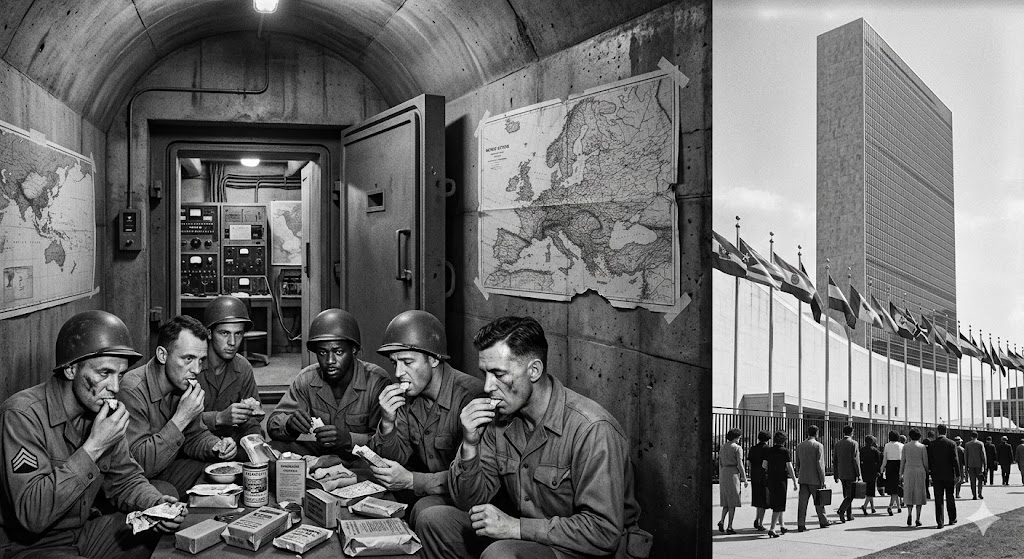
From Bunkers to Diplomacy. This dual composition visualizes the profound shift in the post-war world. On the left, soldiers endure the human cost of conflict inside defensive infrastructure (reminiscent of USA World War II bunkers). On the right, the rise of modern diplomacy is symbolized by a nascent international organization (representing the creation of the United Nations after World War II) emerging from the rubble to prevent future global conflicts
Conclusion
World War II was not inevitable, but it resulted from a failure to learn the lessons of World War I and to confront aggression early. Its consequences—mass destruction, economic upheaval, the birth of the United Nations, and the realignment of superpowers—continue to define our world. By studying how World War II began, its alliances, battles, and aftermath, we gain insight into preventing future catastrophes. The Second World War’s story is one of both profound tragedy and remarkable resilience, reminding us that peace requires constant vigilance, international cooperation, and a commitment to human dignity.