" World War 1: Causes, History, and Consequences"
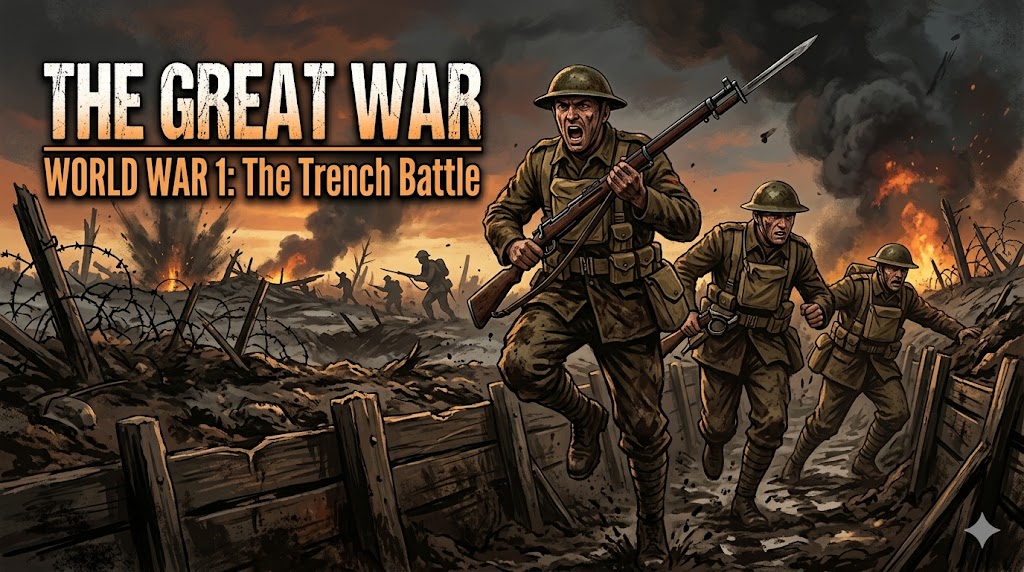
World War 1: Causes, History, and Consequences
The echoes of World War 1 still shape our world more than a century later. Also known as the First World War or the Great War, this conflict from 1914 to 1918 redrew maps, toppled empires, and claimed millions of lives. It introduced modern warfare on an unprecedented scale and planted the seeds for future global instability. In this detailed guide, we explore every aspect of World War 1—from the complex reasons it started to its far-reaching consequences, including the economic crisis and inflation that followed.
Understanding World War 1 requires examining not just the battles but the underlying tensions that made Europe a powder keg ready to explode. Historians agree that a mix of long-term forces and a single spark ignited the deadliest conflict the world had yet seen.
The Causes of World War 1: A Powder Keg in Europe
The immediate trigger for World War 1 was the assassination of Archduke Franz Ferdinand, heir to the Austro-Hungarian throne, and his wife Sophie on June 28, 1914, in Sarajevo, Bosnia. Gavrilo Princip, a Serbian nationalist tied to the secret society Black Hand, carried out the attack. Austria-Hungary blamed Serbia and issued a harsh ultimatum that Serbia could not fully accept. On July 28, 1914, Austria-Hungary declared war on Serbia.
Yet the causes of World War 1 ran much deeper. Four major factors—often remembered by the acronym MAIN—created the conditions for war:
Militarism: European powers had built massive armies and navies. Germany’s military culture emphasized rapid movement and flank attacks, while Britain maintained naval supremacy. Conscription swelled forces across the continent.
Alliances: Secret treaties divided Europe into two armed camps. The Triple Alliance (Germany, Austria-Hungary, Italy) faced the Triple Entente (France, Russia, Britain). These pacts turned a regional dispute into a continental war.
Imperialism: Rivalries over colonies in Africa and Asia heightened tensions. Germany’s late entry into empire-building clashed with established powers like Britain and France.
Nationalism: Fierce pride fueled movements across the Balkans and beyond. Pan-Slavic ambitions in Serbia directly challenged Austro-Hungarian control.
By late July 1914, Russia mobilized to support Serbia, prompting Germany to declare war on Russia and then France. Germany’s invasion of neutral Belgium brought Britain into the fray on August 4. Within weeks, World War 1 engulfed Europe.
Alliances and Countries Involved in World War 1
World War 1 pitted the Central Powers against the Allied Powers (also called the Entente).
Central Powers:
- Germany
- Austria-Hungary
- Ottoman Empire (joined late 1914)
- Bulgaria (joined 1915)
Allied Powers:
- France
- Great Britain (and its empire, including Canada, Australia, India)
- Russia (until 1917)
- Serbia
- Japan (August 1914)
- Italy (switched sides in 1915)
- Romania and others
- United States (April 1917)
The Allies held clear advantages in population (over 265 million versus 115 million for the Central Powers) and industrial capacity, though Germany’s efficient rail network allowed rapid troop movements early on. Colonial troops from Africa, Asia, and elsewhere fought on both sides, making World War 1 truly global.
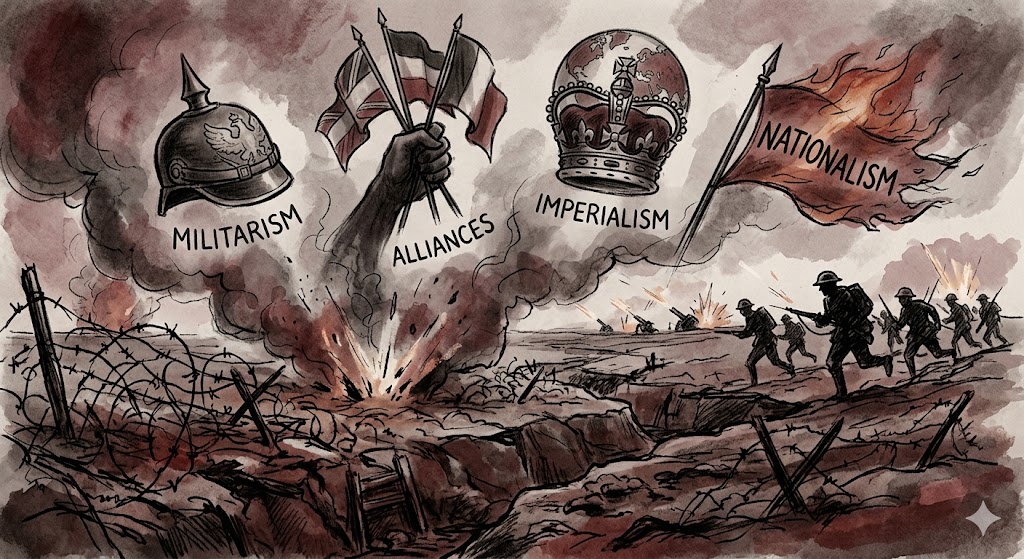
A conceptual illustration depicting the ignition of the European "powder keg." The immediate spark—the assassination in Sarajevo—sets off a chain reaction, fueled by the deep-seated forces of Militarism, rigid Alliances, Imperialism, and Nationalism (MAIN), dragging the continent into a new era of industrialized, total war.
World War 1 Timeline: Key Events and Major Battles
World War 1 unfolded across multiple fronts, but the Western Front in France and Belgium defined its brutal character.
1914: The war opened with Germany’s Schlieffen Plan. German forces swept through Belgium toward Paris but were halted at the First Battle of the Marne in September. Trench warfare began as both sides dug in.
1915–1916: Stalemate set in. The Gallipoli Campaign (1915) saw Allied forces fail against the Ottomans. On the Western Front, the Battle of Verdun (1916) cost nearly a million lives, while the Battle of the Somme claimed over 1 million casualties in months of grinding attrition.
1917: Russia exited after the Bolshevik Revolution. Germany’s unrestricted submarine warfare sank American ships, and the Zimmermann Telegram (proposing a German-Mexican alliance) pushed the United States to declare war on April 6.
1918: Germany launched its final Spring Offensive but exhausted its resources. Allied counterattacks, bolstered by fresh American troops, broke the lines. The Battle of Amiens in August marked the beginning of the end.
On November 11, 1918, at 11 a.m., an armistice ended the fighting. World War 1 was over.
Military Forces, Strategies, and Innovations in World War 1
At the outset, Germany fielded about 1.9 million men in 98 divisions, Austria-Hungary around 450,000, Russia 1.4 million, and France 1.29 million. Britain relied on a small professional army that expanded dramatically through volunteers and conscription.
Trench warfare dominated the Western Front, with soldiers enduring mud, rats, disease, and constant shelling. New technologies transformed combat:
Tanks: Britain introduced the first tanks at the Somme in 1916, offering a way to cross no-man’s-land.
Chemical weapons: Germany unleashed chlorine gas at Ypres in 1915; mustard gas followed.
Aircraft and submarines: Planes evolved from reconnaissance tools to fighters and bombers. German U-boats nearly starved Britain by targeting merchant ships.
Machine guns and artillery: These caused the majority of casualties in static battles.
The scale of mobilization was staggering. Over 65 million men were called to arms worldwide.
Major Destructions and Casualties of World War 1
World War 1 produced casualties on a scale never before seen. Estimates place military deaths between 8.5 and 9.7 million, with another 21 million wounded. Civilian deaths reached 6 to 13 million from starvation, disease, and genocide. Total deaths ranged from 15 to 22 million.
Major battles alone claimed hundreds of thousands:
- Verdun: Nearly 1 million French and German casualties.
- Somme: Over 1 million total.
- The Eastern Front and Gallipoli added further slaughter.
Entire regions lay in ruins. Cities in Belgium and northern France were devastated. The war also accelerated the 1918 Spanish flu pandemic, which killed tens of millions more globally. Families across Europe lost entire generations of young men.
The End of World War 1 and the Push for Peace
By autumn 1918, the Central Powers crumbled. Bulgaria surrendered first, followed by the Ottoman Empire and Austria-Hungary. Germany, facing revolution at home and collapsing armies, signed the armistice on November 11, 1918.
U.S. President Woodrow Wilson’s Fourteen Points offered a vision of “peace without victory,” but Allied leaders sought punishment.
Treaty of Versailles and Immediate Aftermath of World War 1
The 1919 Paris Peace Conference produced several treaties, the most famous being the Treaty of Versailles signed with Germany on June 28, 1919.
Key terms included:
- Germany accepted sole war guilt (Article 231).
- Massive reparations payments.
- Loss of territory in Europe and all overseas colonies.
- Severe limits on the German army, navy, and air force.
- Creation of the League of Nations to prevent future wars.
Austria-Hungary dissolved into new states. The Ottoman Empire was carved up. Russia, now the Soviet Union, faced civil war. Four empires—the German, Austro-Hungarian, Russian, and Ottoman—collapsed, reshaping Europe’s political map.
Economic Crisis and Inflation After World War 1
The war left Europe economically shattered. Governments had borrowed heavily and printed money to finance the fighting. Germany entered the postwar period with enormous debts.
The most dramatic example was hyperinflation in the Weimar Republic. By 1923, the German mark had become worthless. A loaf of bread that cost a few marks before the war soared to billions. People pushed wheelbarrows of cash to buy basic goods. The government printed ever-larger denominations to pay striking workers and reparations. This economic chaos destroyed middle-class savings, fueled political extremism, and created fertile ground for future unrest.
Other nations faced severe inflation, debt, and unemployment. Britain and France struggled with war debts owed to the United States. The global economy remained fragile throughout the 1920s, contributing to the Great Depression that began in 1929.
Long-Term Consequences and Legacy of World War 1
The consequences of World War 1 extended far beyond the battlefield. Politically, it enabled the rise of totalitarian regimes. Socially, women entered the workforce in large numbers and gained voting rights in many countries. Culturally, the war produced profound disillusionment, reflected in literature by authors like Erich Maria Remarque and Wilfred Owen.
1.Geopolitically, the redrawn borders sowed resentment, particularly in Germany and among new ethnic minorities. The League of Nations proved too weak to stop aggression. Many historians view World War 1 as the direct precursor to World War
2.Technologically, the conflict accelerated aviation, medicine, and communications. It also introduced the world to the horrors of industrialized warfare that would define the 20th century.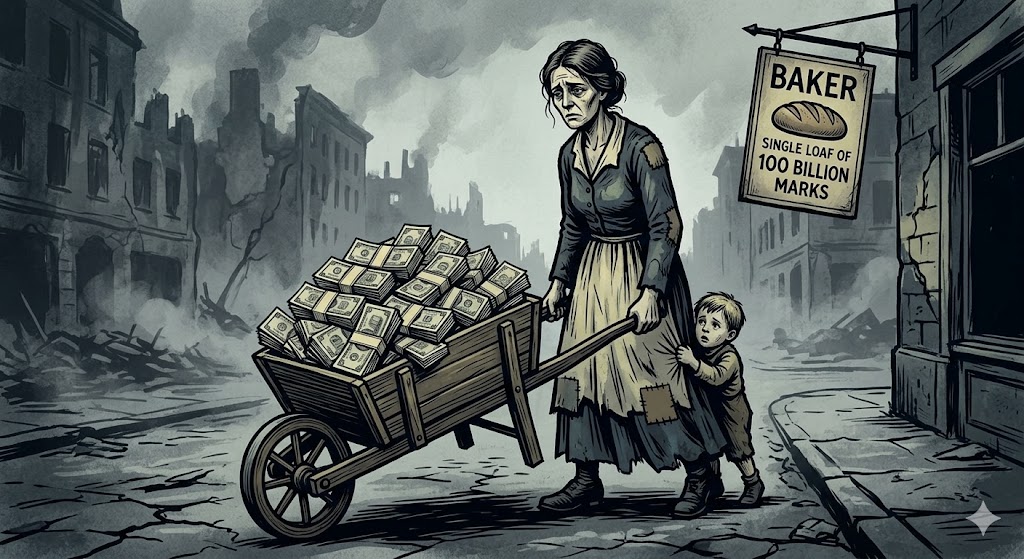
The economic aftermath: hyperinflation in the Weimar Republic. Following the punitive Treaty of Versailles and the devastating costs of the war, the German Mark collapsed. This illustration visualizes the crisis where basic necessities cost billions, and citizens were forced to use wheelbarrows to transport bundles of essentially worthless currency.
Why World War 1 Still Matters Today
World War 1 was not simply a European conflict—it marked the beginning of the modern era. Its causes remind us how fragile peace can be when nationalism, alliances, and militarism combine. Its history shows the human cost of total war. Its consequences, from economic crises to redrawn borders, continue to influence international relations.
By studying World War 1 in full—from the assassination in Sarajevo to the hyperinflation in Berlin—we gain insight into the forces that still shape our world. The war claimed millions, destroyed empires, and altered the course of history. Its lessons remain as relevant today as they were in 1918.