Israel-Gaza-Palestine Conflict: Full History to 2026
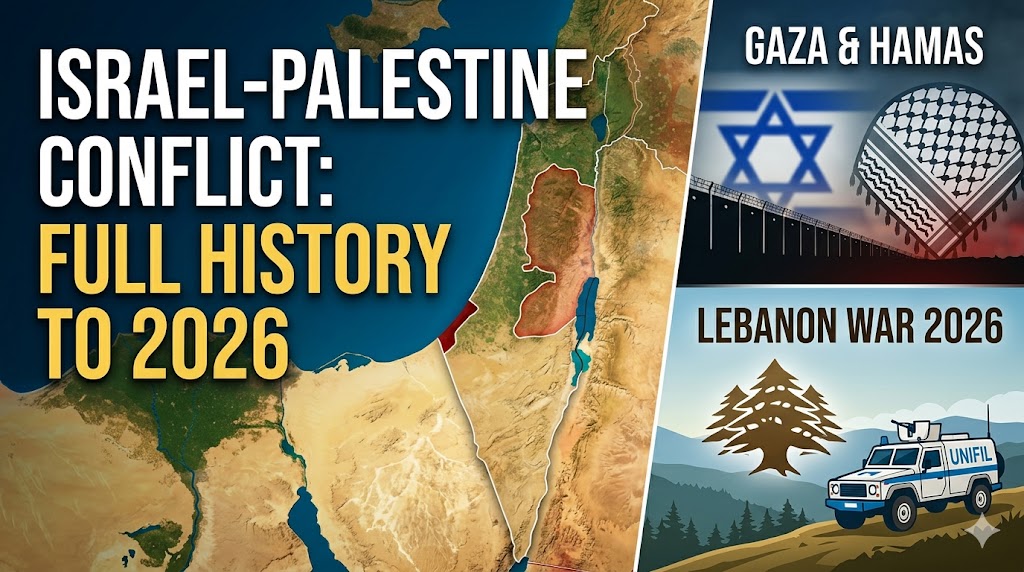
The Israel-Palestine conflict stands as one of the most enduring and complex disputes in modern history. Spanning more than a century, it intertwines deep historical claims, geopolitical rivalries, religious significance, and human suffering on a scale that continues to reverberate far beyond the Middle East. From the dusty streets of Gaza to the rugged hills of southern Lebanon, the conflict has evolved through wars, uprisings, and fragile peace efforts, shaping not only the lives of Israelis and Palestinians but also the broader global order.
At its core, the Israel-Palestine conflict history reflects competing national aspirations over the same land—territory revered by Jews as the biblical homeland of Israel and by Muslims as a key part of the Arab and Islamic world. Today, as of April 2026, the conflict has entered a dangerous new phase with the ongoing 2026 Lebanon war involving Israel and Hezbollah, building directly on years of tension in Gaza and the West Bank. This article provides a complete, chronological examination of the Israel-Palestine conflict, exploring its religious and geopolitical dimensions, the roles of Hamas in Gaza and Hezbollah in Lebanon, and the far-reaching effects on the world stage. Written with balance and clarity, it draws on established historical facts to offer readers a thorough understanding of how past events fuel today’s realities.
The Israel-Palestine conflict history traces back to the late 1800s with the rise of Zionism and Arab nationalism. In the waning years of the Ottoman Empire, which had ruled Palestine for centuries, Jewish immigrants began arriving in larger numbers, fleeing persecution in Europe. The Zionist movement, led by figures like Theodor Herzl, sought to establish a Jewish homeland in historic Palestine, a land central to Jewish identity since biblical times.
Meanwhile, the Arab population, predominantly Muslim with Christian and smaller Jewish communities, viewed the land as their own ancestral home. World War I dramatically altered the landscape. Britain’s 1917 Balfour Declaration promised support for “a national home for the Jewish people” in Palestine while assuring that the rights of non-Jewish communities would not be prejudiced. After the Ottoman collapse, Britain assumed control under a League of Nations mandate in 1920.
Tensions escalated during the British Mandate period (1920–1948) as Jewish immigration surged, especially in the 1930s amid Nazi persecution. Arab revolts in 1929 and 1936–1939 highlighted growing resentment. The Holocaust, in which six million Jews perished, lent urgent moral weight to the Zionist cause. In 1947, the United Nations proposed partitioning Palestine into separate Jewish and Arab states, with Jerusalem under international administration. Jewish leaders accepted the plan; Arab leaders rejected it, arguing it unfairly divided their homeland.
On May 14, 1948, Israel declared independence. The following day, armies from Egypt, Jordan, Syria, Lebanon, and Iraq invaded. The 1948 Arab-Israeli War, known to Israelis as the War of Independence and to Palestinians as the Nakba (“catastrophe”), ended in 1949 with armistice agreements. Israel controlled more territory than originally allotted, Jordan annexed the West Bank and East Jerusalem, and Egypt took the Gaza Strip. Approximately 750,000 Palestinians fled or were expelled, becoming refugees. At the same time, around 850,000 Jews were displaced from Arab countries, many resettling in Israel. This foundational chapter of the Israel-Palestine conflict history set the stage for decades of displacement, occupation, and unresolved claims.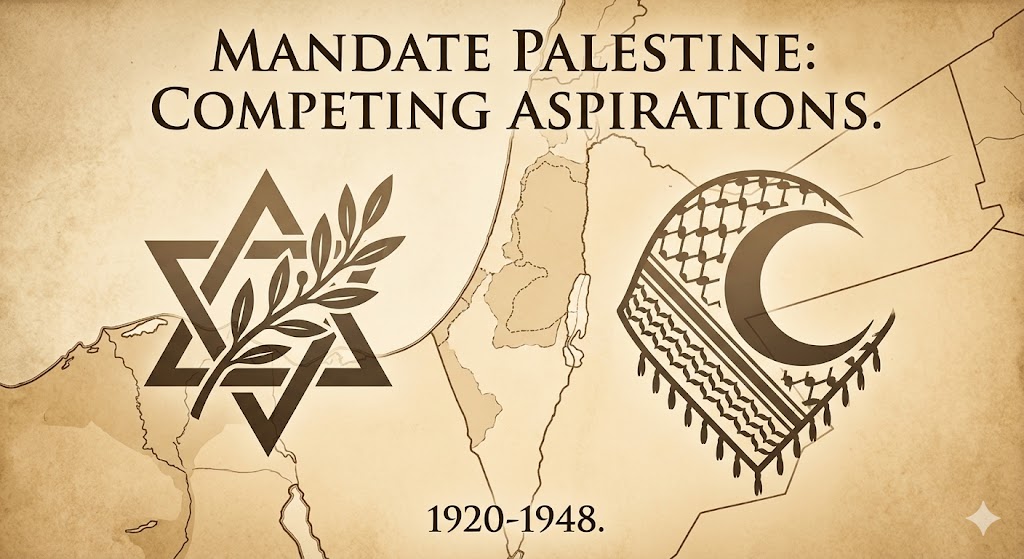
Tracing the Roots: This conceptual illustration symbolizes British Mandate Palestine (1920–1948). It balances Jewish national aspirations (left, symbolized by the Star of David and olive branch) and Arab national aspirations (right, symbolized by the keffiyeh pattern and crescent) over an antique map of the territory, representing the foundational period of the Israel-Palestine conflict history.
Major Wars and the Shaping of Borders: 1956–1982
The next phase of the Israel-Palestine conflict history featured repeated conventional wars that redrew maps and entrenched divisions. The 1956 Suez Crisis saw Israel, Britain, and France invade Egypt over the nationalization of the Suez Canal, though international pressure forced a withdrawal. Tensions boiled over again in the 1967 Six-Day War. Facing threats from Egypt, Jordan, and Syria, Israel launched a preemptive strike, capturing the Sinai Peninsula, Gaza Strip, West Bank, East Jerusalem, and Golan Heights. For Israelis, this victory secured strategic depth and access to holy sites like the Western Wall. For Palestinians and Arabs, it meant occupation of the remaining territories and deepened humiliation.
The 1973 Yom Kippur War, launched by Egypt and Syria to reclaim lost lands, caught Israel off guard but ultimately ended in another Israeli military success, paving the way for the 1979 Egypt-Israel peace treaty—the first between Israel and an Arab state. Yet the Palestinian question remained unresolved. The 1982 Israeli invasion of Lebanon, aimed at expelling the Palestine Liberation Organization (PLO) from southern Lebanon, marked another turning point. Israeli forces reached Beirut, and the PLO was forced to relocate to Tunisia. This invasion, however, sowed the seeds for future resistance movements, including the emergence of Hezbollah.
Throughout these conflicts, religious elements intertwined with political ones. Jerusalem’s Temple Mount—site of the ancient Jewish Temples and home to the Muslim Al-Aqsa Mosque—became a flashpoint symbolizing competing claims to the holy city. Geopolitically, the Cold War amplified the stakes, with the Soviet Union backing Arab states and the United States emerging as Israel’s primary ally.
The Rise of Hamas and the Gaza Focus: 1987–2007
A pivotal shift in the Israel-Palestine conflict history occurred with the First Intifada (1987–1993), a grassroots Palestinian uprising against Israeli occupation in the West Bank and Gaza. Out of this unrest emerged Hamas, the Islamic Resistance Movement. Founded in 1987 by Sheikh Ahmed Yassin as an offshoot of the Muslim Brotherhood, Hamas blended Palestinian nationalism with Islamist ideology. Its original 1988 charter called for the liberation of all of historic Palestine through jihad, rejecting Israel’s right to exist—a stance that contrasted with the more secular PLO’s eventual acceptance of a two-state solution.
Hamas gained popularity through its network of social services—schools, clinics, and charities—in impoverished Gaza, while also conducting attacks against Israeli targets. The 1993 Oslo Accords briefly offered hope, granting limited Palestinian self-rule in parts of the West Bank and Gaza under the newly formed Palestinian Authority. Yet violence persisted, including suicide bombings claimed by Hamas. The Second Intifada (2000–2005), triggered by Ariel Sharon’s visit to the Temple Mount and subsequent clashes, devastated both sides and derailed peace talks.
In 2005, Israel unilaterally withdrew settlers and troops from Gaza. Hamas won legislative elections in 2006, and in 2007, it violently seized control of Gaza from Fatah, the dominant faction of the Palestinian Authority. Israel and Egypt responded with a blockade, citing security threats from rocket fire and weapons smuggling. This period solidified Gaza as the epicenter of the Hamas-Israel conflict, with multiple rounds of fighting in 2008–09, 2012, 2014, and 2021. Each escalation highlighted the humanitarian toll—devastating infrastructure in Gaza while reinforcing Israeli security concerns.
Hezbollah, Lebanon, and the Northern Front: 1982–2023
Parallel to developments in Gaza, the Israel-Palestine conflict history extended northward through Lebanon. Israel’s 1982 invasion inadvertently birthed Hezbollah (“Party of God”), a Shia Islamist group backed by Iran. Formed to resist the occupation and drawing support from Lebanon’s marginalized Shia communities, Hezbollah combined guerrilla warfare with political participation. It earned notoriety for attacks like the 1983 Beirut barracks bombing and developed a formidable arsenal of rockets.
The 2000 Israeli withdrawal from southern Lebanon was hailed by Hezbollah as a victory, boosting its prestige across the Arab world. The 2006 Israel-Hezbollah war, sparked by cross-border raids, lasted 34 days and caused widespread destruction in Lebanon. A UN-brokered ceasefire left Hezbollah intact and even strengthened politically within Lebanon’s fragile sectarian system. Over the following years, Hezbollah’s role as Iran’s proxy linked the Israel-Palestine conflict history to broader regional rivalries, including the Syrian civil war, where it fought alongside Assad’s forces.
Religious and Geopolitical Dimensions: Layers of Complexity
Religion has always been more than a backdrop in the Israel-Palestine conflict history. Judaism, Christianity, and Islam all claim deep ties to the land—Jews through ancient biblical covenants, Muslims through the Prophet Muhammad’s Night Journey to Jerusalem, and Christians through Jesus’s ministry. Holy sites in Jerusalem, Hebron, and Bethlehem remain potent symbols, often igniting violence when access or control is contested.
Geopolitically, the conflict became a proxy battleground. Iran’s support for Hamas and Hezbollah created an “Axis of Resistance” against Israel and U.S. influence. Saudi Arabia and other Sunni Gulf states, initially opposed to Israel, gradually prioritized containing Iran, leading to the 2020 Abraham Accords normalizing ties with several Arab nations. The United States has provided Israel with billions in military aid, viewing it as a strategic democratic ally. Meanwhile, Palestinian leadership has navigated divisions between the Palestinian Authority in the West Bank and Hamas in Gaza, complicating unified negotiations.
These layers—religious fervor fueling grassroots resistance and geopolitical maneuvering sustaining state-level involvement—explain why simple solutions have eluded diplomats for generations.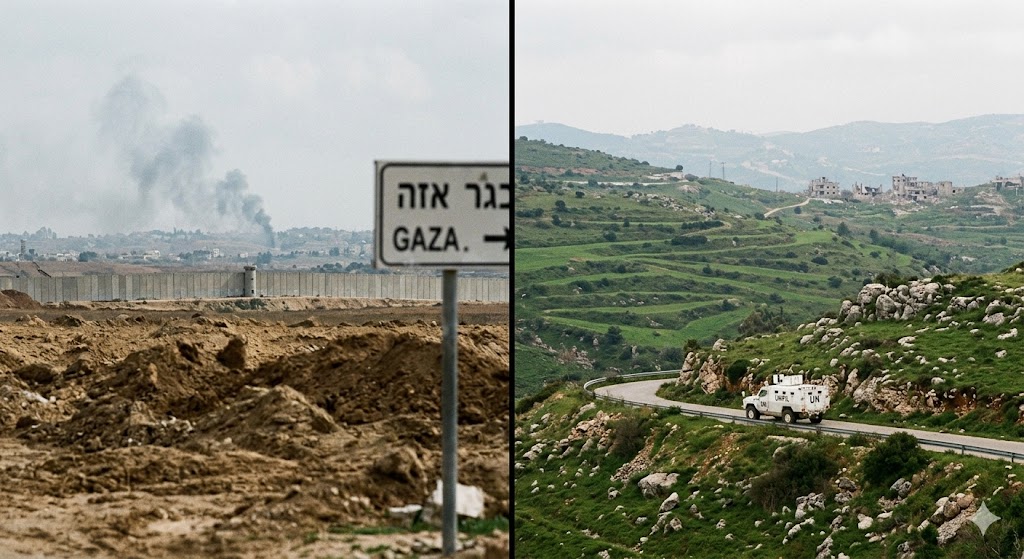
The Dual Fronts of 2026: This composite photograph visualizes the interconnected security challenges facing the region as of early 2026. The left panel shows the arid terrain near the Gaza border, focusing on the security barrier. The right panel shows the contrasting hilly, green terrain of the Israeli-Lebanese border, where a UN patrol is visible. Together, they represent the parallel tensions involving Hamas in Gaza and Hezbollah in Lebanon within the broader Israel-Palestine conflict history.
The 2023 Escalation, Gaza War, and Path to 2026
The October 7, 2023, Hamas-led attacks on Israel killed approximately 1,200 people and took over 250 hostages, the deadliest assault in Israel’s history. Israel’s response—a sustained military campaign in Gaza—aimed to dismantle Hamas’s military capabilities but resulted in massive civilian casualties and destruction, displacing most of Gaza’s population. Ceasefire talks repeatedly faltered amid demands for hostage releases and an end to hostilities.
The spillover effect was immediate. Hezbollah began daily rocket exchanges from Lebanon in solidarity with Gaza, displacing tens of thousands in northern Israel. By late 2025, regional tensions involving Iran further destabilized the situation. This set the stage for the dramatic developments of 2026.
The 2026 Lebanon War: Current Chapter in the Israel-Palestine Conflict History
As of April 2026, the Israel-Palestine conflict history has expanded into a full-scale 2026 Lebanon war. On March 2, 2026, Hezbollah launched rockets and drones into Israel, citing solidarity with Palestinians and retaliation tied to broader Iran-related strikes. Israel responded with a ground invasion of southern Lebanon, airstrikes across the country, and plans for a permanent security buffer zone along the border—echoing tactics used in Gaza.
The fighting has killed over 1,000 in Lebanon, displaced more than a million (a fifth of the population), and severely damaged infrastructure. Israeli forces have pushed toward the Litani River, destroying bridges and homes near the border. Hezbollah, though battered by targeted killings of commanders, continues to resist with rockets and guerrilla tactics. This escalation, part of wider Middle East tensions involving Iran, has strained Lebanon’s already fragile state and deepened internal sectarian divides.
The 2026 Lebanon war illustrates how interconnected the Gaza and Lebanon fronts have become within the larger Israel-Palestine conflict history. What began as a Hamas-Israel confrontation has drawn in Hezbollah, threatening to engulf the region once more.
Global Impact: Far-Reaching Consequences
The Israel-Palestine conflict history, now intensified by the 2026 Lebanon war, affects the world in profound ways. Economically, disruptions in energy markets have driven oil prices higher, contributing to global inflation and straining supply chains. The conflict has diverted international attention and resources, complicating responses to other crises.
Politically, it has polarized global opinion. Protests worldwide highlight divisions over humanitarian issues, with accusations of war crimes on both sides fueling debates in the United Nations and International Court of Justice. The humanitarian toll—refugee flows, food insecurity in Gaza, and civilian suffering in Lebanon—strains aid organizations and neighboring countries.
Socially, the conflict exacerbates antisemitism and Islamophobia in diaspora communities. It also influences domestic politics in the United States, Europe, and beyond, shaping foreign policy and electoral outcomes. In an era of great-power competition, the Israel-Palestine conflict history serves as a litmus test for multilateral institutions and a reminder of unresolved colonial legacies.
Prospects for Peace and Enduring Challenges
Despite repeated cycles of violence, the Israel-Palestine conflict history also includes moments of hope—Camp David, Oslo, and the Abraham Accords. A lasting resolution likely requires addressing core issues: borders, security, Jerusalem’s status, refugees, and settlements. Yet mutual distrust, internal divisions (Hamas vs. Palestinian Authority; Israeli coalition politics), and external interference continue to obstruct progress.
As the 2026 Lebanon war unfolds, the path forward remains uncertain. International mediation, regional diplomacy involving Saudi Arabia and others, and grassroots efforts for coexistence offer glimmers of possibility. Ultimately, any sustainable peace must acknowledge the legitimate aspirations and historical grievances of both Israelis and Palestinians.
Conclusion
The Israel-Palestine conflict history is not a simple narrative of right versus wrong but a tragic tapestry woven from legitimate claims, painful losses, and missed opportunities. From the 1948 war to the current 2026 Lebanon war involving Hezbollah, Gaza’s struggles under Hamas, and the enduring religious and geopolitical forces at play, each chapter reveals how deeply intertwined the fates of Israelis, Palestinians, and their neighbors have become.
Understanding this history—political, geographical, and religious—is essential not only for comprehending today’s headlines but also for envisioning a more peaceful tomorrow. As the world watches developments in Gaza, Lebanon, and beyond, the lessons of the past underscore one truth: lasting security and dignity for all peoples in the region will require courage, compromise, and a genuine commitment to shared humanity. The conflict’s global ripples remind us that, in our interconnected world, no dispute remains truly local.