Indus Valley Civilization: Mohenjo-Daro Insights.
.jpg)
The Indus valley civilization- Mohenjodaro insights
The Indus Valley Civilization, also widely known as the Harappan Civilization, stands as one of the world’s earliest and most sophisticated urban societies. Flourishing between approximately 3300 BCE and 1300 BCE in the northwestern regions of South Asia, this remarkable culture left behind meticulously planned cities, advanced sanitation systems, and intriguing glimpses into daily life and belief systems. At its heart lies Mohenjo-Daro, often called the “Mound of the Dead,” whose ruins continue to captivate archaeologists and historians alike. In this comprehensive exploration, we trace the prehistoric roots, historic rise, and distinct ages of the Indus Valley Civilization, while delving deep into the city systems, river networks, religious practices, construction techniques, and the ways its innovations echo into future perspectives of urban development and cultural continuity.
Far from the grand pyramids or ziggurats of contemporary Egypt and Mesopotamia, the Indus Valley Civilization emphasized practicality, hygiene, and egalitarian planning. With no evidence of towering palaces or monumental temples, its people built thriving metropolises supported by the mighty Indus River and its tributaries. As we journey through the prehistoric, historic, and phased ages of this ancient world, the story of Mohenjo-Daro emerges as a shining example of human ingenuity that still influences modern understandings of sustainable city design.
Prehistoric Roots: The Foundations of the Indus Valley Civilization
The story of the Indus Valley Civilization egins long before its famous urban phase, in what scholars term the prehistoric or pre-Harappan era. Around 7000 BCE, early farming communities emerged at sites like Mehrgarh in present-day Balochistan, Pakistan. These Neolithic settlers cultivated wheat, barley, and domesticated animals, laying the agricultural groundwork that would sustain later cities. Unlike sudden leaps seen elsewhere, the transition here was gradual and locally driven, blending influences from the Near East with indigenous innovations such as cotton cultivation by 5500 BCE.
By the Early Harappan period (circa 3300–2600 BCE), small villages evolved into larger, walled settlements. Places like Rehman Dheri and Amri showcased early experimentation with mud-brick architecture and basic drainage. Trade networks expanded, bringing lapis lazuli from Afghanistan and shells from the coast. The earliest traces of the still-undeciphered Indus script appeared, hinting at organized administration. People migrated toward river plains, drawn by fertile alluvial soils. This prehistoric phase of the Indus Valley Civilization was not isolated but part of a broader regionalisation era, where diverse communities began integrating through shared technologies and resources.
Archaeologists note the absence of warfare indicators during these formative centuries—no massive fortifications or weapon hoards—suggesting a relatively peaceful society focused on cooperation. As the Early Harappan period drew to a close around 2600 BCE, the stage was set for explosive urban growth. The Indus Valley Civilization was transitioning from scattered villages to a network of interconnected cities, setting the foundation for the mature phase that would define its global legacy.
The Historic Rise and Ages of the Harappan Civilization
The historic heart of the Indus Valley Civilization unfolds across three distinct ages: the Early, Mature, and Late Harappan phases. The Mature Harappan period (2600–1900 BCE) marks the civilization’s golden age, when over 1,000 settlements flourished across a vast territory stretching from northeast Afghanistan to western India. Cities like Harappa, Mohenjo-Daro, Dholavira, and Rakhigarhi housed populations of 30,000 to 60,000, supported by sophisticated bureaucracy evident in standardized weights, measures, and brick sizes.
Mohenjo-Daro, discovered in the 1920s, exemplifies this historic peak. Excavated by British archaeologist John Marshall, the site revealed a city deliberately planned before occupation—a hallmark of centralized authority. The Indus Valley Civilization at this stage displayed remarkable cultural uniformity across hundreds of miles, from identical pottery styles to uniform street widths. Trade thrived with Mesopotamia, as Indus seals appear in Sumerian records, exchanging cotton, beads, and carnelian for metals and luxury goods.
The Late Harappan phase (1900–1300 BCE) tells a story of adaptation and eventual transformation. Urban centers gradually declined as environmental pressures mounted, but rural life persisted. Settlements shifted eastward toward the Ganges plain, with new regional styles like Cemetery H culture emerging. Agriculture diversified with double-cropping and rice cultivation. While grand cities emptied, the Indus Valley Civilization's influence lingered in crafts, farming techniques, and possibly early Vedic traditions. This phased evolution—from prehistoric villages through historic urban splendor to late rural resilience—highlights the civilization’s flexibility rather than collapse.
Mohenjo-Daro: The Jewel of the Indus Valley Civilization
No discussion of the Indus Valley Civilization is complete without Mohenjo-Daro, the largest and most iconic excavated site. Covering roughly 250 hectares, this city once bustled with an estimated 40,000 residents in the Mature Harappan phase. Its layout divided into a raised citadel (likely for public functions) and a lower town for residences created a clear yet accessible hierarchy.
Streets followed a precise grid pattern, oriented north-south and east-west, with main avenues up to 10 meters wide. Houses, built around central courtyards, featured private wells and bathrooms—innovations that underscored a societal priority on cleanliness. Wind catchers on rooftops provided natural cooling, while flat clay roofs offered practical shelter. The absence of royal palaces or lavish tombs suggests a more egalitarian structure, where wealth derived from trade and craftsmanship rather than hereditary rule.
Mohenjo-Daro’s artifacts, including the famous “Dancing Girl” bronze and “Priest-King” steatite figurine, reveal a society of skilled artisans. These discoveries paint a vivid picture of daily life in the Indus Valley Civilization: merchants sealing goods with unicorn-stamped seals, farmers tending fields, and families enjoying indoor plumbing centuries before Rome.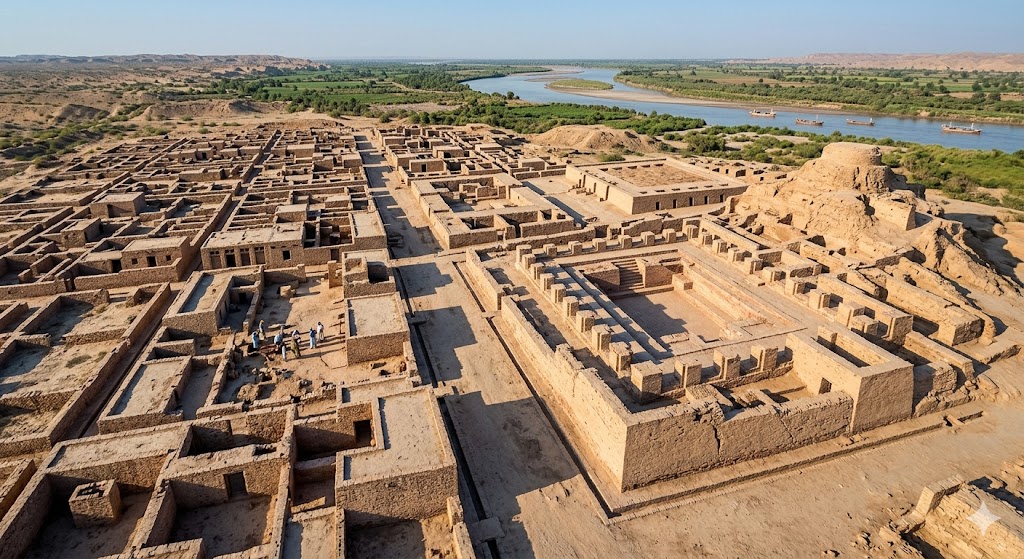
An aerial recreation of the ancient city of Mohenjo-Daro, highlighting the sophisticated grid-based urban planning and baked-brick architecture of the Indus Valley Civilization
The City System: Advanced Urban Planning in the Indus Valley Civilization
The city system of the Indus Valley Civilization remains one of its most enduring achievements. Unlike organic growth in other ancient centers, Harappan cities were master-planned with modular precision. Standardized baked bricks—typically in a 4:2:1 ratio—ensured uniformity, allowing quick assembly and structural integrity against floods.
Public infrastructure included warehouses for grain storage near rivers and massive platforms possibly serving as flood defenses. In Mohenjo-Daro, every neighborhood connected to a network of covered drains lined with baked bricks. Wastewater from household bathing platforms flowed into street channels, which sloped gently to soak pits or outfalls. This sophisticated sanitation system prevented waterborne diseases and reflected deep engineering knowledge.
The Indus Valley Civilization’s urban model prioritized functionality over ostentation. No grand avenues for parades or defensive moats dominated; instead, wide lanes facilitated cart traffic, and public wells served all residents equally. Modern urban planners still admire this grid-based efficiency, which minimized congestion and maximized hygiene—principles that resonate in sustainable city design today.
The River System: Lifeline of the Indus Valley Civilization
At the core of the Indus Valley Civilization lay its river system. The mighty Indus River, fed by Himalayan snowmelt and monsoon rains, provided fertile floodplains for wheat, barley, and cotton. Alongside it flowed the seasonal Ghaggar-Hakra (often linked to the Vedic Sarasvati), whose waters supported western settlements until climatic shifts around 1900 BCE.
Rivers served not only as irrigation sources but as trade arteries. Flat-bottomed boats carried goods between cities and coastal ports like Lothal. Annual floods replenished soils naturally, eliminating the need for complex canal systems seen in Mesopotamia. However, this dependence proved double-edged; silting and shifting courses contributed to later challenges.
The Indus Valley Civilization adapted by siting cities on elevated platforms and maintaining flexible agricultural zones. This harmonious relationship with rivers underscores how geography shaped one of history’s most resilient early societies.
Construction Materials and Architectural Ingenuity of the Indus Valley Civilization
Builders of the Indus Valley Civilization relied heavily on locally abundant materials transformed through ingenuity. Standardized baked bricks, fired in kilns for durability, formed the backbone of construction—resistant to moisture unlike mud bricks used in earlier phases. Gypsum mortar sealed joints, while bitumen (natural tar) waterproofed critical structures like the Great Bath.
Wood from riverine forests framed doors and roofs, supplemented by stone for sculptures and chert for tools. Terracotta figurines and steatite seals showcased artistic skill alongside utility. In Mohenjo-Daro, houses featured inner courtyards for privacy and ventilation, with vertical chutes directing wastewater to street drains.
This material mastery enabled the Indus Valley Civilization to erect enduring cities that withstood millennia. The uniformity of bricks across vast distances points to centralized production and quality control—hallmarks of a sophisticated economy.
Religious System and Practices in the Indus Valley Civilization
Religion in the Indus Valley Civilization remains partly enigmatic due to the undeciphered script, yet abundant artifacts offer compelling clues. Unlike temple-centric societies elsewhere, no large shrines or deity statues dominate. Instead, evidence points to domestic and communal rituals centered on purity and fertility.
The Great Bath in Mohenjo-Daro—measuring 12 by 7 meters and 2.4 meters deep—stands as the earliest known public water tank. Constructed with finely fitted bricks, gypsum plaster, and bitumen waterproofing, it featured staircases, colonnades, and a corbelled drain. Scholars interpret it as a site for ritual bathing, where water symbolized renewal and spiritual cleansing. Adjacent rooms and wells suggest controlled access for ceremonial use.
Terracotta mother goddess figurines hint at fertility worship, possibly precursors to later Shaktism. The famous Pashupati seal depicts a horned, seated figure surrounded by animals, often linked to a proto-Shiva or “Lord of Beasts.” Unicorn seals and animal motifs suggest veneration of nature and symbolic totems. Burial practices varied—fractional burials, cremations in some late phases—indicating diverse beliefs without rigid dogma.
Daily religious factors in the Indus Valley Civilization likely included home altars, amulets for protection, and communal gatherings at public tanks. The emphasis on cleanliness through advanced drainage may itself reflect ritual purity. These practices, though speculative, reveal a spiritual worldview integrated seamlessly with urban life rather than separated in grand monuments.
Decline, Legacy, and Future Perspectives: How the Indus Valley Civilization Shaped Tomorrow
Around 1900 BCE, the Mature Harappan phase waned as monsoons weakened and rivers shifted, leading to aridification. Cities like Mohenjo-Daro were gradually abandoned, yet the Indus Valley Civilization did not vanish abruptly. Populations dispersed eastward, carrying agricultural know-how and crafts into new settlements. The Late Harappan age saw continuity in pottery, weights, and farming techniques that influenced subsequent cultures, including elements possibly absorbed into early Vedic traditions.
The legacy of the Indus Valley Civilization extends far beyond its time. Its urban planning principles—grid layouts, sanitation, and standardized construction—inspire modern sustainable cities. Concepts of egalitarian access to water and waste management prefigure contemporary public health standards. In South Asia, echoes appear in later town planning, bead-making traditions, and multi-cropping agriculture that fed growing populations.
From a future perspective, the Indus Valley Civilization offers lessons in resilience. Its adaptation to environmental change highlights the importance of flexible infrastructure amid climate shifts. UNESCO recognition of Mohenjo-Daro and Dholavira underscores its role in global heritage education. Ongoing excavations continue to rewrite timelines, revealing even deeper prehistoric roots and reinforcing its place among antiquity’s greatest achievements.
As scholars piece together more from seals and sediments, the Indus Valley Civilization reminds us that advanced societies thrive not through conquest but through innovation, cooperation, and harmony with nature. Its story, preserved in the bricks of Mohenjo-Daro, continues to inform how we build smarter, cleaner cities for generations ahead.
The Indus Valley Civilization, through its Harappan cities and Mohenjo-Daro’s marvels, exemplifies humanity’s capacity for thoughtful progress. From prehistoric villages to historic urban peaks and late transformations, its city systems, river-supported economy, baked-brick architecture, and ritual-focused religious practices formed a cohesive whole. Though silent in script, its legacy speaks volumes—urging us to value sustainability, equity, and ingenuity in our own era.
Whether exploring ancient drains or pondering future urban models, the Indus Valley Civilization endures as a beacon of what thoughtful civilization can achieve. Its insights remain as relevant today as they were over 4,000 years ago, inviting further discovery and appreciation.