"Indus Valley Civilization: History, Culture & Legacy"
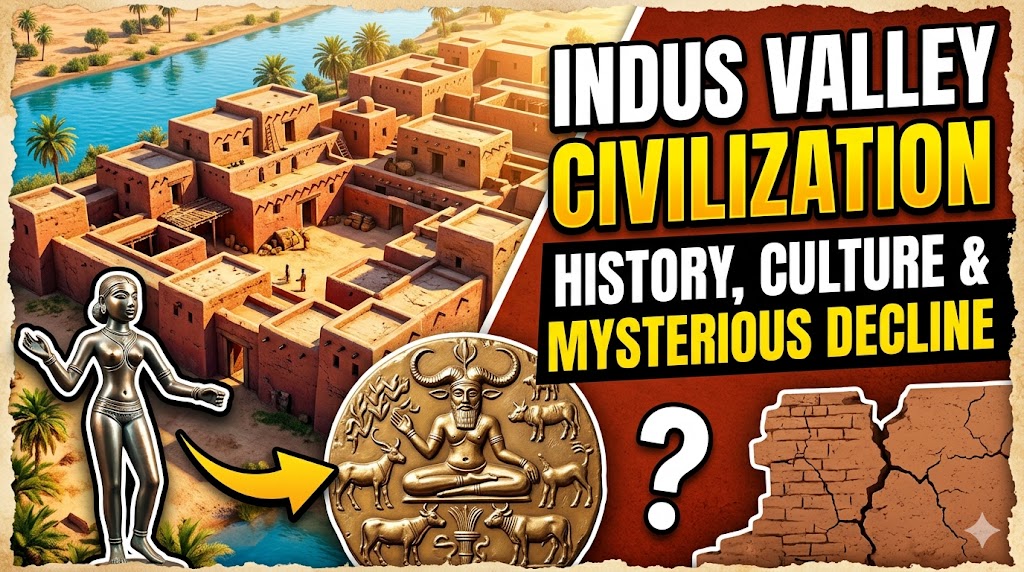
The Indus Valley Civilization stands as one of the four great ancient civilizations of the world, alongside Mesopotamia, Egypt, and China. Flourishing between approximately 3300 BCE and 1300 BCE, with its mature phase from 2600 BCE to 1900 BCE, the Indus Valley Civilization represents a remarkable achievement in human history. Also known in Hindi as *Sindhu Ghati Sabhyata* (or sometimes referred to in regional contexts as Hindu Ghati Sabhyata), and alternatively called the Harappan Civilization after its first major excavated site, this ancient society thrived across a vast region spanning present-day Pakistan, northwest India, and parts of Afghanistan.
What makes the Indus Valley Civilization truly exceptional is its sophisticated urban planning, standardized systems, and peaceful nature, all achieved without the large-scale warfare or monumental palaces typical of contemporary civilizations. Unlike the pyramid-building Egyptians or the ziggurat-constructing Mesopotamians, the people of the Indus Valley Civilization focused on practical, egalitarian infrastructure that supported thriving cities with populations in the tens of thousands. This comprehensive article explores every facet of the Indus Valley Civilization – from its discovery and geography to its economy, society, religion, language, decline, and enduring legacy – providing a detailed resource for students, researchers, UPSC aspirants, and history enthusiasts alike.
Scholars continue to study the Indus Valley Civilization because it challenges many assumptions about early complex societies. With no evidence of kings, armies, or slavery on a large scale, the Indus Valley Civilization appears to have been governed through civic consensus rather than centralized monarchy. Its influence on later Indian culture remains a subject of ongoing debate, yet its contributions to urbanism, trade, and craftsmanship are undeniable.
Historical Discovery and Excavations of the Indus Valley Civilization
The modern rediscovery of the Indus Valley Civilization began in the early 20th century under British India. In 1921–1922, archaeologists led by John Marshall, Director-General of the Archaeological Survey of India, excavated Harappa in Punjab (now Pakistan). Almost simultaneously, R.D. Banerji uncovered Mohenjo-Daro in Sindh. These finds stunned the world, pushing back the timeline of Indian civilization by thousands of years and proving it rivaled the antiquity of Mesopotamia and Egypt.
Subsequent excavations revealed over 1,500 sites across a 1.2 million square kilometer area. Key contributors included Mortimer Wheeler, who introduced scientific methods in the 1940s, and Indian archaeologists like B.B. Lal and S.R. Rao. Post-independence discoveries expanded the map dramatically. In India, sites such as Lothal (Gujarat), Dholavira (Kutch), Kalibangan (Rajasthan), and the massive Rakhigarhi (Haryana) – now recognized as the largest Harappan site – reshaped understanding of the Indus Valley Civilization’s scale.
Recent excavations using modern techniques like satellite imagery, GIS mapping, and DNA analysis have uncovered new insights. For instance, the 2010s–2020s digs at Rakhigarhi and Bhirrana have pushed the timeline of early settlements back further, confirming continuous occupation from the Neolithic period. These Indus Valley Civilization facts highlight how the civilization evolved organically from local farming communities rather than through sudden external influence.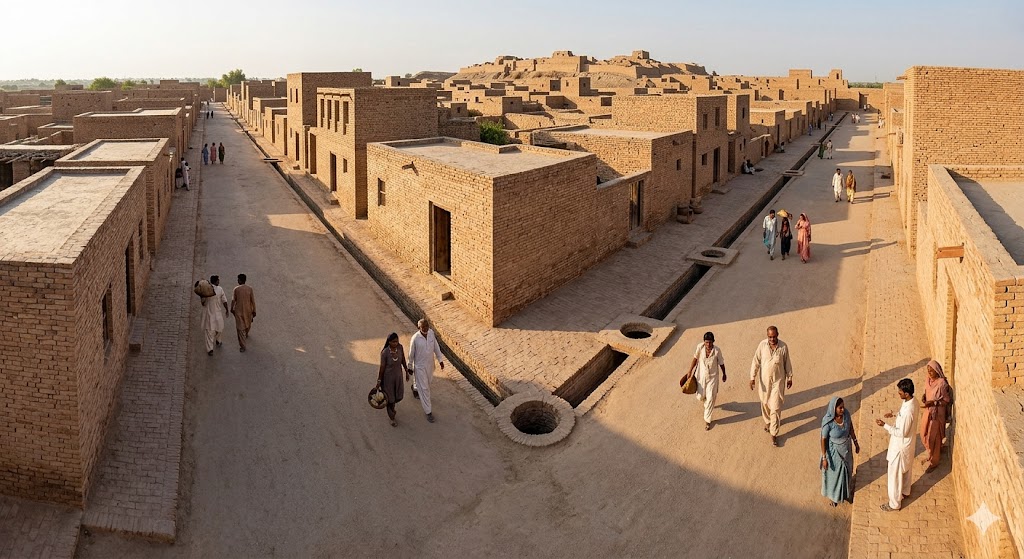
A reconstruction of the streets of Mohenjo-Daro, highlighting the sophisticated grid layout, multi-story brick buildings, and unique covered drainage systems that defined the Indus Valley Civilization’s advanced urban planning
The Indus Valley Civilization covered an area larger than ancient Egypt and Mesopotamia combined. It stretched from the Arabian Sea in the south to the Himalayan foothills in the north, and from the Iranian border in the west to the Yamuna River in the east. The lifeblood of the Indus Valley Civilization was the mighty Indus River and its tributaries – the Ravi, Beas, Sutlej, and Ghaggar-Hakra (often identified with the ancient Saraswati).
Major cities of the Indus Valley Civilization included:
- Mohenjo-Daro (“Mound of the Dead”): A UNESCO World Heritage Site featuring the Great Bath, granaries, and the famous “Priest-King” statue.
- Harappa: The first discovered site, known for its citadel and advanced drainage.
- Lothal: A bustling port city with the world’s earliest known dockyard, evidencing maritime trade.
- Dholavira: Noted for its sophisticated water conservation system with reservoirs and stepwells.
- Rakhigarhi: The largest known site, spanning over 350 hectares, revealing residential and industrial zones.
Smaller settlements numbered in the hundreds, indicating a well-integrated network rather than isolated city-states. The uniformity in brick sizes (ratio 4:2:1), weights, and seals across these distant sites underscores the remarkable standardization achieved by the Indus Valley Civilization.
Urban Planning and Infrastructure in the Indus Valley Civilization
Urban planning in the Indus Valley Civilization remains its most celebrated achievement. Cities were laid out on a grid pattern with wide streets intersecting at right angles – a system unmatched until modern times. Houses were built with standardized baked bricks, featuring private wells, bathrooms, and an efficient covered drainage system that emptied into soak pits or rivers.
The Great Bath at Mohenjo-Daro, measuring 12 × 7 × 2.4 meters, is believed to have served ritual or public bathing purposes, suggesting advanced hydraulic engineering. Granaries with raised platforms protected grain from floods and pests. Public buildings, assembly halls, and marketplaces indicate organized civic life. Remarkably, there is little evidence of defensive walls or palaces, reinforcing the view of the Indus Valley Civilization as relatively peaceful and egalitarian.
Sanitation was exemplary: every house had a toilet connected to street drains with manholes for cleaning. This level of public health infrastructure in the Indus Valley Civilization predates similar systems in Europe by over 4,000 years.
Economic Activities and Trade Networks of the Indus Valley Civilization
The economy of the Indus Valley Civilization was agrarian yet highly commercial. Farmers grew wheat, barley, millet, peas, sesame, and cotton – the latter being the first cultivated cotton in the world. They domesticated cattle, sheep, goats, and possibly elephants. Irrigation canals and flood management supported surplus production.
Trade was extensive. The Indus Valley Civilization exported cotton textiles, beads, carnelian, and ivory to Mesopotamia (via the Persian Gulf) and imported lapis lazuli from Afghanistan, copper from Rajasthan and Oman, and gold from South India. Standardized weights and measures (cubic and binary systems) facilitated fair trade. Lothal’s dockyard and seals found in Sumerian cities confirm maritime capabilities.
Internally, craft specialization thrived. Potters, metalworkers, bead-makers, and shell-workers operated in dedicated zones. The Indus Valley Civilization’s economy supported a middle class of merchants and artisans, evidenced by varied house sizes rather than extreme wealth disparities.
Social Structure and Daily Life in the Indus Valley Civilization
Society in the Indus Valley Civilization appears stratified but not rigidly hierarchical. No royal tombs or grand palaces exist, suggesting leadership by a council of elders or merchant guilds rather than divine kings. Artifacts indicate a peaceful society with emphasis on cleanliness, trade, and community.
Daily life revolved around farming, crafting, and commerce. Toys like terracotta carts and whistles suggest children enjoyed play. Women likely held important roles, as evidenced by numerous female figurines (possibly mother goddesses). Jewelry, cosmetics, and dyed clothing point to a refined aesthetic sense. The absence of large temples or weapons implies social stability unusual for the Bronze Age.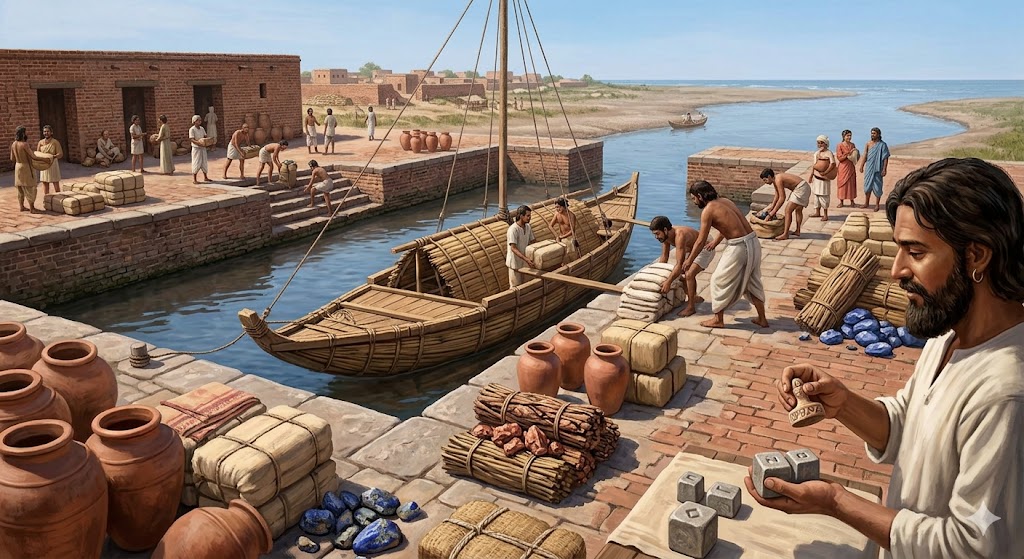
The bustling dockyard of Lothal, showing the world's earliest known artificial basin for maritime trade. Harappan merchants are depicted exchanging goods, using standardized weights and the famous carved seals to certify cargo bound for Mesopotamia.
Art, Craft, and Technology of the Indus Valley Civilization
Artisans of the Indus Valley Civilization excelled in metallurgy (bronze, copper), pottery (red ware with black designs), and bead-making. The famous “Dancing Girl” bronze statuette from Mohenjo-Daro and the “Priest-King” steatite sculpture showcase realistic artistry. Seals carved with animals (unicorn, bull, elephant) and the undeciphered script served as trademarks for merchants.
Technology included lost-wax casting, dentistry (drilled teeth found at Harappa), and precise measurement tools. The Indus Valley Civilization’s innovations in cotton weaving and dyeing influenced global textile traditions for millennia.
Religion and Spiritual Beliefs of the Indus Valley Civilization
Religion in the Indus Valley Civilization was likely nature-oriented and proto-Hindu in character. The Pashupati seal depicts a horned figure surrounded by animals, interpreted by some as an early form of Shiva (Pashupati, “Lord of Animals”). Mother goddess figurines suggest fertility worship. Sacred trees (pipal), fire altars at Kalibangan, and ritual bathing facilities indicate reverence for water and vegetation.
No large temples exist, suggesting worship occurred in homes or open spaces. The Indus Valley Civilization’s religious practices may have influenced later Vedic traditions, though direct continuity remains debated among scholars. Animal motifs on seals and the prominence of the unicorn suggest totemism or symbolic reverence.
Language and Writing System of the Indus Valley Civilization
The Indus script, consisting of about 400 pictographic symbols found on seals, pottery, and copper tablets, remains undeciphered. Short inscriptions (average 5–6 symbols) have resisted translation despite decades of effort. Linguists propose it may represent a Dravidian language or an early form related to later South Asian tongues.
The absence of bilingual texts like the Rosetta Stone complicates decipherment. Some scholars argue the script was primarily administrative rather than literary. Understanding the language of the Indus Valley Civilization would unlock deeper insights into its governance and worldview, making it one of archaeology’s greatest unsolved mysteries.
The Decline and Fall of the Indus Valley Civilization
Around 1900 BCE, the Indus Valley Civilization began a gradual decline, with cities abandoned by 1300 BCE. Multiple factors contributed rather than a single catastrophe. Climate change – weakening of the monsoon and drying of the Ghaggar-Hakra river – disrupted agriculture. Tectonic shifts may have altered river courses. Overexploitation of resources and possible disease outbreaks added pressure.
The outdated “Aryan invasion” theory has been largely discarded due to lack of evidence for mass violence. Instead, the decline of the Indus Valley Civilization appears as a transformation: populations migrated eastward toward the Ganges plain, carrying urban knowledge that later influenced Vedic culture. Late Harappan phases show continuity in crafts but loss of standardization and large cities.
Legacy and Significance of the Indus Valley Civilization
The legacy of the Indus Valley Civilization endures in modern South Asia. Urban planning principles, standardized weights, and sanitation concepts influenced later Indian town planning. Cotton cultivation and maritime trade routes laid foundations for India’s historical economic prowess. Elements of its religious symbolism appear in Hinduism, Jainism, and Buddhism.
For UPSC aspirants, the Indus Valley Civilization remains a vital topic in ancient Indian history, with previous year questions (PYQs) frequently testing sites, features, and decline theories. Its study underscores India’s ancient sophistication and contributes to global understanding of early urbanism.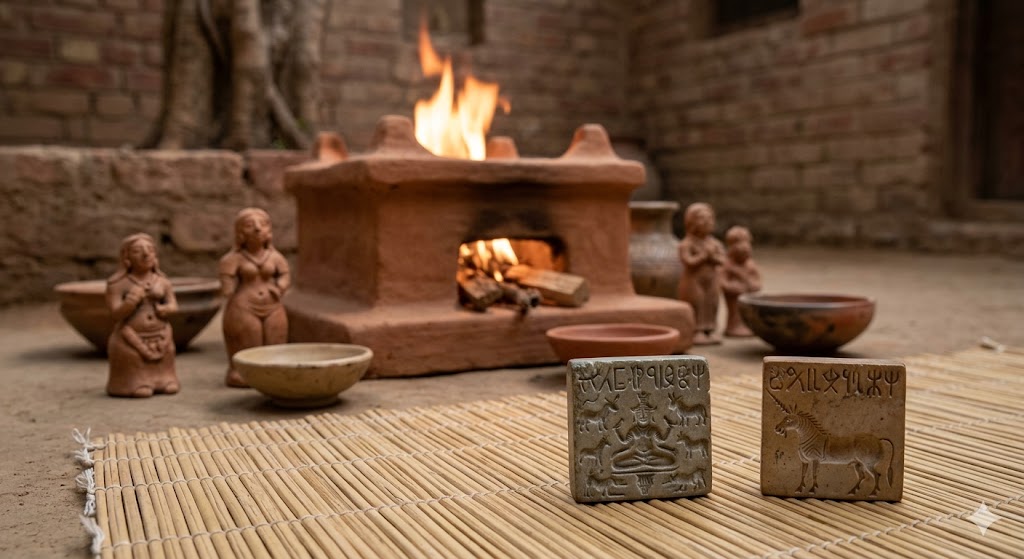
An intimate ritual setting showing terracotta mother goddess figurines near a fire altar, alongside the famous 'Pashupati' and 'unicorn' seals. Both seals display the mysterious, undeciphered Indus script, a key unsolved aspect of the civilization.
Conclusion: The Enduring Mystery of the Indus Valley Civilization
The Indus Valley Civilization continues to captivate because it reminds us that advanced societies can flourish through cooperation, innovation, and harmony with nature. From its meticulously planned cities and thriving trade to its enigmatic script and peaceful ethos, the Indus Valley Civilization offers timeless lessons in sustainable living and civic organization.
As new excavations and technologies reveal fresh Indus Valley Civilization facts, our appreciation only deepens. Whether viewed through the lens of *Sindhu Ghati Sabhyata* in Indian scholarship or as the Harappan Civilization globally, this ancient wonder remains a cornerstone of human civilization’s story – a testament to the ingenuity of our ancestors and an inspiration for the future.