Indian Knowledge System: Philosophy, Varna, and Education
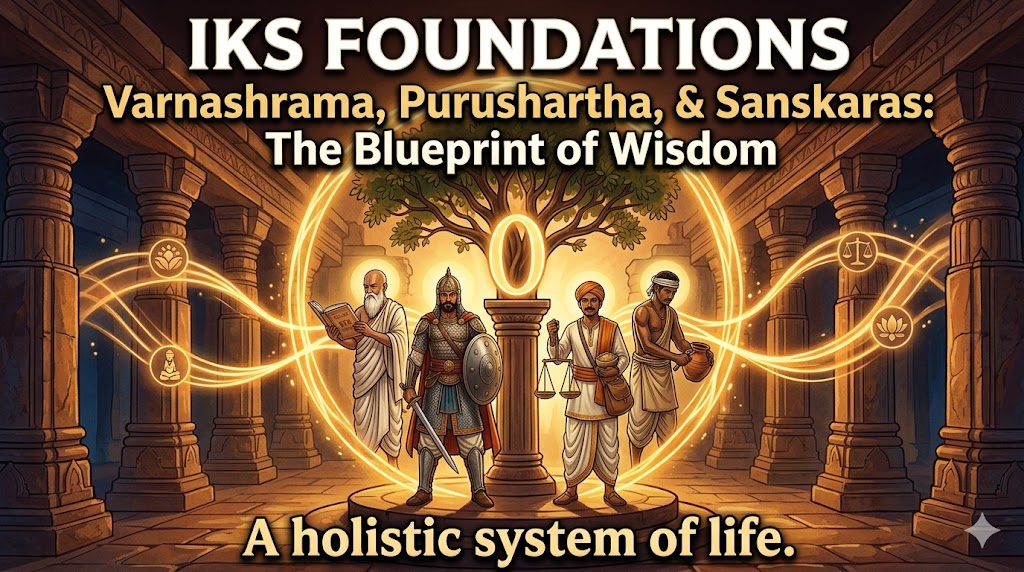
Introduction to the Genesis of the Indian Knowledge System (IKS)
The Indian Knowledge System (IKS) is not merely a collection of ancient texts; it is a sophisticated, living tradition that represents the intellectual and spiritual labor of thousands of years. At its core, IKS is characterized by its holistic approach to human existence. Unlike modern Western paradigms that often separate the secular from the sacred, or science from philosophy, the Indian tradition views the universe as an interconnected web of consciousness and matter.
The historical origin of IKS can be traced back to the Vedic period, where the realization of Rta—the cosmic order—governed everything from the movement of stars to the conduct of an individual. This system encompasses a wide array of disciplines, including Ganita (mathematics), Khagola-shastra (astronomy), Ayurveda (medicine), Vyakaran (linguistics), and Dharmashastra (ethics and law). To understand how this system works, one must look at the structural pillars that support the life of an individual within a society: the Varna, the Ashrama, the Purushartha, and the Sanskaras.
As the UGC (University Grants Commission) integrates IKS into modern curricula, it is essential to recognize that this is not a step backward into "religion," but a step forward into a more integrated, sustainable, and ethical way of living. For the modern student, IKS provides the tools to achieve not just professional success, but personal fulfillment and spiritual liberation.
The Historical Map of Varna: Aptitude over Birth
One of the most discussed aspects of Indian history is the Varna system. To understand its actual historical function, we must look at the etymology of the word "Varna," which comes from the root Vr, meaning "to choose" or "to describe a color/texture of character." Historically, the Varna system was a functional classification of society based on Guna (psychological attributes) and Karma (aptitude for specific work).
In the early Vedic period, the Varna system was fluid. It was a recognition that a healthy society requires four distinct types of energy:
Brahmins (The Intellectual and Spiritual Wing): Those whose nature was inclined toward Sattva (purity and knowledge). Their duty was to preserve the oral traditions, conduct rituals, and provide ethical guidance. They were the "head" of the social body, focusing on the preservation of the Indian Knowledge System.
Kshatriyas (The Administrative and Protective Wing): Those with a preponderance of Rajas (energy and passion). They were the warriors and kings responsible for maintaining Dharma (justice) and protecting the weak. They represented the "arms" of society.
Vaishyas (The Economic Wing): Those who managed the resources of the land. This included agriculture, animal husbandry, and trade. They were the "thighs" of the nation, providing the support and prosperity needed for civilization to flourish.
Shudras (The Service and Artistic Wing): Those who provided the specialized labor, craftsmanship, and essential services. They represented the "feet," the foundation upon which the entire structure stood.
The depiction of Varna in Indian history, specifically in the Rig Veda’s Purusha Sukta, uses the metaphor of a single cosmic being. This was never meant to imply a hierarchy of "superior" or "inferior," but rather a biological necessity—just as a human body cannot survive without its feet or its head, society requires all four Varnas to be in harmony. History shows that individuals often moved between these categories based on their demonstrated skills and character, highlighting the "easy explanation" of IKS as a meritocracy of the spirit.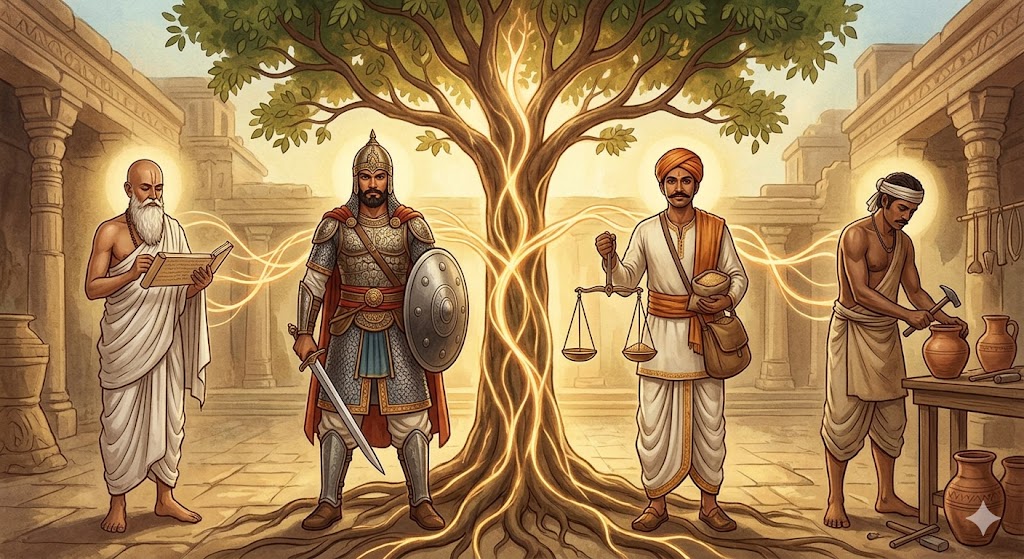
A stylized representation of the Four Varnas—Brahmin, Kshatriya, Vaishya, and Shudra—as functional aspects radiating from a single, cosmic tree of life. This visualization emphasizes their organic interconnectedness and cooperative function in upholding the Vedic social body, rather than a rigid hierarchy
The Varna Ashrama Philosophy and the Four Stages of Life
While Varna organizes society horizontally, the Ashrama system organizes the individual’s life vertically through time. The term "Ashrama" literally means a "resting place" or a "stage of effort." Historically, the Indian Knowledge System recognized that a human being’s needs and duties change as they age.
The transition from a "Varna Ashram" Focus—the life of a seeker—into the four distinct stages allowed for a balanced distribution of human energy and resources:
Brahmacharya (The Student Phase)
This was the foundation of the IKS education system. Between the ages of 8 and 25, the individual lived a life of rigorous discipline, celibacy, and learning. The focus was on building character and mastering the sciences. The student, or Brahmachari, lived in a Gurukul, learning through service and observation.
Grihastha (The Householder Phase)
From 25 to 50, the individual entered society, married, raised a family, and pursued wealth (Artha) and pleasure (Kama). This was considered the most critical Ashrama because the householder provided the food and resources for the students, the retirees, and the monks. It is the phase where the value system is put into practical use.
Vanaprastha (The Hermit/Retirement Phase)
At age 50, once domestic responsibilities were fulfilled, the individual began to withdraw. This was a period of "social retirement" where the couple would move to a quieter environment to focus on meditation and sharing their wisdom with the younger generation. It served as a bridge between the material and the spiritual worlds.
Sannyasa (The Renunciation Phase)
The final stage involved the complete renunciation of worldly identity. The Sannyasi focused entirely on Moksha (liberation). By detaching from the ego, the individual prepared for the final transition of death with peace and clarity.
This system ensured that there was no "mid-life crisis" or "fear of aging," as every stage of life was seen as a necessary and sacred step toward the ultimate goal.
Purushartha: The Four Dimensions of Human Purpose
Why do we live? The Indian Knowledge System answers this through the concept of Purushartha. The history behind Purushartha lies in the deep psychological understanding that human beings are multifaceted. We are not just spiritual beings, nor are we just economic animals.
The four types of Purushartha are:
Dharma (Ethical Foundation): This is the most critical. It is the set of values that holds society together. It includes one’s duties to family, society, and the environment.
Artha (Economic Security): IKS does not demonize money. Artha is the pursuit of the means of life. In a Hindu household, earning wealth honestly and using it for the benefit of others is considered a divine duty.
Kama (Emotional and Sensory Fulfillment): This includes love, desire, and the enjoyment of the arts. IKS acknowledges that human beings need joy and emotional connection to remain healthy and productive.
Moksha (Spiritual Freedom): The ultimate "exit strategy" from the limitations of the physical world. It is the realization of the eternal nature of the soul (Atman).
The historical reason for this four-fold path was to create a society where people didn't feel guilty about their desires but were taught to channel them constructively. By fulfilling Dharma, Artha, and Kama, one naturally becomes ready for Moksha. This balance is what makes the Indian value system so resilient.
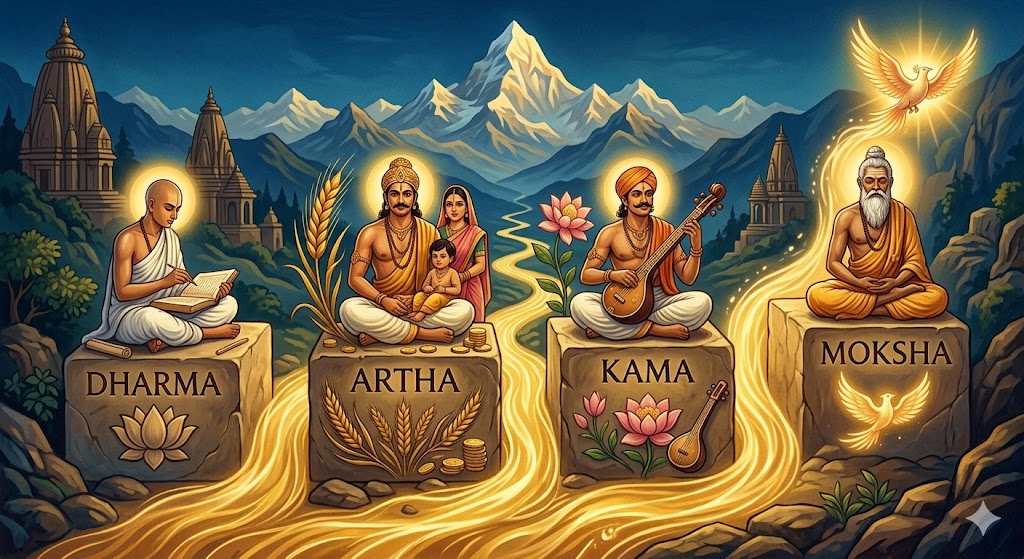
A sequential flow illustration of the Four Purusharthas (goals of life): from the foundation of ethical duty (Dharma), through material prosperity (Artha) and sensory experience (Kama), leading to final spiritual liberation (Moksha).
Manusmriti, Natural Law, and Social Ethics
The Manusmriti is often the subject of intense debate, but in the context of IKS history, it must be understood as a Dharmashastra—a legal and ethical manual. The text was an attempt to align social behavior with what the ancients called Sanatana Dharma (Eternal Law).
The connection between Manusmriti and our "natural" state is based on the idea that humans have different Prakritis (natures). The text attempted to create a code of conduct that allowed people of different temperaments to live together without conflict. It emphasizes the importance of Sanskaras (refinement) to elevate a person from their raw, animalistic instincts to a higher state of consciousness. While modern perspectives criticize its rigidities, historically, it provided the structural stability that allowed Indian civilization to survive for millennia despite numerous foreign invasions. It provided a framework for legal disputes, property rights, and social obligations that were deeply rooted in the concept of cosmic balance.
Shodasha Sanskara: The Science of Refinement
In the Indian Knowledge System, a person is not born "civilized." They are made civilized through a series of rites of passage known as the Sanskaras. The word "Sanskara" means to refine or to polish, much like a rough stone is carved into a beautiful deity.
There are traditionally 16 primary Sanskaras (Shodasha Sanskaras) that mark every major transition in a person's life:
Garbhadhana: The very first Sanskara, which involves the conscious intention of the parents during conception.
Upanayana (Initiation): Perhaps the most important in the education system. It marked the "second birth" (Dvija) of a child into the world of knowledge. The child was given the sacred thread and began their Vedic studies.
Vivaha (Marriage): Not just a legal contract, but a spiritual union intended to fulfill the Purusharthas together as a team.
Antyeshti (Funeral Rites): The final Sanskara, where the body is returned to the five elements (Pancha Bhoota), teaching the living the lesson of detachment and the immortality of the soul.
These Sanskaras ensure that every stage of life is lived with mindfulness and sanctity. In the Indian history of education, these rituals were integrated into the curriculum, ensuring that a student did not just learn facts but underwent a total transformation of character.
The Ancient Indian Education System: Gurukul to University
The history of the Indian education system is a story of unparalleled excellence. The universities of Takshashila, Nalanda, and Vikramshila were the intellectual centers of the world.
The Gurukul System
Education began at home and then moved to the Gurukul. Here, the relationship between the Guru and the Shishya (student) was paramount. Students lived with the teacher, learning not just through books but through living a life of discipline. The pedagogy included:
Sravana: Listening to the Guru's words.
Manana: Reflecting and thinking deeply about the teachings.
Nididhyasana: Realizing the truth through meditation and practice.
Interdisciplinary Learning
The IKS syllabus was vast. A student might study grammar (Vyakarana) in the morning and metallurgy or archery in the afternoon. This holistic approach ensured that graduates were not just clerks but thinkers, creators, and protectors.
Mathematics: The Indian vs. International Place Value System
A crowning achievement of the Indian Knowledge System is its contribution to mathematics. The Indian place value system, which introduced the decimal notation and the concept of Zero (Shunya), revolutionized the world.
Comparison of Systems
Indian System: Uses terms like Lakh, Crore, Arab, and Kharab. It groups numbers by two digits after the initial thousand (e.g., 1,00,00,000).
International System: Uses Millions and Billions, grouping by three digits (e.g., 10,000,000).
The Indian system is deeply tied to the Sanskrit language, where numbers as high as 10⁵³
(Tallakshana) were named long before Western mathematics had a word for a million. This mathematical precision was not just for commerce; it was used to calculate planetary positions, astronomical cycles, and the rhythmic patterns of Sanskrit poetry. Without the Indian invention of the zero and place value, modern computing and binary logic would not exist.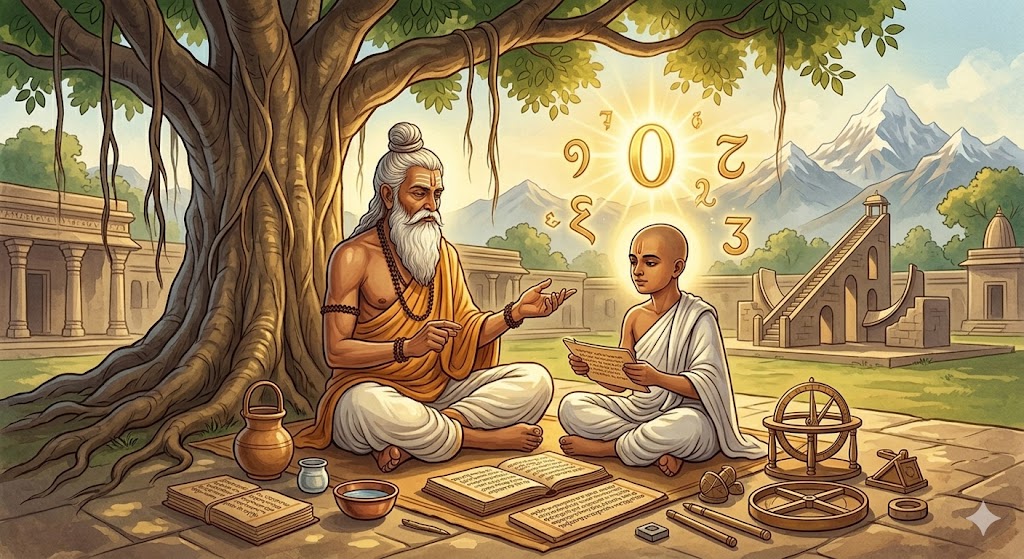
A Guru teaches a student under a tree, symbolizing learning beyond a formal classroom. Floating above the student are stylized mathematical symbols, including the Shunya (Zero) in glowing golden light, directly referencing the Indian Place Value System discussed in the article. This highlights the interdisciplinary nature of IKS.
The Indian Knowledge System is a testament to the intellectual and spiritual depth of ancient India. By integrating the Varna and Ashrama systems with the goals of Purushartha and the refinement of the Sanskaras, it created a society that was both stable and spiritually vibrant.
As we look at the modern world, the values of IKS—sustainability, balance, and the pursuit of higher truth—remain as relevant today as they were thousands of years ago. This system is not just a relic of history; it is a living philosophy that continues to offer answers to the most profound questions of human existence. By re-adopting these values, we can build an education system that fosters not just intelligence, but wisdom.