Artemis II Breaks Apollo 13 Record in Historic Lunar Mission
News• April 06, 2026• Global Edition
A New Chapter in Human Space Exploration
In a landmark achievement for NASA's Artemis program, the Artemis II mission has captured global attention as the first crewed flight to the Moon in over five decades. Launched on April 1, 2026, aboard the powerful Space Launch System (SLS) rocket and Orion spacecraft named Integrity, this deep space mission has already broken the Apollo 13 distance record, venturing farther from Earth than any humans in history.
The four-member Artemis crew—Commander Reid Wiseman, Pilot Victor Glover, Mission Specialist Christina Koch, and Canadian Space Agency astronaut Jeremy Hansen—embarked on an approximately 10-day journey that tests critical technologies for future lunar landings and eventual Mars missions. From the dramatic launch process to the tense 40-minute communications blackout behind the Moon, every phase of the Artemis II mission highlights humanity's return to deep space exploration.
This NASA Artemis ll flight not only advances the Artemis accords and international collaboration but also inspires a new generation. As the mission progresses smoothly toward splashdown, it underscores the program's commitment to sustainable lunar presence. In this comprehensive Artemis II update, we explore the launch, record-breaking moments, daily flight progress, breathtaking views from lunar distance, and preparations for the crew's safe return home.
The Historic Launch of Artemis II: Precision Engineering at Work
The Artemis II launch unfolded flawlessly from Launch Complex 39B at NASA's Kennedy Space Center in Florida at 6:35 p.m. EDT on April 1, 2026. The SLS rocket, one of the most powerful ever built, propelled the Orion integrity spacecraft into orbit with the precision expected of modern spaceflight.
Engineers had prepared meticulously for weeks, conducting tanking operations and final weather checks that favored an 80-90% "go" probability. The countdown clock, initiated days earlier, ticked down without major issues, allowing the crew to strap in for humanity's first crewed lunar voyage since Apollo 17 in 1972.
Early mission milestones included a successful perigee raise burn and the critical translunar injection burn on Day 2 (April 2), which sent the spacecraft hurtling toward the Moon at speeds exceeding 24,000 mph. This Artemis 2 launch process explained involved flawless coordination between Mission Control in Houston and teams worldwide, demonstrating the robustness of the Artemis program infrastructure.
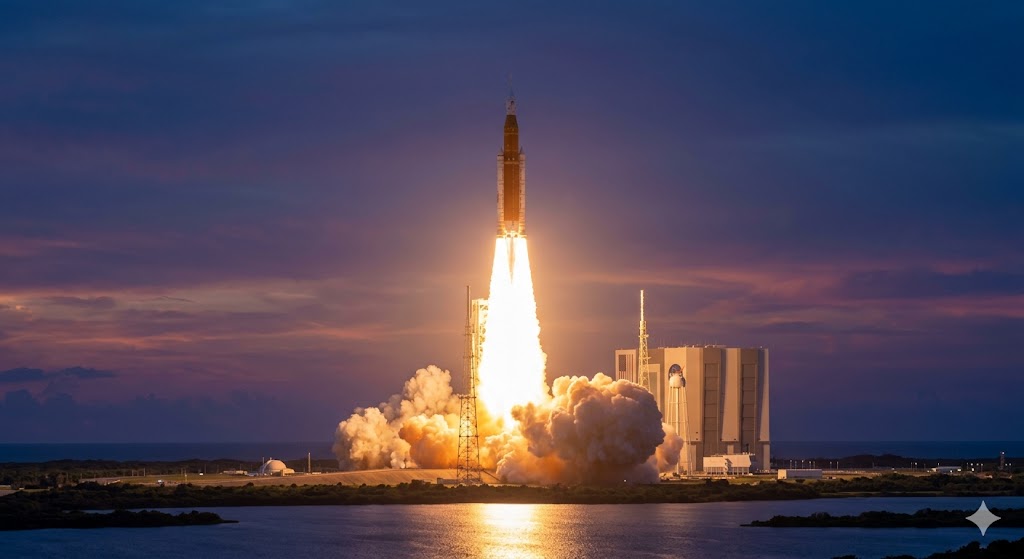
NASA's Space Launch System (SLS) rocket lifts off from Launch Complex 39B at Kennedy Space Center, carrying the Orion Integrity spacecraft and the four-member Artemis II crew on humanity's first crewed lunar mission in over 50 years.
The Artemis crew represents diversity and expertise at its finest. Commander Reid Wiseman leads with prior ISS experience, while Pilot Victor Glover brings shuttle-era knowledge. Mission Specialist Jeremy Hansen, from Canada, highlights the international Artemis accords. At the heart of the narrative is Christina Koch, a female scientist and electrical engineer with a physics background, who became the first woman to venture beyond low Earth orbit on this lunar mission.
Koch, who previously set the record for the longest single spaceflight by a woman (328 days on the ISS), described the mission as "an incredible privilege and responsibility." Her selection as the first woman on a Lunar orbit mission builds on the legacy of Valentina Tereshkova, the first woman in space in 1963, but takes it to unprecedented depths. Koch's expertise in spacecraft systems has proven invaluable during the flight.
The crew's camaraderie shone through in early transmissions, with light-hearted moments amid rigorous system checks. Their journey aboard Integrity tests life support, navigation, and human factors in deep space—key data for Artemis III and beyond.
Breaking the Apollo 13 Record: Farther Than Ever Before
One of the most anticipated milestones occurred on April 6, 2026 (Mission Day 6), when the Artemis II mission officially surpassed Apollo 13's 1970 distance record of 248,655 miles from Earth. At approximately 1:56 p.m. EDT, the crew pushed beyond that mark, eventually reaching a maximum of about 252,756 miles—roughly 4,000 miles farther.
This achievement during the lunar flyby phase was no accident; the free-return trajectory was designed to test Orion's capabilities at extreme distances. As Commander Wiseman noted in updates, the record "merges the past with the present and even the future." The Artemis II second day and subsequent days built momentum, with orbital adjustments ensuring a safe path around the Moon's far side.
Unlike Apollo 13's emergency return, Artemis II's success reflects decades of engineering advancements in propulsion and thermal protection.
The 40-Minute Communications Blackout: A Moment of Isolation
As the spacecraft swung behind the Moon on April 6, the crew experienced a planned 40-minute loss of signal with Earth—often described in mission updates as the "whole 40 minutes left out in message." Radio waves cannot penetrate the lunar mass, creating a natural communications blackout.
During this period, the crew reached their farthest point from Earth while conducting lunar observations. Upon reacquiring signal, Christina Koch radioed back: "It is so great to hear from Earth again." The moment, tense yet triumphant, highlighted the isolation of deep space and the reliability of Orion's systems.
Mission Control teams monitored closely, confirming all systems nominal post-blackout. This Artemis II day 3 through flyby progression (with updates on Days 4-5 focusing on trajectory refinements) proved the spacecraft's autonomy.
Daily Flight Timeline: From Earth Orbit to Lunar Flyby and Beyond
The total travel of these days unfolded methodically over the 10-day mission:
Day 1 (April 1): Launch and initial Earth orbit checkout.
Day 2 (April 2): Perigee raise and translunar injection; first high-resolution Earth images captured.
Day 3 (April 3): Mid-course corrections; crew rest and system tests.
Days 4-5: Approach to the Moon; preparation for flyby.
Day 6 (April 6): Lunar flyby, record break, 40-minute blackout, and closest lunar approach.
Days 7-9 (April 7 onward): Return trajectory; ongoing observations and preparations for reentry.
Day 10 (April 10): Splashdown in the Pacific Ocean off San Diego.
Each Artemis II day two and Artemis II day 3 update from NASA confirmed healthy spacecraft performance, with the crew sharing insights via downlinked messages. The flight path covered nearly 685,000 miles round-trip, providing invaluable data on radiation and microgravity effects.
Views from Lunar Distance: Earth, Planets, and the Cosmos
From roughly 250,000 miles away, the Artemis crew captured awe-inspiring perspectives. Earth appeared as a fragile blue marble, with visible auroras, continents, and atmospheric glow. Commander Wiseman shared the iconic "Hello, World" image post-translunar burn, showing South America, Africa, Spain, and dual auroras—boreal and austral.
Venus gleamed brightly in one frame, offering rare deep-space planetary context. These Earth images they have sent to NASA—downlinked promptly—echo Apollo-era "Blue Marble" shots but with modern clarity, emphasizing unchanged planetary beauty amid technological progress.
The crew described the Moon's far side as "absolutely spectacular," with the Orientale basin visible in unprecedented human detail. Such visuals fuel public engagement and scientific analysis back on Earth.
breathtaking view from the Orion spacecraft Integrity captures a partial Earthrise over the rugged lunar horizon. This perspective, looking back from nearly 250,000 miles away during the record-breaking lunar flyby, emphasizes Earth as a fragile "Blue Marble" isolated in the deep space void
Preparing for the Journey Home: Reentry and Splashdown
With the lunar flyby complete, the Artemis II mission now focuses on the return leg. The crew is conducting final system checks, stowing equipment, and preparing for the high-speed reentry—expected to reach 25,000 mph, the fastest crewed return ever.
Orion's heat shield and parachutes will slow the spacecraft for a Pacific splashdown on April 10, 2026, near San Diego. U.S. Navy recovery teams aboard the USS John P. Murtha stand ready for a swift extraction, followed by medical evaluations and transport to Houston.
This phase of preparing to come home mirrors the outbound precision, ensuring crew safety after their successful Moon mission. Post-mission debriefs will inform Artemis III's crewed landing.
The Broader Impact: Artemis Program and Future Horizons
The Artemis program—bolstered by international Artemis accords—positions NASA for sustainable lunar exploration. Artemis II's success paves the way for landings, resource utilization, and Mars ambitions. Christina Koch's role as the pioneering female scientist in this deep space milestone inspires countless young explorers, proving space knows no gender barriers.
From mission control triumphs to public Earth images, Artemis II latest developments reaffirm humanity's drive to explore. As the crew hurtles homeward, their journey reminds us: the Moon is not just a destination—it's a stepping stone.
Conclusion: Humanity's Bold Return to the Moon
The Artemis II mission stands as a testament to innovation, resilience, and collaboration. By breaking Apollo 13's record, navigating the 40-minute blackout, sharing stunning lunar-distance views, and methodically preparing for return, the crew has delivered a flawless successful mission. With splashdown imminent, this lunar mission cements NASA's leadership in space.
As we await the crew's safe homecoming, one thing is clear: the era of sustained deep space travel has begun. Follow ongoing Artemis II updates for the latest from NASA—because the stars are closer than ever.
Frequently Asked Questions
What is the primary significance of Artemis II Breaks Apollo 13 Record in Historic Lunar Mission?
A New Chapter in Human Space ExplorationIn a landmark achievement for NASA's Artemis program, the Artemis II mission has captured global attention as the first crewed flight to the Moon in over five decades. Launched on April 1, 2026, aboard the powerful Space Launch System (SLS) rocket and Orion spacecraft named Integrity, this deep space mission has already broken the Apollo 13 distance record, venturing farther from Earth than any humans in history.The four-member Artemis crew—Commander Reid Wiseman, Pilot Victor Glover, Mission Specialist Christina Koch, and Canadian Space Agency astronaut Jeremy Hansen—embarked on an approximately 10-day journey that tests critical technologies for future lunar landings and eventual Mars missions.
How does this development impact News?
From the dramatic launch process to the tense 40-minute communications blackout behind the Moon, every phase of the Artemis II mission highlights humanity's return to deep space exploration.This NASA Artemis ll flight not only advances the Artemis accords and international collaboration but also inspires a new generation. As the mission progresses smoothly toward splashdown, it underscores the program's commitment to sustainable lunar presence.
What are the key future projections to monitor?
In this comprehensive Artemis II update, we explore the launch, record-breaking moments, daily flight progress, breathtaking views from lunar distance, and preparations for the crew's safe return home.The Historic Launch of Artemis II: Precision Engineering at WorkThe Artemis II launch unfolded flawlessly from Launch Complex 39B at NASA's Kennedy Space Center in Florida at 6:35 p.m.
.jpeg)