ITR Filing 2026 Guide: Deadlines, Process & Budget Changes
News• April 06, 2026• Global Edition
As the financial year 2025-26 draws to a close, millions of business owners, professionals, and individuals across India are preparing for ITR filing 2026. The Assessment Year (AY) 2026-27 brings updated deadlines, streamlined processes, and important announcements from the Union Budget 2026 that directly affect how you file your Income Tax Return (ITR) online. Whether you run a small business, operate under presumptive taxation, or manage complex income streams, understanding the latest rules is crucial to avoid penalties and maximise refunds.
In this comprehensive guide, we break down everything you need to know about ITR filing 2026—from eligibility and forms to exact last dates, the complete online process, and how Budget 2026 has eased compliance. We also address common concerns like filing after the due date for AY 2025-26 (if pending), changes effective from 2026, and the current status of tax relief for married couples in India. Let’s dive in so you can file confidently and on time.
Before jumping into ITR filing 2026, clarify the basics. The Financial Year (FY) 2025-26 runs from April 1, 2025, to March 31, 2026. The income earned during this period is assessed and reported in Assessment Year (AY) 2026-27. For businesses, this distinction is vital because audit requirements, presumptive schemes, and ITR forms depend on your turnover and income sources.
If your business turnover exceeds ₹1 crore (or ₹2 crore in certain cases for digital transactions), you may need a tax audit, pushing your ITR filing 2026 deadline later. Salaried individuals or small businesses under Section 44AD/44ADA can opt for simpler forms and earlier deadlines. Timely ITR filing 2026 not only helps you claim deductions under Sections 80C, 80D, or 10AA but also builds a strong compliance record for loans, visas, or future audits.
Who Must File ITR for Business in AY 2026-27?
Not everyone needs to file, but most business owners do. You must file an ITR if:
- Your gross total income exceeds the basic exemption limit (₹2.5 lakh under old regime or ₹3 lakh under new regime, subject to rebates).
- You have business or professional income, even if below the threshold, especially if you have foreign assets, capital gains, or want to carry forward losses.
- You are a partner in a firm, director in a company, or run a proprietorship with turnover requiring audit.
For businesses specifically, ITR filing 2026 is mandatory if you maintain books of accounts or fall under presumptive taxation. Skipping it can lead to notices under Section 139(9) or penalties up to ₹5,000 under Section 234F.
Choosing the Right ITR Form for Business Owners
Selecting the correct form is the first step in successful ITR filing 2026:
ITR-1 (Sahaj): For salaried or pensioners with total income up to ₹50 lakh and no business income.
ITR-2: For individuals/HUFs with income from salary, house property, capital gains, or foreign sources—but no business/profession income.
ITR-3: For individuals/HUFs with business or profession income who are not eligible for presumptive taxation (requires maintaining books and audit if applicable).
ITR-4 (Sugam): Ideal for small businesses and professionals under presumptive schemes (Section 44AD, 44ADA, 44AE) with turnover up to ₹50 lakh (or higher under certain conditions).
Pro Tip": If your business income is from a proprietorship and you maintain detailed accounts, switch to ITR-3. Using the wrong form can trigger a defective return notice.
ITR-2 for FY 2024-25 (AY 2025-26) saw minor tweaks in capital gains reporting, but for AY 2026-27, the forms notified in March 2026 remain largely similar under the Income Tax Act, 1961.
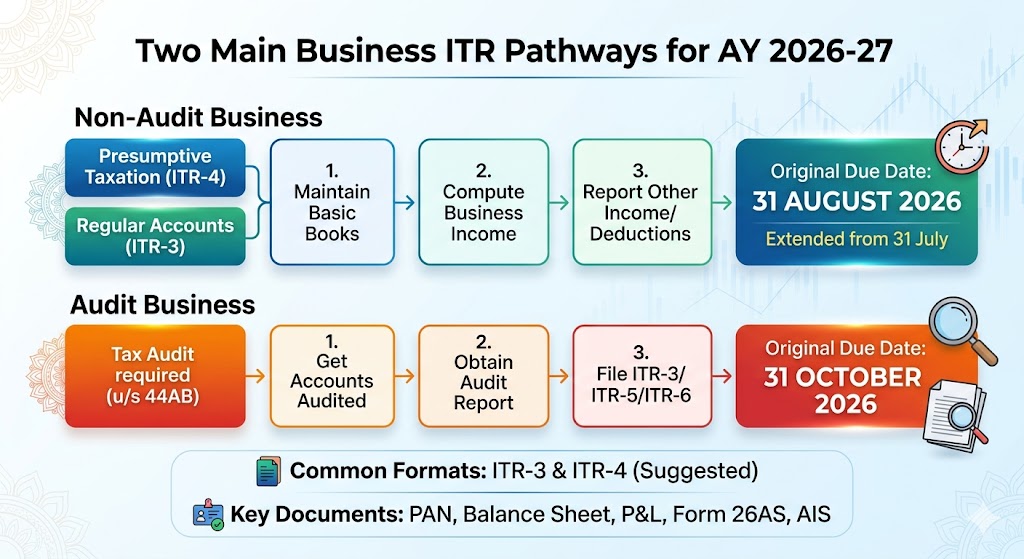
This infographic visually separates the filing process for audit and non-audit businesses. It highlights the main deadlines mentioned in your article—August 31, 2026, for non-audit and October 31, 2026, for audit cases—and suggests the appropriate ITR forms.
ITR Filing Last Date for AY 2026-27: Key Deadlines You Cannot Miss
One of the most searched queries this season is the ITR filing last date 2026. Thanks to rationalisation in Budget 2026, deadlines are now staggered:
| Taxpayer Category | ITR Forms | Original Deadline | Extended Deadline (Budget 2026) | Audit Cases |
| Individuals (Salaried, No Business) | ITR-1 & ITR-2 | 31 July 2026 | Remains 31 July 2026 | N/A |
| Non-audit Business/Profession | ITR-3 & ITR-4 | 31 July 2026 | 31 August 2026 | N/A |
| Transfer Pricing Cases | All | – | 30 November 2026 | Yes |
| Belated Return | All | – | 31 December 2026 | – |
| Revised Return | All | 31 Dec 2026 | Extended to 31 March 2027 (with nominal fee) | – |
These extensions for non-audit business cases (from 31 July to 31 August) are a welcome relief announced in the Union Budget 2026 presented on February 1, 2026. They reduce portal congestion and give small businesses extra time to finalise accounts.
Note on AY 2025-26 Extension News: If you still haven’t filed for the previous year, the extended deadline (originally to 15 September 2025) has long passed. You can still file a belated return under Section 139(4) until 31 December 2025 (for AY 2025-26), but late fees apply.
When Does ITR Filing Start in 2026?
Good news—ITR filing 2026 has already begun! The CBDT notified ITR forms 1 to 7 in late March 2026, and the e-filing portal utilities are live. Most taxpayers can start uploading returns from early April 2026. Pre-filled data from Form 16, 26AS, and AIS makes the process faster than ever.
Step-by-Step Guide: How to File ITR Online for Business in 2026
Follow this professional, error-free process for seamless ITR filing 2026:
1. Gather Documents: PAN, Aadhaar, Form 16/16A, bank statements, profit & loss account, balance sheet, GST returns, capital gains statements, and foreign asset details (if any).
2. Register/Login on e-Filing Portal: Visit incometax.gov.in. Use PAN as username. Complete e-verification via Aadhaar OTP or net banking.
3. Select AY and Form: Choose Assessment Year 2026-27 and the appropriate ITR form (ITR-3 or ITR-4 for most businesses).
4. Fill Details:
- Personal & business information.
- Income from all heads (business, salary, capital gains, other sources).
- Claim deductions and exemptions.
- Opt for new or old tax regime (default is new regime for most).
5. Verify and Compute Tax: The system auto-calculates tax liability, rebate u/s 87A (up to ₹60,000 in new regime), and TDS credits.
6.Pay Self-Assessment Tax (if any):Use challan 280 or pay via portal.
7. E-Verify Return: Options include Aadhaar OTP, DSC, EVC via bank, or generate EVC offline.
8. Download Acknowledgement: ITR-V (if not e-verified) must be posted within 30 days.
The entire online ITR filing process takes 30-60 minutes for simple cases and up to a few hours for complex business returns. Use the offline Java utility if you prefer preparing returns without internet.
India Budget 2026: Key Announcements Impacting ITR Filing
Finance Minister Nirmala Sitharaman presented the Union Budget 2026-27 on February 1, 2026. Major highlights relevant to ITR filing 2026 include:
Staggered ITR Deadlines: As detailed in the table above—big relief for non-audit businesses.
Extended Revised Return Window: Now till 31 March of the following year with a nominal fee (₹1,000 if income ≤ ₹5 lakh; ₹5,000 otherwise).
New Income Tax Act, 2025: Comes into force from April 1, 2026 (Tax Year 2026-27). AY 2026-27 filing still follows the 1961 Act, but expect simplified rules and forms from next year.
No Major Slab Changes: Personal income tax slabs remain unchanged from the previous revision.
Other Reforms: Easier lower/nil TDS certificates via automated process, revised TCS rates, and continued focus on MSME compliance ease.
These Budget 2026 measures make ITR filing 2026 more taxpayer-friendly.
ITR Changes Effective 2026 and Beyond
While AY 2026-27 follows existing rules, the new Income Tax Act 2025 and Rules 2026 (effective Tax Year 2026-27) introduce:
- Concept of “Tax Year” replacing FY.
- Further deadline rationalisation.
- Enhanced deductions for HRA, children education allowance, and meal coupons.
- Mandatory PAN linking for more high-value transactions.
Stay updated via the official portal for ITR changes 2026.
Filing ITR After Due Date: Belated Returns, Penalties & Consequences
Missed the ITR filing last date for AY 2026-27? You can file a belated return until 31 December 2026 under Section 139(4). However:
- Late fee u/s 234F: ₹1,000 (income ≤ ₹5 lakh) or ₹5,000 (income > ₹5 lakh).
- Interest u/s 234A @1% per month on unpaid tax.
- Loss carry-forward may be disallowed (except house property loss).
- Possible scrutiny notice and higher compliance burden.
For AY 2025-26, the window for belated filing closed on 31 December 2025—file an updated return (ITR-U) only if additional tax is payable.
Tax Relief for Married Couples in India: Current Status
Many hoped Budget 2026 would introduce optional joint taxation for married couples, as proposed by ICAI. This would have allowed combining incomes, doubling exemption limits, and reducing tax for single-income households. However, the government did not implement joint filing in Budget 2026. Taxation remains individual. Couples can still optimise through separate filings, clubbing provisions (if applicable), and maximising deductions. Watch for future amendments.
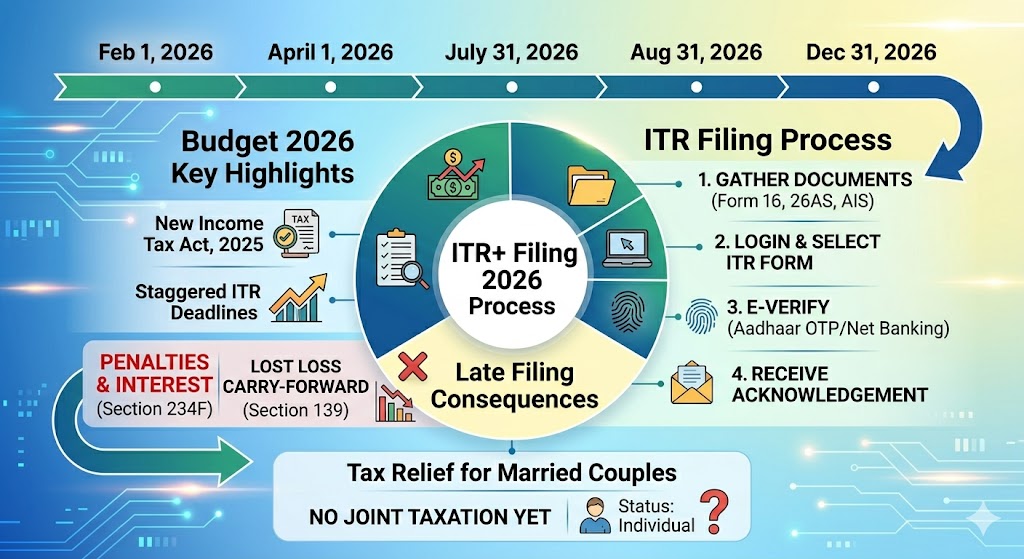
It visualizes key highlights from the 2026 budget (like the staggered deadlines), illustrates the step-by-step ITR filing process, and addresses specific points from your article, such as the penalties for late filing and the 'individual filing' status for married couples.
Common Mistakes to Avoid in ITR Filing 2026
- Wrong form selection.
- Mismatching AIS/26AS data.
- Forgetting to report foreign income or digital assets.
- Missing e-verification (return treated as invalid).
- Claiming incorrect presumptive income percentages.
Double-check every schedule—especially business profit computation—for accurate ITR filing 2026.
Conclusion: File Smart, File Early
ITR filing 2026 doesn’t have to be stressful. With extended deadlines for business taxpayers, pre-filled data, and simplified processes, the government has made compliance easier than ever. Whether you’re a freelancer, small business owner, or large professional firm, timely filing secures your refunds, avoids penalties, and strengthens your financial profile.
Start gathering documents today, choose the right form, and complete your online ITR filing well before the ITR filing last date 2026. For complex cases, consult a chartered accountant. Stay updated on the e-filing portal and official CBDT notifications.
Your ITR is more than paperwork—it’s proof of your contribution to nation-building. File accurately, file on time, and enjoy peace of mind.
Frequently Asked Questions
What is the primary significance of ITR Filing 2026 Guide: Deadlines, Process & Budget Changes?
As the financial year 2025-26 draws to a close, millions of business owners, professionals, and individuals across India are preparing for ITR filing 2026. The Assessment Year (AY) 2026-27 brings updated deadlines, streamlined processes, and important announcements from the Union Budget 2026 that directly affect how you file your Income Tax Return (ITR) online.
How does this development impact News?
Whether you run a small business, operate under presumptive taxation, or manage complex income streams, understanding the latest rules is crucial to avoid penalties and maximise refunds.In this comprehensive guide, we break down everything you need to know about ITR filing 2026—from eligibility and forms to exact last dates, the complete online process, and how Budget 2026 has eased compliance. We also address common concerns like filing after the due date for AY 2025-26 (if pending), changes effective from 2026, and the current status of tax relief for married couples in India.
What are the key future projections to monitor?
Let’s dive in so you can file confidently and on time.Understanding FY 2025-26 vs AY 2026-27 and Why It Matters for BusinessBefore jumping into ITR filing 2026, clarify the basics.