India's Quest for UN Security Council Permanent Membership
News• April 06, 2026• Global Edition
In an era of rapid geopolitical shifts, India's quest for a permanent seat in the United Nations Security Council (UNSC) stands as a cornerstone of its ambition for global status. As the world's largest democracy and a rising economic powerhouse, India has long argued that the UNSC—unchanged in its core structure since 1945—must reflect 21st-century realities. The phrase "India UN Security Council permanent member" resonates across diplomatic corridors, symbolizing not just national aspiration but a broader call for multilateral reform.
The UNSC, tasked with maintaining international peace and security, currently comprises five permanent members (P5)—China, France, Russia, the United Kingdom, and the United States—each wielding veto power, alongside 10 elected non-permanent members. This outdated framework, critics argue, marginalizes emerging powers like India, which has served on the Council eight times as a non-permanent member yet lacks the decisive voice its contributions warrant.
India's bid for permanent membership in the UN Security Council is not a recent phenomenon but a sustained diplomatic campaign spanning decades. Backed by the G4 nations (India, Brazil, Germany, and Japan), New Delhi advocates for an expanded Council that includes new permanent seats for underrepresented regions. Yet progress remains elusive, hindered by procedural hurdles in the UN Charter and political resistance, particularly from China.
This article examines India's relentless efforts, its formidable capabilities that make it eminently qualified as a UNSC permanent member, the historical context of the P5 powers, the reasons behind ongoing delays, and the specific role of China amid regional tensions. It also analyzes recent developments over the past seven years, underscoring why India's inclusion would strengthen global governance.
The United Nations Security Council was established in 1945 under the UN Charter, born from the ashes of World War II. Its permanent members—the P5—were the victorious Allied powers: the Republic of China (later succeeded by the People's Republic of China in 1971), France, the Soviet Union (succeeded by Russia in 1991), the United Kingdom, and the United States. These nations were granted veto rights under Article 27 to ensure great-power consensus, a pragmatic compromise to prevent future conflicts among the victors.
The Council's structure has seen only one major change: in 1965, the number of non-permanent seats expanded from six to 10 via Charter amendment. This modest reform underscored the difficulty of altering the P5's privileges. Today, with 193 UN member states, the P5's dominance appears increasingly anachronistic. The world has transformed—decolonization, economic globalization, and the rise of the Global South have redistributed power.
India, a founding UN member, participated actively in early debates but was never offered a permanent seat at inception. Historical records show occasional suggestions in the 1950s for India to replace or join China, which Prime Minister Jawaharlal Nehru rejected to support the People's Republic of China's legitimate claim. This principled stand reflected India's commitment to fairness, even at the expense of its own elevation.
The P5's veto has been exercised over 300 times collectively, often paralyzing action on issues from Syria to Ukraine. Reform advocates, including India, argue that without expansion, the UNSC risks irrelevance in addressing contemporary threats like climate change, terrorism, and cyber security—domains where India brings unique perspectives.
India's Long-Standing Quest for Permanent Membership
India's pursuit of a permanent UN Security Council seat dates back to the early post-independence years but gained momentum in the 1990s amid economic liberalization and assertive foreign policy. By the 2005 World Summit, the G4 formally proposed expanding the Council to 25 or 26 members, including six new permanent seats (two from Africa, two from Asia-Pacific, one from Latin America, and one from Western Europe and Others Group).
India's case rests on equity and representation. With over 1.4 billion people—nearly one-fifth of humanity—India cannot be sidelined. Its bid aligns with broader UNSC reforms to enhance legitimacy and effectiveness. Successive Indian leaders, from Atal Bihari Vajpayee to Narendra Modi, have elevated this demand in UN General Assembly (UNGA) addresses and bilateral summits.
The quest symbolizes India's broader global status ambitions: from non-aligned leader to Quad partner and G20 host. Yet, as External Affairs Minister S. Jaishankar has noted, while four P5 members support India's candidature, consensus remains elusive.
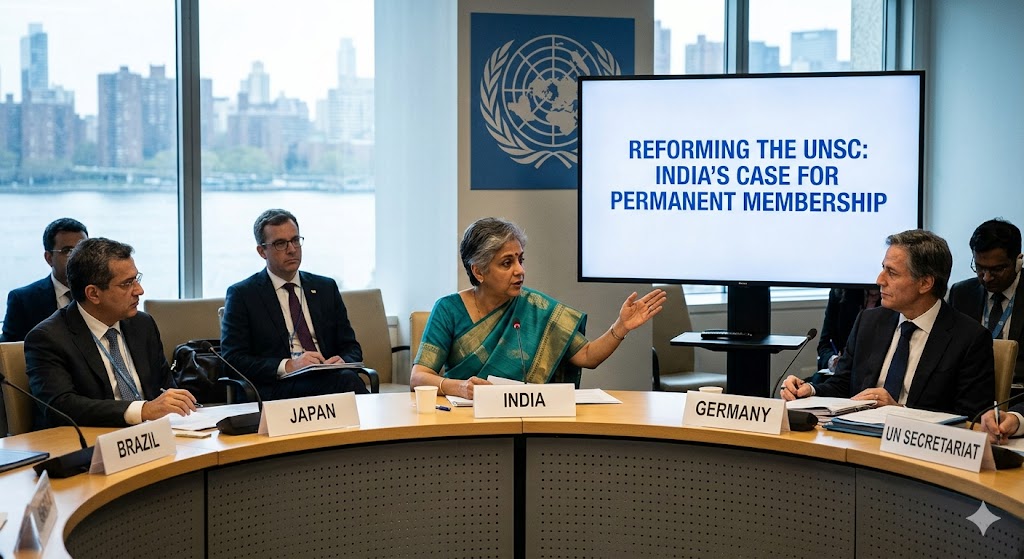
India's External Affairs Minister leads high-level discussions at the United Nations in New York, actively advocating for India’s permanent seat in a reformed Security Council.
India's Relentless Efforts and Global Contributions
India has pursued its UN Security Council permanent member ambitions through multifaceted diplomacy. Key efforts include:
Active Non-Permanent Tenure: India’s eight terms, most recently 2021-2022, showcased leadership on counter-terrorism, peacekeeping, and maritime security. During its 2021-22 stint, New Delhi championed reformed multilateralism and climate action.
G4 Coordination: Joint advocacy with Brazil, Germany, and Japan has produced detailed reform models, including text-based negotiations at Intergovernmental Negotiations (IGN) sessions. In 2026 IGN meetings, the G4 proposed adding permanent seats without immediate veto for new members as a compromise.
UNGA Advocacy: Annual high-level speeches by Prime Ministers and Foreign Ministers consistently highlight the need for UNSC reform. Jaishankar's 2025 UNGA address emphasized that "both permanent and non-permanent membership must expand" for a truly representative Council.
Bilateral and Multilateral Outreach: India secures endorsements from over 150 nations, including the African Union, European Union partners, and the Quad. Russia has repeatedly affirmed support for India alongside Brazil. The United States, United Kingdom, and France have expressed backing in joint statements.
Peacekeeping Leadership: India has deployed over 290,000 personnel across more than 50 UN peacekeeping missions since 1948—the highest contribution globally. Currently, around 5,200 Indian troops serve in nine missions, often in high-risk African theaters. This operational experience positions India uniquely among aspirants.
Global Initiatives: Hosting the 2023 G20 Summit under the theme "One Earth, One Family, One Future" amplified India's voice on sustainable development and inclusive governance. Vaccine Maitri during COVID-19 and disaster relief further burnished its credentials.
These efforts demonstrate India's proactive role, not mere rhetoric, in strengthening the UN system.
India's Strengths: Why It Deserves—and Is Capable of—a Permanent Seat
India's qualifications as a UN Security Council permanent member are compelling and, in many respects, surpass those of some current P5 nations. Its positive points include:
-Demographic and Democratic Weight: As the world's largest democracy, India represents the aspirations of the Global South. Its population and vibrant institutions ensure decisions reflect diverse voices, unlike smaller P5 members.
Economic Prowess: Ranked among the top five global economies (fourth by some metrics in 2025-26 projections), India's growth trajectory—projected to contribute significantly to world GDP—underscores its stake in global stability.
Military and Security Contributions: With the world's third-largest armed forces and a blue-water navy, India secures critical sea lanes. Its nuclear status and counter-terrorism expertise address modern threats effectively.
Peacekeeping Record: Beyond numbers, Indian peacekeepers have shaped doctrine, provided Force Commanders, and suffered 182 fatalities in service—demonstrating sacrifice over self-interest.
Multilateral Leadership: India's Non-Aligned Movement legacy, BRICS engagement, and climate diplomacy (e.g., International Solar Alliance) position it as a bridge-builder between North and South.
Normative Influence: Commitment to sovereignty, non-intervention, and equitable development aligns with UN principles, offering a counterbalance to great-power politics.
India already possesses the capabilities of a P5 member: diplomatic networks spanning 190+ countries, economic leverage via trade and technology, and a proven ability to deploy forces rapidly for humanitarian and stability operations. In a reformed Council, it would enhance decision-making without diluting effectiveness—studies of G4 models suggest expanded Councils could pass more resolutions.
Challenges and Opposition: The Role of China and Regional Problems
Despite strong credentials, India's path to permanent membership faces formidable barriers. Chief among them is opposition from China—the only P5 member yet to endorse New Delhi unequivocally. Beijing views itself as Asia's sole permanent representative and fears dilution of its influence. Ongoing border disputes, notably in Ladakh, exacerbate tensions; China has linked India's "unqualified" status to Kashmir issues in state media.
Regional dynamics compound this. Pakistan, a vocal opponent within the Uniting for Consensus (UfC) group, argues against adding new permanents, fearing India's elevation would tilt South Asian balances. Italy, South Korea, and others in UfC prefer consensus-based expansion or additional non-permanent seats only.
These stances stem from geopolitical rivalries rather than merit. China’s resistance preserves its veto leverage in Asian affairs, while smaller powers worry about marginalization. Such opposition highlights how national interests trump collective reform.
UN Charter Reforms and Structural Barriers
Fundamental to the impasse are the UN Charter's amendment provisions (Article 108). Any expansion requires a two-thirds majority in the UNGA (at least 128 votes) followed by ratification by two-thirds of member states, **including all five P5 nations**. This grants each permanent member de facto veto over reforms affecting their status.
The G4's flexible approach—new permanents initially without veto—seeks compromise, yet P5 divisions persist. France and the UK favor expansion; the US supports in principle but prioritizes effectiveness; Russia endorses India but hedges on details; China blocks outright. Without P5 unanimity, Charter changes remain theoretical.
Regional problems, including African demands for two permanent seats and Latin American aspirations, further fragment support, creating competing models.
Recent Developments: India's Global Status Over the Last Seven Years (2019–2026)
The past seven years have accelerated India's momentum. Its 2021-2022 UNSC term coincided with the COVID-19 crisis, where it advocated equitable vaccine access. The 2023 G20 presidency delivered the Delhi Declaration, bridging divides on Ukraine and development.
At UNGA 80 (2025), world leaders from Bhutan, Mauritius, and others endorsed India's bid, citing its peacekeeping and economic roles. Russia reiterated support in September 2025. Diplomatic engagements, including UK Prime Minister Keir Starmer's 2025 India visit and Quad summits, reinforced backing from the US, UK, and France.
Even China showed nuanced signals in early 2026 Delhi talks, stressing "respect" for India's role amid border management. Yet, full endorsement remains absent. Jaishankar's consistent messaging—"the world is moving towards multipolarity"—resonates, but structural inertia endures. India's capabilities continue to outpace obstacles, with troop contributions and economic growth reinforcing its claim.
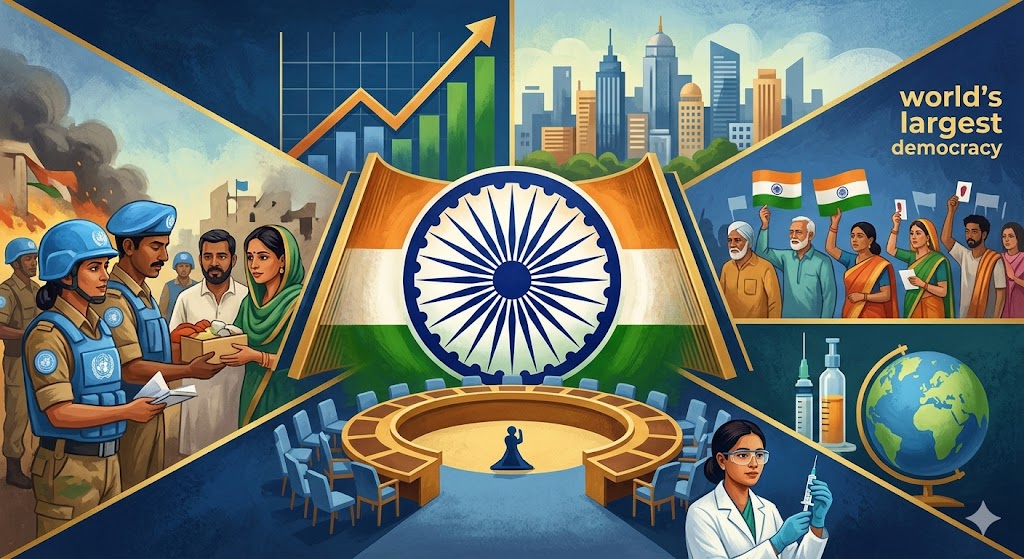
This conceptual graphic illustrates the pillars supporting India's bid for permanent UNSC membership, highlighting its massive UN peacekeeping contributions, rapid economic growth, and demographic significance as the world’s largest democracy.
The Road Ahead: Prospects and India's Enduring Capabilities
India's quest for UNSC permanent membership embodies a just demand for reformed global governance. Its positive attributes—scale, contributions, and vision—make it not only deserving but essential for a credible Council. While China's role as primary obstacle, coupled with Charter rigidity and regional frictions, explains the delay, shifting global dynamics favor progress.
A reformed UNSC with India as a permanent member would be more representative, legitimate, and effective. New Delhi stands ready, as evidenced by decades of service. The coming years demand sustained diplomacy, P5 consensus-building, and Global South solidarity.
In conclusion, India's bid transcends national interest; it is a call to align the UN with contemporary realities. As global challenges mount, the case for India as a UN Security Council permanent member grows irrefutable. The world—and the UN—stands to gain immensely from its inclusion.
Frequently Asked Questions
What is the primary significance of India's Quest for UN Security Council Permanent Membership?
In an era of rapid geopolitical shifts, India's quest for a permanent seat in the United Nations Security Council (UNSC) stands as a cornerstone of its ambition for global status. As the world's largest democracy and a rising economic powerhouse, India has long argued that the UNSC—unchanged in its core structure since 1945—must reflect 21st-century realities.
How does this development impact News?
The phrase "India UN Security Council permanent member" resonates across diplomatic corridors, symbolizing not just national aspiration but a broader call for multilateral reform.The UNSC, tasked with maintaining international peace and security, currently comprises five permanent members (P5)—China, France, Russia, the United Kingdom, and the United States—each wielding veto power, alongside 10 elected non-permanent members. This outdated framework, critics argue, marginalizes emerging powers like India, which has served on the Council eight times as a non-permanent member yet lacks the decisive voice its contributions warrant.India's bid for permanent membership in the UN Security Council is not a recent phenomenon but a sustained diplomatic campaign spanning decades.
What are the key future projections to monitor?
Backed by the G4 nations (India, Brazil, Germany, and Japan), New Delhi advocates for an expanded Council that includes new permanent seats for underrepresented regions.