Insolvency and Bankruptcy Code Amendment Bill 2026
News• April 05, 2026• Global Edition
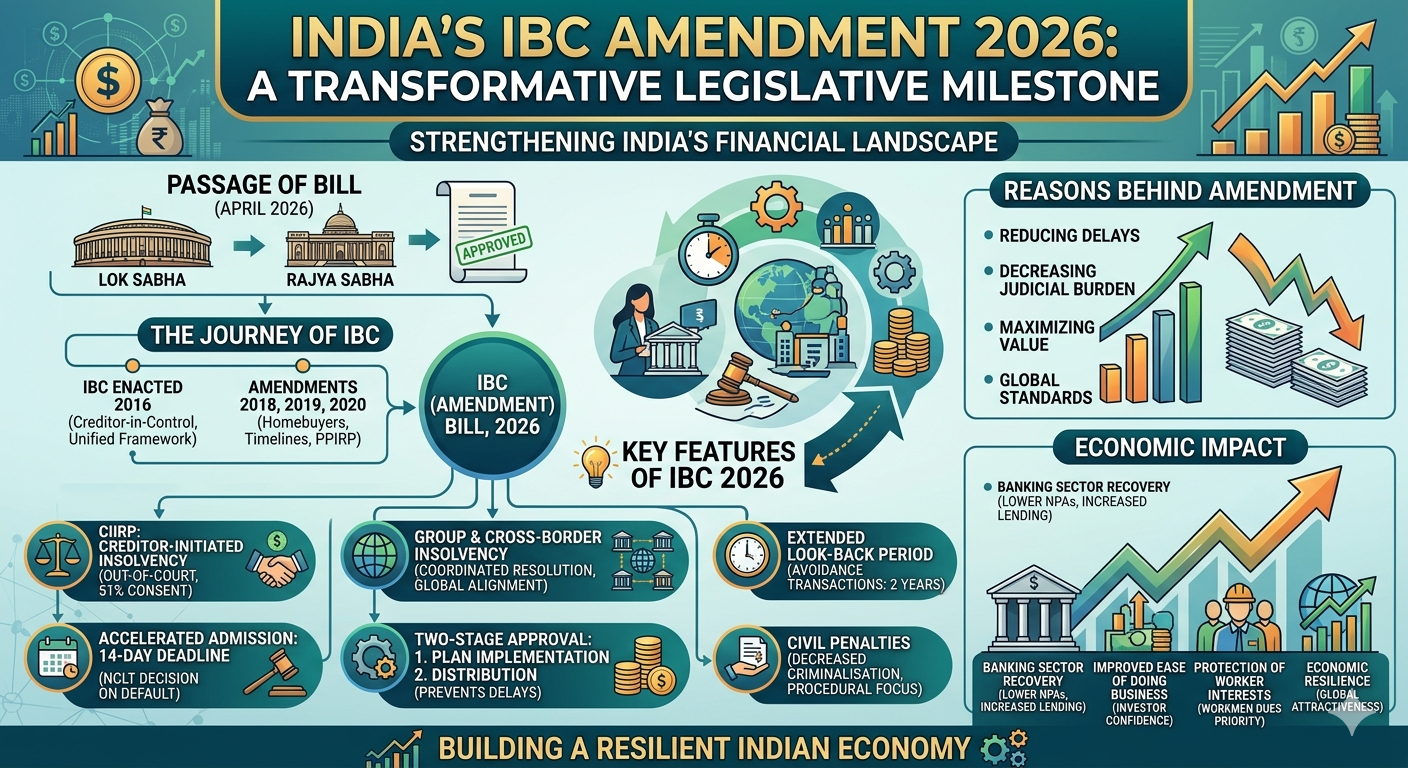
The Indian financial landscape has witnessed a transformative shift with the passage of the Insolvency and Bankruptcy Code (Amendment) Bill, 2026. Approved by both the Lok Sabha and the Rajya Sabha, this legislative milestone marks a significant step in refining India’s insolvency framework. Since its inception in 2016, the Insolvency and Bankruptcy Code (IBC) has been the cornerstone of corporate debt resolution. The 2026 amendment seeks to address existing bottlenecks, accelerate resolution timelines, and enhance the overall efficiency of the process. This article provides a comprehensive overview of the Bill, its historical context, key provisions, and the profound impact it is expected to have on the Indian economy.
History of the Insolvency and Bankruptcy Code (IBC)
To understand the 2026 amendment, it is essential to look back at the origins of the IBC. Before 2016, India's insolvency and bankruptcy laws were fragmented, governed by multiple outdated statutes such as the Sick Industrial Companies Act (SICA) and the SARFAESI Act. This fragmentation led to prolonged delays, often spanning several years, and resulted in significant value erosion of stressed assets.
The Enactment of IBC 2016
The Insolvency and Bankruptcy Code, 2016, was introduced to provide a unified, time-bound framework for resolving insolvency. It established the National Company Law Tribunal (NCLT) as the adjudicating authority and the Insolvency and Bankruptcy Board of India (IBBI) as the regulator. The primary objective was to move away from a "debtor-in-possession" model to a "creditor-in-control" model, ensuring that creditors had the power to steer the resolution process.
Evolution Through Amendments
Since 2016, the IBC has undergone several amendments to adapt to the evolving economic environment. Notable amendments include:
2018 Amendment: Focused on homebuyer rights and the eligibility of resolution applicants.
2019 Amendment: Strengthened timelines and clarified the distribution of proceeds.
2020 Amendment: Introduced the Pre-packaged Insolvency Resolution Process (PPIRP) for MSMEs.
The 2026 amendment is the most comprehensive update yet, incorporating feedback from stakeholders and recommendations from various expert committees.
The Journey of the 2026 Amendment Bill
The Insolvency and Bankruptcy Code (Amendment) Bill, 2026, followed a rigorous legislative process before becoming law.
Introduction in Lok Sabha
The Bill was introduced in the Lok Sabha on March 30, 2026, by the Minister of State for Corporate Affairs. During the discussions, the government emphasized the need to streamline the resolution process and reduce the burden on the NCLT. The Lok Sabha passed the Bill after extensive debate, highlighting its potential to improve the ease of doing business.
Approval by Rajya Sabha
Following its passage in the Lok Sabha, the Bill was presented to the Rajya Sabha. On April 1, 2026, the Rajya Sabha approved the Bill via a voice vote. Finance Minister Nirmala Sitharaman, while replying to the discussion, reiterated that the IBC's primary goal is to rescue viable businesses and preserve enterprise value rather than functioning merely as a debt recovery tool.
Key Features of the IBC Amendment Bill 2026
The 2026 amendment introduces several groundbreaking features designed to modernize the insolvency framework.
1. Creditor-Initiated Insolvency Resolution Process (CIIRP)
One of the most significant reforms is the introduction of the CIIRP. This process allows financial creditors to initiate insolvency proceedings outside the traditional court-driven framework, provided they have 51% voting consent. This "out-of-court" mechanism is expected to significantly reduce the time and cost associated with litigation.
2. Accelerated Admission Process
The amendment mandates that the NCLT must admit or reject an insolvency application within 14 days once a default is established. This move aims to eliminate the initial delays that have historically plagued the insolvency process.
3. Two-Stage Approval Framework
The Bill introduces a two-stage approval process for resolution plans. The Adjudicating Authority (AA) will first approve the implementation of the plan and then, within 30 days, approve the manner of distribution. This de-linking prevents inter-creditor disputes from stalling the actual revival of the company.
4. Group and Cross-Border Insolvency
For the first time, India has introduced a framework for group insolvency. This allows for the coordinated resolution of interconnected companies within the same corporate group. Additionally, the Bill paves the way for cross-border insolvency, aligning India’s laws with global best practices and facilitating cooperation with international jurisdictions.
5. Extended Look-Back Period for Avoidance Transactions
To prevent the diversion of assets before insolvency, the look-back period for preferential, undervalued, and fraudulent transactions has been extended. The period now runs two years back from the date of filing the insolvency application, rather than the date of admission.
6. Transition from Criminal to Civil Penalties
Recognizing that procedural delays are not always malicious, the Bill omits certain criminal penalties and replaces them with civil penalties. This shift aims to reduce unnecessary litigation while maintaining accountability.
Insolvency and Bankruptcy Code (Amendment) Bill, 2026: The Parliament of India has passed the historic Insolvency and Bankruptcy Code (Amendment) Bill, 2026, marking a significant milestone in India’s corporate insolvency resolution framework. Approved by both the Lok Sabha and the Rajya Sabha, the landmark legislation introduces crucial reforms designed to streamline the resolution process, reduce delays, and strengthen the overall efficiency of the regime. Key features include an accelerated admission process, group and cross-border insolvency provisions, and a two-stage approval framework for resolution plans. This comprehensive update is expected to boost investor confidence, improve the ease of doing business, and ultimately contribute to a more resilient and dynamic Indian economy.
Reasons Behind the 2026 Amendment
The government identified several critical areas that necessitated these reforms:
• Reducing Procedural Delays: Despite the IBC’s intent to be time-bound, many cases faced significant delays at the admission and approval stages.
• Decreasing Judicial Burden: By introducing out-of-court mechanisms like CIIRP, the government aims to reduce the massive backlog of cases at the NCLT.
• Maximizing Value Realization: Faster resolution ensures that assets do not lose their value during prolonged litigation, leading to better recovery for creditors.
• Aligning with Global Standards: Provisions for cross-border and group insolvency make India a more attractive destination for foreign investment.
The 2026 amendment is poised to have a far-reaching impact on India’s economic growth and financial stability.
1. Strengthening the Banking Sector
By facilitating faster recovery of Non-Performing Assets (NPAs), the Bill will improve the health of the banking sector. Increased recoveries allow banks to lend more freely, fueling credit growth across various sectors.
2. Improving Ease of Doing Business
A robust insolvency framework is a key metric for global ease of doing business rankings. The reforms in the 2026 Bill signal India's commitment to providing a predictable and efficient legal environment for businesses and investors.
3. Boosting Investor Confidence
Clearer guidelines on creditor rights and prioritized distribution will enhance the confidence of both domestic and international investors. The ability to resolve group insolvencies and handle cross-border cases reduces the risks associated with large-scale investments.
4. Protection of Worker Interests
The amendment reinforces the priority of workmen dues during the liquidation process. By ensuring that employees' interests are safeguarded, the Bill maintains a balance between economic efficiency and social responsibility.
Conclusion
The passage of the Insolvency and Bankruptcy Code (Amendment) Bill, 2026, by the Lok Sabha and Rajya Sabha marks a new era in India's financial reforms. By addressing the practical challenges faced over the last decade and incorporating global best practices, the amendment provides a more agile, transparent, and creditor-friendly framework. As these changes take effect, they are expected to significantly reduce resolution timelines, maximize asset value, and ultimately contribute to a more resilient and dynamic Indian economy. The 2026 Bill is not just a legislative update; it is a strategic move to fortify India's position as a global economic powerhouse.
Frequently Asked Questions
What is the primary significance of Insolvency and Bankruptcy Code Amendment Bill 2026?
The Indian financial landscape has witnessed a transformative shift with the passage of the Insolvency and Bankruptcy Code (Amendment) Bill, 2026. Approved by both the Lok Sabha and the Rajya Sabha, this legislative milestone marks a significant step in refining India’s insolvency framework.
How does this development impact News?
Since its inception in 2016, the Insolvency and Bankruptcy Code (IBC) has been the cornerstone of corporate debt resolution. The 2026 amendment seeks to address existing bottlenecks, accelerate resolution timelines, and enhance the overall efficiency of the process.
What are the key future projections to monitor?
This article provides a comprehensive overview of the Bill, its historical context, key provisions, and the profound impact it is expected to have on the Indian economy.History of the Insolvency and Bankruptcy Code (IBC)To understand the 2026 amendment, it is essential to look back at the origins of the IBC.