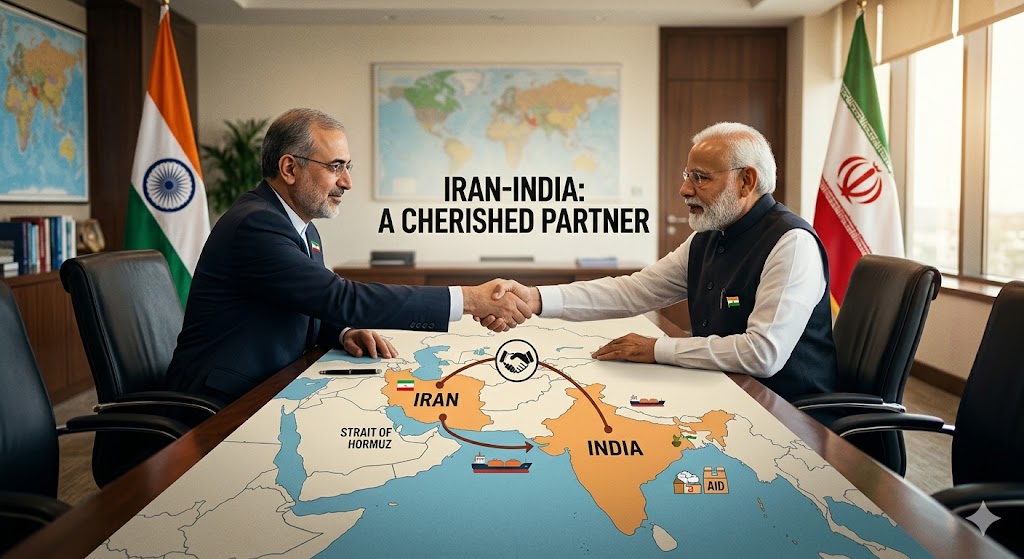
Iran-India: A Trusted Civilizational Bond Secures Global LPG
International Affairs• April 04, 2026• Global Edition
A Legacy of Brotherhood: The History of India-Iran Friendship
The modern geopolitical landscape of 2026 is navigating one of its most volatile and defining periods in recent memory. The triangular tension involving Israel, Iran, and the United States has sent unprecedented shockwaves through global energy markets, creating a mid-work crisis for nations dependent on the fragile stability of the Persian Gulf. However, amidst the chaos of the Strait of Hormuz—a maritime chokepoint responsible for nearly 20% of the world’s Liquefied Petroleum Gas (LPG) and oil trade—one nation stands out as a unique beacon of diplomatic pragmatism: India. While many global powers have been forced to halt maritime operations due to security threats, naval skirmishes, and active blockades, India has maintained a "trusted partner" status that defies the binary logic of modern warfare. This relationship has culminated in a significant development where Tehran has explicitly authorized the safe passage of Indian LPG tankers, ensuring that the energy needs of over 1.4 billion people remain insulated from the regional firestorm.
Iran Labels India a "Trusted Partner" Amidst War
To understand why Iran would grant such a massive strategic concession during a period of high-alert conflict with the US and Israel, one must look back at the civilizational bridge that connects New Delhi and Tehran. This friendship is not a product of 20th-century oil contracts; it is a 2,500-year-old legacy of shared culture, language, and mutual survival. From the era of the Achaemenid Empire to the Mughal period, the exchange of ideas, art, and scholars created a "deep state" of cultural affinity. Persian was the official court language of India for centuries, and this historical proximity has fostered a level of psychological trust that Western diplomacy often fails to grasp. When Iran refers to India as a "trusted partner," they are invoking a history where India has never sought to colonize, subvert, or militarily threaten the Persian plateau.
The core of this unique maritime arrangement lies in a recent, high-level declaration from the Iranian leadership. In a move that surprised global analysts but felt natural to those familiar with regional history, Iran officially designated India as its "most trusted partner" in the East. This was not merely a rhetorical flourish; it was a functional directive to the Iranian Revolutionary Guard Corps (IRGC) and naval authorities managing the Strait of Hormuz. The message was clear: while the waterway might be contested or closed to those perceived as aggressors, the path remains open for India. This "India-only" corridor has seen the successful transit of 8 major LPG ships over the last four months—a period during which global shipping insurance rates skyrocketed and many Western vessels were diverted around the Cape of Good Hope.
This trust has been meticulously reciprocated by India, especially during Iran’s times of greatest need. India’s foreign policy is defined by a refusal to abandon friends under external pressure. During previous rounds of global sanctions and throughout the various crises of the 2020s, India remained one of the few nations to continue humanitarian aid and trade. When Iran faced critical shortages of medical supplies and essential commodities during regional upheavals, India bypassed complex financial blockades to ensure that life-saving aid reached the Iranian people. This "aid without strings" approach is precisely why Iran today views India as a "peace country." India does not see Iran as a "target" or a "threat," but as a vital part of the Asian landscape that must be integrated rather than isolated.
The current situation in 2026 highlights India’s "straightforward" diplomacy. While the US and Israel have sought to build a coalition to contain Iranian influence, India has maintained a principled distance from military entanglements. New Delhi has been vocal in its stance: it does not support the escalation of war, whether from the West or the Middle East. Instead, India’s support is directed squarely at the people suffering from the conflict. By refusing to join naval task forces aimed at Iran, India signaled that its interests are focused on regional stability and energy security, not regime change or ideological warfare. This stance of strategic autonomy has allowed India to act as a bridge, communicating with Tel Aviv and Washington on one hand, while maintaining "trusted partner" status with Tehran on the other.
The Logistics of Peace: LPG Tankers and the Strait of Hormuz
The logistics of the LPG passage in the Strait of Hormuz serve as the ultimate proof of this diplomatic success. Over the last quarter, while the world watched the Sensex and global markets fluctuate due to war fears, Indian tankers like the Jag Vasant and the Green Sanvi moved through the narrowest points of the Strait with Iranian naval escorts often providing silent protection rather than hindrance. These ships have carried the equivalent of millions of domestic cylinders, preventing a massive energy inflation spike within India. Iran’s commitment to "always keep the Strait open for India" is a direct reward for India’s refusal to succumb to third-party pressures.
Furthermore, India’s help to Iran is not just about the past; it is an ongoing commitment. Even as the Israel-Iran conflict reached a fever pitch, India continued to facilitate the development of the Chabahar Port, providing Iran with a vital economic outlet that bypasses traditional conflict zones. This "reciprocal loyalty" creates a cycle where both nations protect each other’s core interests—energy for India and economic connectivity for Iran. It is a partnership built on the understanding that while regimes and global alliances may change, the geography and the shared history of these two nations are permanent.
The specific dynamics of the 2026 crisis have forced many nations to choose sides, but India has chosen the path of the "Peace Broker." In various international forums, Indian representatives have emphasized that the world is "really suffering from war" and that the disruption of energy supplies is a humanitarian crisis, not just an economic one. By positioning itself as a "straightforward supporter of the people," India has managed to convince Iran that its use of the Strait of Hormuz is for the greater good of the common man, rather than for military posturing. This narrative has resonated deeply in Tehran, leading to the unprecedented security guarantees for Indian LPG tankers.
Official Strategic Meeting: Securing the Indo-Iranian Energy Corridor
India’s "People-First" Diplomacy
As we look toward the future of 2026 and beyond, the India-Iran relationship stands as a masterclass in "peace-state" diplomacy. By choosing to support people over politics and humanitarian stability over military alliances, India has secured an "energy lifeline" that other nations can only envy. Iran’s designation of India as a "trusted partner" is a testament to a friendship that has survived the test of centuries and is now surviving the test of modern war. As the ships pass through the Strait of Hormuz, they carry more than just LPG; they carry the weight of a civilizational bond that remains unbroken despite the world’s suffering.
Conclusion: A Partnership Built on Mutual Respect
This partnership also has a profound impact on the Indian economy. While global oil and gas prices spiked by 30% in early 2026 due to the Hormuz tensions, India managed to keep its domestic LPG prices stable. This was only possible because of the guaranteed volumes and the "safe passage" status. The Indian government’s ability to provide relief to its citizens during a global conflict is a direct result of this long-term investment in Iranian friendship. It serves as a reminder that in the world of realpolitik, sometimes the most "human-like" and straightforward friendships are the most strategically valuable.
In conclusion, the story of India and Iran in the Strait of Hormuz is one of mutual respect and shared destiny. It proves that even in a world divided by war, there are pockets of trust that can keep the wheels of the world turning. As India continues to provide aid to Iran and Iran continues to protect India’s energy interests, the rest of the world can look to this relationship as a blueprint for stability in an increasingly unstable age..
Frequently Asked Questions
What is the primary significance of Iran-India: A Trusted Civilizational Bond Secures Global LPG?
A Legacy of Brotherhood: The History of India-Iran FriendshipThe modern geopolitical landscape of 2026 is navigating one of its most volatile and defining periods in recent memory. The triangular tension involving Israel, Iran, and the United States has sent unprecedented shockwaves through global energy markets, creating a mid-work crisis for nations dependent on the fragile stability of the Persian Gulf.
How does this development impact International Affairs?
However, amidst the chaos of the Strait of Hormuz—a maritime chokepoint responsible for nearly 20% of the world’s Liquefied Petroleum Gas (LPG) and oil trade—one nation stands out as a unique beacon of diplomatic pragmatism: India. While many global powers have been forced to halt maritime operations due to security threats, naval skirmishes, and active blockades, India has maintained a "trusted partner" status that defies the binary logic of modern warfare.
What are the key future projections to monitor?
This relationship has culminated in a significant development where Tehran has explicitly authorized the safe passage of Indian LPG tankers, ensuring that the energy needs of over 1.4 billion people remain insulated from the regional firestorm.Iran Labels India a "Trusted Partner" Amidst WarTo understand why Iran would grant such a massive strategic concession during a period of high-alert conflict with the US and Israel, one must look back at the civilizational bridge that connects New Delhi and Tehran.