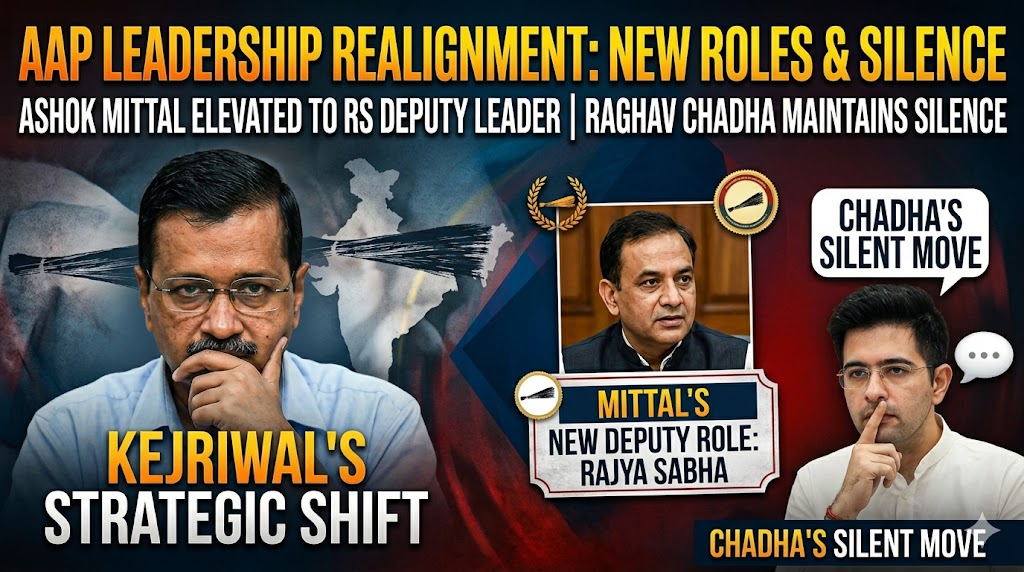
AAP Removes Raghav Chadha as Rajya Sabha Deputy Leader
News• April 02, 2026• Global Edition
In a surprising yet decisive move that has sent ripples through Indian political circles, the Aam Aadmi Party (AAP) has formally removed Raghav Chadha as its Rajya Sabha deputy leader. On April 2, 2026, the party wrote to the Rajya Sabha Secretariat, not only proposing Punjab MP Ashok Mittal as the replacement but also explicitly instructing the House not to allot speaking time to Chadha from AAP’s allocated quota. This development, coming just days after key court outcomes for senior AAP leaders, has ignited intense speculation about internal dynamics within a party long known for projecting an image of unity and anti-establishment resolve.
For observers of Indian politics, the decision to sideline a once-promising face like Raghav Chadha is more than a routine organisational reshuffle. It raises fundamental questions about loyalty, discipline, and leadership style in a party that rose to prominence on the promise of clean, people-centric governance. In this comprehensive article, we delve deep into the sequence of events, the speculated reasons behind AAP and Arvind Kejriwal’s decision, the negative effects of Chadha’s personality and leadership approach on the party, and the potential impact on the broader political landscape. As AAP navigates multiple state elections and ongoing challenges at the national level, this episode offers a window into how even established parties recalibrate power to preserve cohesion.
Raghav Chadha’s journey with AAP began in the early days of the party’s formation, during the India Against Corruption movement. A chartered accountant by training, Chadha quickly caught the eye of Arvind Kejriwal with his sharp intellect and organisational skills. He played a behind-the-scenes role in drafting the Delhi Lokpal Bill in 2012 and rose through the ranks to become the party’s national spokesperson and its youngest treasurer after the landmark 2015 Delhi Assembly victory.
His electoral foray included a loss in the 2019 Lok Sabha polls from South Delhi, followed by a win in the 2020 Delhi Assembly elections from Rajendra Nagar. Chadha later served as vice-chairman of the Delhi Jal Board, where he gained visibility on issues like water management and urban governance. In 2022, at just 33, he became one of the youngest Rajya Sabha MPs, representing Punjab. By 2023, AAP had elevated him to deputy leader in the Upper House, where he carved a niche by raising citizen-centric issues—from menstrual hygiene and gig workers’ rights to air pollution, rising airfares, and the “sarpanch pati” phenomenon that undermines women’s political empowerment.
Chadha’s articulate interventions in Parliament often went viral, earning him praise for bringing urban, middle-class concerns into national discourse. He was seen as a bridge between AAP’s grassroots appeal and its aspirational, educated voter base. Yet, beneath this polished public image, subtle signs of disconnect began emerging over the past few years. Insiders now point to a gradual drift that ultimately led to the party’s decision to remove Raghav Chadha from his influential post.
The Announcement: What Exactly Happened on April 2, 2026
The move unfolded swiftly. AAP dispatched an official letter to the Rajya Sabha Secretariat requesting the immediate removal of Raghav Chadha as deputy leader. In the same communication, the party nominated Ashok Mittal—a Punjab-based MP and chancellor of Lovely Professional University—as the new deputy leader. Crucially, the letter went further: it directed the Secretariat not to allot any speaking time to Chadha from AAP’s quota in the Upper House.
This dual action—demotion plus restriction on parliamentary voice—is unprecedented in recent AAP history. While Chadha remains a Rajya Sabha MP and has not been suspended or expelled, the message was clear: his role as a prominent spokesperson and floor manager for the party in the House was over. Within hours, the Rajya Sabha website reflected the change, with Mittal listed in the new position alongside leader Sanjay Singh.
Chadha’s immediate response was understated but telling. He posted a video compilation of his past parliamentary interventions on social media, highlighting his work on public issues without directly addressing the demotion. Party leaders, including Mittal, downplayed the development as a “normal organisational process” that allows fresh faces to gain experience. However, the explicit bar on speaking time suggests a deeper intent to limit Chadha’s visibility and influence.
Why Did AAP Remove Raghav Chadha? Unpacking the Reasons
While AAP has not issued an official statement citing specific grievances, multiple reliable sources point to a pattern of behaviour that eroded trust. The primary triggers revolve around Chadha’s prolonged silence on critical party matters and his absence during moments of crisis.
One glaring example was his muted response during Arvind Kejriwal’s arrest in the excise policy case in March 2024. At the time, Chadha was abroad for eye surgery, which he cited as the reason for his delayed public engagement. Even after returning, however, he met Kejriwal sparingly and refrained from robust defence of the party leadership. Similarly, when Kejriwal and Manish Sisodia received a clean chit in the same case in late February 2026, Chadha was notably absent from the celebratory press conference and made no public statement.
Reports also highlight his limited participation in the run-up to the 2025 Delhi Assembly polls and other campaigns. Party insiders allege that Chadha appeared “unavailable at crucial junctures,” focusing instead on enhancing his personal profile through high-visibility parliamentary questions rather than collective party work. There were murmurs of interference in the day-to-day affairs of the Bhagwant Mann-led Punjab government, which some viewed as overstepping his mandate as a Rajya Sabha MP.
These factors combined to create a perception of indiscipline and misalignment. In a party that prides itself on collective decision-making and unwavering loyalty to its founding ideals, such distance was seen as detrimental. The decision to remove Raghav Chadha, therefore, appears driven by the need to reinforce discipline and ensure all leaders speak with one voice—especially ahead of key state polls.
Raghav Chadha’s Personality and Leadership Style: The Negative Impact on AAP
To understand why AAP ultimately chose to sideline Chadha, one must examine his personality and leadership traits, which, while assets in opposition politics, increasingly became liabilities for party cohesion.
Chadha is widely regarded as ambitious, articulate, and media-savvy—a polished orator who excels at framing complex issues for urban audiences. His background as a chartered accountant lent him credibility on economic and governance matters. However, this very ambition often translated into a perceived self-focused approach. Insiders describe him as someone who prioritised building an independent public brand over subordinating himself to the party’s collective narrative. His aggressive questioning in Rajya Sabha on niche topics like gig economy reforms or menstrual hygiene, while popular externally, sometimes came at the expense of toeing the party line on broader political battles.
This independent streak had tangible negative effects on AAP. First, it fostered perceptions of internal discord. When a high-profile leader like Chadha remains silent during leadership crises, it signals to cadres and voters that unity may be fracturing. In a party built on the cult of Kejriwal’s personal integrity and anti-corruption ethos, such absences undermined the “one family” image AAP has carefully cultivated.
Second, his reported interference in Punjab affairs created operational friction. State units felt micromanaged by a national-level figure whose primary platform was Parliament, leading to resentment and inefficiency. This diluted the party’s federal structure, where local leaders like Bhagwant Mann are meant to hold primary sway.
Third, from a leadership perspective, Chadha’s style lacked the humility and deference that AAP demands from its second-rung leaders. While his oratory boosted visibility, it also projected an image of individualism that clashed with the party’s emphasis on collective sacrifice. Over time, this eroded trust at the top. Kejriwal, known for nurturing loyal lieutenants who prioritise party over persona, reportedly viewed Chadha’s gradual distancing as a threat to organisational discipline.
In essence, Raghav Chadha’s personality—charismatic yet ambitious, articulate yet selective in engagement—negatively impacted AAP by introducing elements of unpredictability and perceived elitism. It risked alienating grassroots workers who saw him as more focused on personal milestones than the party’s long-term survival. By removing him from the deputy leader role, AAP has signalled that no individual, however talented, is indispensable if their approach compromises unity.
The Broader Political Dynamics: Impact on AAP and Indian Politics
The removal of Raghav Chadha as Rajya Sabha deputy leader carries significant implications for AAP’s internal and external political standing.
Internally, the move reinforces centralised control under Kejriwal. It sends a clear message to other leaders: alignment and active participation are non-negotiable. By avoiding outright suspension, the party cleverly prevents Chadha from gaining “martyr” status while still curtailing his influence. This recalibration could strengthen AAP’s cohesion as it prepares for polls in states like Punjab, where Chadha hails from, but it also risks losing a young, articulate voice that appealed to urban voters.
Externally, opposition parties have already pounced on the development. The BJP has described it as evidence of “growing dissent” and questioned Kejriwal’s ability to manage his own house. Such narratives could dent AAP’s carefully built brand of being different from traditional parties plagued by factionalism. In the Rajya Sabha, where numbers matter for legislative battles, reducing Chadha’s speaking opportunities may weaken AAP’s parliamentary firepower on key issues.
On a larger scale, this episode reflects the evolving nature of Indian politics, where even reformist parties must balance individual talent with iron-clad discipline. It highlights how personality-driven movements like AAP eventually confront the same challenges of succession and loyalty that older parties face. The restriction on speaking time, in particular, underscores a strategic shift: parliamentary performance will now be tightly coordinated, potentially making AAP’s interventions more focused but less spontaneous.
The Aam Aadmi Party (AAP) is witnessing a significant shift in its internal dynamics. With Ashok Mittal stepping into the role of Rajya Sabha Deputy Leader, questions arise regarding the party’s evolving hierarchy
Why AAP and Kejriwal Chose This Path: A Strategic Reckoning
At its core, the decision stems from self-preservation. AAP has weathered multiple legal and electoral storms precisely because of its image as a disciplined, Kejriwal-centric outfit. Chadha’s drift threatened that narrative. By acting now, the party pre-empts further erosion of authority and demonstrates that even former protégés must adhere to the collective ethos.
Kejriwal, whose own leadership style emphasises loyalty and visibility during crises, likely saw Chadha’s absences as a breach of the unwritten code that binds AAP. The move also paves the way for newer, more aligned leaders like Mittal to rise, injecting fresh energy while sidelining potential sources of discord. In short, AAP removed Raghav Chadha to safeguard its unity and project an image of decisive, merit-based leadership—qualities it has always claimed define the party.
Future Implications and What Lies Ahead
Looking forward, Chadha’s political trajectory remains uncertain. As a sitting MP, he can still attend sessions and raise issues independently, though without party backing his visibility will diminish. Speculation about a possible shift to another party persists, though he has given no indication of defection. For AAP, the focus will be on damage control—reassuring cadres and projecting business-as-usual.
This episode may also prompt introspection within AAP about nurturing second-generation leaders without allowing personal ambitions to overshadow party goals. For Indian politics at large, it serves as a reminder that in an era of 24/7 media scrutiny, internal rifts—no matter how subtle—can quickly become national talking points.
Conclusion
The decision by AAP and Arvind Kejriwal to remove Raghav Chadha as Rajya Sabha deputy leader, coupled with the bar on speaking time, marks a pivotal moment in the party’s evolution. What began as a promising partnership between a visionary founder and a talented protégé has given way to a pragmatic assertion of discipline. While Chadha’s contributions to parliamentary discourse were noteworthy, his personality and leadership approach ultimately exerted a negative influence by fostering perceptions of distance and individualism—qualities that clashed with AAP’s core DNA.
As the party moves ahead, this reshuffle may strengthen its internal resolve but at the cost of losing a dynamic voice. Only time will tell whether this recalibration bolsters AAP’s unity or exposes deeper fault lines. In the volatile arena of Indian politics, one thing is certain: loyalty and alignment remain the currency of survival, and AAP has once again reminded everyone of that unyielding reality.
Frequently Asked Questions
What is the primary significance of AAP Removes Raghav Chadha as Rajya Sabha Deputy Leader?
In a surprising yet decisive move that has sent ripples through Indian political circles, the Aam Aadmi Party (AAP) has formally removed Raghav Chadha as its Rajya Sabha deputy leader. On April 2, 2026, the party wrote to the Rajya Sabha Secretariat, not only proposing Punjab MP Ashok Mittal as the replacement but also explicitly instructing the House not to allot speaking time to Chadha from AAP’s allocated quota.
How does this development impact News?
This development, coming just days after key court outcomes for senior AAP leaders, has ignited intense speculation about internal dynamics within a party long known for projecting an image of unity and anti-establishment resolve.For observers of Indian politics, the decision to sideline a once-promising face like Raghav Chadha is more than a routine organisational reshuffle. It raises fundamental questions about loyalty, discipline, and leadership style in a party that rose to prominence on the promise of clean, people-centric governance.
What are the key future projections to monitor?
In this comprehensive article, we delve deep into the sequence of events, the speculated reasons behind AAP and Arvind Kejriwal’s decision, the negative effects of Chadha’s personality and leadership approach on the party, and the potential impact on the broader political landscape.