The dawn of 2026 has brought with it a terrifying transformation in the nature of global warfare. No longer confined to the traditional domains of land, sea, and air, the conflict initiated on February 28, 2026, has metastasized into what strategic analysts are now calling the "Integrated Infrastructure War." In a radical departure from conventional engagement, the Iranian leadership has officially designated private American technology corporations—most notably Google and Amazon—as frontline combatants.
This article explores the high-stakes retaliation by Tehran, the Iran bomb blast incidents targeting corporate data stations, the United Arab Emirates’ (UAE) unprecedented decision to join the U.S. in the fight, and the current global scenario that threatens to dismantle the world's digital and economic stability.
I. The Designation of Corporate Combatants
On April 1, 2026, the Islamic Revolutionary Guard Corps (IRGC) issued a decree that will likely be studied by international lawyers for decades. They argued that the distinction between the U.S. government and its tech giants has become a "legal fiction." According to Tehran, the massive data-processing capabilities of Amazon Web Services (AWS) and the geospatial intelligence of Google are the primary engines driving U.S. military precision in the ongoing Operation Epic Fury.
The Logic of Retaliation
Iran’s shift toward targeting Google Amazon stations is not merely an act of desperation but a calculated strategic pivot. Following the "Roaring Lion" strikes earlier this year—which utilized advanced AI to neutralize Iranian command structures—Tehran concluded that destroying a tank or a jet was less effective than destroying the server that directs them.
When we discuss the "Iran returns America’s met" (an idiomatic reference to Iran meeting American force with equivalent corporate pressure), we are looking at a scenario where data centers are viewed with the same tactical importance as ammunition dumps. The IRGC statement was explicit: “These companies should expect the destruction of their respective units in exchange for each terror act in Iran.”
II. The Strikes on Amazon and Google Infrastructure
The current situation as Iran escalates has led to a series of direct kinetic strikes. Specifically, Amazon’s regional data hubs in the Middle East have been targeted by sophisticated drone swarms. These facilities, often referred to as "stations," are the backbone of the region's digital economy.
Anatomy of an Iran Bomb Blast
The reports of an Iran bomb blast at these sites describe a multi-layered attack. Iran has utilized "Shahed-238" jet-powered drones equipped with electromagnetic pulse (EMP) warheads designed to fry server racks before the physical explosion occurs. This ensures that even if the fire is contained, the data—and the military intelligence allegedly stored within—is irrecoverable.
By attacking the America’s Amazon centre in the UAE and neighboring territories, Iran is sending a message to the Pentagon: your "invisible" war in the cloud has very physical consequences. On March 31, 2026, AWS reported that its data center in the mec1-az2 region was on fire after being struck by "objects," leading to widespread service outages across the Gulf.
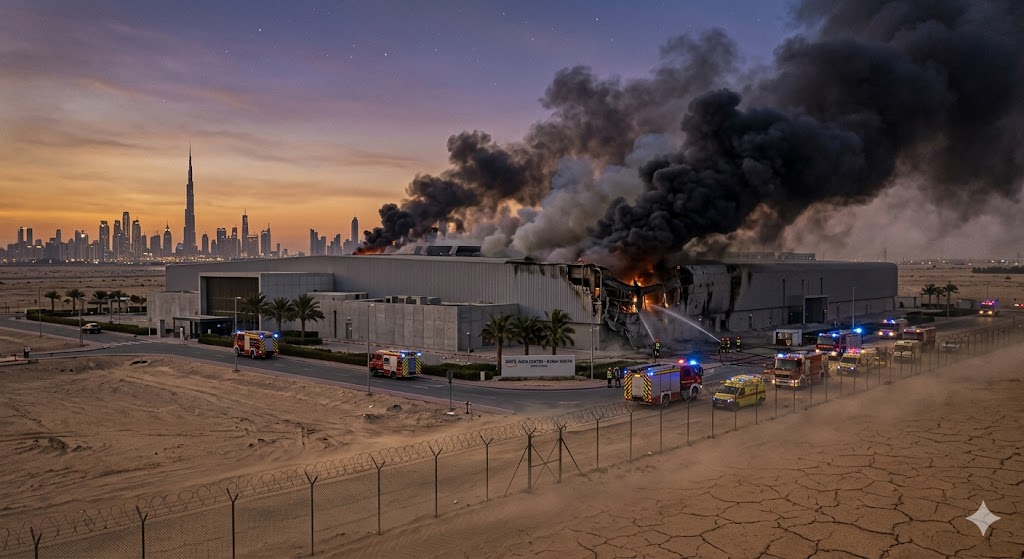
The 2026 Landscape of Conflict: Thick smoke rises from an Amazon Web Services data center outside Dubai following an Iran-linked kinetic strike. The attack marks a critical escalation in Tehran’s 'Integrated Infrastructure War' against American technology giants. Photograph: 2026 Digital Conflict Archive.
III. The UAE’s Decisive Intervention: "Including in the Fight"
Perhaps the most significant geopolitical shift of 2026 is the UAE support US in an active combat capacity. For weeks, Abu Dhabi pursued a policy of "precautionary defense," intercepting over 2,000 drones and missiles. However, the direct targeting of infrastructure on Emirati soil has forced a total re-evaluation of their national security doctrine.
Why the UAE is Supporting the US Buy-In
The UAE’s decision to move from a "neutral facilitator" to an "active participant" is driven by three critical factors:
Economic Sovereignty: The UAE has invested trillions into becoming a global tech and AI hub. The destruction of Google Amazon stations on their soil is seen as an existential threat to their "Vision 2031" goals.
The Strait of Hormuz 2026: Iran’s threats to close this vital waterway would strangle the UAE’s oil exports. Abu Dhabi has decided that a decisive military resolution is better than a slow economic death.
The "Island Issue": The UAE is leveraging its military support to demand that the U.S. help them reclaim the islands of Abu Musa, which have been under Iranian occupation for over fifty years.
The UAE is now reportedly pushing for a United Nations Security Council resolution to permit direct action to reopen the Strait of Hormuz 2026 by force. Even if the resolution is blocked by Russia or China, Emirati officials have stated they are ready to provide mine-clearing and tactical support.
IV. Technical Deep-Dive: The Vulnerability of Global Cloud Stations
To understand why Iran attacks US tech stations, one must understand the centralization of data. Amazon data center attacks are effective because these centers act as "hubs" for thousands of secondary businesses. When a single Amazon station in Dubai is hit, logistics in Riyadh, banking in Kuwait, and government services in Oman all feel the lag.
AWS Edge Locations Low latency for military comms Disruption of real-time drone control
Google Cloud Regions AI-driven geospatial data Blind the "Targeting Engines"
Fiber Optic Hubs Regional connectivity Isolate the U.S. from its Gulf allies
V. The Global Economic Fallout: A World on Edge
The current scenario of the world is one of extreme volatility. The targeting of tech giants has triggered what economists are calling the "Tech Shock."
Market Volatility and Inflation
When Amazon and Google are targeted, it isn't just a blow to two companies; it is a blow to the entire global supply chain.
Cloud Disruption: Thousands of businesses relying on AWS for their operations have seen massive service interruptions.
Oil Prices: With the UAE entering the fight, the risk of a total blockade of the Strait of Hormuz 2026 has pushed Brent Crude toward $160 per barrel.
Insurance Costs: Maritime insurance for the Persian Gulf has increased by 400%, making it nearly impossible for civilian tankers to operate without military escort.
VI. Strategic Analysis: Operation Epic Fury
The U.S. response, led by the Department of War under Secretary Pete Hegseth, is focused on a "decapitation and degradation" strategy. Unlike previous conflicts, the U.S. is not seeking a protracted ground occupation. Instead, Operation Epic Fury aims to:
Disable the IRGC Navy: Through coordinated strikes with the UAE and British forces.
Protect the "Digital Silk Road": Deploying mobile Patriot and THAAD missile batteries around every major data center in the region.
Cyber-Kinetic Integration: Launching massive cyberattacks on Iranian power grids in retaliation for the physical attacks on Amazon centers.
As the IRGC tech threats escalate, the world is grappling with the ethics of "Corporate War." If a Google employee in Dubai is providing data that helps a drone strike, is that employee a "combatant"? This question is at the heart of the US Iran war update. The mass evacuation of Western tech talent from the Gulf region has led to a "Brain Drain" that may take a decade to reverse. The IRGC has warned employees to “immediately leave their workplaces to preserve their lives.”
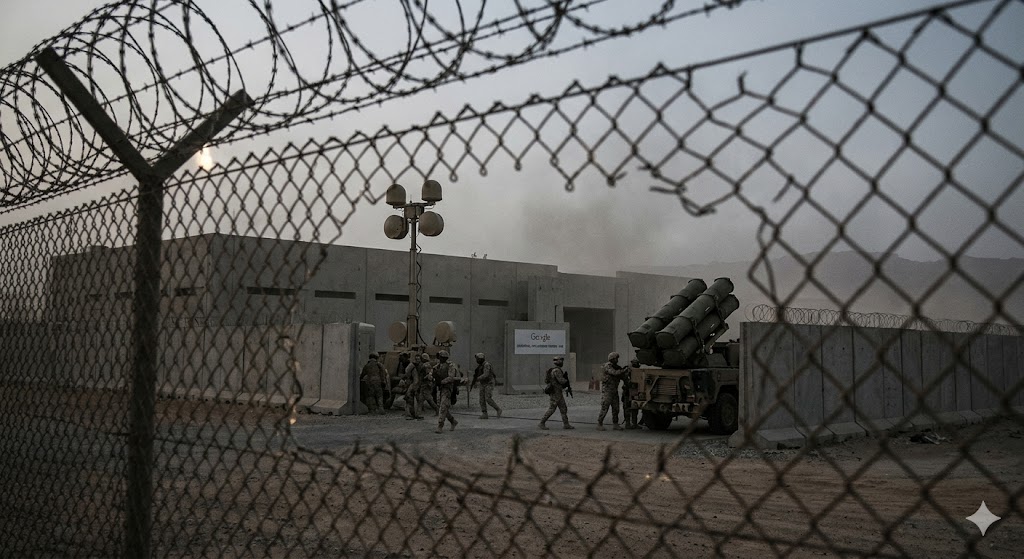
Corporate Militarization: United Arab Emirates security forces deploy advanced mobile anti-drone systems around a fortified Google geospatial intelligence station. The deployment follows IRGC threats designating tech employees and infrastructure as legitimate military targets. Photograph: 2026 Security Bureau.
VIII. Current Scenario of the World: The Rise of Multi-Polarity
As we analyze the Middle East crisis 2026, it is clear that we have entered a bipolar reality. On one side is the U.S.-led coalition (including the UAE, Israel, and the UK), defending the "global digital commons." On the other is Iran, supported by back-channel agreements with other adversarial powers, seeking to dismantle Western technical hegemony.
The world is currently witnessing:
The Death of Corporate Neutrality: Companies must now choose sides and invest in their own private defense forces.
The Balkanization of the Internet: As Iran targets Western servers, they are accelerating the move toward a "Sovereign Internet" model.
IX. Detailed Case Study: The Amazon Center Attack in Dubai
On the night of March 30, 2026, the America’s Amazon centre in the Jebel Ali Free Zone became a literal front line. Despite the protection of UAE Patriot batteries, debris from a mid-air interception struck the facility’s cooling system. The resulting Iran bomb blast and subsequent fire caused a 48-hour outage for 15% of the regional internet.
This event served as the final straw for Abu Dhabi. UAE officials stated that "the security of our digital infrastructure is inseparable from our national security." This event directly precipitated the UAE’s offer to join the naval coalition in the Strait of Hormuz 2026.
X. Future Outlook: Escalation or Resolution?
The current situation as Iran continues its "Infrastructure War" suggests that the conflict is far from over. President Trump’s administration has taken a hardline stance, telling allies to "go get your own oil" if they do not support the effort to secure the Strait.
The UAE’s proactive stance may provide the necessary regional legitimacy for a broader coalition. However, if the Iran attacks US tech centers continue to spread to Europe or the continental United States, the world may be looking at the first truly global "Data War."
Conclusion: The Long Road Ahead
The "Iran returns America's met" strategy has fundamentally changed the rules of engagement. By hitting Google Amazon stations, Iran has found a vulnerability in the American "way of war." However, by forcing the UAE support US actively, Tehran may have inadvertently created a regional coalition that is too powerful to overcome.
The current situation as Iran continues its offensive is a grim reminder that in 2026, peace is a fragile commodity. The Iran bomb blast incidents and the missile exchanges over the Persian Gulf are the opening salvos of a conflict that will redefine the 21st century. As the international community watches the America’s Amazon centre burn and the UAE fleet set sail, one thing is certain: the world will never go back to the way it was before April 2026.
Frequently Asked Questions
What is the primary significance of Silicon Siege: Iran's 2026 Tech War & UAE's New Pact?
The New Frontier of Kinetic ConflictThe dawn of 2026 has brought with it a terrifying transformation in the nature of global warfare. No longer confined to the traditional domains of land, sea, and air, the conflict initiated on February 28, 2026, has metastasized into what strategic analysts are now calling the "Integrated Infrastructure War." In a radical departure from conventional engagement, the Iranian leadership has officially designated private American technology corporations—most notably Google and Amazon—as frontline combatants.This article explores the high-stakes retaliation by Tehran, the Iran bomb blast incidents targeting corporate data stations, the United Arab Emirates’ (UAE) unprecedented decision to join the U.S.
How does this development impact International Affairs?
in the fight, and the current global scenario that threatens to dismantle the world's digital and economic stability.I. The Designation of Corporate CombatantsOn April 1, 2026, the Islamic Revolutionary Guard Corps (IRGC) issued a decree that will likely be studied by international lawyers for decades.