Dwarka Submergence: Archaeology of Krishna's lost City
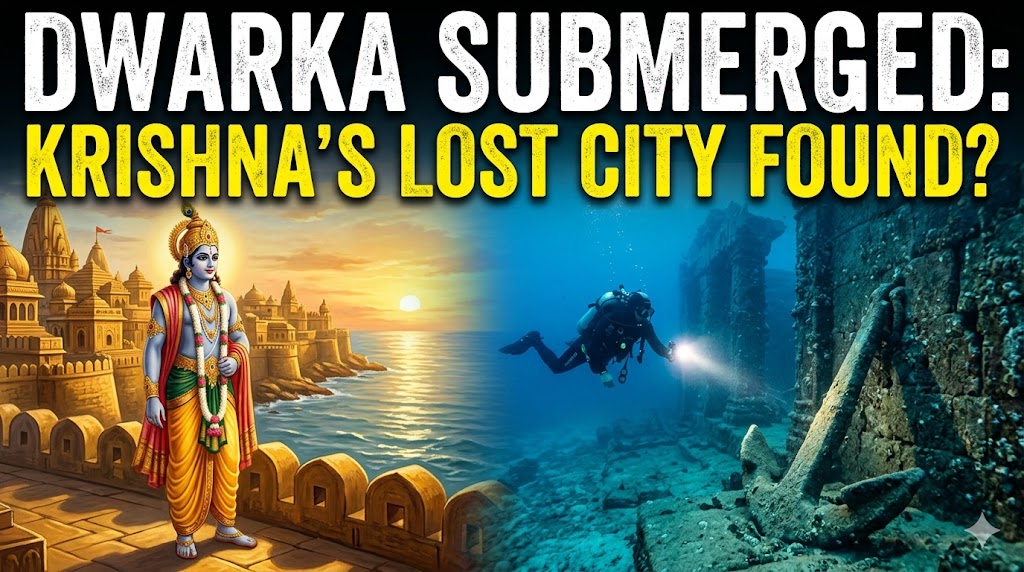
The story of Dwarka's submergence continues to fascinate scholars, spiritual seekers, and history enthusiasts around the world. As the legendary capital of Lord Krishna, this ancient city is described in sacred Hindu texts as a prosperous metropolis that ultimately vanished beneath the Arabian Sea. What was once purely a matter of faith and oral tradition has gradually gained scientific attention through marine archaeological expeditions that have revealed physical remains of a sophisticated ancient settlement.
Located off the coast of present-day Dwarka in Gujarat, India, these underwater ruins provide a rare window into the past. The tale of Dwarka submergence is not simply about a city lost to the waves; it encompasses themes of urban planning, maritime trade, environmental change, cultural continuity, and the complex relationship between mythology and historical evidence. This extended exploration examines the full spectrum of the Dwarka narrative — from its mythological origins and textual references to detailed archaeological findings, geological explanations, recent research developments, comparative studies, and its enduring relevance in contemporary times. By weaving together these perspectives, a richer and more nuanced understanding of one of India’s most compelling submerged heritage sites emerges.
Mythological Account of Dwarka's Founding and Fall
Hindu scriptures, especially the Mahabharata, Bhagavata Purana, and Harivamsa, offer vivid descriptions of Dwarka’s creation and eventual fate. According to tradition, Lord Krishna founded the city to protect the Yadava clan from repeated assaults in Mathura. He is said to have requested the sea god Varuna to yield land, resulting in the emergence of a vast, well-planned city spanning approximately 12 yojanas.
The city featured majestic palaces adorned with precious stones, wide avenues, intricate drainage systems, defensive fortifications, temples, and lush gardens. It served as a thriving center of commerce, governance, and culture. Krishna ruled from here with wisdom and justice, establishing Dwarka as a model of dharma and prosperity during the Dvapara Yuga.
The submergence narrative is equally dramatic. After the great Mahabharata war, Krishna’s departure from the earthly plane marked a turning point. Internal conflicts among the Yadavas led to their downfall. As Krishna ascended, the ocean is described as rising and engulfing the magnificent city, sometimes portrayed as occurring within a single day. This event symbolizes the transition into Kali Yuga, the age of moral decline. The cyclical theme of creation and dissolution in these texts reflects deeper philosophical ideas about impermanence and the interplay between divine will and natural forces.
Such accounts have been passed down through generations, shaping religious practices and cultural identity in the region.
Historical and Textual References Across Traditions
Beyond Hindu texts, Dwarka finds mention in Jain and Buddhist literature, often under names like Dvaraka or Dvāravatī. Its strategic location as a “gateway” (from Sanskrit Dvara) underscores its importance as a port city facilitating trade across the Arabian Sea. Ancient references portray it as one of the seven sacred pilgrimage cities (Sapta Puri), a status it retains today.
Scholars have long debated the extent to which these descriptions correspond to real historical events or places. While some view them as purely allegorical, others see embedded memories of actual coastal settlements affected by environmental shifts. The continuity of the name and sacred geography from ancient texts to the modern town of Dwarka strengthens the link between legend and location.
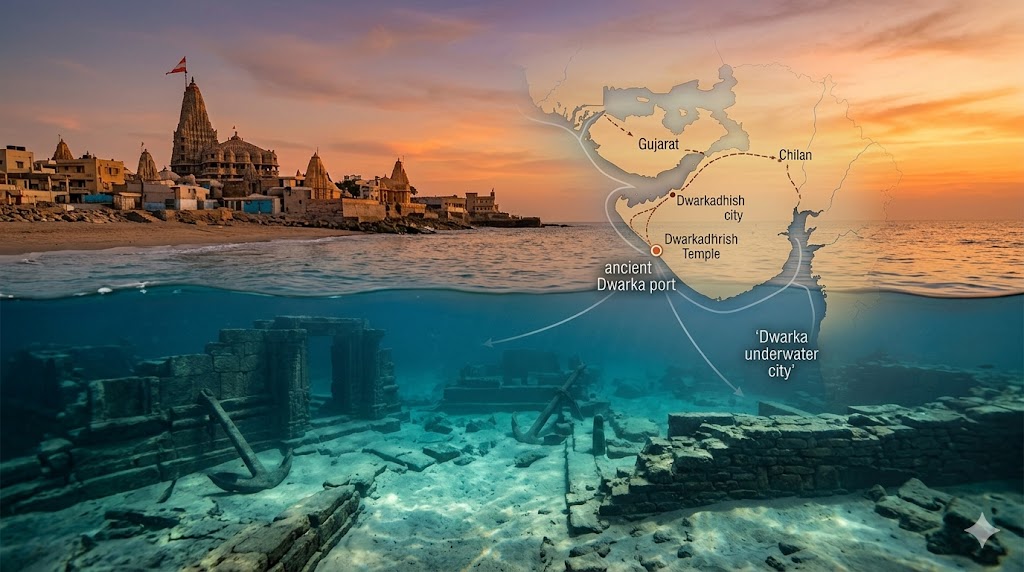
submerged city of dwarka
Archaeological Discoveries: Unveiling the Submerged City
Modern investigations into Dwarka submergence began gaining traction in the early 20th century. Initial observations by historians like Hiranand Shastri were followed by more organized efforts. The groundbreaking work of marine archaeologist Dr. S.R. Rao and teams from the National Institute of Oceanography (NIO) in the 1980s and 1990s brought international attention.
Divers explored sites at depths ranging from a few meters to over 20 meters near Dwarka and the island of Bet Dwarka. They documented extensive remains including bastions, walls, rectangular building foundations, and possible jetty structures. A large number of stone anchors — triangular, bar, and ring types — were recovered, some weighing several hundred kilograms, indicating intensive maritime activity.
Pottery shards, bead fragments, inscribed objects, and tools resembling Late Harappan styles have been unearthed. These findings suggest a prosperous port city with connections to broader Indus Valley networks. Bet Dwarka has yielded comparable structures and artifacts, pointing to a cluster of settlements rather than a single isolated city.
Subsequent expeditions by the Archaeological Survey of India’s Underwater Archaeology Wing, along with collaborations involving Indian and international institutions, have used side-scan sonar, sub-bottom profilers, and remotely operated vehicles (ROVs) to map larger areas. Discoveries in the 2020s have included additional masonry alignments, possible roads, and artifacts that continue to fuel academic discussion.
Scientific Analysis, Dating, and Interpretation
Radiocarbon dating and thermoluminescence techniques on recovered materials generally place the prominent structures between approximately 1500 BCE and 1800 BCE, corresponding to the late phases of the Indus Valley Civilization. Some researchers propose evidence of earlier layers potentially extending back several thousand years, though these claims require further verification.
The artifacts display advanced craftsmanship consistent with a society engaged in long-distance trade. Chemical analysis of pottery and metals points to connections with regions as far as Mesopotamia. The layout of underwater structures suggests deliberate urban planning, including considerations for defense against both human and natural threats.
Challenges in marine archaeology — such as strong currents, sedimentation, and bio-encrustation — make precise interpretation demanding. Nevertheless, the cumulative evidence supports the existence of a significant ancient settlement that experienced progressive or episodic inundation.
Geological and Environmental Causes of Dwarka Submergence
Scientific consensus attributes the submergence primarily to natural processes rather than a single supernatural event. The Saurashtra peninsula lies in a tectonically active zone where land subsidence, earthquakes, and sea-level fluctuations have occurred over millennia.
The Post-Ice Age sea-level rise during the Holocene period led to marine transgression along many coastlines worldwide. Sediment core samples from the Gulf of Khambhat and nearby areas reveal multiple episodes of flooding and coastal reconfiguration. Local factors like tectonic subsidence, storm surges, and tidal dynamics likely accelerated the inundation of low-lying areas.
While mythological accounts describe a rapid event, geological evidence favors a combination of gradual rise interspersed with more sudden episodes triggered by seismic activity or cyclones. This nuanced understanding does not diminish the cultural power of the legends; rather, it suggests that ancient storytellers may have preserved memories of real environmental catastrophes in dramatic form.
The Port City Hypothesis and Economic Significance
All available data strongly indicate that ancient Dwarka functioned as a vital trading port. Its position at the mouth of the Gomti River offered natural harbor advantages and access to inland trade routes. Goods such as cotton textiles, semi-precious stones, metals, and marine products were likely exchanged with distant civilizations.
The abundance of stone anchors and harbor-like structures reinforces this view. Such economic vibrancy would explain the city’s legendary wealth and its strategic importance, aligning textual descriptions with physical evidence.
Cultural and Religious Importance in Contemporary India
Today, Dwarka remains a living pilgrimage destination as part of the Char Dham circuit. The Dwarkadhish Temple, dedicated to Lord Krishna, attracts millions of devotees annually. Many visitors view the offshore ruins as tangible proof of scriptural narratives, enhancing their spiritual experience.
Local communities and religious organizations actively participate in heritage awareness programs. Festivals and cultural events celebrate both the divine and historical aspects of Dwarka, fostering a unique blend of faith and archaeology.
Challenges in Underwater Research
Conducting archaeology underwater in the Arabian Sea presents numerous obstacles. Monsoon seasons limit fieldwork windows, while strong tidal currents and poor visibility complicate dives. Preservation of artifacts in saline environments requires specialized techniques.
Funding remains a constraint despite growing interest. Coordination between government bodies, research institutions, and local stakeholders is essential for sustainable progress. Ethical considerations around site protection versus public access also require careful balancing.
Recent Developments and Future Research Directions
In recent years, renewed government interest and technological advancements have accelerated studies. Multi-beam echo sounding, satellite imagery analysis, and DNA sequencing of ancient sediments offer promising new avenues. Collaborative projects aim to create comprehensive digital maps of the submerged landscape.
Future efforts may focus on excavating promising anomalies, conducting comparative studies with other coastal sites, and integrating traditional knowledge with scientific methods. Public-private partnerships could support the development of underwater museums or virtual reality experiences for educational tourism.
Broader Implications for Indian History and Civilization
The study of Dwarka submergence enriches our understanding of ancient Indian urbanism and maritime capabilities. It suggests greater continuity between Indus Valley traditions and later historical periods than previously emphasized in some textbooks. The site also provides valuable data on how ancient societies adapted to — and sometimes succumbed to — environmental changes.
In an era of climate change and rising sea levels, lessons from Dwarka’s fate carry contemporary relevance. Coastal vulnerability, sustainable urban planning, and the preservation of cultural heritage amid environmental shifts are issues that resonate globally.
Comparative Perspectives with Global Submerged Sites
Dwarka is often compared to other legendary underwater cities such as Atlantis described by Plato, the sunken port of Pavlopetri in Greece, or ruins off the coast of Cuba and Japan. Many cultures possess flood myths that parallel real geological events following the last Ice Age.
This phenomenon, sometimes called “geomythology,” highlights how human societies encoded observations of environmental change into enduring stories. Dwarka stands out due to the richness of its textual tradition and the ongoing accessibility of its remains for research.
Conservation, Sustainable Tourism, and Community Engagement
Protecting the submerged Dwarka site is paramount. Designating marine conservation zones, regulating diving activities, and implementing monitoring systems can help prevent damage. Community involvement ensures that local benefits arise from heritage preservation.
Responsible tourism, including glass-bottom boat tours and interpretive centers, can generate revenue while educating visitors. Educational initiatives in schools and universities can inspire the next generation of researchers and conservationists.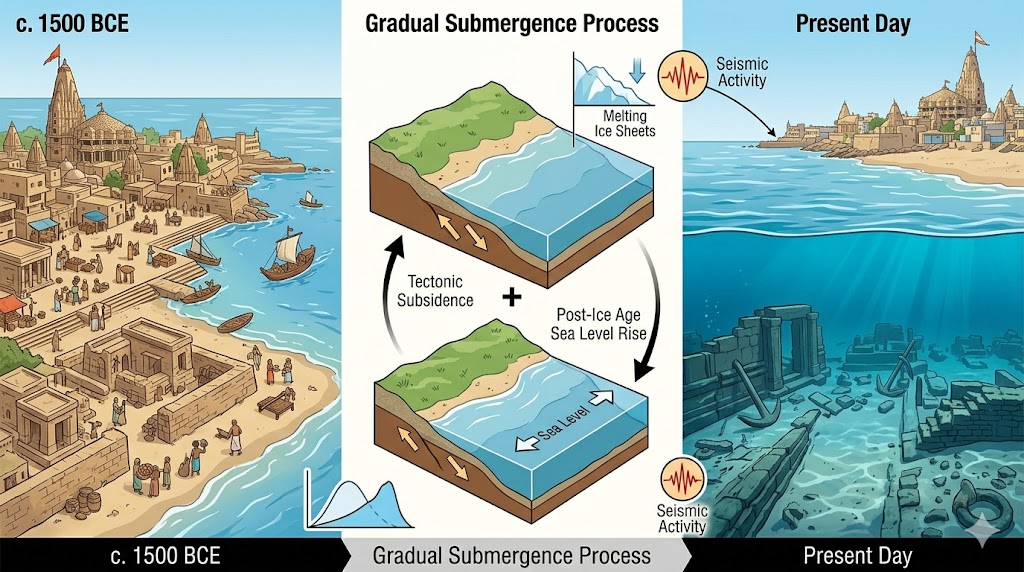
philosophy and archeological sources
Philosophical and Symbolic Dimensions
Beyond its historical value, the Dwarka submergence narrative carries profound symbolic weight. It speaks to the impermanence of material achievements, the power of nature, and the enduring nature of spiritual truth. In Hindu philosophy, the rise and fall of cities like Dwarka illustrate the cycles of time (yugas) and the importance of ethical living amid uncertainty.
These themes offer timeless wisdom applicable to modern challenges ranging from environmental stewardship to personal resilience.
Conclusion
The submergence of Dwarka remains one of the most evocative chapters in India’s ancient heritage. Mythological accounts of Krishna’s splendid city reclaimed by the sea find resonance in the archaeological structures resting beneath the Arabian Sea. While science explains the process through sea-level changes, tectonics, and coastal dynamics, the legends preserve cultural memory and spiritual significance that continue to inspire millions.
As research advances with new technologies and interdisciplinary approaches, our knowledge of this lost city deepens. Each discovery adds another layer to the story, bridging faith, history, and science. Dwarka’s legacy reminds us of humanity’s longstanding relationship with the sea — one marked by ingenuity, vulnerability, and wonder.
The quest to understand Dwarka submergence is far from complete. It invites continued exploration, respectful dialogue between different ways of knowing, and thoughtful conservation for future generations. In uncovering the secrets of this ancient city, we not only illuminate the past but also gain valuable perspectives for navigating an uncertain future shaped by similar environmental forces.