Eternal Yuga Cycles: Repetition in Hindu spritual Cosmology
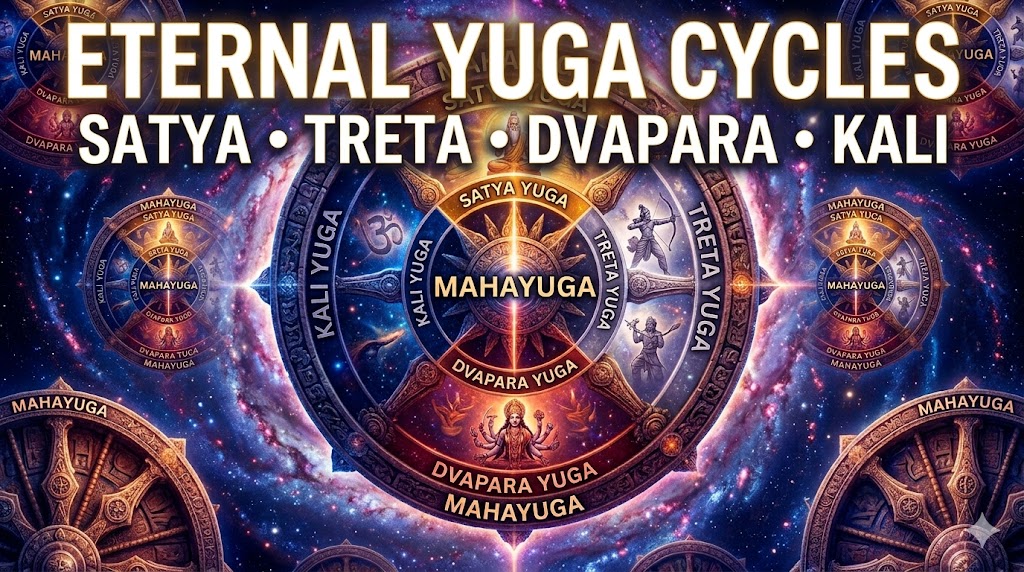
In the rich tapestry of Sanatan Dharma, time is not linear but profoundly cyclic. The concepts of Satya Yuga, Treta Yuga, Dvapara Yuga, and Kali Yuga represent more than mere divisions of time—they embody the eternal rhythm of creation, preservation, decline, and renewal. Many seekers remain unaware that these four Yugas do not occur in isolation but repeat endlessly within larger cosmic structures known as Mahayuga cycles.
This cyclical understanding challenges conventional historical narratives that view events like the Ramayana and Mahabharata as singular occurrences. Ancient scriptures suggest these epics and similar cosmic dramas unfold repeatedly across vast timescales. Some modern interpretations even draw parallels with multiverse theory, proposing that such events manifest across parallel realities or successive cycles.
This comprehensive article explores the structure of Yuga cycles, their repetitive nature, the philosophical implications, scriptural foundations, and contemporary reflections on how these eternal rhythms shape our understanding of spirituality, history, and existence.
Understanding the Four Yugas: Foundations of Cosmic Time
The four Yugas form the basic unit of Hindu cosmological time. Each age reflects a progressive decline in dharma (righteousness, moral order) and human capabilities, followed by renewal.
Satya Yuga (Krita Yuga): Often called the Golden Age, this period represents truth, virtue, and perfection. Dharma stands on four legs. Lifespans are extraordinarily long, and spiritual awareness reaches its peak. According to traditional calculations, it spans 1,728,000 human years (including transitional periods).
Treta Yuga: The Silver Age sees dharma standing on three legs. Virtue remains strong but begins to diminish. This is the era traditionally associated with Lord Rama’s incarnation and the events of the Ramayana. It lasts 1,296,000 years.
Dvapara Yuga: In this Bronze Age, dharma stands on two legs. Moral and physical decline accelerates. Lord Krishna’s life and the Mahabharata epic define this period. Its duration is 864,000 years.
Kali Yuga: The current Iron Age, marked by one leg of dharma, strife, materialism, and spiritual challenges. It lasts 432,000 years. We are said to be in the early phase of the present Kali Yuga, which began around 3102 BCE.
These durations follow a 4:3:2:1 ratio, reflecting the gradual waning of cosmic order. Together, they constitute one Mahayuga or Chatur Yuga, totaling 4,320,000 years.
The Repetitive Nature of Yuga Cycles
A fundamental yet often overlooked aspect of Hindu cosmology is the repetition of these four Yugas. One Mahayuga is not a singular event but part of an infinite loop within larger cosmic frameworks.
Seventy-one Mahayugas form one Manvantara (era of a Manu, progenitor of humanity). Fourteen Manvantaras, with transitional periods, make up one Kalpa—a single day in the life of Brahma, the creator. A full day-night cycle of Brahma equals 8.64 billion years, and Brahma’s lifespan comprises 100 such years, leading to immense timescales exceeding 311 trillion years.
This structure ensures that the sequence of Satya, Treta, Dvapara, and Kali Yugas repeats countless times. Each cycle brings renewal after dissolution (pralaya), with dharma rising again in the subsequent Satya Yuga. The repetition underscores a core philosophical truth: nothing is permanent, yet the underlying order persists eternally.
Scholars and texts like the Puranas emphasize this cyclicality. Time (Kala) operates like a wheel—ever-turning, with events echoing across aeons. This repetition is not mere duplication but part of a grand evolutionary spiral, where consciousness learns and expands through each iteration.
Scriptural Evidence for Repetition and Multiple Occurrences
Ancient texts support the idea that major events unfold across multiple cycles. The Ramayana and Mahabharata, while anchored in specific Yugas within our current Kalpa, find echoes in broader cosmological narratives.
In the Yoga Vasistha and certain Puranic references, sages like Kakabhushundi describe witnessing the Ramayana and similar leelas (divine plays) across numerous cycles. Lord Rama and Lord Krishna’s incarnations are part of Vishnu’s eternal avatars, manifesting as needed to restore dharma whenever it declines—implying recurrence aligned with Yuga rhythms.
The Mahabharata itself contains dialogues where sages discuss previous Manvantaras and similar wars or heroic deeds in past cycles. Valmiki’s Ramayana and Vyasa’s Mahabharata document specific instances, but the Puranas hint at parallel or previous unfoldings.
This repetitive framework explains why certain motifs—divine incarnations, epic battles between good and evil, moral dilemmas—reappear in spiritual lore. It is not historical repetition in a linear sense but cosmic recurrence within the eternal wheel of time.
Yuga Cycles and the Illusion of Linear History
Our modern education and historical consciousness often emphasize linear progress, leading to ignorance about the deeper cyclic reality described in Sanatan scriptures. We tend to view Ramayana as occurring solely in one Treta Yuga and Mahabharata in one Dvapara Yuga, without appreciating the millions of years and countless cycles that preceded and will follow.
This limited perspective arises from Kali Yuga’s influence, where material focus overshadows subtle cosmic truths. Scriptures like the Bhagavata Purana and Vishnu Purana remind us that what we perceive as “history” is but one frame in an infinite cosmic cinema. Multiple iterations of these Yugas mean that dharma’s struggles and triumphs have played out innumerable times, offering endless opportunities for souls to evolve.
Connections to Multiverse Theory in Hindu Philosophy
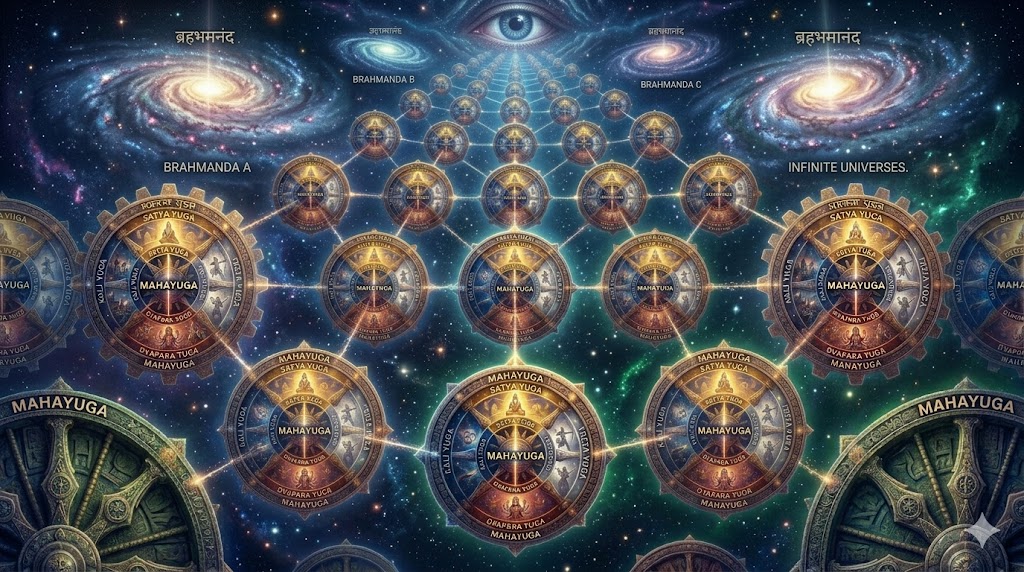
Contemporary thinkers often draw fascinating parallels between Yuga cycles and modern multiverse concepts. Hindu cosmology describes not just one universe but countless Brahmandas (cosmic eggs), each with its own Brahma, Vishnu, and Shiva, manifesting and dissolving independently or in harmony.
The Bhagavata Purana narrates Lord Vishnu revealing multiple universes to sage Narada, each with distinct realities. Krishna’s Vishvarupa in the Mahabharata offers Arjuna a glimpse of infinite forms and timelines. These descriptions resonate with quantum physics and multiverse hypotheses, where parallel realities coexist with varying physical laws or historical outcomes.
In this framework, the repetitive Yugas might unfold differently across parallel universes—variations of Ramayana or Mahabharata playing out simultaneously in different cosmic branches. This does not diminish the sanctity of our tradition but expands it, suggesting that divine leelas transcend single timelines.
Such interpretations bridge ancient wisdom and cutting-edge science, highlighting Sanatan Dharma’s timeless relevance. They invite humility: our observable universe and history may represent only a tiny fraction of the grand design.
Philosophical and Spiritual Implications of Cyclic Time
Understanding Yuga repetition fosters profound spiritual insights. It cultivates detachment from transient achievements and encourages focus on eternal dharma. In Kali Yuga, despite challenges, the cycle assures eventual renewal—no decline is permanent.
This knowledge promotes resilience. Knowing that Satya Yuga will dawn again inspires ethical living and spiritual practice. It also explains the presence of enlightened souls across ages who remember or transcend these cycles.
Repetition underscores karma’s role: actions in one cycle influence future manifestations, driving soul evolution across Mahayugas. It reinforces the unity of all existence within Brahman, the ultimate reality beyond time.
Challenges in Interpreting Ancient Cosmology Today
Modern readers sometimes struggle with the vast numbers in Yuga calculations, leading to debates between literal and symbolic interpretations. Some scholars, like Sri Yukteswar, proposed shorter cycles aligned with astronomical phenomena, while traditional Puranic figures emphasize immense durations.
Regardless of exact metrics, the core message remains consistent: time is cyclic, dharma fluctuates, and divine order prevails. The integration with multiverse ideas offers rich ground for dialogue between spirituality and science, without forcing literal equivalences.
Living in Kali Yuga: Wisdom for the Current Cycle
As we navigate the present Kali Yuga, awareness of larger repetitive cycles provides perspective. Challenges like moral decay and conflict are characteristic but temporary. Scriptures assure that sincere devotion and righteous action can mitigate effects and prepare for the transition ahead.
Practices such as meditation, study of epics, and ethical conduct help align with dharma. Recognizing the repetitive nature encourages viewing current events as part of a larger cosmic education rather than isolated crises.
Conclusion: Embracing the Eternal Rhythm
The repetitive cycles of Satya, Treta, Dvapara, and Kali Yugas reveal time as an eternal teacher in Hindu cosmology. Far from being confined to single occurrences, the profound narratives of Ramayana, Mahabharata, and divine interventions echo across Mahayugas and possibly parallel realities, enriching our spiritual heritage with infinite depth.
This understanding dismantles ignorance of linear history, inviting us into a worldview of profound interconnectedness and renewal. Whether through traditional scriptural study or contemporary multiverse reflections, the message endures: dharma rises and falls, but consciousness evolves eternally.
By contemplating these vast cycles, we cultivate humility, wisdom, and devotion. In Sanatan Dharma, time is not an enemy but a sacred rhythm guiding souls back to the divine source. As one cycle ends and another begins, the eternal play continues—reminding us that in the grand design, every ending heralds a new dawn of truth and light.