India Census 2027: Complete Guide to the Digital Revolution
Current Affairs • March 31, 2026 • Global Edition

The Historical Evolution: From 1872 to Census 2027
To understand the magnitude of the India Census 2027, one must look back at the history of demographic counting in the subcontinent. The first non-synchronous census was conducted in 1872 under British rule, followed by the first synchronous census in 1881. Since then, every ten years, India has mapped its population without fail until the 2021 cycle was disrupted by the COVID-19 pandemic.
The delay has created a data vacuum, making the census update 2027 the most anticipated administrative exercise in modern Indian history. This isn't just a headcount; it is the backbone of the nation's planning, from the distribution of food grains under the National Food Security Act to the delimitation of parliamentary seats.
The 2027 Census Plan: A Shift to Digital-First
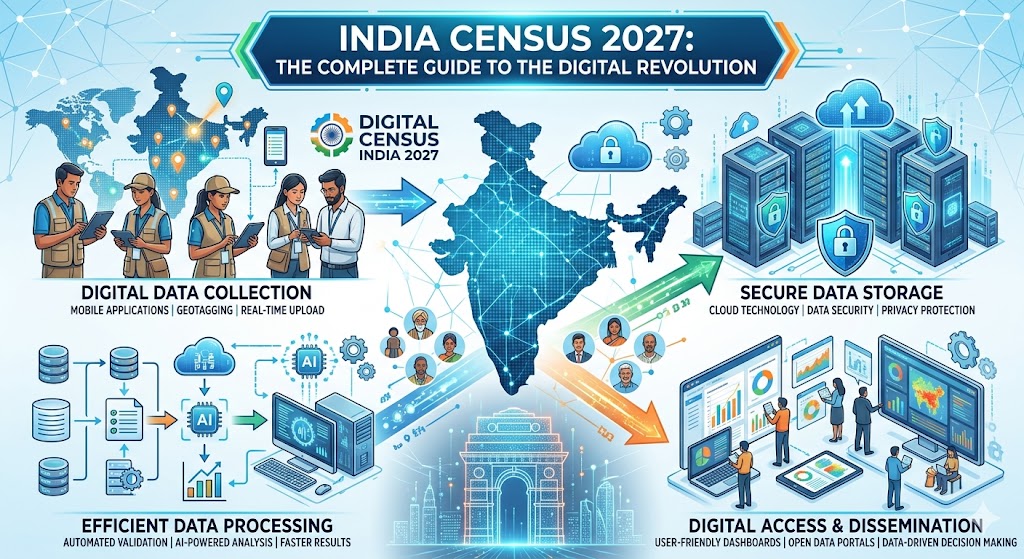
The Union Government’s 2027 census plan represents a radical departure from the "paper-and-pen" era. In 2011, enumerators carried heavy bundles of schedules, which were later scanned using Intelligent Character Recognition (ICR) technology. The digital census 2027 eliminates this lag.
By using the mobile app census 2027 framework, data is validated at the point of entry. If an enumerator enters an impossible age or conflicting data regarding literacy and employment, the app flags it immediately. This ensures that the ppulation census 2027 results are not only faster but significantly more accurate.
Census 2027 Phases: The Two-Step Roadmap
The census 2027 two phase approach is designed to manage the sheer complexity of India’s geography.
Phase 1: House listing and Housing Census (HLO)
The census 2027 house list operations are the foundation. Conducted roughly six months before the actual headcount, this phase identifies every structure in India.
Purpose: To identify residential, commercial, and vacant buildings.
Technological Tool: The census 2027 hlo app is used here to record details about the house construction material, source of drinking water, and availability of toilets.
Mapping: The census 2027 hlb map (Houselisting Block Map) is generated digitally, ensuring that no household is left out and no area is double-counted.
Phase 2: Population Enumeration (PE)
This is the core of the india census 2027. During this phase, every individual is counted.
Caste Integration: For the first time in independent India, the caste census 2027 will be integrated into this phase.
Demographics: Data on age, gender, marital status, religion, mother tongue, and migration patterns are recorded.
Swa-Ganana: Empowering the Citizen
One of the most innovative features of the census india 2027 is the Swa Ganana census 2027 (Self-Enumeration) portal. Recognizing the high mobile and internet penetration in urban India, the government has introduced a "self-service" option.
How Online Census 2027 (Self-Enumeration) Works:
Login: Citizens log into the official portal using their mobile number and OTP.
Data Entry: Users fill in the details of all family members following the census 2027 new rules.
Unique SE ID: Upon completion, a 15-digit Reference Number is generated.
Verification: When the enumerator visits during the census 2027 start date window, the citizen simply provides this ID. The enumerator syncs the pre-filled data, saving time and ensuring privacy.
The Historic Move: Caste Census 2027 Explained
The inclusion of census 2027 caste data is a landmark policy shift. Since 1951, Indian censuses only published data on Scheduled Castes (SC) and Scheduled Tribes (ST). The demand for a full caste census 2027 has been a central theme in Indian politics, aimed at understanding the socio-economic status of Other Backward Classes (OBCs).
The census 2027 explained documents suggest that the government will use a "Code Directory." This directory contains thousands of pre-identified caste names. This avoids the chaotic "free-text" entries of the 2011 Socio-Economic and Caste Census (SECC), which resulted in over 40 lakh unique caste names due to spelling variations, making the data unusable.
Technological Backbone: HLO App and HLB Maps
The success of the digital census 2027 rests on two pillars: the census 2027 hlo app and the census 2027 hlb map.
The HLO App: Designed by the IT cell of the Registrar General of India (RGI), the app works in offline mode critical for rural areas with poor connectivity. Data is stored locally and uploaded once the enumerator reaches a network zone.
The HLB Map Creator: This web-based application allows administrators to create "Digital Layout Maps." By using satellite imagery, the census 2027 hlb map provides a visual boundary for every enumerator, preventing jurisdictional disputes.
Census 2027 Training: Preparing the Workforce
Mobilizing 3 million government employees (mostly teachers) requires a Herculean effort in census 2027 training. The training follows a "Cascade Model":
National Trainers: Experts trained directly by the RGI.
Master Trainers: Trained at the state level.
Field Enumerators: The final tier who interact with the public.
Frequently Asked Questions
What is the primary significance of India Census 2027: Complete Guide to the Digital Revolution?
The Historical Evolution: From 1872 to Census 2027To understand the magnitude of the India Census 2027, one must look back at the history of demographic counting in the subcontinent. The first non-synchronous census was conducted in 1872 under British rule, followed by the first synchronous census in 1881.
How does this development impact Current Affairs?
Since then, every ten years, India has mapped its population without fail until the 2021 cycle was disrupted by the COVID-19 pandemic.The delay has created a data vacuum, making the census update 2027 the most anticipated administrative exercise in modern Indian history. This isn't just a headcount; it is the backbone of the nation's planning, from the distribution of food grains under the National Food Security Act to the delimitation of parliamentary seats.The 2027 Census Plan: A Shift to Digital-FirstThe Union Government’s 2027 census plan represents a radical departure from the "paper-and-pen" era.
What are the key future projections to monitor?
In 2011, enumerators carried heavy bundles of schedules, which were later scanned using Intelligent Character Recognition (ICR) technology.
Discussion & Reader Insights (0)
No comments yet. Share your thoughts first!