NASA PACE Satellite Launch: Ocean and Climate Insights
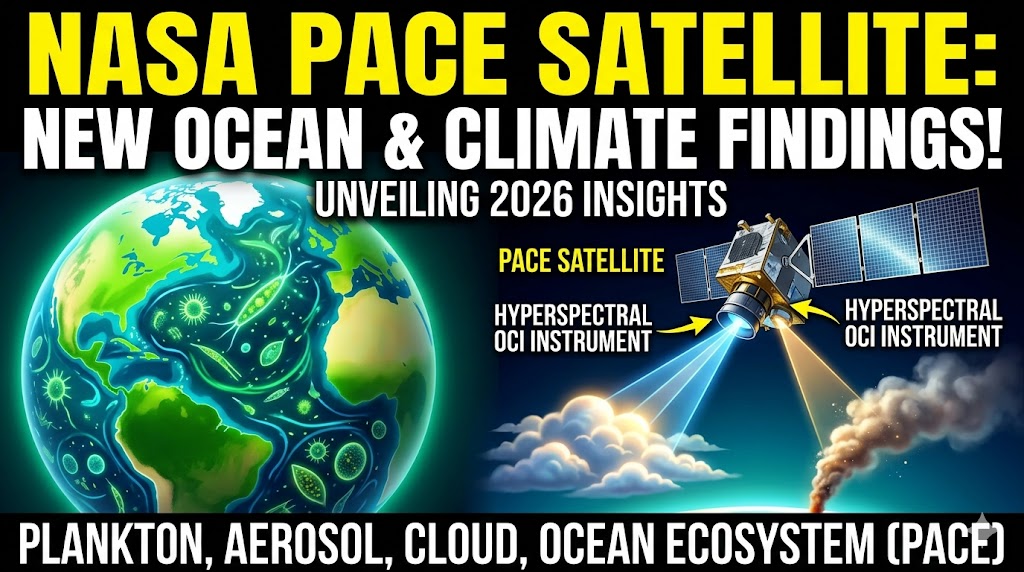
The successful NASA PACE satellite launch on February 8, 2024, marked a significant milestone in Earth observation science. This advanced spacecraft, formally known as the Plankton, Aerosol, Cloud, ocean Ecosystem mission, has since been delivering unprecedented data on the intricate connections between our planet’s oceans and atmosphere. Operating from a sun-synchronous orbit, PACE continues to provide scientists with detailed insights into marine life, air quality, and climate processes that shape our world.
In an era of rapid environmental change, the PACE mission addresses critical gaps in our understanding of how microscopic ocean organisms influence global carbon cycles and how atmospheric particles affect weather and climate. This article explores the background, technology, launch events, scientific objectives, early results as of 2026, and broader implications of this groundbreaking endeavor.
Background and Development of the PACE Mission
The concept for PACE emerged from the need to continue and enhance long-term satellite records of ocean biology, aerosols, and clouds. NASA initiated the mission around 2010 to ensure continuity after earlier instruments like MODIS on Terra and Aqua satellites. Development involved extensive collaboration among scientists, engineers, and international partners, with a total mission cost approaching one billion dollars including launch and operations.
Key challenges during development included creating hyperspectral instruments capable of distinguishing subtle differences in light wavelengths reflected from the ocean and atmosphere. Rigorous testing ensured the spacecraft could withstand the harsh space environment while delivering high-precision data. The mission’s design emphasized not only extending existing records but also enabling new scientific discoveries through advanced polarization and spectral measurements.
The Historic NASA PACE Satellite Launch
The NASA PACE satellite launch took place at 1:33 a.m. EST on February 8, 2024, aboard a SpaceX Falcon 9 rocket from Space Launch Complex 40 at Cape Canaveral Space Force Station in Florida. After minor weather-related delays, the rocket lifted off smoothly, placing PACE into its intended orbit approximately 676 kilometers above Earth.
Signal acquisition occurred shortly after separation, confirming the spacecraft’s healthy status. The Falcon 9 first stage performed a successful landing, highlighting the growing role of commercial partnerships in NASA’s Earth science missions. This event represented the first NASA-procured polar-orbiting mission launched from Cape Canaveral using a southbound trajectory.
In the days and weeks following the NASA PACE satellite launch, teams at NASA’s Goddard Space Flight Center conducted commissioning activities. Instruments were powered on, calibrated, and tested to ensure optimal performance. By April 2024, the first operational data reached the scientific community and public, setting the stage for ongoing discoveries.
Advanced Instruments Onboard PACE
At the heart of the mission lies a suite of sophisticated instruments that work together to provide a comprehensive view of Earth systems.
The primary instrument, the Ocean Color Instrument (OCI), functions as a highly advanced hyperspectral radiometer. It measures light across hundreds of wavelengths, allowing scientists to identify different types of phytoplankton, detect harmful algal blooms, and assess ocean health with greater accuracy than previous missions.
Complementing OCI are two multi-angle polarimeters: the Hyper-Angular Rainbow Polarimeter (HARP2) and the Spectro-polarimeter for Planetary Exploration (SPEXone). These instruments measure the polarization of light, providing detailed information about aerosols and cloud properties. Together, they enable researchers to study how particles in the atmosphere interact with clouds and influence climate.
The combination of hyperspectral and polarimetric data represents a major technological leap, offering views of Earth that were previously unattainable from space.
Scientific Objectives and Goals
The PACE mission pursues two fundamental goals. First, it extends key systematic records of ocean color, aerosols, and clouds for long-term climate studies. Second, it tackles new scientific questions using its enhanced capabilities.
Key objectives include:
Mapping the distribution and composition of phytoplankton communities that form the base of the marine food web.
Understanding carbon exchange between the ocean and atmosphere.
Studying aerosol-cloud interactions and their effects on radiative forcing.
Monitoring air quality and identifying sources of atmospheric pollution.
Detecting and tracking harmful algal blooms that can impact fisheries and human health.
By observing these interconnected systems simultaneously, PACE helps scientists unravel complex feedback loops in the Earth’s climate system.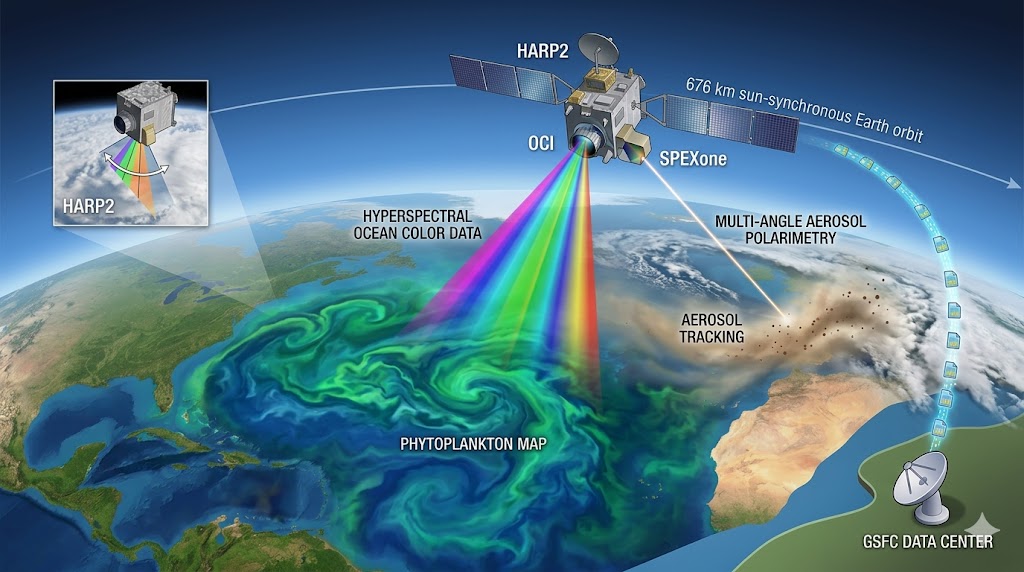
NASA Space satellite
Early Results and Findings in 2026
By mid-2026, the PACE mission has already generated substantial scientific output. Researchers released the first global ocean health maps in May 2026, revealing detailed patterns of phytoplankton productivity across seasons and regions. These maps highlight areas of high biological activity and those showing concerning changes linked to warming waters.
Data from the mission has improved our ability to pinpoint sources of air pollution and track how dust and smoke particles travel across oceans, sometimes fertilizing phytoplankton blooms. Studies using PACE observations have advanced methods for monitoring global ecosystem productivity through hyperspectral analysis, offering new tools for climate modeling.
Validation campaigns involving aircraft and ships have confirmed the accuracy of satellite measurements, building confidence in the data products now freely available to researchers worldwide.
Impact on Ocean Ecosystem Research
The NASA PACE satellite launch has transformed our approach to studying marine ecosystems. Phytoplankton, though microscopic, play an outsized role in global oxygen production and carbon sequestration. PACE’s ability to distinguish different phytoplankton types helps scientists assess ecosystem health and resilience to climate stressors such as ocean acidification and marine heatwaves.
Applications extend to fisheries management, where early detection of harmful algal blooms can protect coastal economies and public health. The mission also supports efforts to understand how changes in ocean biology might affect the global carbon cycle and, consequently, future climate trajectories.
Contributions to Climate Science and Atmospheric Studies
PACE data is proving invaluable for reducing uncertainties in climate models, particularly regarding aerosol effects on cloud formation and planetary albedo. Better characterization of these processes improves predictions of how Earth’s energy balance responds to human and natural influences.
The mission sheds light on air quality issues, helping track pollutants and their movement across continents and oceans. This information supports public health initiatives and international efforts to mitigate atmospheric pollution.
Broader Societal and Economic Benefits
Beyond pure science, PACE delivers practical benefits across multiple sectors. Water resource managers, disaster response teams, and agricultural planners can leverage the data for better decision-making. The mission’s open data policy ensures that scientists, educators, and policymakers globally can access and apply these insights.
Economic impacts include improved forecasting for industries dependent on ocean conditions, such as aquaculture, shipping, and tourism. In the long term, enhanced understanding of climate processes will inform adaptation and mitigation strategies worldwide.
Technical Challenges and Mission Operations
Operating a hyperspectral mission in orbit presents ongoing challenges, from maintaining instrument calibration to managing large volumes of data. As of 2026, PACE continues to perform nominally, with mission teams implementing refinements to data processing algorithms and planning for extended operations.
The spacecraft’s sun-synchronous orbit ensures consistent lighting conditions ideal for ocean color observations, enabling near-global coverage every one to two days.
International Collaboration and Future Prospects
While led by NASA, the PACE mission benefits from international scientific partnerships that enhance data validation and application. Future plans include integrating PACE observations with other satellite missions and ground-based measurements for a more holistic Earth system view.
As the mission progresses, scientists anticipate further breakthroughs in understanding the ocean-atmosphere interface and its role in a changing climate. Extensions beyond the primary mission life could yield even richer long-term datasets.
Conclusion
The NASA PACE satellite launch in 2024 has opened new windows into the living systems that sustain our planet. Through its advanced instruments and comprehensive approach, PACE is deepening our knowledge of ocean ecosystems, atmospheric processes, and their interconnected influences on climate. As data continues to flow and analyses mature through 2026 and beyond, the mission stands as a testament to the power of scientific innovation in addressing humanity’s most pressing environmental challenges.
With its freely available observations and collaborative spirit, PACE not only advances knowledge but also equips society with tools to navigate an uncertain future. The insights gained will shape research, policy, and conservation efforts for decades, underscoring the enduring value of Earth-observing satellite missions.