The EQ-AI Nexus: Human Logic in the 2030 AI World.
Technology• March 31, 2026• Global Edition
The Great Convergence: Silicon Logic and the Human Heart:
As we stand in 2026, looking toward the 2030 horizon, the global landscape has undergone a transformation more profound than any industrial shift in history. The concept of the "workload" has been fundamentally re-engineered. Artificial Intelligence (AI) and Machine Learning (ML) have transitioned from peripheral tools into the very central nervous system of global civilization. However, this era is not defined solely by the power of processors, but by the resurgence of Emotional Intelligence (EQ) as the most valuable currency in a 2030 AI world.
The Automation of Logic: AI’s Takeover of the Workload
By 2030, the traditional "human workload" has been bifurcated. Repetitive, data-heavy, and analytically rigid tasks have fully migrated to autonomous systems. In the Technology field, this is often referred to as the "Total Automation Era." Recent projections indicate that AI has augmented or replaced the equivalent of 300 million full-time jobs globally, primarily targeting tasks that do not require high social intelligence.
From legal research to diagnostic radiology, Machine Learning algorithms now perform with a precision and speed that no human could replicate. This transition has liberated the human mind from the "mechanical" aspects of cognitive labor. We are no longer required to spend hours synthesizing spreadsheets; instead, Artificial Intelligence handles the foundational architecture, leaving humans to act as the strategic architects and ethical arbiter.
The Geopolitics of Silicon: Conflict and AI Sovereignty
The ongoing geopolitical tensions of the mid-2020s, specifically the ripple effects of the US-Iran conflict, have fundamentally altered how nations prioritize AI development. This conflict acted as a catalyst for "Sovereign AI."
The Shift to Sovereign Clouds: To avoid digital isolation and supply chain disruptions, nations like India and Japan accelerated their independent data center strategies. This ensures their 2030 AI world remains resilient to global energy price volatility and hardware shortages.
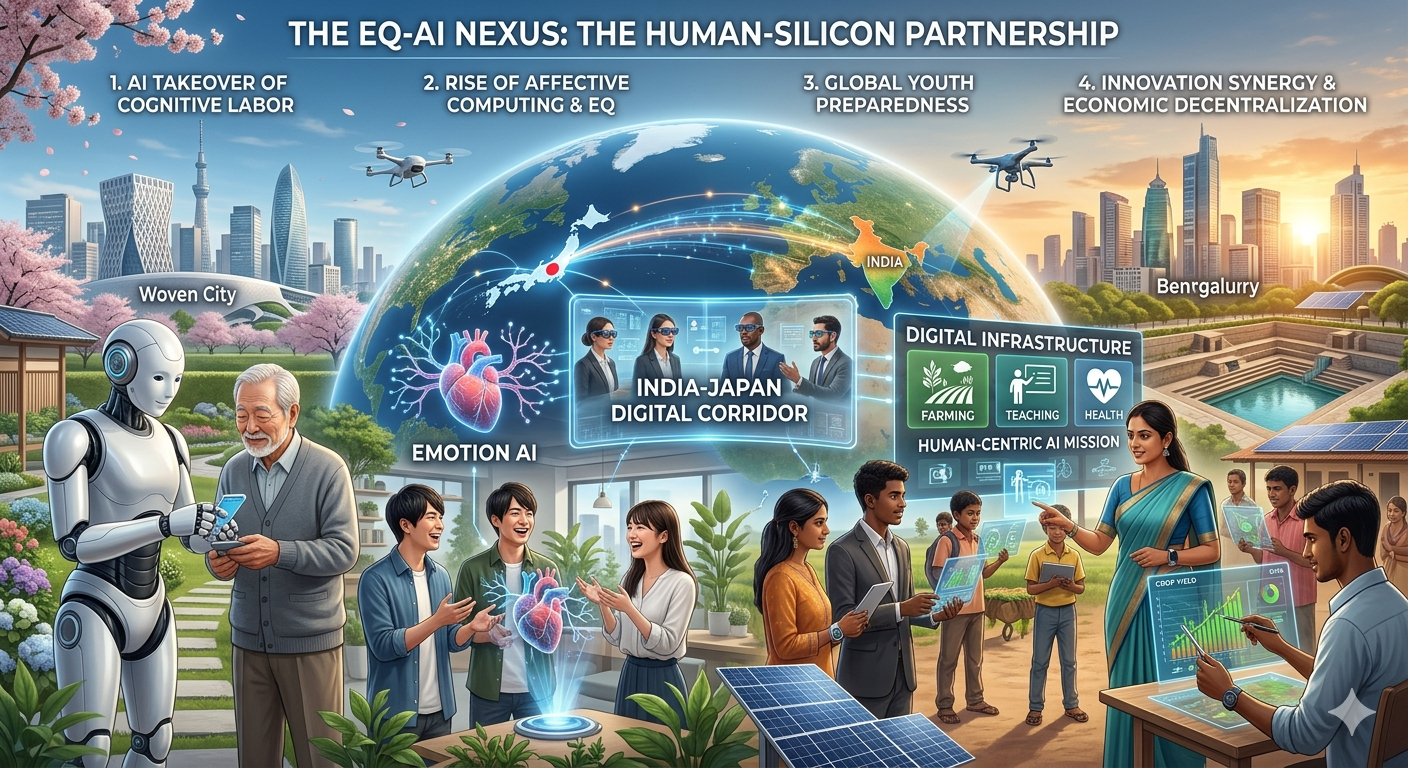
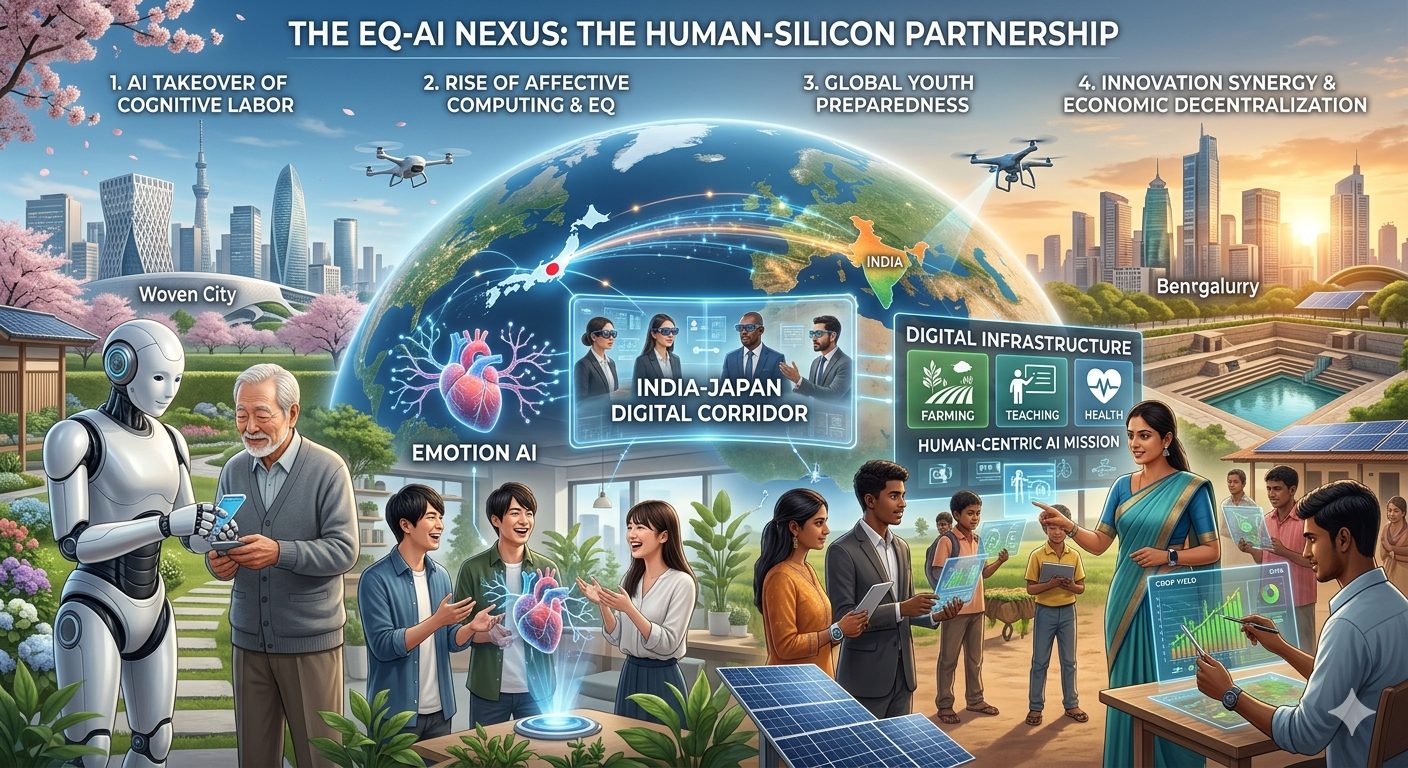
Central Nexus: The connection of neural 'EQ' branches and AI networks.
AI as a Kinetic Force: The conflict highlighted the use of AI in warfare for logistics and targeting. As machines take over the "kill chain," the demand for human Emotional Intelligence and ethical oversight in the military has reached an all-time high. The "Workload" of the modern soldier has shifted from manual operations to the ethical management of autonomous systems.
Deep Dive: The Sector-Specific Shift
The impact of Artificial Intelligence manifests as a specialized partnership where Machine Learning handles the quantitative load while humans manage the qualitative experience.
1. Healthcare: Precision Meets Presence
In the 2030 AI world, diagnosis is almost entirely handled by Machine Learning models that analyze genomic data, lifestyle patterns, and real-time biometric feeds. However, the role of the physician has evolved into a "Health Navigator." While the AI identifies the pathology, the human doctor uses high Emotional Intelligence to help the patient navigate the psychological burden of illness.
2. Education: Algorithmic Tutors and Human Mentors
The Technology field has revolutionized learning. Students have 1:1 AI tutors that adapt to their cognitive pace. Yet, the "Educator" of 2030 focuses on character building and Youth EQ. The machine teaches the math; the human teaches the meaning.
3. The Intelligent Shield: Police and Army
In Law Enforcement, police departments utilize Predictive Policing to identify crime patterns before they occur. AI tools analyze hours of surveillance footage in minutes, allowing investigators to focus on high-EQ tasks like community building and de-escalation rather than manual data review.
India’s Sovereign AI Policy: Empowering the "Annadata"
India’s approach ensures that the 2030 AI world is inclusive. The government’s Digital Agriculture Mission has created a "Human-Centric AI" blueprint for the world.
1. The Digital Agriculture Mission & AgriStack
The cornerstone of India’s policy is the Digital Agriculture Mission. Central to this is AgriStack, a digital ecosystem that provides every farmer with a unique Farmer ID. By 2026, over 11 crore farmers have been integrated into this registry, providing the "soil" for Machine Learning models to provide hyper-local advice.
2. Bharat-VISTAAR: The Multilingual AI Brain
Launched in 2026, Bharat-VISTAAR acts as the intelligence layer. It is a multilingual AI tool that translates complex scientific data into actionable, local-language advice. Whether a farmer speaks Marathi or Tamil, they can interact with the AI assistant "Bharti" to receive real-time risk advisories.
3. The Drone Revolution: Namo Drone Didi
India’s policy toward "Kisan Drones" has transformed rural labor. Under the Namo Drone Didi scheme, 15,000 women-led Self-Help Groups have been equipped with drones and pilot training. These women provide rental services to local farmers, handling the hazardous Workload of pesticide spraying while managing the business logic and community trust—a perfect blend of high-tech and high-EQ.
Japan: The Hardware Soul and Society 5.0
While India leads in software and scale, Japan remains the leader in the physical manifestation of AI through Society 5.0. This concept seeks to create a "super-smart society" where the digital and physical worlds are indistinguishable.
Affective Computing: Japan has integrated Emotional Intelligence into its social fabric via "emotionally intelligent" robots in elderly care.
Woven Cities: These are fully autonomous urban living centers where AI manages traffic, energy distribution, and waste disposal with zero latency, proving that technology can be a sanctuary for human culture if guided by the "heart" (Kokoro).
The 2030 Global Economy: The Experience Economy
The global economy of 2030 operates on a "Dual-Value System."
1. The Shift to "Experiences"
As the cost of basic services has plummeted due to Machine Learning optimization, consumer value has shifted toward "Experiences." A product is no longer judged just by its utility, but by the human story behind it. The most successful brands in 2030 use Technology for logistics but employ high-EQ humans to manage the customer journey.
2. The "Human-Certified" Premium
A new global standard has emerged: the "Human-Certified" (HC) label. This ensures that while Artificial Intelligence may have assisted in the process, the final creative or ethical decisions were made by a person. In the Technology field, "Human-in-the-Loop" (HITL) is now a luxury marketing point
Decentralized Infrastructure: Includes a unique view of a sustainable smart-village that is integrated with Digital Literacy Labs and localized data centers, representing the scaling of the "India AI Mission" in a human-centric wa..
The Psychology of Cognitive Offloading
As the youth depend more upon AI for memory and calculation, a psychological shift called "Cognitive Offloading" has occurred. By 2030, humans no longer "store" raw data; they store "methods of retrieval."
While critics feared this would lead to a decline in intelligence, it has actually led to an expansion of Emotional Intelligence. With the brain no longer burdened by mundane data retention, the future generation has more cognitive "bandwidth" for empathy, ethical reasoning, and complex social negotiation. The Workload of the human brain has evolved from a storage unit to a high-level processing center for sentiment and strategy.
Why the Youth Must Master EQ
For the future generation, the mandate is clear: technical proficiency is the baseline, but Emotional Intelligence is the premium. The 2030 AI world rewards those who can bridge the gap between silicon logic and human sentiment.
Key EQ Skills for the Future:
• Self-Awareness: Managing emotional triggers in a high- speed, AI-driven environment.
• Social Intuition: Reading the unsaid cues in a virtual meeting that an AI might overlook.
• Ethical Leadership: Applying a moral compass to the decisions made by autonomous drones and police algorithms.
Conclusion: The Human Compass in a Digital Sea
The transition to a society driven by Artificial Intelligence and Machine Learning is a liberation, not a replacement. It strips away the mundane, leaving behind the essence of what it means to be alive.
As we move deeper into the 2030s, the importance of being "Human" has never been greater. The youth who succeed will be those who treat Technology as their tool and Emotional Intelligence as their compass. In the end, the most advanced technology on the planet is still the human heart, and the most powerful algorithm is still empathy. The 2030 AI world is here—a world where silicon logic and human emotion walk hand-in-hand toward a new frontier.
Frequently Asked Questions
What is the primary significance of The EQ-AI Nexus: Human Logic in the 2030 AI World.?
The Great Convergence: Silicon Logic and the Human Heart:As we stand in 2026, looking toward the 2030 horizon, the global landscape has undergone a transformation more profound than any industrial shift in history. The concept of the "workload" has been fundamentally re-engineered.
How does this development impact Technology?
Artificial Intelligence (AI) and Machine Learning (ML) have transitioned from peripheral tools into the very central nervous system of global civilization. However, this era is not defined solely by the power of processors, but by the resurgence of Emotional Intelligence (EQ) as the most valuable currency in a 2030 AI world.The Automation of Logic: AI’s Takeover of the WorkloadBy 2030, the traditional "human workload" has been bifurcated.
What are the key future projections to monitor?
Repetitive, data-heavy, and analytically rigid tasks have fully migrated to autonomous systems.