"Assam and Puducherry Elections 2026: Key Outcomes"

The Assam and Puducherry elections 2026 marked a significant chapter in India's democratic calendar, held alongside polls in other states on April 9, 2026. These contests tested the popularity of incumbent governments, regional aspirations, and national political trends. In both regions, the National Democratic Alliance (NDA) emerged victorious, reinforcing its stronghold in diverse political landscapes.
This article provides a detailed, educational overview of the Assam and Puducherry elections 2026, covering the background, campaign issues, polling process, results, key performances, and broader implications. The outcomes on May 4, 2026, delivered clear mandates that will shape governance in these regions for the next five years.
Assam, with its 126-member Legislative Assembly, has been governed by the BJP-led NDA since 2016. Chief Minister Himanta Biswa Sarma sought a third consecutive term, building on a platform of development, cultural preservation, and strong governance. The state’s complex demographic fabric, including issues related to illegal immigration, flood management, and economic growth, dominated discussions.
Puducherry, a Union Territory with a 30-member Legislative Assembly, saw the AINRC-led NDA, headed by Chief Minister N. Rangasamy, defend its record. Known for political fluidity, Puducherry’s elections often hinge on local welfare schemes, alliances, and the influence of national parties like Congress, DMK, and BJP.
Both elections were announced by the Election Commission of India in March 2026, with polling conducted in a single phase on April 9 and vote counting on May 4. High voter turnout reflected strong public engagement.
Election Schedule and Process
Key Dates for Assam and Puducherry Elections 2026:
Notification: March 16, 2026
Last date for nominations: March 23, 2026
Scrutiny: March 24, 2026
Withdrawal of candidatures: March 26, 2026
Polling Date: April 9, 2026
Results Declaration: May 4, 2026
The Election Commission deployed extensive security measures and advanced technology for transparent polling. Voter turnout in Assam was robust, while Puducherry recorded one of its highest participation rates, underscoring the electorate’s enthusiasm.
Campaign Highlights and Major Issues
In Assam, the BJP-led NDA campaigned on achievements in infrastructure, tea industry revival, and border security. Himanta Biswa Sarma’s energetic rallies emphasized stability and development. The Congress-led alliance focused on social justice, minority welfare, and allegations of governance gaps. Regional parties like AGP and AIUDF played influential roles in specific pockets.
In Puducherry, welfare schemes, employment generation, and tourism development took center stage. N. Rangasamy highlighted the government’s track record in delivering freebies and infrastructure projects. Opposition parties, including Congress and DMK-backed alliances, promised better governance and highlighted issues like unemployment and local autonomy.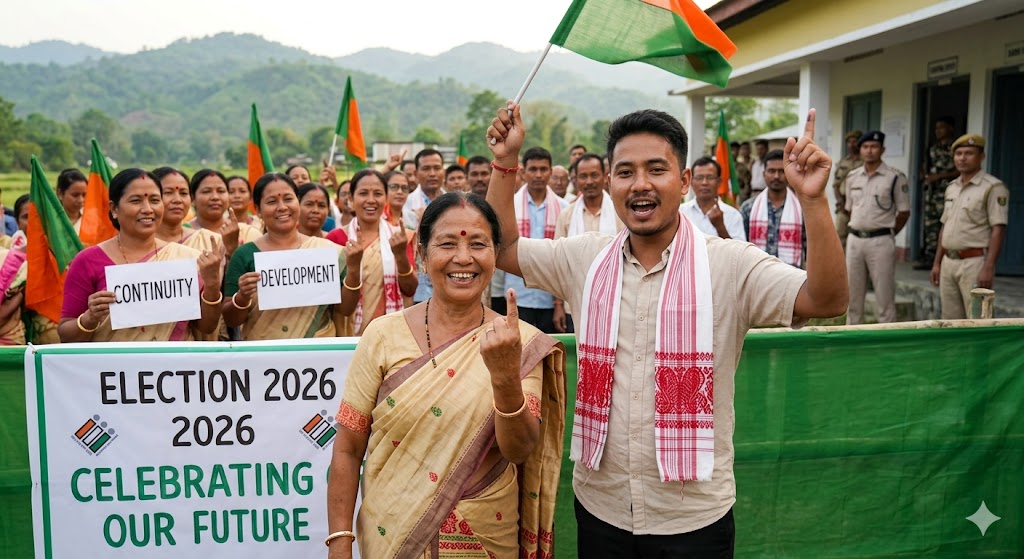
Voting and Election Campaigning
Both campaigns witnessed intense digital outreach, door-to-door canvassing, and star campaigner visits, reflecting the evolving nature of electoral strategies in India.
Results and Seat-wise Performance: Assam Elections 2026
The Assam elections 2026 delivered a decisive victory for the NDA. The alliance secured a strong majority, with the BJP winning the lion’s share of seats. This hat-trick victory marked the third consecutive term for the BJP-led government in the state.
Approximate Final Tally (Assam):
NDA (BJP + AGP + BPF): Over 100 seats
BJP: Around 82 seats
Congress-led alliance: Significantly lower
Other parties and Independents: Remaining seats
Himanta Biswa Sarma retained his Jalukbari seat comfortably. Several high-profile candidates, including those who switched parties, performed well. The results underscored voter preference for continuity and strong leadership in a strategically important state.
The NDA’s performance exceeded expectations in many urban and semi-urban constituencies, while regional allies maintained influence in their traditional strongholds.
Results and Seat-wise Performance: Puducherry Elections 2026
In Puducherry, the AINRC-led NDA comfortably retained power, crossing the majority mark of 16 seats. Chief Minister N. Rangasamy secured a strong victory in his constituency, reinforcing his personal popularity.
Approximate Final Tally (Puducherry):
NDA (AINRC + BJP + allies): Around 18 seats
AINRC: 12 seats
BJP: 4 seats
Opposition (Congress, DMK, others): Remaining seats
The outcome ensured stability in the Union Territory, with Rangasamy poised to continue as Chief Minister. The results reflected appreciation for the incumbent government’s welfare-focused governance model.
Key Factors Behind the Victories
Several elements contributed to the NDA’s success in both Assam and Puducherry elections 2026
:Incumbency Advantage: Effective implementation of central and state schemes resonated with voters.
Leadership Appeal: Strong personal images of Himanta Biswa Sarma and N. Rangasamy played crucial roles.
Alliance Cohesion: Seamless coordination within the NDA delivered dividends.
Development Narrative: Focus on tangible progress over divisive issues swayed the electorate.
Strategic Campaigning: Use of technology and targeted outreach in key demographics.
Opposition parties faced challenges in presenting a unified alternative, which impacted their performance.
Political Implications and outlook
The results of the Assam elections 2026 strengthen the BJP’s position in Northeast India, providing a boost ahead of future national contests. For Puducherry, the NDA’s win ensures policy continuity in a region often marked by political instability.
These victories highlight shifting voter priorities toward governance and development. Analysts note that the outcomes may influence alliance strategies and policy directions in other states.
In Assam, the new government is expected to focus on flood mitigation, economic diversification, and social harmony. In Puducherry, priorities include tourism enhancement, industrial growth, and urban development.
Voter Turnout and Democratic Participation
High participation rates in both regions demonstrated the vibrancy of Indian democracy. Women and young voters turned out in significant numbers, influenced by targeted welfare programs and digital awareness campaigns. The peaceful conduct of polls, despite occasional local tensions, was widely appreciated.
Broader Significance in National Politics
The Assam and Puducherry elections 2026 served as important barometers for national trends. The NDA’s consistent performance reinforces its organizational strength and appeal across diverse geographies—from the culturally rich landscapes of Assam to the coastal charm of Puducherry.
These results also spark discussions on federalism, regional aspirations, and the role of national parties in Union Territories. Political observers will closely monitor how the winning alliances translate electoral mandates into effective governance.
Conclusion
The Assam and Puducherry elections 2026 concluded with clear mandates favoring the NDA, ushering in stable governments focused on progress and development. In Assam, the BJP-led alliance’s third-term victory under Himanta Biswa Sarma marks a historic achievement. In Puducherry, N. Rangasamy’s leadership secured another term for the AINRC-led NDA.
These elections highlighted the maturity of Indian voters in choosing continuity where performance was visible. As the new governments take charge, expectations remain high for addressing local challenges while contributing to national growth.
The democratic exercise once again reaffirmed the strength of India’s electoral process, setting the stage for more engaging political battles in the years ahead.