Iran China Talks Follow Trump Pause on Hormuz Effort
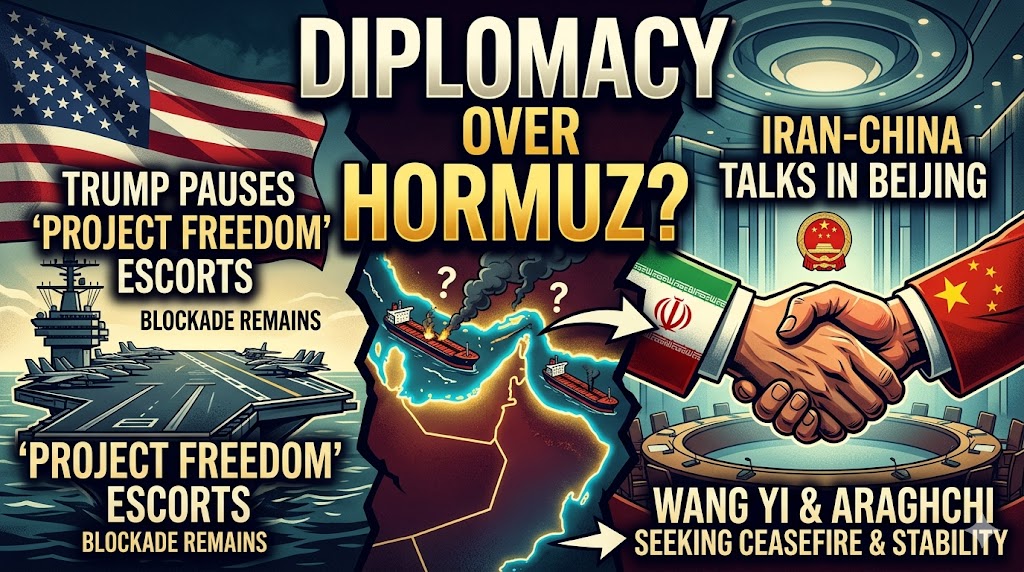
In a notable display of parallel diplomacy, Iranian Foreign Minister Abbas Araghchi met with Chinese counterpart Wang Yi in Beijing on Wednesday, even as U.S. President Donald Trump announced a pause in American efforts to guide vessels through the Strait of Hormuz. The developments underscore the intricate web of international negotiations aimed at resolving the ongoing conflict and restoring vital maritime traffic in one of the world's most critical energy chokepoints.
Trump's decision to temporarily halt "Project Freedom" — the short-lived U.S. operation to escort stranded commercial ships — comes amid reported progress toward a potential agreement with Iran. Meanwhile, China's engagement with Tehran highlights Beijing's strategic interest in stabilizing the region, given its heavy reliance on Gulf oil imports.
These moves reflect a delicate balancing act: military and economic pressure from the United States paired with diplomatic outreach involving key global players like China.
Background of the Strait of Hormuz Crisis
The Strait of Hormuz has been at the center of escalating tensions since the outbreak of major hostilities in late February 2026. Following U.S. and Israeli strikes under Operation Epic Fury, Iran responded by disrupting shipping through the narrow waterway, effectively imposing restrictions that impacted global oil flows.
Roughly one-fifth of the world's seaborne oil trade normally passes through this strategic passage between the Persian Gulf and the Gulf of Oman. Disruptions have led to higher energy prices, increased shipping costs, and concerns over supply chain stability across multiple continents.
The United States responded with a naval blockade of Iranian ports and, more recently, the initiation of Project Freedom to safeguard commercial navigation. However, just days after launching the escort mission, President Trump signaled a shift in approach.
Trump's Pause on Project Freedom: Reasons and Reactions
On Tuesday evening, President Trump posted on Truth Social announcing the temporary suspension of efforts to guide stranded vessels out of the Strait of Hormuz. He cited "great progress" toward a complete and final agreement with Iranian representatives, along with requests from countries including Pakistan.
The blockade of Iranian ports remains in place, maintaining leverage while talks continue. Administration officials, including Secretary of State Marco Rubio, have emphasized that the pause aims to create space for diplomacy without relinquishing strategic advantages gained through military operations.
Market reactions were largely positive, with oil prices easing and stock markets showing gains on optimism that a broader resolution might be near. Critics, however, question the rapid policy shift, noting the operation had only recently begun.
Iranian officials have welcomed the pause, with some Revolutionary Guard statements indicating willingness to allow safe transit under certain conditions, provided external threats are neutralized.
The Iran-China Meeting in Beijing
Iran’s top diplomat Abbas Araghchi’s visit to Beijing marks his first trip to China since the conflict intensified. During talks with Wang Yi, both sides discussed the need for a comprehensive ceasefire and the prompt resumption of normal shipping through the Strait of Hormuz.
China, as Iran’s largest oil buyer, has significant stakes in regional stability. Wang Yi reportedly expressed deep distress over the prolonged war and called for efforts to restore navigation. Iranian statements highlighted trust in China’s role in promoting peace and shaping a post-conflict regional framework.
The timing is particularly significant, occurring just days before President Trump’s scheduled summit with Chinese President Xi Jinping. U.S. officials have been pressing Beijing to use its influence with Tehran to help reopen the strait, though China has balanced this with criticism of unilateral actions and sanctions.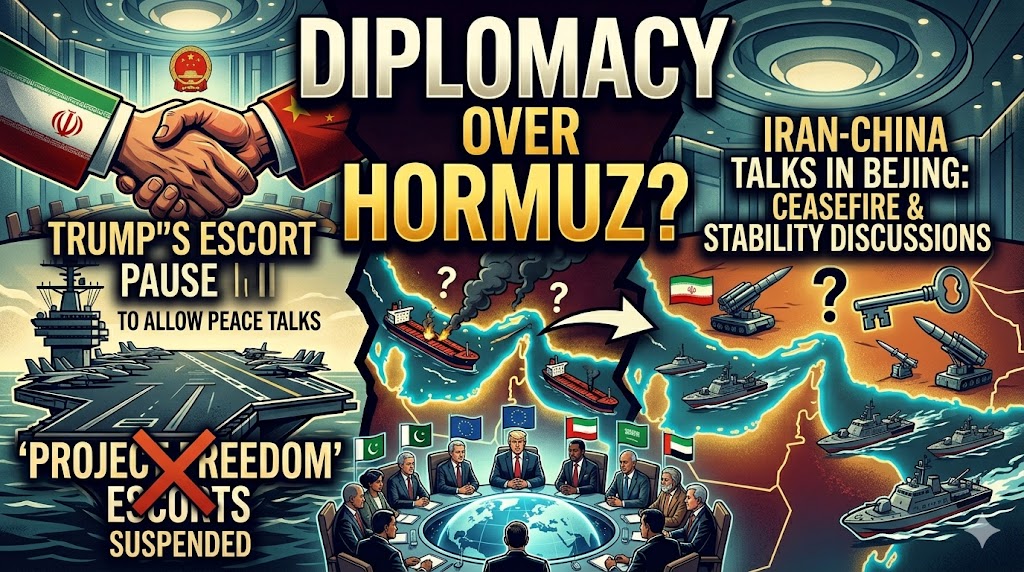
Unlocking the Strait: A Global Endeavor
Diplomatic Dynamics and Broader Geopolitics
The convergence of these events illustrates shifting alliances and competing interests. The United States maintains a policy of maximum pressure combined with openness to deals, while China positions itself as a proponent of multilateral solutions and stability in global trade routes.
Key elements under discussion in various channels include:
Limitations on Iran’s nuclear program with enhanced verification
Phased sanctions relief tied to verifiable actions
Commitments to freedom of navigation in the Strait of Hormuz
Regional security arrangements involving Gulf states
China’s dual role — maintaining close ties with Iran while engaging the U.S. ahead of the Trump-Xi meeting — adds complexity. Beijing has called for an end to disruptions but has also resisted certain U.S. sanctions on entities trading with Iran.
Economic Implications of the Ongoing Crisis
The prolonged uncertainty around the Strait of Hormuz has ripple effects far beyond the Middle East. Elevated oil prices have contributed to inflationary pressures in importing nations, affecting everything from transportation costs to consumer goods.
Alternative routes and increased use of pipelines offer only partial mitigation. Insurance premiums for vessels operating in the region have surged, and many shipping companies have rerouted or suspended services.
For China, reliable access to Iranian and other Gulf oil is crucial for energy security and economic growth. This explains Beijing’s active diplomatic engagement. For the global economy, a sustained reopening of the strait could provide relief, potentially lowering energy costs and boosting market confidence.
Defense and energy sector stocks have shown volatility tied to headlines, while broader indices reflect hope for de-escalation.
Military and Security Considerations
Despite the pause in escort operations, U.S. forces continue to monitor the area closely. The American naval presence, combined with the ongoing blockade, serves as a deterrent while negotiations proceed.
Iran possesses capabilities for asymmetric warfare, including missile systems, drones, and naval assets suited to the confined waters of the strait. Any miscalculation could rapidly escalate tensions anew.
Analysts emphasize the importance of clear communication channels to prevent incidents during this sensitive period. The involvement of multiple international actors, including indirect roles for Russia and European nations, further complicates the security landscape.
Historical Context of Hormuz Tensions
Disputes over the Strait of Hormuz are not unprecedented. The 1980s Tanker War saw attacks on commercial shipping amid the Iran-Iraq conflict. More recent incidents in 2019-2020 involved seizures and sabotage attributed to Iranian forces following the U.S. withdrawal from the JCPOA.
The current crisis, however, stands out due to its scale, direct U.S. military involvement, and intersection with broader great-power competition involving China. Lessons from past episodes highlight both the high costs of disruption and the eventual necessity of diplomatic off-ramps.
Potential Paths Forward
As talks continue on multiple tracks, several scenarios emerge:
1. Near-term Agreement: A limited memorandum addressing nuclear constraints, sanctions, and Hormuz access could lead to rapid normalization of shipping.
2. Extended Negotiations: Incremental steps with periodic pauses and confidence-building measures, potentially culminating in a more comprehensive deal.
3. Renewed Pressure: If progress stalls, the U.S. might resume or intensify operations, prompting further Iranian responses and Chinese mediation efforts.
The upcoming Trump-Xi summit in Beijing is expected to feature the Iran situation prominently, offering an opportunity for high-level coordination.
Success will depend on verifiable commitments, mutual compromises, and sustained international support. For Iran, balancing domestic priorities with external demands remains challenging. For the U.S. and China, managing competition while addressing shared interests in energy security will be key.
Voices from Stakeholders
Gulf Arab states have expressed quiet support for secure navigation while urging de-escalation. European countries emphasize diplomatic solutions and non-proliferation. Within Iran, hardliners and pragmatists appear to be navigating internal debates over concessions.
Public statements from all sides reflect a desire to avoid broader regional war, though underlying mistrust persists.
Conclusion
The meeting between Iranian and Chinese envoys, coinciding with President Trump’s pause on U.S. efforts in the Strait of Hormuz, represents a critical juncture in efforts to resolve the conflict. While challenges remain, the alignment of diplomatic activities suggests momentum toward de-escalation and reopening this vital waterway.
The coming weeks, particularly around the Trump-Xi summit, will likely determine whether current optimism translates into concrete agreements. For the global community, restoring stability in the Strait of Hormuz offers not only economic relief but also hope for reduced tensions in a strategically vital region.
Restoring normal operations will require careful implementation and ongoing vigilance. Yet the shared interest in preventing further disruption provides a foundation for potential breakthroughs in the days and weeks ahead.