'Made in India': Boosting Economic growth and Jobs
In today's interconnected world, "Made in India" stands as a symbol of national pride and economic ambition. Launched in September 2014, the Make in India initiative has evolved into a comprehensive movement that is transforming how the world perceives Indian manufacturing. From humble beginnings to high-tech assembly lines, Indian products are increasingly competing—and winning—on the global stage.
This article delves into the journey of Made in India, its profound impact on the economy and labor market, real-world success stories across sectors, ongoing challenges, and future prospects. As India advances toward greater self-reliance through Atmanirbhar Bharat, the initiative continues to fuel innovation, attract investments, and generate sustainable employment.
The Genesis and Objectives of Made in India
The Make in India campaign was designed with ambitious goals: raising manufacturing’s share in GDP to 25%, creating 100 million additional jobs, and making India a preferred destination for global investment. It identified 25 priority sectors such as automobiles, electronics, defense, textiles, pharmaceuticals, food processing, and renewable energy.
Key pillars include simplifying business processes, building world-class infrastructure, opening new sectors to FDI, and fostering a culture of innovation. Complementary schemes like Production Linked Incentives (PLI), Skill India, and Startup India have amplified its reach. While global events slowed some targets, the initiative has delivered steady gains, with manufacturing contributing around 17% to GDP and notable successes in exports and employment.
Day-by-Day Development: Growth in Indian Products and Manufacturing
Indian manufacturing is advancing steadily through policy support, technology adoption, and entrepreneurial energy. The PLI schemes have been game-changers, incentivizing production and attracting both domestic and international players.
Electronics Revolution: Mobile phone production has skyrocketed from ₹18,000 crore to over ₹5.45 lakh crore in a decade. Exports jumped 127 times to more than ₹2 lakh crore. Companies like Foxconn, Pegatron, and Dixon Technologies have set up massive facilities, while Apple now manufactures a significant portion of its iPhones in India. Beyond mobiles, laptop and tablet production has surged, turning India into a major exporter of IT hardware.
Pharmaceutical Leadership: India supplies affordable medicines to over 200 countries. Domestic firms like Sun Pharma, Dr. Reddy’s Laboratories, and Serum Institute of India have expanded capacities. During the pandemic, India’s vaccine production and export under Vaccine Maitri highlighted its global role. Pharma exports crossed $30 billion recently, with strong growth in generics, APIs, and biologics.
Automotive and Engineering Goods: Tata Motors, Mahindra & Mahindra, and Maruti Suzuki are not only serving domestic markets but exporting vehicles and components worldwide. The electric vehicle (EV) segment is booming, with companies like Ola Electric, Ather Energy, and Tata expanding battery and two-wheeler production. Engineering exports, including auto components and machinery, have more than doubled.
Textiles and Apparel: Brands like Raymond, Arvind Ltd., and numerous MSME clusters in Tiruppur and Surat are exporting to Europe and the US. The shift toward sustainable fabrics and technical textiles is creating new opportunities.
Toys and Consumer Goods: Once a net importer, India now exports toys worth hundreds of crores, thanks to PLI support. Companies like Funskool and local manufacturers in Channapatna have scaled up. Other examples include jewelry from Jaipur, leather goods from Kanpur, and organic spices and teas from various states finding markets on Amazon and other global platforms.
Defense and Aerospace: Hindustan Aeronautics Limited (HAL), Bharat Electronics Limited (BEL), and private players like Larsen & Toubro and Tata Advanced Systems are producing everything from Tejas fighter jets to missiles and drones. Import substitution has saved billions of rupees while creating skilled jobs.
Renewables and New Frontiers: Solar module manufacturers like Adani Solar and wafer production initiatives are reducing import dependence. Semiconductor plants under the India Semiconductor Mission signal entry into high-tech manufacturing.
These examples illustrate how Made in India is progressing daily—from basic assembly to design and innovation.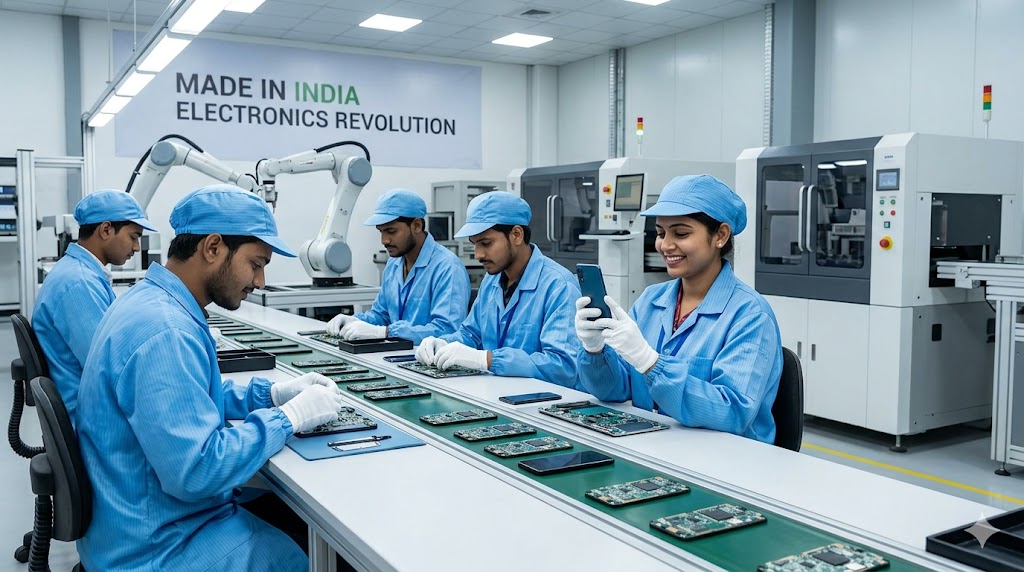
An inside view of a clean, well-lit electronics manufacturing facility in India, illustrating a real-world 'Made in India' success story.
Economic Impact: Extending India's Growth Story
The initiative has delivered multifaceted economic benefits:
FDI and Investment: Billions in fresh capital have flowed into manufacturing, with thousands of proposals approved. Global firms are choosing India over alternatives for its large market and improving ecosystem.
Export Boom: Merchandise exports have reached record levels, with electronics, pharmaceuticals, and engineering goods leading diversification. Total exports (goods + services) have crossed $800 billion milestones in recent years.
GDP and Multiplier Effects: Growth in manufacturing supports logistics, retail, banking, and services. It helps narrow trade deficits and increases government revenues for infrastructure and welfare.
MSME and Startup Ecosystem: With over 7.5 crore people employed in MSMEs and more than 1.48 lakh DPIIT-recognized startups, the base of the economy is strengthening. Many startups focus on manufacturing tech, agritech, and health products.
Rural economies benefit through food processing units, handicraft exports, and schemes linking farmers to markets.
Impact on Labor and Employment
Employment generation is a core success area:
PLI schemes alone have created approximately 8 lakh direct jobs, with many more indirect opportunities.
The textile sector employs over 14.5 crore workers, many in small towns.
Electronics manufacturing hubs in states like Tamil Nadu, Karnataka, and Uttar Pradesh provide jobs to engineers, technicians, and assembly line workers.
Defense and aerospace projects employ highly skilled professionals, while EV and renewable sectors are creating roles for youth trained in green technologies.
Women’s participation is rising through targeted skilling programs in apparel and electronics.
Periodic Labour Force Surveys show improving worker population ratios and declining unemployment. Focus on Tier-2/3 cities is spreading opportunities more evenly, reducing migration pressures.
Challenges like skill gaps and formalization remain, but continuous training initiatives are bridging them.
Challenges and the Road Ahead
Infrastructure bottlenecks, complex regulations in certain areas, global supply chain disruptions, and competition from other nations pose ongoing challenges. Achieving the 25% GDP target requires sustained effort, especially amid automation trends.
The future looks promising with the National Manufacturing Mission emphasizing MSME support, technology adoption, sustainability, and moving toward “Design in India.” Investments in semiconductors, AI-driven manufacturing, and green energy will elevate India’s position in global value chains.
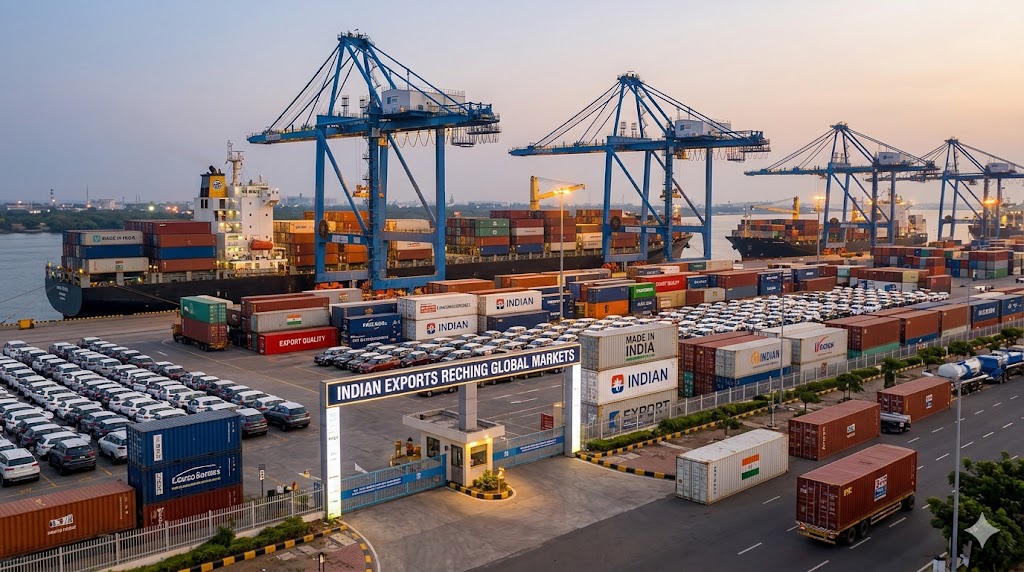
A bustling multi-modal logistics hub near a major Indian port at dusk, where newly manufactured automobiles, engineering goods, and pharmaceutical containers are loaded onto a massive cargo ship.
Conclusion
Made in India represents a dynamic journey of progress, visible in factories humming with activity, products reaching distant shores, and millions of Indians gaining livelihoods. From mobile phones assembled in Noida to life-saving vaccines from Pune, from EVs rolling out of Maharashtra to solar panels powering homes—the examples are numerous and inspiring.
This initiative is not only strengthening the economy through higher exports, investments, and GDP growth but also empowering the labor force with dignity and opportunity. As Indian products earn global trust day by day, India is carving a niche as a reliable, innovative manufacturing powerhouse.
The road ahead is filled with potential. With continued policy focus, entrepreneurial zeal, and workforce dedication, Made in India will play a defining role in realizing India’s economic aspirations. Every “Made in India” product tells a story of resilience, innovation, and national progress.