India Tests Naval Anti-Ship Missile in Bay of Bengal
India’s Recent Naval Anti-Ship Missile Test
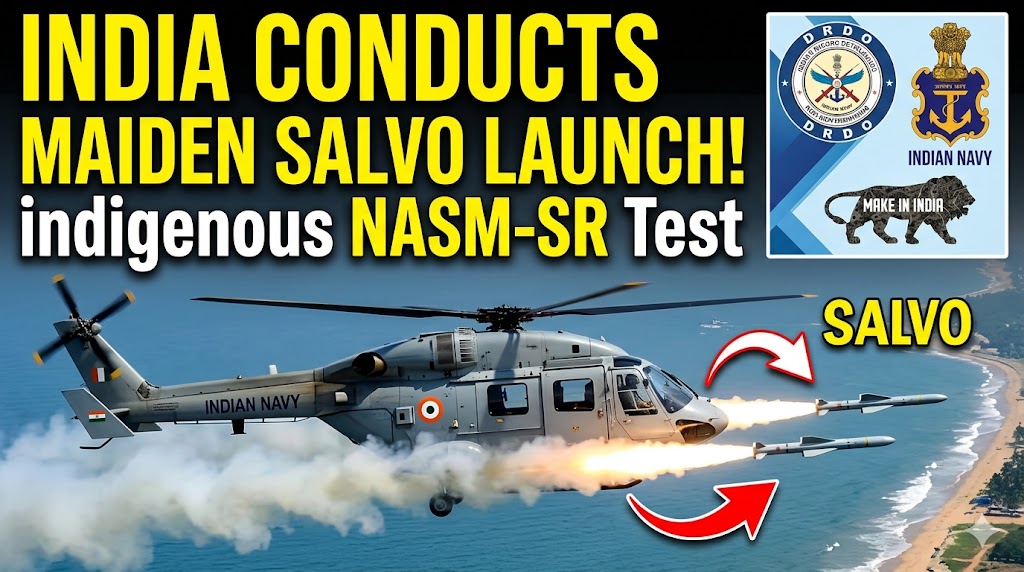
In a significant advancement for India’s maritime defence capabilities, the Defence Research and Development Organisation (DRDO) and the Indian Navy successfully carried out the maiden salvo launch of the indigenous Naval Anti-Ship Missile – Short Range (NASM-SR). The test took place from a naval helicopter platform over the Bay of Bengal, off the coast of Odisha, demonstrating India’s growing prowess in precision-guided munitions and air-launched strike systems.
Conducted on April 29, 2026, this trial involved firing two missiles in quick succession from the same helicopter platform. It achieved all intended objectives, including precise targeting and waterline hits on naval targets. Defence Minister Rajnath Singh commended the DRDO, Indian Navy, and associated industry partners for this achievement, describing it as a major boost to the country’s self-reliant defence ecosystem.
This article provides a detailed overview of the NASM-SR missile test, its technical features, strategic importance, development background, and broader implications for India’s naval preparedness in an increasingly complex maritime environment.
Background and Development of the NASM-SR Missile
The NASM-SR represents a critical component of India’s efforts to develop a family of indigenous anti-ship missiles tailored for naval operations. Developed by multiple DRDO laboratories in collaboration with Indian industry partners and start-ups, the missile embodies the “Make in India” and Atmanirbhar Bharat initiatives in the defence sector.
The short-range variant is designed primarily for launch from helicopters and other aerial platforms, providing naval forces with a potent tool to engage surface targets at closer ranges with high accuracy. Earlier tests of the NASM-SR had validated single-shot capabilities, but the April 2026 trial marked the first-ever salvo launch — the simultaneous or rapid sequential firing of multiple missiles from the same platform.
This capability is essential in modern naval warfare, where engaging multiple threats or ensuring mission success through redundancy can determine the outcome of an engagement. The successful salvo test validates the missile’s reliability, guidance systems, and integration with helicopter avionics under realistic operational conditions.
Details of the Bay of Bengal Test
The test was conducted off the coast of Odisha in the Bay of Bengal, a strategically important maritime zone for India. The Integrated Test Range (ITR) at Chandipur provided comprehensive tracking support through radar, electro-optical systems, and telemetry data.
During the trial, two NASM-SR missiles were fired in quick succession from an Indian Navy helicopter. Both missiles successfully struck their designated targets at the waterline, confirming the system’s precision strike capability against naval vessels. All mission parameters — including launch sequence, flight trajectory, guidance performance, and terminal accuracy — were met successfully.
Key technologies demonstrated during the test include
:Fibre-optic gyroscope-based inertial navigation system for accurate mid-course guidance.
Advanced jet-vane control mechanisms for enhanced manoeuvrability.
High-bandwidth data link enabling real-time updates and potential man-in-the-loop control.
Indigenous imaging infra-red seeker for terminal homing and precision targeting.
These features allow the missile to operate effectively in contested environments, maintaining accuracy even against moving targets while resisting electronic countermeasures.
Senior scientists from DRDO and senior officers from the Indian Navy witnessed the test, underscoring the collaborative nature of the programme.
Technical Specifications and Capabilities
While exact classified details remain limited, publicly available information highlights the NASM-SR as a lightweight, high-performance missile optimized for helicopter launch. It features solid propulsion, compact design suitable for aerial platforms, and advanced seeker technology for all-weather operation.
The missile’s short-range profile makes it ideal for rapid-response scenarios in littoral waters or during anti-surface warfare missions closer to the coast. Its ability to hit at the waterline maximizes damage to enemy vessels by targeting vulnerable areas below the deck line.
The salvo launch capability tested in the Bay of Bengal significantly enhances tactical flexibility. It allows a single helicopter to saturate a target area or engage multiple vessels in a short timeframe, increasing survivability and mission effectiveness in high-threat environments.
This test also builds upon previous successful trials of the NASM series, including single launches that validated imaging infra-red seekers and fibre-optic gyro navigation. The progression from single-shot to salvo capability indicates maturing technology and growing confidence in the system’s reliability.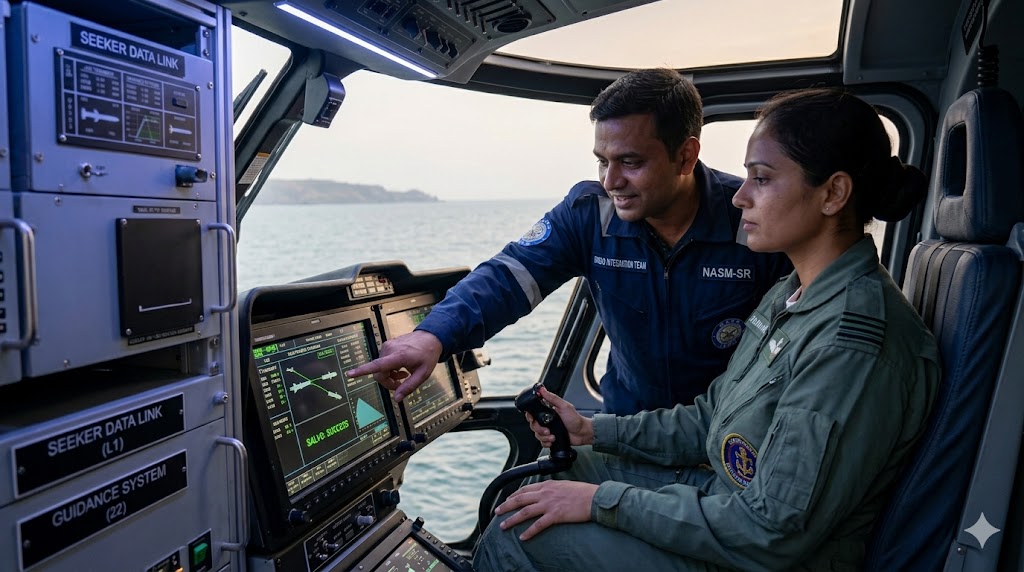
strategic importance for Indian navy
Strategic Importance for Indian Navy
The successful NASM-SR test comes at a time when maritime security challenges in the Indo-Pacific region are intensifying. India’s vast coastline, extensive exclusive economic zone, and critical sea lines of communication require robust anti-ship capabilities to deter potential adversaries and protect national interests.
Integration of the NASM-SR with naval helicopters significantly extends the Indian Navy’s reach and striking power from rotary-wing platforms. Helicopters operating from ships or shore bases can now deliver precise, rapid anti-surface strikes without relying solely on larger fixed-wing aircraft or ship-launched systems.
This capability complements existing Indian naval assets, including BrahMos supersonic cruise missiles and other indigenous weapon systems. Together, they create layered defence and offence options across different ranges and platforms.
The test also strengthens India’s position in regional maritime security architecture. Enhanced indigenous anti-ship missiles reduce dependence on foreign suppliers, ensuring operational sovereignty and faster response times during crises.
Contribution to Atmanirbhar Bharat and Defence Self-Reliance
One of the most noteworthy aspects of the NASM-SR programme is its high level of indigenous content. Multiple DRDO laboratories worked closely with private industry partners and start-ups, fostering innovation and building domestic manufacturing ecosystems.
This collaborative model not only accelerates development but also creates skilled jobs and technological spillovers into civilian sectors. Successful tests like the Bay of Bengal salvo launch validate years of investment in research, design, and testing infrastructure.
Defence Minister Rajnath Singh’s praise highlighted the collective effort, noting that such achievements reinforce India’s commitment to becoming a global leader in defence manufacturing. The NASM-SR joins a growing list of indigenous systems — from BrahMos to Akash and Agni series — that demonstrate India’s expanding technological maturity.
Challenges and Future Roadmap
While the salvo launch marks a major milestone, further trials and integration phases are likely before full operational induction. These may include tests against moving targets under electronic warfare conditions, night operations, and compatibility with different helicopter platforms.
The Indian Navy and DRDO are also developing medium and long-range variants of naval anti-ship missiles. The NASM family is expected to provide a comprehensive suite of weapons addressing various operational scenarios — from short-range helicopter strikes to longer-range ship and aircraft-launched options.
Future developments may incorporate advanced features such as improved stealth, hypersonic speeds in related programmes, and enhanced networking for swarm or coordinated attacks.
Broader Implications for Regional Security
India’s successful naval anti-ship missile test sends a clear message of deterrence and capability. In an era of evolving maritime threats, including anti-access/area denial strategies, robust anti-ship weapons play a crucial role in maintaining freedom of navigation and protecting vital trade routes.
The Bay of Bengal test also highlights India’s focus on the eastern seaboard, which holds strategic importance due to its proximity to key chokepoints and growing economic activities.
For the Indian Armed Forces, this achievement enhances jointness between DRDO, the Navy, and supporting agencies. It reflects a maturing defence innovation ecosystem capable of delivering cutting-edge solutions tailored to India’s unique security requirements.
Conclusion: A Step Forward in Maritime Defence
The maiden salvo launch of the NASM-SR from a naval helicopter over the Bay of Bengal represents a notable success in India’s defence journey. It validates indigenous technology, demonstrates operational maturity, and strengthens the Indian Navy’s anti-surface warfare capabilities.
As India continues to modernize its armed forces under the umbrella of self-reliance, tests like this one in April 2026 underscore the steady progress being made. They contribute not only to national security but also to technological sovereignty in a competitive global landscape.
With further refinements and integration, the NASM-SR and its variants are poised to become important assets in safeguarding India’s maritime interests. This successful trial in the Bay of Bengal adds another proud chapter to the story of indigenous defence development, reinforcing confidence in India’s ability to meet future challenges with homegrown solutions.