Arabian Sea: Strategic Lifeline of the Indian Ocean
News• April 27, 2026• Global Edition
The Arabian Sea
The Arabian Sea stands as one of the most strategically vital bodies of water in the world, forming a northwestern extension of the Indian Ocean. Spanning approximately 3,862,000 square kilometers, it serves as a bustling maritime highway connecting Europe, Asia, Africa, and the Middle East. For India, with its long western coastline, this sea is far more than a geographical boundary—it is the artery through which much of the nation's energy imports, trade, and economic aspirations flow.
Historically, the Arabian Sea has facilitated ancient trade routes, cultural exchanges, and naval expeditions. In Roman times, it was known as the Erythraean Sea, while medieval Arab traders called it the Sea of India. Today, its importance has only amplified in an era of globalization, energy interdependence, and great-power competition. The sea's waters witness the daily passage of oil tankers, container ships, fishing vessels, and naval fleets from multiple nations.
Geopolitically, the Arabian Sea is a theater of both cooperation and contention. Checkpoint like the Strait of Hormuz and the Gulf of Aden make it susceptible to disruptions that can ripple across global economies. Persistent tensions—ranging from regional rivalries to non-traditional threats like piracy, smuggling, and climate-induced extreme weather—add layers of complexity. For India and its neighbors, securing these waters is essential for national security, economic stability, and regional influence.
This article provides a comprehensive analysis of the Arabian Sea across geographical, political, geopolitical, economic, and ecological dimensions, with special emphasis on its profound significance for India. As naval forces from Asian powers increasingly deploy warships and submarines, the sea remains a barometer of broader Indo-Pacific dynamics.
Geographical Features and Physical Characteristics
The Arabian Sea is bounded on the west by the Arabian Peninsula, the Gulf of Aden, and the Guardafui Channel; on the northwest by the Gulf of Oman and Iran; on the north by Pakistan; on the east by India; and on the southeast by the Laccadive Sea and the Maldives, with Somalia marking the southwest. Its maximum width reaches about 2,400 km, while its average depth is around 2,734 meters. The maximum depth occurs at Wheatley Deep, plunging to approximately 5,395–5,803 meters in different measurements.
Geologically, the sea formed roughly 50 million years ago during the collision of the Indian subcontinent with Asia. Submarine features include the Carlsberg Ridge, which divides the sea into the Arabian Basin and Somali Basin, and the seismically active Murray Ridge. These ridges and basins influence ocean currents, sediment distribution, and seismic activity in the region.
The sea's floor features extensive continental shelves, particularly off the coasts of India and Pakistan, which are rich in potential hydrocarbon resources. Deep waters reach close to most shores, except in the northeast near India and Pakistan, where shallower zones support productive fisheries.
Major Rivers Flowing into the Arabian Sea
Rivers play a crucial role in shaping the sea's hydrology, nutrient levels, and coastal ecosystems. The largest is the Indus River, which originates in the Himalayas, traverses India and Pakistan, and forms a massive delta near Karachi, Pakistan. It carries significant freshwater and sediments, influencing salinity and marine productivity.
Other important Indian rivers include the west-flowing Narmada and Tapi (Tapti), which carve distinctive rift valleys before emptying into the Gulf of Khambhat (Cambay). Additional contributors are the Mahi, Sabarmati, and smaller streams from Gujarat and Rajasthan. These rivers not only sustain agriculture and drinking water supplies but also deposit nutrients that fuel plankton blooms and support fisheries. However, upstream damming and pollution have altered sediment flows, affecting delta ecosystems and coastal morphology.
The influx of freshwater creates gradients in salinity and temperature, driving seasonal upwelling—especially strong off Somalia and Oman during the southwest monsoon. This upwelling brings nutrient-rich deep waters to the surface, making the Arabian Sea one of the most biologically productive regions in the Indian Ocean.
The Arabian Sea is a shared maritime domain involving several nations, each with unique stakes:
India boasts the longest coastline along the sea, exceeding 2,500 km, encompassing key states like Gujarat, Maharashtra, Goa, Karnataka, and Kerala, plus the Lakshadweep Union Territory. Major ports include Mumbai, Kandla, and Kochi.
Pakistan maintains about 1,050 km of coastline, centered on Karachi and the strategically important Gwadar port, developed with Chinese assistance under the China-Pakistan Economic Corridor (CPEC).
Iran, Oman, Yemen, and Somalia form the western and southwestern boundaries, with the Maldives adding an island dimension in the southeast.
These countries share interests in fisheries, trade, and resource exploration but also compete over maritime boundaries, fishing rights, and influence. Oman and Iran control access through the Strait of Hormuz, while Yemen and Somalia flank the Gulf of Aden route. This shared space necessitates diplomatic engagement, yet it also breeds friction when national interests diverge.
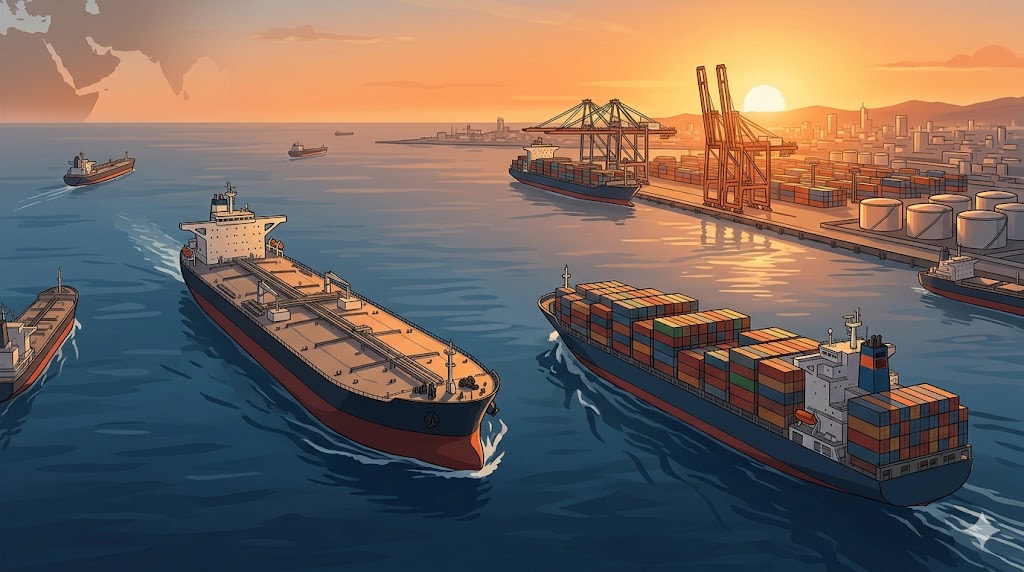
Energy and Commerce Artery: A panoramic digital illustration showing the Arabian Sea as a bustling maritime highway. An unbranded oil tanker and container ship transit the vital corridor at sunset, steering toward a massive port facility (like Mumbai or Mundra) on India's glowing western coastline.
Weather Patterns, Cyclones, and Environmental Dynamics
The Arabian Sea is dominated by the Indian Ocean monsoon system. Southwest monsoons (June–September) bring strong winds, heavy rainfall, and rough seas, while northeast monsoons (winter) create calmer conditions. These seasonal shifts drive coastal upwelling, enhancing biological productivity but also generating powerful waves and currents that challenge navigation.
Tropical cyclones, though less frequent than in the Bay of Bengal, have increased in intensity and frequency in recent decades, a trend linked to rising sea surface temperatures from climate change. Historically rare, the Arabian Sea has seen notable events like Cyclone Gonu (2007), the strongest recorded, which devastated Oman and Iran with winds over 240 km/h and caused billions in damage. Other significant storms include Phet (2010), Chapala and Megh (2015), Mekunu (2018), and Luban (2018), which brought torrential rains, flash floods, and infrastructure destruction to arid regions.
Studies indicate a five-fold increase in intense cyclones post-1995, with longer durations and greater landfall potential. These events recharge groundwater in desert areas but wreak havoc on coastal communities, fisheries, and shipping. For India, cyclones often threaten Gujarat and Maharashtra, disrupting ports and oil installations. Improved forecasting and regional cooperation in disaster management have mitigated some risks, yet vulnerabilities persist amid climate variability.
Rich Biodiversity and Ecological Significance
The Arabian Sea supports diverse marine life thanks to nutrient-rich upwelling. It forms part of a Large Marine Ecosystem with high primary productivity. Key species include pelagic fish such as tuna, sardines, mackerel, billfish, and sharks, alongside turtles, dolphins, and seabirds. Coral reefs, seagrass beds, and mangrove ecosystems fringe the coasts, particularly around Lakshadweep, Socotra, and Omani waters.
However, the ecosystem faces stress. Climate change has expanded Oxygen Minimum Zones (OMZs), altering food webs. Diatom-dominated plankton communities are giving way to Noctiluca scintillans blooms and jellyfish proliferations, disrupting traditional fisheries. Overfishing, pollution from shipping and coastal development, and plastic waste compound these issues. For coastal communities in India, Pakistan, and Oman, sustainable fisheries are vital for livelihoods and food security.
Conservation efforts include marine protected areas and bilateral agreements, but enforcement remains challenging in a high-traffic sea.
Geopolitical Importance: Energy, Trade, and Chokepoints
The Arabian Sea's geopolitical weight derives primarily from its role as an energy corridor. The Strait of Hormuz, connecting to the Persian Gulf, handles roughly 20-30% of global seaborne oil trade. Disruptions here—whether from conflict, mines, or blockades—can spike global energy prices and trigger economic shocks.
For India, the stakes are exceptionally high. Over 80% of its crude oil imports, significant LNG supplies (including from Qatar), and a large share of merchandise trade transit these waters. Any instability affects inflation, industrial output, and strategic reserves. The sea also supports India's growing blue economy ambitions in shipping, offshore energy, and port development.
Non-traditional threats add complexity. Narcotics smuggling—often Afghan opiates via the Makran coast—routes through the sea toward Europe, Africa, and beyond. Arms trafficking, human smuggling, and occasional piracy (though diminished since the Somali peak) require constant vigilance. Multinational task forces, including the Combined Maritime Forces (CMF), have conducted successful interdictions, seizing narcotics worth hundreds of millions.
Persistent Tensions and Naval Deployments
Geopolitical tensions in the Arabian Sea are enduring, fueled by regional rivalries, proxy conflicts, and extra-regional involvement. The sea has witnessed Houthi-related disruptions in adjacent areas, shipping attacks, and broader Middle East volatility. In 2026, ongoing West Asia crises have prompted heightened naval activity, with Indian commanders focusing on operational readiness and energy route security.
Naval forces from multiple Asian countries maintain a visible presence, signaling resolve and protecting interests:
The United States Navy sustains operations through CENTCOM, emphasizing freedom of navigation and counter-piracy.
India has expanded deployments under frameworks like Operation Sankalp (launched 2019). The Indian Navy regularly escorts merchant vessels, particularly near the Strait of Hormuz and Gulf of Oman, deploys carrier battle groups (including INS Vikrant), surface combatants, submarines, and aviation assets. It positions itself as a "net security provider," conducting anti-piracy missions in the Gulf of Aden and information-sharing with partners. Recent enhancements include forward deployments to deter threats and safeguard Indian-flagged tankers.
China maintains anti-piracy escorts and leverages dual-use infrastructure, raising concerns over long-term influence via ports like Gwadar.
Pakistan, with Chinese assistance, is inducting Hangor-class (Yuan-variant) submarines by 2026, aiming to bolster its underwater capabilities in the Arabian Sea. Joint China-Pakistan drills have featured submarine operations.
Other players like Iran and Oman conduct patrols, while submarines from various navies operate discreetly as deterrents.
This posturing reflects a delicate balance: asserting presence without escalation. For India, robust capabilities in the Arabian Sea deter adventurism, secure SLOCs (sea lines of communication), and support broader Indo-Pacific strategies, including Quad engagements. Neighboring countries view the sea as essential for protecting economic lifelines and territorial waters. Submarine deployments, in particular, underscore readiness for potential underwater warfare scenarios.
Analytically, these activities highlight shifting power dynamics. India's proactive stance—escorting vessels, monitoring routes, and participating in multilateral exercises—enhances its credibility as a responsible maritime power. However, it must navigate complex diplomacy with Gulf partners, Iran, and extra-regional actors to avoid entanglement in broader conflicts.
Special Significance for India: Security, Economy, and Strategy
India's relationship with the Arabian Sea is uniquely deep and multifaceted. The sea forms India's western maritime frontier, directly supporting major economic hubs. Ports like Mumbai handle vast cargo volumes, while offshore areas hold hydrocarbon potential.
Strategically, control and monitoring of the Arabian Sea are indispensable for countering northwest threats, securing Gulf energy flows, and projecting influence westward. Lakshadweep islands enhance surveillance and logistical reach. India's naval modernization— including stealth submarines and carrier capabilities—aims to maintain superiority in these waters against evolving challenges from China-Pakistan collaboration.
Economically, the sea underpins fisheries (supporting millions of livelihoods along the west coast), shipping, shipbuilding, and tourism. Culturally, it has shaped cosmopolitan coastal societies through centuries of trade with Arab, African, and European merchants.
In times of crisis, the Indian Navy has demonstrated agility, such as guiding vessels through tense zones or responding to humanitarian needs. This capability reassures allies and deters risks, while initiatives like port diplomacy (Chabahar, Duqm) extend operational footprints.
For India's neighbors, the sea offers opportunities for cooperative security—joint patrols, capacity-building, and disaster response—but also risks if competition intensifies. India's emphasis on inclusive maritime architectures promotes stability without dominance.
Economic and Ecological Dimensions: Opportunities and Challenges
Beyond geopolitics, the Arabian Sea drives substantial economic activity. Fisheries provide protein and employment, though sustainability is threatened by overexploitation and habitat loss. Hydrocarbon exploration continues, with new discoveries off India's west coast. Tourism thrives in areas like Goa's beaches and Oman's coasts.
Ecologically, seasonal productivity supports rich food webs, but climate change poses existential risks. Warming waters, acidification, deoxygenation, and altered cyclone patterns could reshape ecosystems. Low-oxygen zones expanding due to warming may displace fish stocks, affecting dependent communities. Pollution from shipping, desalination brine, and coastal runoff further degrades habitats.
Sustainable management requires integrated approaches: marine spatial planning, reduced emissions, and regional cooperation on conservation. India's initiatives in blue economy and coastal regulation offer models, yet enforcement gaps persist.
Future Outlook: Navigating Uncertainty
Looking ahead, the Arabian Sea's importance will likely intensify with growing global trade, energy transitions, and technological advances in naval warfare (unmanned systems, hypersonics). Climate-induced extremes may increase humanitarian demands, while resource competition could spark disputes.
Opportunities for cooperation exist in areas like marine scientific research, anti-smuggling operations, and HADR (humanitarian assistance and disaster relief). Enhanced maritime domain awareness through information-sharing platforms could reduce miscalculations.
For India, sustaining naval modernization, strengthening alliances, and investing in green maritime technologies will be key. Balancing strategic autonomy with collaborative security will define its approach.
Challenges include navigating great-power rivalry, addressing non-state threats, and mitigating climate impacts without compromising development goals. Multilateral forums and confidence-building measures offer pathways to stability.
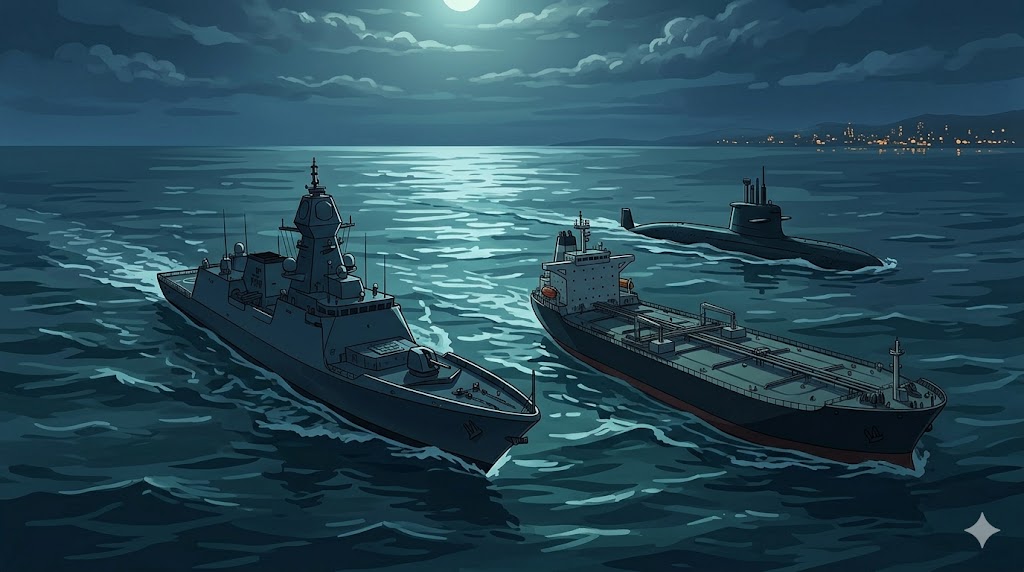
Night Vigil over Strategic Waters: A cinematic nighttime illustration focusing on the Arabian Sea's security landscape.
Conclusion
The Arabian Sea exemplifies the intricate convergence of geography, ecology, economics, and geopolitics. Its vast expanse, nutrient-rich waters, and critical chokepoints make it indispensable for global commerce and regional powers alike. Persistent naval deployments—from Indian warships escorting tankers to submarines signaling readiness—underscore the high stakes in an environment of ongoing tensions.
For India, the sea is a domain of opportunity and responsibility: central to energy security, economic prosperity, naval projection, and leadership in the Indian Ocean Region. As Asian navies assert presence, India's role as a net security provider becomes ever more vital, fostering stability while safeguarding sovereign interests.
In an interconnected world, the Arabian Sea's fortunes shape broader Indo-Pacific dynamics. Preserving it as a pathway for peace and shared prosperity demands vigilance, diplomatic wisdom, sustainable practices, and collaborative stewardship. As climate patterns shift and geopolitical currents evolve, proactive engagement will determine whether this strategic lifeline continues to nourish nations or becomes a source of enduring friction.
The story of the Arabian Sea is ultimately one of resilience and interdependence. By addressing its challenges with foresight and unity, bordering countries—and India in particular—can harness its potential for generations to come.
Arabian Sea, Arabian Sea geography, Arabian Sea geopolitical importance, Arabian Sea India, Arabian Sea navy deployments, Arabian Sea tensions, rivers into Arabian Sea, Arabian Sea cyclones, Strait of Hormuz.
,Arabian Sea bordering countries, Indian Navy Arabian Sea, China Pakistan submarines Arabian Sea, Arabian Sea fisheries ecology, Arabian Sea narcotics smuggling, Arabian Sea climate change impacts, naval presence Asian countries Arabian Sea.
Frequently Asked Questions
What is the primary significance of Arabian Sea: Strategic Lifeline of the Indian Ocean?
The Arabian SeaThe Arabian Sea stands as one of the most strategically vital bodies of water in the world, forming a northwestern extension of the Indian Ocean. Spanning approximately 3,862,000 square kilometers, it serves as a bustling maritime highway connecting Europe, Asia, Africa, and the Middle East.
How does this development impact News?
For India, with its long western coastline, this sea is far more than a geographical boundary—it is the artery through which much of the nation's energy imports, trade, and economic aspirations flow.Historically, the Arabian Sea has facilitated ancient trade routes, cultural exchanges, and naval expeditions. In Roman times, it was known as the Erythraean Sea, while medieval Arab traders called it the Sea of India.
What are the key future projections to monitor?
Today, its importance has only amplified in an era of globalization, energy interdependence, and great-power competition.