National Panchayati Raj Day: Empowering Grassroots Democracy
Current Affairs• April 24, 2026• Global Edition
National Panchayati Raj Day, also known as Rashtriya Panchayati Raj Diwas, is observed every year on April 24 across India. This significant day commemorates the enforcement of the Constitution (73rd Amendment) Act, 1992, which came into force on April 24, 1993, granting constitutional status to Panchayati Raj Institutions (PRIs) in rural areas.
The day highlights the importance of democratic decentralization, empowering local communities to participate actively in governance and development. It serves as a reminder of India's commitment to grassroots democracy, where decisions affecting villages are made by the people themselves rather than distant authorities.
In 2026, National Panchayati Raj Day falls on Friday, April 24. The Ministry of Panchayati Raj organizes various events, including award ceremonies for outstanding Panchayats, seminars, and awareness programs. The focus often revolves around themes like "Sashakt Panchayat, Sarvangeen Vikas" (Empowered Panchayats, Holistic Development), emphasizing localized Sustainable Development Goals (SDGs), digital governance through platforms like e-GramSwaraj, and contributions toward Viksit Bharat by 2047.
This article delves deep into the history, provisions of the 73rd Amendment, significance, and the evolving role of Panchayati Raj in transforming rural India.
Historical Background of Panchayati Raj in India
The concept of Panchayati Raj is deeply rooted in India's ancient traditions. Villages have long been governed by assemblies of elders, often referred to as "panchayats" meaning a council of five. However, in modern independent India, the system evolved through various experiments.
Article 40 of the Directive Principles of State Policy in the Indian Constitution directs the state to organize village panchayats and endow them with powers to function as units of self-government. Early efforts, such as the Balwant Rai Mehta Committee (1957), recommended a three-tier structure: Gram Panchayat at the village level, Panchayat Samiti at the block level, and Zila Parishad at the district level.
Despite these recommendations, the system remained weak and dependent on state governments without constitutional backing. Panchayats often lacked financial and administrative autonomy, leading to irregular elections and limited effectiveness.
The turning point came in the early 1990s when the government recognized the need for genuine decentralization to address rural challenges effectively.
PANCHARATI RAJ DAY 2026: EMPOWERING DEMOCRACY
The 73rd Constitutional Amendment Act, 1992: A Landmark Reform
The Constitution (73rd Amendment) Act, 1992, was a revolutionary step that provided constitutional status to Panchayati Raj Institutions. Passed by the Lok Sabha on December 22, 1992, and by the Rajya Sabha on December 23, 1992, it received presidential assent and came into effect on April 24, 1993.
This amendment added Part IX to the Constitution, covering Articles 243 to 243-O, titled "The Panchayats." It also introduced the Eleventh Schedule, listing 29 subjects that could be devolved to Panchayats, including agriculture, rural housing, drinking water, roads, education, health, and poverty alleviation programs.
Key Provisions of the 73rd Amendment
The amendment introduced several mandatory and enabling features to strengthen local self-governance:
1. Three-Tier Structure: Panchayats are to be constituted at three levels in every state—village (Gram Panchayat), intermediate (Panchayat Samiti or Block level), and district (Zila Parishad). States with a population of less than 20 lakh may skip the intermediate level.
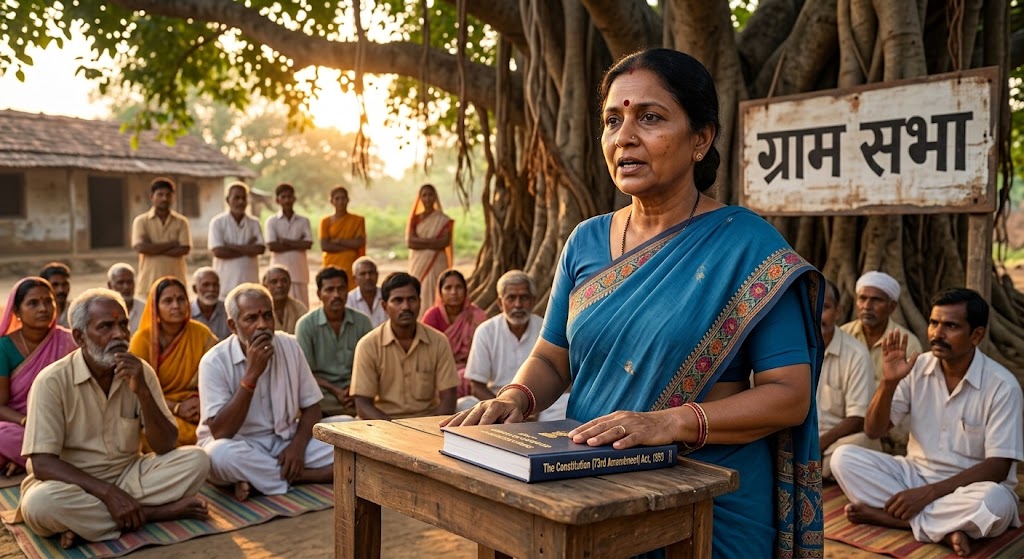
2. Gram Sabha: Recognized as the foundational body consisting of all registered voters in the village. It serves as a platform for direct democracy, where people discuss and approve development plans.
3. Direct Elections and Fixed Tenure: All seats in Panchayats at the village and intermediate levels are filled through direct elections. The tenure is fixed at five years, with fresh elections required within six months if a Panchayat is dissolved prematurely.
4. Reservations for Inclusive Representation:
- Seats reserved for Scheduled Castes (SCs) and Scheduled Tribes (STs) in proportion to their population.
- Not less than one-third of total seats (including those reserved for SCs/STs) reserved for women. Many states have enhanced this to 50%.
- Similar reservations apply to the offices of Chairpersons.
5. State Election Commission: An independent body to conduct Panchayat elections, ensuring fairness and regularity.
6. State Finance Commission: Established every five years to review the financial position of Panchayats and recommend the devolution of funds, taxes, duties, and grants.
7. Powers and Responsibilities: States are expected to devolve powers to Panchayats for preparing and implementing plans for economic development and social justice, covering the 29 subjects in the Eleventh Schedule.
8. Disqualifications and Audit: Provisions for disqualifying members and mandatory auditing of accounts.
While some provisions are compulsory, others like representation for Members of Parliament/Legislative Assemblies or reservations for Other Backward Classes are left to the discretion of state legislatures.
This amendment transformed Panchayats from mere advisory bodies into institutions of self-governance with legal sanctity.
Significance and Aims of National Panchayati Raj Day
National Panchayati Raj Day was first celebrated on April 24, 2010, when then-Prime Minister Dr. Manmohan Singh formally declared it as a national observance.
The primary aims include:
- Raising awareness about the importance of Panchayati Raj in democratic decentralization.
- Recognizing the contributions of elected representatives, especially women, SCs, and STs, in rural development.
- Encouraging greater public participation in local governance.
- Promoting best practices through National Panchayat Awards, which honor exemplary work in areas like sanitation, education, health, and digital governance.
- Aligning Panchayat activities with national goals such as Sustainable Development Goals and Viksit Bharat.
The day underscores how empowered Panchayats can address local issues effectively, reduce dependency on higher governments, and foster inclusive growth. It also highlights challenges like inadequate devolution of funds and functions (the "3Fs" — Funds, Functions, and Functionaries) that many states still need to address fully.
Structure and Functioning of Panchayati Raj Institutions
At the village level, the Gram Panchayat handles day-to-day affairs with the Sarpanch as the elected head. The Gram Sabha meets periodically to approve budgets and plans.
The intermediate level coordinates between villages and districts, focusing on block-level schemes.
The district level Zila Parishad oversees larger development programs and integrates planning with district administration.
Together, these tiers form a robust framework for bottom-up planning, where needs identified at the grassroots level feed into state and national policies.
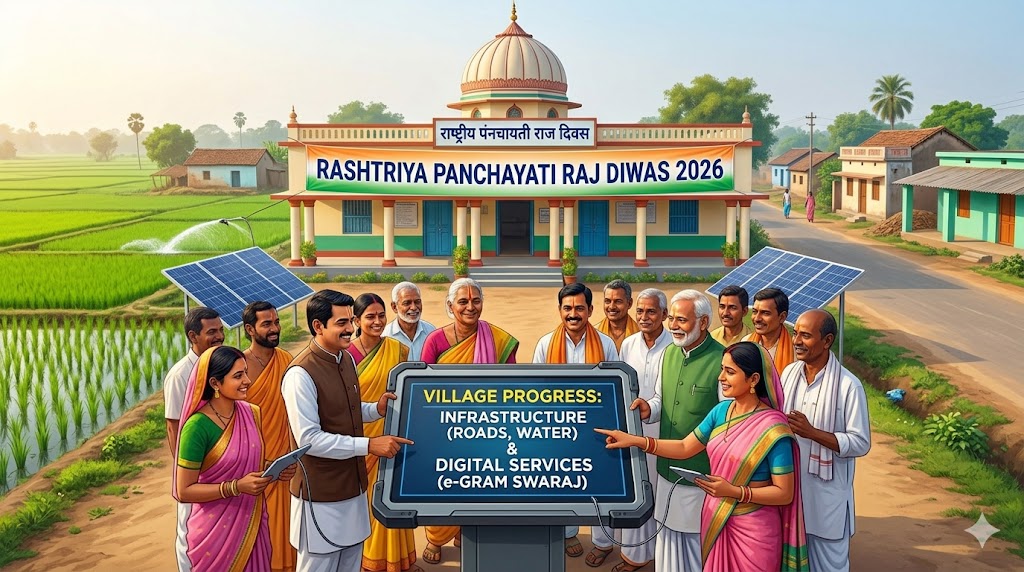
Digital initiatives like e-GramSwaraj have further enhanced transparency, enabling online accounting, planning, and monitoring of Panchayat works.
Impact on Rural India and Women's Empowerment
Since 1993, the 73rd Amendment has brought about visible changes. Millions of elected representatives, including over a million women, now participate in decision-making. This has led to improved focus on issues like girls' education, maternal health, sanitation (Swachh Bharat), and rural infrastructure.
Reservations for women have challenged traditional gender roles, with many women leaders emerging as effective change-makers, often overcoming the initial "Sarpanch Pati" phenomenon where male relatives influenced decisions.
Panchayats play a crucial role in implementing flagship schemes such as MGNREGA, PMAY-G, Jal Jeevan Mission, and Ayushman Bharat at the local level.
Challenges and the Way Forward
Despite progress, challenges persist. These include:
Uneven devolution of powers across states.
Capacity building needs for elected representatives, especially first-time ones from marginalized sections.
Financial constraints, with many Panchayats relying heavily on grants rather than own revenue.
Political interference and low awareness among citizens.
To overcome these, continuous efforts toward capacity enhancement, greater use of technology, and stricter adherence to the spirit of the 73rd Amendment are essential. Strengthening District Planning Committees can further integrate Panchayat plans with broader development strategies.
RASHTRIYA PANCHAYATI RAJ DIWAS 2026
Conclusion
National Panchayati Raj Day is more than an annual observance—it is a celebration of India's vibrant grassroots democracy. The 73rd Constitutional Amendment of 1993 laid the foundation for a truly decentralized governance model, bringing power closer to the people.
As India marches toward becoming a developed nation by 2047, empowered Panchayats will remain pivotal in achieving holistic, inclusive, and sustainable development. On this day, let us reaffirm our commitment to strengthening these institutions so that every village can thrive as a vibrant unit of self-governance.
By actively participating in Gram Sabhas and supporting local leaders, citizens can contribute to building a stronger, more democratic India from the bottom up.
Frequently Asked Questions
What is the primary significance of National Panchayati Raj Day: Empowering Grassroots Democracy?
National Panchayati Raj Day, also known as Rashtriya Panchayati Raj Diwas, is observed every year on April 24 across India. This significant day commemorates the enforcement of the Constitution (73rd Amendment) Act, 1992, which came into force on April 24, 1993, granting constitutional status to Panchayati Raj Institutions (PRIs) in rural areas.The day highlights the importance of democratic decentralization, empowering local communities to participate actively in governance and development.
How does this development impact Current Affairs?
It serves as a reminder of India's commitment to grassroots democracy, where decisions affecting villages are made by the people themselves rather than distant authorities.In 2026, National Panchayati Raj Day falls on Friday, April 24. The Ministry of Panchayati Raj organizes various events, including award ceremonies for outstanding Panchayats, seminars, and awareness programs.
What are the key future projections to monitor?
The focus often revolves around themes like "Sashakt Panchayat, Sarvangeen Vikas" (Empowered Panchayats, Holistic Development), emphasizing localized Sustainable Development Goals (SDGs), digital governance through platforms like e-GramSwaraj, and contributions toward Viksit Bharat by 2047.This article delves deep into the history, provisions of the 73rd Amendment, significance, and the evolving role of Panchayati Raj in transforming rural India.Historical Background of Panchayati Raj in IndiaThe concept of Panchayati Raj is deeply rooted in India's ancient traditions.