Exploring the Milky Way's : Our Galactic Home and planets
Current Affairs• April 23, 2026• Global Edition
The Milky Way galaxy is our cosmic home, a vast barred spiral system containing hundreds of billions of stars, including our Sun. Visible as a faint, luminous band stretching across the night sky on dark, moonless evenings, it has inspired wonder, mythology, and scientific inquiry for millennia. From ancient cultures naming it after spilled milk to modern astronomers mapping its hidden structures with advanced telescopes, the Milky Way continues to reveal secrets about our place in the universe.
Spanning roughly 100,000 light-years in diameter and harboring an estimated 100 to 400 billion stars, along with countless planets, gas clouds, and dust, the Milky Way is far more than a beautiful sight. It is a dynamic system with a supermassive black hole at its heart, intricate spiral arms, and a complex history of mergers and star formation. Recent observations, including high-resolution images of the central molecular zone and studies of its central black hole, have deepened our understanding while raising new questions.
This article explores the structure, scale, and key features of the Milky Way galaxy, our solar system's position within it, the enigmatic center, comparisons with neighboring galaxies like Andromeda, and fascinating facts that highlight its immense scale and ongoing evolution. Whether viewing stunning Milky Way photos or contemplating its vast journey through space, the galaxy offers profound insights into the cosmos.
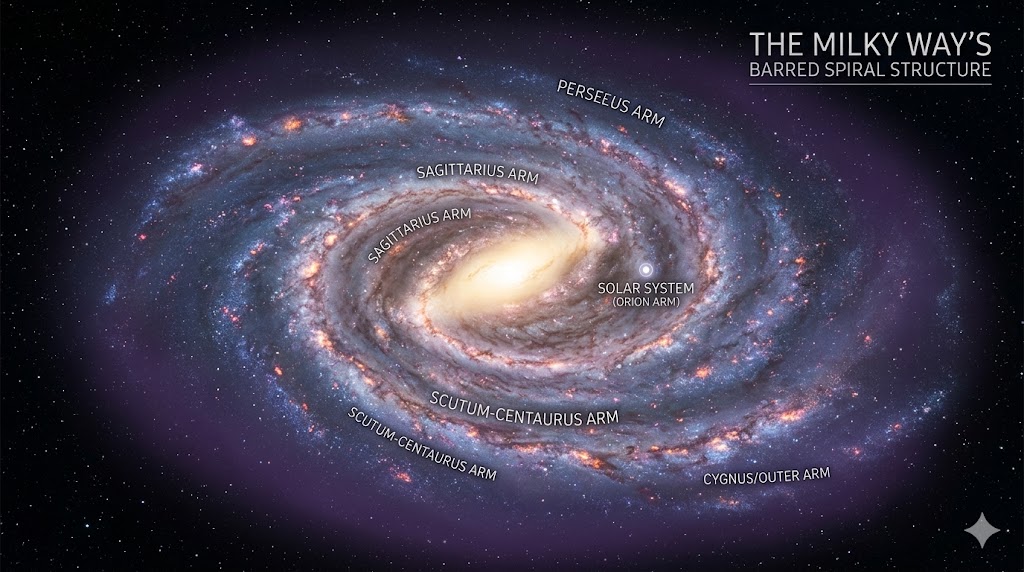
The Milky Way is classified as a barred spiral galaxy, featuring a central bar-shaped core from which spiral arms extend. Its overall structure includes several main components: the galactic bulge, the disk, the halo, and the central region.
The galactic bulge, located at the center, consists of older stars and is densely packed. Extending outward is the thin galactic disk, approximately 1,000 light-years thick but stretching 100,000 light-years across, where most star formation occurs. Spiral arms—regions of higher density containing young stars, nebulae, and gas—wind through the disk. Our solar system resides in the Orion Arm, on the inner edge, about halfway from the center to the outer rim.
Surrounding the disk is the galactic halo, a spherical region populated by ancient globular clusters and dark matter. Dark matter, though invisible, provides the gravitational scaffolding that holds the galaxy together and influences its rotation.
The Milky Way contains vast amounts of interstellar gas and dust, which obscure optical views of the center but fuel new star birth in the spiral arms. Recent surveys, such as the ALMA CMZ Exploration Survey released in early 2026, have provided unprecedented detail of the central molecular zone—the innermost 700 light-years—revealing dense gas filaments, turbulent clouds, and structures as small as 0.15 light-years across. This region holds about 80% of the galaxy's dense gas despite occupying less than 1% of the disk, highlighting its role as a dynamic hub for star formation and material flows toward the center.
The Scale of the Milky Way: Putting Vastness into Perspective
Grasping the scale of the Milky Way challenges human intuition. At approximately 100,000 light-years in diameter (with some estimates extending to 120,000–180,000 light-years when including the outer halo), traveling across it at the speed of light would take 100,000 years. Our solar system orbits the galactic center at about 515,000 miles per hour (828,000 km/h), completing one full revolution—a galactic year—every 225 to 250 million years. The last time Earth was in its current galactic position, dinosaurs were just beginning to dominate the planet.
The Sun lies roughly 26,000 to 27,000 light-years from the galactic center, placing us in a relatively stable region known as the galactic habitable zone, where conditions favor life. The galaxy's height is remarkably thin—only about 1,000 light-years at the disk—making it appear flattened like a pancake when viewed edge-on.
To visualize, if the Milky Way were scaled to the size of the continental United States, our solar system would be smaller than a pinpoint, and the nearest stars would be separated by miles. The galaxy rotates differentially: stars nearer the center orbit faster than those farther out, a pattern influenced by the distribution of visible matter and the unseen dark matter halo.
The Galactic Structure and Our Position
Our Solar System's Position and Journey in the Milky Way
The solar system is not at the center but on the inner edge of the Orion Arm, slightly above the galactic mid-plane (about 50–100 light-years north). This offset, combined with the galaxy's rotation, means we are on a long, winding journey around the core.
Every 225–250 million years, the Sun completes an orbit, carrying the entire solar system through varying galactic environments. During this Milky Way journey, we pass through denser spiral arms, where increased star density and interstellar material can influence comet impacts or cosmic ray exposure on Earth. Our current position offers relatively calm, away from the intense radiation and gravitational disruptions near the center.
Understanding this motion helps astronomers trace the galaxy's history. The Milky Way has grown through mergers with smaller galaxies over billions of years, incorporating their stars and gas. Gaia spacecraft data has mapped these ancient collisions, revealing "streams" of stars from devoured dwarf galaxies.
The Centre of the Milky Way: Sagittarius A and the Supermassive Black Hole
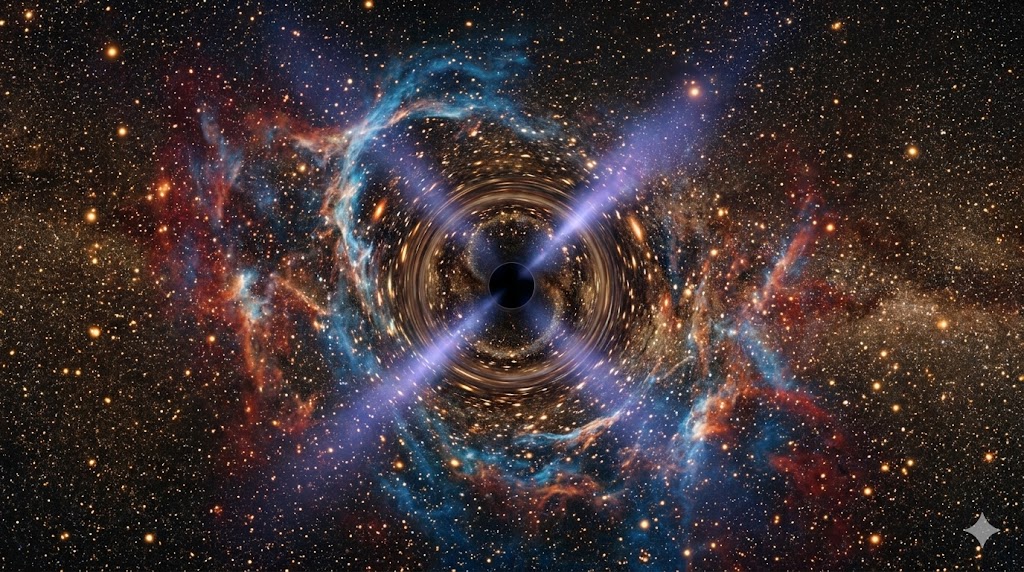
At the heart of the Milky Way lies Sagittarius A (Sgr A), a supermassive black hole with a mass of approximately 4.3 million times that of the Sun. Located about 26,000 light-years away in the direction of the constellation Sagittarius, it anchors the galaxy gravitationally.
Despite its enormous mass, Sgr A is relatively quiet today—one of the dimmest supermassive black holes observed—emitting modest radiation detectable primarily in radio, infrared, and X-ray wavelengths. Its event horizon shadow was imaged in 2022 by the Event Horizon Telescope, confirming predictions of general relativity.
Recent studies add intrigue. In January 2026, data from the XRISM space telescope revealed "light echoes" from molecular clouds near the center, suggesting Sgr A experienced a dramatic flare hundreds to a thousand years ago, shining thousands of times brighter before quieting again. This indicates the black hole has a more active past, occasionally consuming gas clouds or stars.
The central molecular zone surrounding it is a turbulent region of dense gas, intense radiation, and rapid star formation. High-resolution ALMA images from February 2026 show intricate filaments and clouds, offering clues about how material flows inward or forms stars rather than feeding the black hole.
Some 2026 research has even proposed alternative models, such as a dense core of exotic dark matter mimicking the gravitational effects of a black hole, though the black hole interpretation remains dominant based on stellar orbits.
Milky Way vs Andromeda: A Galactic Comparison and Future Collision?
The Milky Way is often compared to its nearest large neighbor, the Andromeda galaxy (M31), located about 2.5 million light-years away. Andromeda is larger, with a diameter of roughly 220,000 light-years and an estimated one trillion stars, compared to the Milky Way's 100,000–120,000 light-years and 100–400 billion stars. Andromeda's mass is slightly greater, around 1.2–1.5 trillion solar masses versus the Milky Way's roughly one trillion.
Both are barred spiral galaxies in the Local Group, but Andromeda appears brighter and more prominent from Earth under dark skies. The two galaxies are approaching each other at about 250,000 miles per hour. Classic models predicted a collision in roughly 4–5 billion years, potentially forming a new elliptical galaxy.
However, 2025–2026 studies incorporating Gaia and Hubble data, along with uncertainties in masses and motions of nearby galaxies like the Large Magellanic Cloud and Triangulum, suggest only about a 50% chance of a merger within 10 billion years—and as low as 2% for a head-on collision in the next 4–5 billion years. In other scenarios, the galaxies may pass by or interact mildly without fully merging. Dark matter structures, including possible sheets or halos, further influence these dynamics.
This Milky Way vs Andromeda outlook underscores the uncertainties in galactic evolution and highlights how our understanding continues to evolve with better data.
Fascinating Milky Way Galaxy Facts and Rare Sights
The Milky Way holds countless wonders. It is approximately 13.6 billion years old, nearly as ancient as the universe itself. Its rotation period at our distance is around 250 million years, and it contains complex organic molecules in star-forming regions, hinting at the building blocks of life distributed widely.
Rare sights include the full galactic band visible from dark locations, best in summer or winter depending on the hemisphere. Milky Way photos from remote sites or space often capture its intricate dust lanes and star clouds. Animations and BBC documentaries vividly illustrate its structure, spiral arms, and central dynamics.
"Crazy facts" abound: the galaxy may host trillions of planets; its magnetic fields form a vast skeleton guiding cosmic rays; and occasional flares from the center could have been visible as bright outbursts in historical skies, though no confirmed "panic stories" or 911-related events tie directly to galactic phenomena in modern records.
Observing and Photographing the Milky Way
Capturing a clear Milky Way photo requires dark skies away from light pollution, ideally during new moon phases in summer for the northern hemisphere. Long-exposure techniques with DSLR cameras or smartphones on tripods reveal its beauty. Professional observatories and space telescopes provide Milky Way maps across wavelengths, from radio to gamma rays, penetrating dust to reveal the hidden center.
The Heart of the Galaxy and Sgr A*
Conclusion
The Milky Way galaxy is a majestic, ever-evolving system that anchors our existence. From its sprawling scale and intricate structure to the enigmatic Milky Way center with Sagittarius A and the dynamic flows of gas and stars, it embodies the grandeur of the cosmos. Our solar system's humble position within it underscores both our insignificance and the remarkable conditions that allow life to thrive.
As new observations from ALMA, XRISM, Gaia, and future missions refine our Milky Way map, they continue to reshape our understanding of galactic history, black hole behavior, and potential futures with neighbors like Andromeda. Whether through stunning photographs, detailed animations, or quiet contemplation under the night sky, the Milky Way invites us to explore, wonder, and appreciate the vast journey we share as inhabitants of this spiral island of stars
Frequently Asked Questions
What is the primary significance of Exploring the Milky Way's : Our Galactic Home and planets?
The Milky Way galaxy is our cosmic home, a vast barred spiral system containing hundreds of billions of stars, including our Sun. Visible as a faint, luminous band stretching across the night sky on dark, moonless evenings, it has inspired wonder, mythology, and scientific inquiry for millennia.
How does this development impact Current Affairs?
From ancient cultures naming it after spilled milk to modern astronomers mapping its hidden structures with advanced telescopes, the Milky Way continues to reveal secrets about our place in the universe.Spanning roughly 100,000 light-years in diameter and harboring an estimated 100 to 400 billion stars, along with countless planets, gas clouds, and dust, the Milky Way is far more than a beautiful sight. It is a dynamic system with a supermassive black hole at its heart, intricate spiral arms, and a complex history of mergers and star formation.
What are the key future projections to monitor?
Recent observations, including high-resolution images of the central molecular zone and studies of its central black hole, have deepened our understanding while raising new questions.This article explores the structure, scale, and key features of the Milky Way galaxy, our solar system's position within it, the enigmatic center, comparisons with neighboring galaxies like Andromeda, and fascinating facts that highlight its immense scale and ongoing evolution.