The Rigveda: The Primordial Foundation of Sanatan Dharma
Dharma• March 29, 2026• Global Edition
I. The Genesis of Human Consciousness and the Vedic Dawn
The spiritual and philosophical landscape of India is not a mere collection of dogmatic rituals; it is a sophisticated architectural marvel of thought, grounded in the most ancient of records: the
Rigveda. As the primary text of the four Vedas, the Rigveda is defined as Shruti —that which is heard. It represents the primordial vibrations of cosmic truths perceived by the Rishis (enlightened seers) in states of profound meditative absorption (Samadhi). To understand Sanatan Dharma—the eternal way of life—one must return to these verses, which serve as the genetic code of Indian civilization.
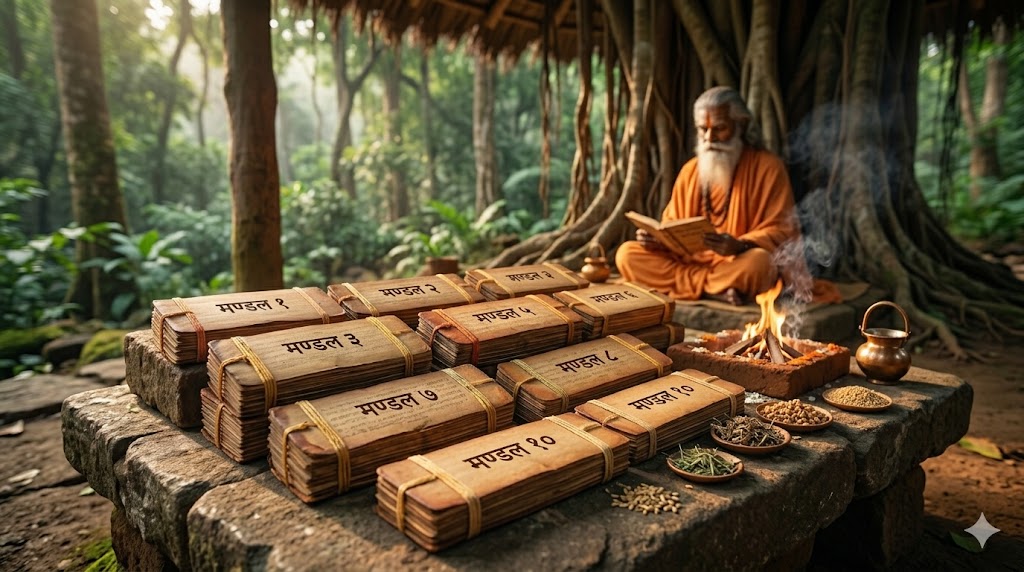
The Rigveda is a monumental collection of 1,028 hymns (Suktas) organized into ten books known as Mandala.. Composed in archaic Vedic Sanskrit, these verses reflect a period of profound naturalism and philosophical inquiry. It addresses the elements—fire (Agni), water (Varuna), and the sun (Surya)—not merely as physical entities, but as divine manifestations of a singular, underlying reality. In the eyes of the Vedic seer, the universe was not a dead machine but a living, breathing organism pulsated by a divine intelligence.
II. The Structural Architecture: A Deep Dive into the Ten Mandalas
To grasp the full breadth of Vedic wisdom, one must understand the structural and thematic distribution of the Rigveda. Each Mandala has a specific focus, chronological layer, and lineage of seers.
The Family Books (Mandalas 2–7)
These are the oldest core of the Rigveda. Each book belongs to a specific family of Rishis who preserved the oral tradition with absolute phonetic precision for millennia.
•Mandala 2 (Gritasamada): Focuses on the internal fire of devotion and the heroic qualities of Indra.
Mandala 3 (Vishvamitra):Contains the Gayatri Mantra, the most sacred prayer for intellectual illumination.
Mandala 4 (Vamadeva): Explores the mystical aspects of the birth of the gods and the inner transformation of the seeker.
Mandala 5 (Atri): Dedicated heavily to the Vishvedevas (all-gods), emphasizing the unity of the divine pantheon.
Mandala 6 (Bharadvaja): Known for its martial spirit and prayers for protection and prosperity.
Mandala 7 (Vashistha): Highly philosophical, dealing with the concept of Varuna as the guardian of moral law and cosmic order.
The Mixed and Philosophical Books (Mandalas 1, 8, 9, 10)
Mandala 1: A diverse collection that acts as a gateway to the Veda, introducing the foundational concepts of the Yajna (sacrifice).
Mandala 8: Focuses on pragmatic hymns and the pragmatic application of spiritual power in daily life.
Mandala 9 (The Soma Book): Entirely dedicated to Soma Pavamana. Soma is not just a plant; it is the symbol of spiritual bliss and the nectar of immortality that flows when the mind is purified.
Mandala 10: The pinnacle of Vedic thought. It contains the Nasadiya Sukta (Creation Hymn), the Purusha Sukta (Cosmic Being), and the Vak Sukta (The Goddess of Speech). It transitions from the ritualistic to the purely metaphysical, laying the groundwork for the Upanishads.
III. The Concept of Rta: The Cosmic Pulse
One of the most vital contributions of the Rigveda to Sanatan Dharma is the concept of Rta.This term denotes the natural, moral, and sacrificial order that governs the universe. According to the Vedic seers, the stars follow their paths, the rivers flow, and the seasons cycle because of Rta.
In this framework, Hinduism is seen as a commitment to living in harmony with this cosmic rhythm. When an individual aligns their actions with Rta, they are practicing Dharma. This precedes the modern scientific understanding of "laws of nature," suggesting that the universe is not chaotic but inherently ethical. If humanity breaks its alignment with Rta, the result is Anrta (chaos, falsehood, and ecological imbalance).
Rigveda the true way of living
IV. Philosophical Monism and the Inclusivity of Truth
A common misconception among early Western Indologists was that the Rigveda promotes a fragmented polytheism. However, the text explicitly moves toward monism—the belief that all diversity stems from one source. The most famous verse from the first Mandala (1.164.46) states:
"Ekam Sat Vipra Bahudha Vadanti"(Truth is one, though the wise refer to it by various names.)
This single sentence is the cornerstone of "Sanatan Dharma’s" legendary inclusivity. It allows for a multitude of forms, deities, and practices while maintaining the integrity of a singular Ultimate Reality (Brahman). This philosophical flexibility is precisely why Ancient Philosophy in India avoided the religious wars seen elsewhere; it recognized that different paths could lead to the same summit. It teaches that the Divine is not a jealous entity but a pervasive reality that can be approached through any sincere door.
V. The Nasadiya Sukta: The Intellectual Daring of the Vedas
Perhaps the most intellectually daring portion of the Rigveda is the Nasadiya Sukta (10.129). It poses radical questions about the origins of existence, suggesting that before creation, there was "neither existence nor non-existence."
"Who really knows? Who will here proclaim it? Whence was it produced? Whence is this creation? The gods came afterwards, with the creation of this universe. Who then knows whence it has arisen?"
This spirit of inquiry is what distinguishes Sanatan Dharma. It does not demand blind faith or the acceptance of a static creation myth. Instead, it encourages the seeker to question the very fabric of reality. This intellectual rigor is what keeps the Rigveda relevant in the age of modern science and quantum physics, as it describes the "Singularity" (the Bindu) from which all matter and energy unfolded.
VI. Socio-Economic Wisdom and the Purusha Sukta
The Purusha Sukta (10.90) provides a metaphorical description of the cosmos emerging from the sacrifice of a primordial being. While often misunderstood in contemporary sociological debates, its original intent was to illustrate the organic interconnectedness of all social functions.
The Head (Brahmana): The intellectual and spiritual core.
The Arms (Kshatriya): The protective and administrative strength.
The Thighs (Vaishya): The commercial and supportive base.
The Feet (Shudra):The foundation of service and labor.
In the Vedic view, no part is "superior" in value; rather, all are essential for the survival of the social body. If the feet fail, the head cannot move; if the head fails, the body has no direction. This model was intended to create a society based on Dharma (duty) rather than Adhikara (rights).
VII. The Linguistic Science of Sanskrit Literature
The language of the Rigveda, Vedic Sanskrit, is not a conventional language evolved for trade or gossip. It is a "constructed" language of vibration. The Shiksha (science of phonetics) ensures that every syllable is chanted with the correct pitch (Swara) and duration (Matra).
Modern neurological studies have suggested that the rhythmic chanting of Vedic mantras can synchronize brain waves and induce states of deep relaxation and clarity. This is the "Science of Mantra." The propagation of the Rigveda is, therefore, the preservation of a sound-based technology designed to upgrade human consciousness.
VIII. Relevance in Today's World: The Path of Dharma
In an era defined by climate crises, mental health struggles, and social fragmentation, the teachings of the Rigveda offer a profound "back-to-basics" approach for humanity.
1. Environmental Stewardship
The Rigveda treats the Earth (Prithvi) as a mother and the heavens as a father. By following Sanatan Dharma, we recognize that polluting the water (Varuna) or destroying the forests is not just a biological error but a spiritual transgression. The Bhumisukta (though prominent in the Atharvaveda, it finds its roots here) advocates for a sustainable lifestyle where man takes from nature only what is necessary, ensuring the Rta remains undisturbed.
2. Mental Equilibrium and Modern Stress
The Gayatri Mantra is a prayer for the illumination of the intellect (Dhi). In a world of digital distractions and "information overload," the Vedic emphasis on sharpening the "inner eye" is more relevant than ever. It teaches that true wealth is not material accumulation but the clarity and stability of consciousness.
3. Global Unity: Vasudhaiva Kutumbakam
While the specific phrase "The world is one family" comes from later texts, its seeds are in the Rigveda’s vision of a collective human spirit. The propagation of Sanatan Dharma today is not about conversion or proselytization, but about the "Universalization of Human Values." It encourages individuals to find the divine within themselves and others, transcending borders, races, and creeds.
sage performing yagya
- IX. Practice and Propagation: Keeping the Eternal Flame Alive
To practice and propagate Sanatan Dharma in the 21st century, one must move beyond mere ritualism to the "Experience of Truth."
1. Vedic Literacy:We must encourage the study of the Vedas not as "history" but as "living philosophy." This involves translating these complex verses into modern languages without losing their metaphysical essence.
2. The Internal Yajna: While physical fire sacrifices continue, the "Internal Yajna"—sacrificing one's ego, greed, and negative tendencies into the fire of self-knowledge—is the highest form of practice.
3. Dharma in Action: Following Dharma today means ethical business practices, honest governance, and compassionate social service. It is about making every action an offering to the Divine.
4. Preservation of Gurukuls: Supporting the traditional systems of learning where the Vedas are taught with their phonetic integrity is crucial for the survival of this ancient wisdom.
X. Conclusion: The Eternal Return
The Rigveda is more than an ancient artifact; it is a living manual for human excellence. It does not belong to a single era or a single people; it belongs to the spirit of humanity. By establishing the principles of Rta, the oneness of truth, and the sanctity of nature, it provided the blueprint for Sanatan Dharma to survive millennia of upheaval, from foreign invasions to the onslaught of materialism.
As we navigate the complexities of the 2020s and beyond, the Vedic call for "Unity in Diversity" and "Intellectual Illumination" remains the most potent remedy for a fragmented world. To follow the Rigveda is to follow the light of the sun—not just the one in the sky, but the one shining within the heart of every living being.
Frequently Asked Questions
What is the primary significance of The Rigveda: The Primordial Foundation of Sanatan Dharma?
I. The Genesis of Human Consciousness and the Vedic DawnThe spiritual and philosophical landscape of India is not a mere collection of dogmatic rituals; it is a sophisticated architectural marvel of thought, grounded in the most ancient of records: theRigveda.
How does this development impact Dharma?
As the primary text of the four Vedas, the Rigveda is defined as Shruti —that which is heard. It represents the primordial vibrations of cosmic truths perceived by the Rishis (enlightened seers) in states of profound meditative absorption (Samadhi).
What are the key future projections to monitor?
To understand Sanatan Dharma—the eternal way of life—one must return to these verses, which serve as the genetic code of Indian civilization.The Rigveda is a monumental collection of 1,028 hymns (Suktas) organized into ten books known as Mandala..