History of Cricket: From England to Worldwide Phenomenon
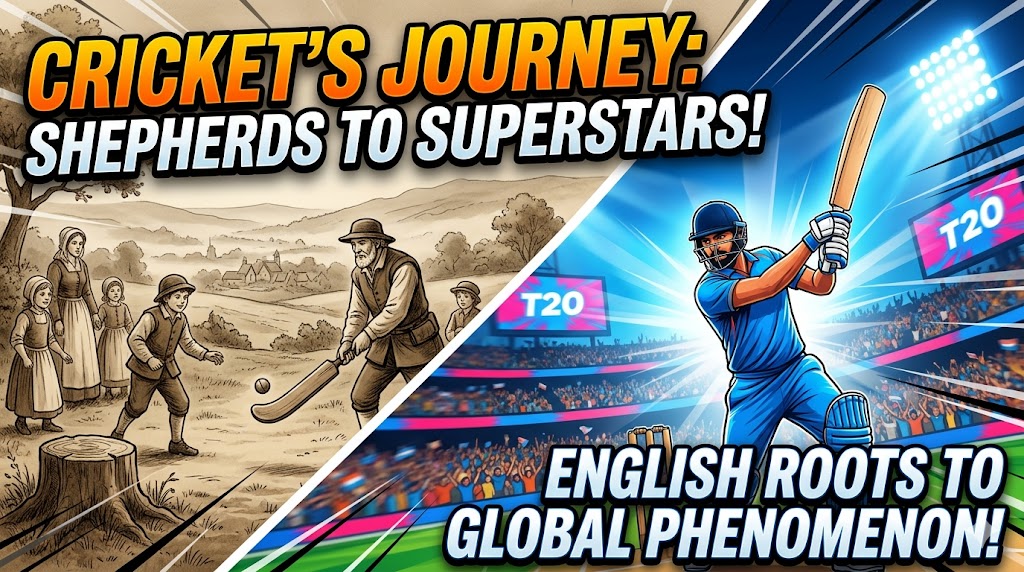
The history of cricket is a captivating tale of humble beginnings, imperial spread, and remarkable transformation into one of the world's most beloved sports. From its origins as a simple pastime in the English countryside to a multi-billion-dollar global phenomenon watched by over 2.5 billion fans, cricket has woven itself into the cultural fabric of nations far beyond its birthplace. This detailed exploration of the history of cricket reveals how a game played by shepherds evolved into an international spectacle, became a de facto national passion in countries like India, and continues to inspire millions through thrilling formats and prestigious awards. Whether you're seeking a short history of cricket or a deep dive into its evolution, this article traces every pivotal chapter.
The history of cricket begins in the late 16th century in southeast England, specifically in the Weald region spanning Kent, Sussex, and Surrey. Historians believe children in these rural areas crafted the earliest version of the game using a bat (possibly derived from the Anglo-Saxon word "cricc," meaning a shepherd's staff) and a ball, bowling at a wicket gate or tree stump. The first definite written reference dates to 1598 in Guildford, Surrey, where a court case mentioned "creckett" being played on common land. By 1611, dictionaries described it as both a boys' game and an adult sport, marking its gradual transition from folk entertainment to organized play.
Early cricket was informal and village-based. Matches often took place on open fields, with teams formed from local laborers, farmers, and even nobility. The game spread slowly during the 17th century amid England's social upheavals, including the English Civil War, yet village cricket thrived. By the mid-1600s, county teams emerged, and the first recorded match between named counties occurred in 1709. Gambling played a surprising role in its early growth—wealthy patrons bet on outcomes, funding professional players and drawing crowds.
This foundational era in the history of cricket in England laid the groundwork for standardization. The game's rural charm—echoing the pastoral life of shepherds defending sheep pens—explains its enduring appeal as a "gentleman's game" rooted in strategy, skill, and camaraderie.
The Evolution of Cricket: From Folk Game to Codified Sport (18th–19th Centuries)
As the 18th century dawned, the history of cricket entered a transformative phase. The Hambledon Club in Hampshire became the epicenter of the sport around 1750, hosting elite matches that attracted thousands. Here, legends like batsman John Small and bowler "Lumpy" Stevens honed techniques that shaped modern play. The first written Laws of Cricket appeared in 1744, drafted by the Star and Garter Club, covering pitch length (22 yards), ball weight, and bat dimensions. These rules were refined in 1774, introducing innovations like the middle stump and leg-before-wicket (LBW).
The Marylebone Cricket Club (MCC), founded in 1787 at Lord's in London, soon became cricket's governing authority. Thomas Lord's original ground (later relocated twice) remains the "home of cricket" today. By the early 19th century, cricket had evolved from underarm bowling to round-arm and eventually overarm styles, revolutionizing the sport's pace and strategy. The straight bat replaced curved designs to counter faster deliveries.
The 19th century marked cricket's professionalization and global ambitions. County championships formalized domestic competition in England, while the first international tour—by an English team to the United States and Canada in 1859—signaled expansion. This period in the history of cricket saw the birth of first-class cricket in 1772 and the establishment of Test cricket's foundations, setting the stage for its imperial journey.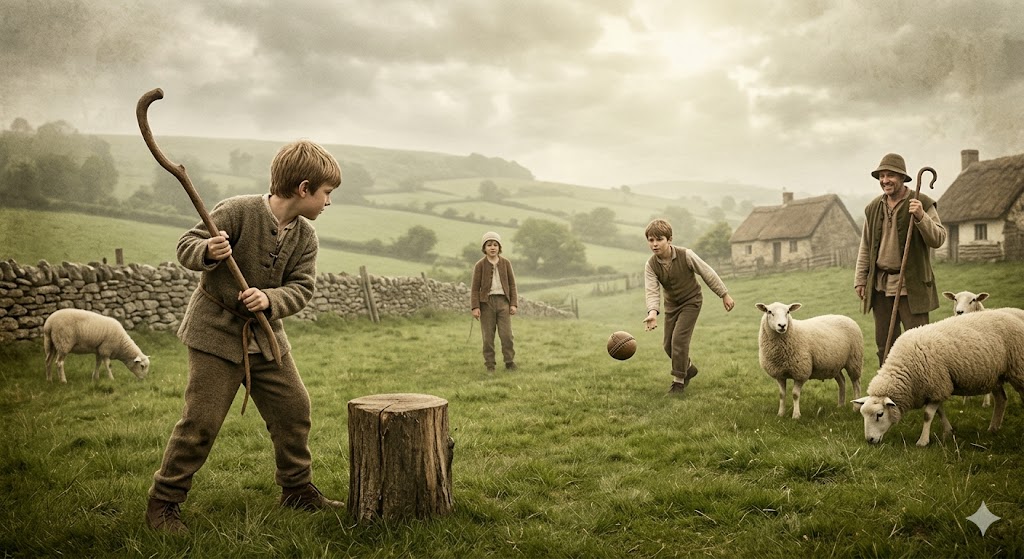
The roots of a timeless game: An illustration of 16th-century rural England, depicting shepherds and children playing an early, informal version of cricket in the Weald region using a primitive curved bat and a ball near a tree stump wicket.
Spread Across the British Empire: How Cricket Went Global
The evolution of cricket accelerated through the British Empire in the 19th century. British soldiers, merchants, and administrators carried the game to colonies in Australia, the West Indies, South Africa, and the Indian subcontinent. The first overseas reference dates to 1676 in Aleppo, Syria, but organized tours began in earnest after 1860.
Australia embraced cricket passionately. The 1877 Test match between England and Australia at the Melbourne Cricket Ground—won by Australia by 45 runs—inaugurated the Ashes rivalry, one of sport's greatest. In the Caribbean, enslaved and freed populations adopted the game, turning it into a symbol of resistance and national pride. South Africa and New Zealand followed suit, with formal Tests by the early 20th century.
This imperial spread transformed the story of cricket from an English pastime into a unifying force across continents. By the late 1800s, international governing bodies like the Imperial Cricket Conference (now ICC, founded 1909) emerged, solidifying cricket's worldwide footprint.
History of Cricket in India: From Colonial Introduction to National Obsession
No chapter in the history of cricket is more dramatic than its adoption in India. Introduced by English East India Company sailors around 1721, the first recorded match occurred in 1792 with the formation of the Calcutta Cricket Club. British expatriates dominated initially, but Indian communities—particularly the Parsis in Bombay—quickly took up the bat. The Parsi Gymkhana's victories over European teams in the 1880s marked the first Indian triumphs on home soil.
The Maharaja of Patiala sponsored India's first tour of England in 1911, paving the way for official Test status. India debuted in Test cricket in 1932 at Lord's, losing to England but igniting national fervor. Post-independence in 1947, cricket became a unifying force amid partition. Legends like C.K. Nayudu, Vijay Merchant, and later Sunil Gavaskar elevated the game.
The 1983 World Cup victory under Kapil Dev remains a watershed moment, transforming cricket into India's unofficial national obsession. Today, with the Indian Premier League (IPL) drawing global audiences since 2008, the history of cricket in India exemplifies how the sport transcended colonialism to become a cultural powerhouse, blending passion, Bollywood glamour, and economic might.
History of Cricket in Nepal: A Remarkable Modern Ascent
While less prominent in early narratives, the history of cricket in Nepal highlights the game's expanding global reach. Cricket arrived in the 1930s under the Rana dynasty but gained formal structure with the Cricket Association of Nepal's founding in 1946. Initially an elite pursuit, it democratized after the 1950s.
Nepal's international debut came in the 1990s at the ACC Trophy. Associate ICC membership in 1996 fueled growth, culminating in qualification for the 2014 T20 World Cup—their proudest moment. Despite challenges like political instability and infrastructure limits, Nepali cricket thrives on grassroots talent and fervent fan support, inspired by neighboring India's success. This recent chapter in the broader history of cricket proves the sport's accessibility in emerging nations.
International Cricket Milestones: The Dawn of Test Matches and Beyond
Test cricket formalized the history of cricket as a test of endurance. The 1877 Australia-England clash set the template for five-day epics. By the 20th century, teams from West Indies (1928), New Zealand (1930), and others joined the fray, creating iconic rivalries like the Ashes and India-Pakistan contests.
Limited-overs cricket emerged in the 1960s for faster entertainment, leading to the ODI format. These innovations kept the evolution of cricket dynamic amid changing societal demands.
The Cricket World Cup: History of a Global Spectacle (1975 Onward)
The history of cricket world cup began in 1975 in England, organized by the ICC as a 60-over tournament. West Indies dominated the inaugural two editions (1975 and 1979), showcasing Caribbean flair. India's shock 1983 win under Kapil Dev, defeating West Indies in the final, remains legendary.
Subsequent tournaments evolved: 1987 (first outside England, co-hosted by India and Pakistan) introduced 50-over matches; 1992 featured colored kits and floodlights; 1996 saw Sri Lanka's triumph; and Australia's dominance in the 1990s–2000s. India lifted the trophy again in 2011, while England won in 2019 in a dramatic final. Australia claimed the 2023 title in India. The history of the cricket world cup from 1975 to the present underscores cricket's shift to high-stakes, high-drama entertainment, captivating billions.
The Modern Era: T20 Revolution and Unprecedented Popularity
The 2007 inaugural T20 World Cup revolutionized the history of cricket. Fast-paced, city-based leagues like the IPL turned players into global superstars and generated massive revenue. Formats now blend tradition with innovation, ensuring cricket's relevance in a fast-paced world.
Today, cricket boasts over 2.5 billion fans, second only to football. It's played in more than 100 countries, with the ICC overseeing 12 full members and dozens of associates.
Cricket as a National Game: Cultural Icon and Passion
Though not always the official national sport (field hockey holds that title in India, for instance), cricket functions as the de facto national game in nations like India, Pakistan, Australia, England, and the West Indies. In India, it unites diverse populations; in Australia, it embodies national identity. This status stems from colonial legacy, media dominance, and emotional investment. The history of cricket shows how it fosters unity, pride, and even diplomacy—think "cricket diplomacy" between India and Pakistan.
Its global appeal lies in accessibility (playable with basic equipment), strategic depth, and inclusivity across genders and ages. Women's cricket has surged, with dedicated World Cups since 1973.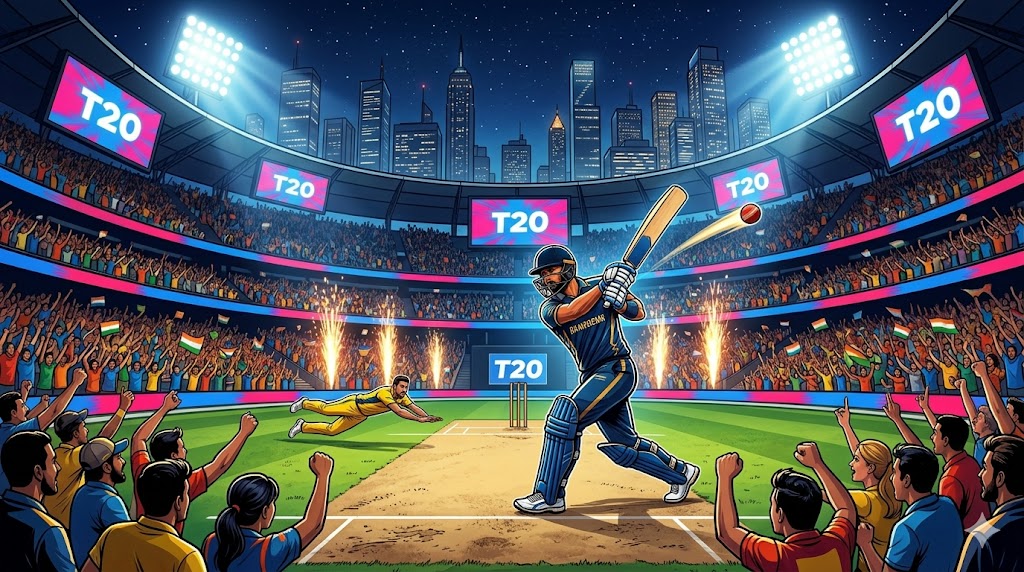
Global phenomenon: An illustrative look at cricket’s modern pinnacle, depicting a floodlit stadium with over 100,000 cheering fans during a massive limited-overs match. A dynamic batsman in a blue kit plays a powerful shot, representing the fast-paced, high-drama evolution of the sport that now unites billions.
Prestigious Awards in Cricket: Celebrating Excellence
The pinnacle of recognition comes through ICC Awards, established in 2004. The Sir Garfield Sobers Trophy honors the ICC Men's Cricketer of the Year, while the Rachael Heyhoe Flint Trophy does the same for women. Other honors include Test, ODI, and T20 Player of the Year categories, plus the ICC Team of the Year. Legends like Virat Kohli (multiple wins) and Ellyse Perry exemplify excellence. These awards, alongside national honors like the Arjuna Award in India or England's Wisden Cricketers' Almanack accolades, underscore cricket's merit-based legacy.
Conclusion: Cricket's Enduring Global Legacy
The history of cricket is more than dates and matches—it's a story of resilience, innovation, and human connection. Born in England's green fields, it evolved through empire, independence struggles, and technological leaps to become a favorite game worldwide. From the first wicket in rural pastures to billion-dollar leagues and World Cup triumphs, cricket mirrors society's progress while preserving its soul.
As new generations embrace the sport in emerging nations and established powers alike, the story of cricket continues. Whether through a nail-biting Test or explosive T20, it remains a bridge between cultures, a source of national pride, and a timeless pursuit of glory. For enthusiasts seeking the complete history of cricket, one truth endures: this is a game that belongs to the world.