Russia’s Energy Hegemony: Oil Exports & Global Conflicts
International Affairs • March 29, 2026 • Global Edition

I. The 2026 Energy Front
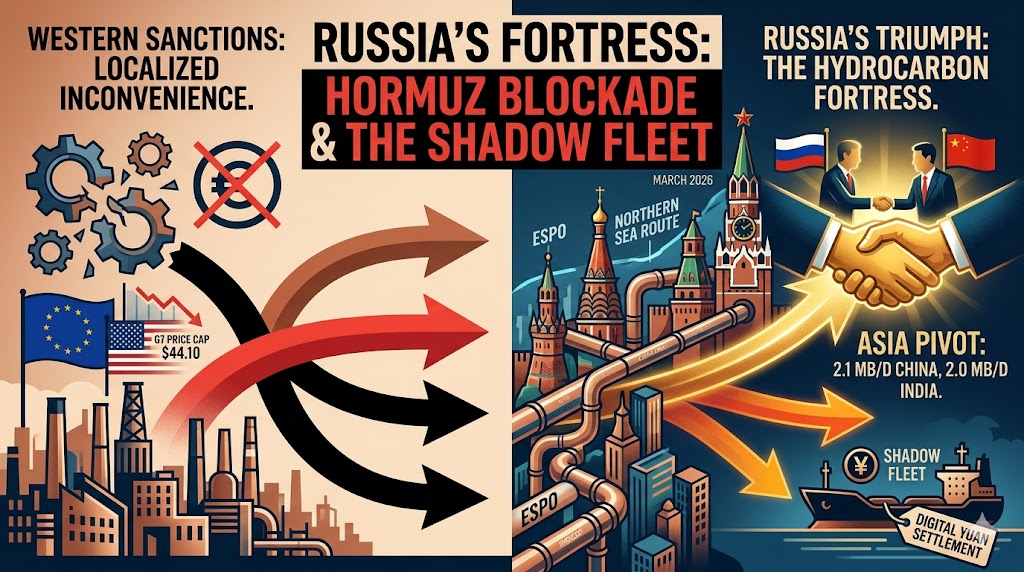
As of March 29, 2026, the global energy landscape is no longer governed by the "Invisible Hand" of the market, but by the "Iron Fist" of geopolitical necessity. Russia oil exports have emerged as the single most resilient—and controversial—component of the global economy. Despite over four years of unprecedented Western sanctions, Moscow has engineered a logistical masterpiece, shifting its primary trade arteries from the Atlantic to the Indo-Pacific.
This transformation occurs against the backdrop of a catastrophic regional war in the Middle East. The direct military confrontation between the United States, Israel, and Iran has paralyzed the Persian Gulf, inadvertently granting Russia oil exports a "monopoly of availability" for energy-hungry nations in Asia. This report explores the structural, financial, and military dimensions of Russia's 2026 energy strategy.
II. The Evolution of Russia Oil Exports (2022–2026)
The history of Russia oil exports over the last four years is a study in "radical adaptation." In 2022, the G7 price cap was intended to create a permanent revenue ceiling for the Kremlin. However, by early 2026, the global "Shadow Fleet" and the emergence of non-Western insurance markets have rendered these caps functionally irrelevant.
1. The Great Diversion to the Global South
Before 2022, the European Union accounted for over 50% of Russian crude sales. Today, that figure is effectively zero, with the exception of limited pipeline flows to landlocked nations. *Russia oil exports have instead found a permanent home in China and India.
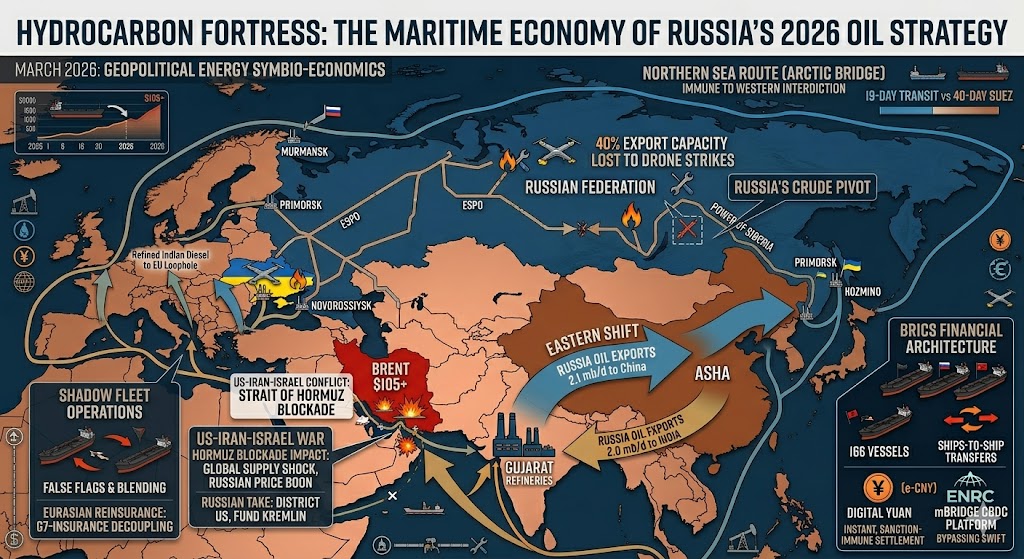
* China's Role: In March 2026, China's imports of Russian crude reached a record 2.1 million barrels per day (mb/d). This represents nearly 48% of Russia’s total seaborne exports.
* India's Strategic Balancing: While India faced pressure in late 2025 to reduce its reliance on Moscow, the 2026 Middle East crisis forced a policy reversal. The US Treasury issued a 30-day waiver in March 2026, allowing Indian refiners to surge their intake of Russian oil to stabilize global prices.
2. The Professionalization of the Shadow Fleet
A critical pillar of Russia oil exports is the "Shadow Fleet." No longer a collection of rogue vessels, this is now a state-sanctioned maritime force of over 180 tanker . These ships utilize advanced AIS transponders to broadcast "false flag" locations and rely on the Eurasian National Reinsurance Company to bypass Western P&I clubs, allowing Russia oil exports to reach any port willing to accept Russian-backed indemnity.
III. Geopolitical Flashpoints: The US-Iran-Israel Conflict
The most volatile variable in the 2026 energy forecast is the direct kinetic conflict in the Middle East. Following the US-Israeli strikes on Iranian infrastructure in late February 2026, the global oil market entered a state of "structural shock."
1. The Blockade of the Strait of Hormuz
Iran’s effective closure of the Strait of Hormuz has removed nearly 20% of the world’s oil supply from the market. This has caused the Brent benchmark to soar past $105 per barrel, For Russia oil exports , this is an unprecedented strategic advantage. As Persian Gulf supply vanishes, Asian refiners have pivoted back to Russian Urals, which are now trading at a premium rather than a "sanctions discount."
2. Moscow’s Strategic Take: "The Arsonist’s Banker"
Russia’s take on the US-Iran-Israel conflict is one of calculated opportunism. While publicly calling for a "ceasefire," Moscow benefits from the US being "bogged down" in a second theater. The high-tempo warfare in the Middle East has depleted Western stockpiles of air defense interceptors, directly weakening the defense of Ukraine and allowing Russia to protect its own energy infrastructure more effectively.
IV. Infrastructure Under Fire: The Drone War
While the global market favors Russia oil exports, the domestic front is a battlefield. In March 2026, Ukraine intensified its "Deep Strike" campaign against the heart of the Russian energy sector.
1. The 40% Capacity Reduction
A combination of Ukrainian drone strikes and the shutdown of segments of the Druzhba pipeline has reportedly halted 40% of Russia’s oil export capacity. Major terminals like Novorossiysk on the Black Sea have been designated "High Risk Zones," forcing Russia oil exports to be rerouted through the Arctic's Northern Sea Route.
2. The Gasoline Ban
On March 27, 2026, Russia announced a total ban on gasoline exports. This move was necessary to prevent a domestic fuel crisis as refineries struggle to repair distillation columns damaged by precision UAV strikes, ensuring that the Russian military remains fueled for its spring maneuvers.

V. The "India-Laundromat" and the European Loophole
As we progress through 2026, Russia oil exports have found a seamless pathway into Western economies through the "India-Laundromat."
The Molecular Transformation Defense
Under current international trade laws, the origin of a hydrocarbon product is defined by where it undergoes "substantial transformation." When Russia oil exports are processed in Indian refineries into diesel or jet fuel, they are legally classified as "Indian origin." This system ensures that while European leaders publicly decry the Kremlin, their domestic trucking fleets remain powered by Russian crude processed in the East.
VI. The Rise of the BRICS Financial Architecture
A fundamental pillar supporting Russia oil exports in 2026 is the decoupling from the U.S. Dollar.
* The Digital Yuan: Approximately 65% of Russia oil exports to China are now settled via the Digital Yuan (e-CNY).
* The mBridge Project: Instant, cryptographically secured transactions between the BRICS nations ensure that Russia oil exports are settled outside the reach of the SWIFT system and U.S. monitoring.
VII. The Arctic Bridge: The Northern Sea Route (NSR)
With Arctic ice reaching record lows in 2026, the Northern Sea Route has become a strategic necessity for Russia oil exports,
Immunity to Interdiction:The NSR lies entirely within Russian territorial waters, immune to U.S. Navy blockades.
Speed to Market :Ice-class tankers can now travel from Murmansk to the Bering Strait in roughly 20 days , significantly faster than the Suez Canal route, ensuring that Russia oil exports reach Asian markets with minimal logistical risk
VIII. Strategic Outlook: Russia’s Energy Footprint (2027–2030)
As we gaze toward the end of the decade, the trajectory of Russia oil exports will be defined by the permanence of the "Eastern Pivot." The Kremlin has shifted from a defensive posture to a long-term offensive strategy aimed at dominating the energy needs of the "Global South."
Infrastructure Maturity: By 2028, the second phase of the Eastern Siberia–Pacific Ocean (ESPO) pipeline expansion is expected to be complete, potentially adding another 30 million tonnes of capacity.
- The "OPEC+ Plus" Reality: In 2026, Russia has solidified its role within the OPEC+ alliance. Despite Western efforts to drive a wedge between Moscow and Riyadh, the US-Iran conflict has forced both major producers into a defensive alignment to maintain high price floors.
IX. The 2026 Energy Risk Matrix
| Risk Factor | Probability | Impact on Exports | Mitigation Strategy |
| Ukrainian UAV Strikes | High | Significant (Capacity Loss) | Decentralization & Electronic Warfare |
| Middle East Ceasefire | Low | Downward Price Pressure | OPEC+ Production Cuts |
| Secondary U.S. Sanctions | Medium | Logistical Delays | Expansion of the Digital Yuan & mBridge |
| Arctic Ice Thaw | Guaranteed | Strategic Speed Increase | Ice-Class Tanker Fleet Expansion |
X. Conclusion: The Indestructible Pivot
The narrative of Russia oil exports in 2026 is one of a "Hydrocarbon Fortress" that has successfully outlasted the unipolar world. By leveraging the chaos of the US-Iran-Israel war and entrenching its trade in the "Digital Yuan" ecosystem, Russia has created a parallel energy economy.
The West now faces a stark reality: the attempt to decouple Russian energy has resulted in a more fragmented and volatile global market—one where Moscow remains the indispensable pillar of the East.
Frequently Asked Questions
What is the primary significance of Russia’s Energy Hegemony: Oil Exports & Global Conflicts?
I. The 2026 Energy FrontAs of March 29, 2026, the global energy landscape is no longer governed by the "Invisible Hand" of the market, but by the "Iron Fist" of geopolitical necessity. Russia oil exports have emerged as the single most resilient—and controversial—component of the global economy.
How does this development impact International Affairs?
Despite over four years of unprecedented Western sanctions, Moscow has engineered a logistical masterpiece, shifting its primary trade arteries from the Atlantic to the Indo-Pacific.This transformation occurs against the backdrop of a catastrophic regional war in the Middle East. The direct military confrontation between the United States, Israel, and Iran has paralyzed the Persian Gulf, inadvertently granting Russia oil exports a "monopoly of availability" for energy-hungry nations in Asia.
What are the key future projections to monitor?
This report explores the structural, financial, and military dimensions of Russia's 2026 energy strategy.II.