West Bengal Elections 2026: Guide, Strategies & Predictions.
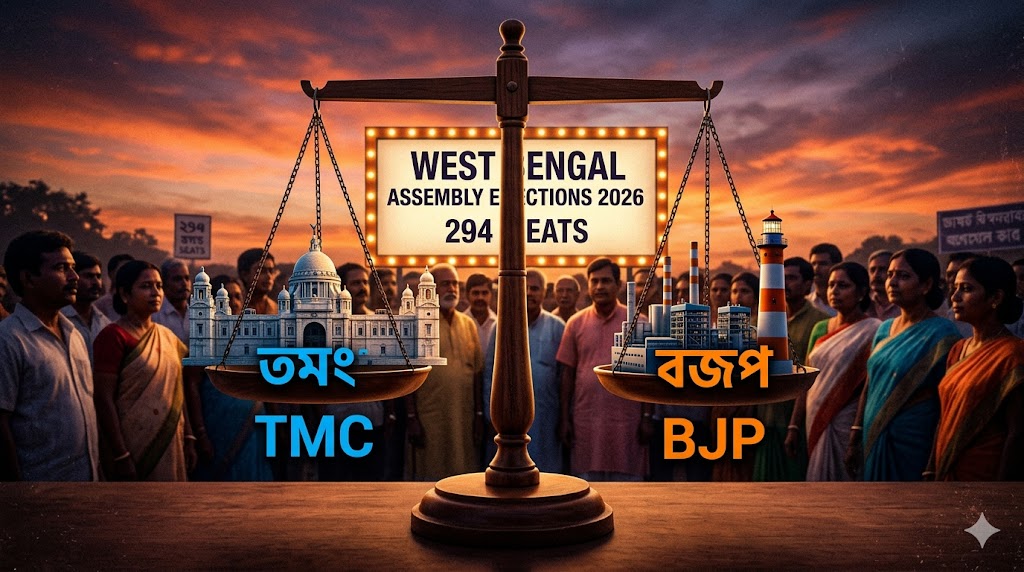
West Bengal Elections 2026: A Comprehensive Analysis of Dates, Campaign Strategies, and Predictions
The West Bengal assembly elections 2026 are set to reshape the political landscape of one of India’s most vibrant states. With polling scheduled in two phases on April 23 and April 29, 2026, and results expected on May 4, the contest between the ruling Trinamool Congress (TMC) and the Bharatiya Janata Party (BJP) has reached fever pitch. This battle is not just about seats in the 294-member assembly; it reflects deeper questions of governance, identity, development, and the legacy of Bengal’s turbulent political history.
As voters prepare to cast ballots, both major parties are leaving no stone unturned. Prime Minister Narendra Modi has led an aggressive BJP push with multiple rallies, while Mamata Banerjee’s TMC counters with grassroots mobilisation and welfare-focused messaging. Opinion polls paint a close race, with TMC holding a narrow edge but BJP making significant inroads. This article delves into how the West Bengal elections 2026 will unfold, the fierce campaigning underway, key criticisms, poll predictions, and the historical context shaping today’s scenario.
The Historical Journey: From Left Dominance to TMC Rule and BJP’s Rise
West Bengal’s electoral history is a story of dramatic shifts that continue to influence the 2026 polls. For decades, the state was a Left Front stronghold under the Communist Party of India (Marxist). The CPI(M)-led alliance governed uninterrupted from 1977 until 2011, winning successive assembly elections on the back of land reforms, rural empowerment, and ideological appeal.
The 2011 turning point came when Mamata Banerjee’s TMC, in alliance with Congress, swept to power with 227 seats, ending 34 years of Left rule. Banerjee’s promise of “Paribartan” (change) resonated amid allegations of Left excesses and economic stagnation. TMC consolidated its hold in 2016, winning 211 seats, and further strengthened it in 2021 with 215 seats despite a strong BJP challenge.
The BJP’s journey in Bengal is equally remarkable. From just three seats in 2016, the party surged to 77 in 2021, emerging as the principal opposition. This growth stemmed from strong performances in North Bengal, consolidation of anti-TMC votes, and national leadership’s focus on the state. The 2024 Lok Sabha results further highlighted the bipolar contest, with TMC securing 29 seats and BJP 12.
As West Bengal gears up for the 2026 assembly elections, history weighs heavily. TMC banks on its incumbency and welfare delivery, while BJP highlights anti-incumbency over issues like corruption and governance lapses. The Left and Congress, now contesting independently after ending their alliance, are expected to play a spoiler role in select pockets, potentially fragmenting votes.
This evolution—from ideological Left dominance to regional TMC populism and the national BJP’s aggressive expansion—sets the stage for what many call Bengal’s most fiercely contested polls in recent memory.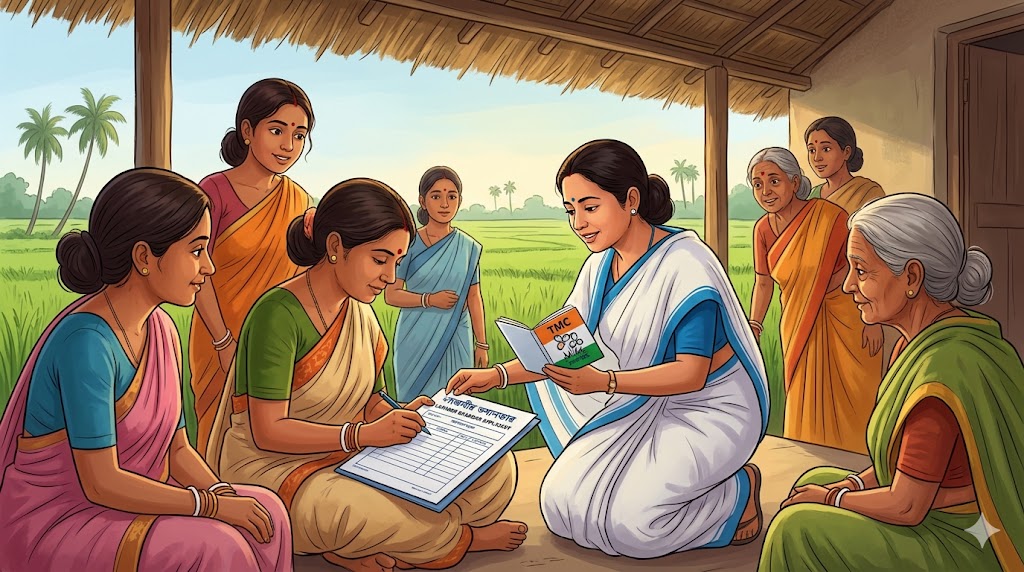
Conceptual illustration of TMC's 'Lakhmir Bhandar' outreach, focusing on women's empowerment in rural Bengal during the 2026 campaign.
How the West Bengal Assembly Elections 2026 Will Be Held: Process and Schedule
The Election Commission of India (ECI) has announced a structured two-phase polling process for the West Bengal assembly elections 2026 to ensure smooth conduct across the state’s diverse geography.
Phase 1 (April 23, 2026): 152 constituencies, covering districts including Cooch Behar, Alipurduar, Jalpaiguri, Darjeeling, and parts of others.
Phase 2 (April 29, 2026): 142 constituencies, including Kolkata, Howrah, and remaining areas.
Key Dates:
Nomination filing deadline: Early April (phase-wise).
Last date for withdrawal: April 9 and 13, 2026.
Counting of votes: May 4, 2026.
The Model Code of Conduct is already in force, restricting government announcements and ensuring a level playing field.
Polling will follow standard ECI protocols: electronic voting machines (EVMs) with VVPAT verification, stringent security measures given past instances of violence, and special arrangements for sensitive booths. Over 68 million voters are expected to participate, with emphasis on women’s turnout and first-time voters.
The phased approach minimises logistical challenges while allowing security forces to focus resources effectively. Both parties have welcomed the schedule but continue to spar over voter list revisions and alleged irregularities—issues that have dominated recent West Bengal election news.
BJP’s Aggressive Strategy: PM Modi Leads the Charge
The BJP has mounted one of its most intense campaigns in West Bengal history, aiming to cross the 147-seat majority mark and form the government for the first time. Central to this is Prime Minister Narendra Modi’s personal involvement. Modi has addressed multiple mega rallies across North and South Bengal, including Cooch Behar, Siliguri, Haldia, and Jhargram. His speeches focus on “double-engine” governance, promising accelerated development, industrial growth, and an end to what he calls the TMC’s “nirmam” (cruel) and “jungle raj.”
Key elements of BJP strategy for West Bengal elections 2026 include:
Targeting Narrow-Margin Seats: The party is zeroing in on 57 constituencies decided by under 8,000 votes in 2021, many of which TMC won narrowly.
Regional Focus: Strong push in North Bengal for consolidation, alongside gains in western districts.
Core Issues: Highlighting TMC’s alleged corruption (school recruitment scam), women’s safety (Sandeshkhali controversy), and infiltration. Modi has repeatedly vowed to fast-track CAA implementation for Matua and Namasudra communities.
Leadership Synergy: Union Home Minister Amit Shah, Suvendu Adhikari, and other national leaders are holding roadshows and rallies, creating a high-energy presence.
A standout moment came during Modi’s Jhargram rally when he made an unscheduled stop at a roadside stall for jhalmuri—the iconic Bengali street snack. This “jhalmuri break” (widely covered as a viral public connect moment) humanised the campaign, drawing praise for its relatability. Yet it also sparked criticism from TMC circles, who accused the BJP of using such gestures for optics while ignoring local issues. Opponents questioned the timing and intent, framing it as a staged “break” amid intense politicking.
BJP leaders project confidence, with some claiming over 170 seats. The strategy blends development promises with sharp attacks on TMC governance, aiming to convert anti-incumbency into votes.
TMC’s Counter-Offensive: Grassroots Strength and Identity Politics
TMC, under Mamata Banerjee and nephew Abhishek Banerjee, is fighting to secure a fourth term with the slogan “Abar Jitbe Bangla” (Bengal Will Win Again). The party’s strategy emphasises hyper-local engagement, welfare continuity, and Bengali pride.
TMC has announced candidates for nearly all 294 seats, dropping 74 sitting MLAs to counter anti-incumbency and introducing fresh faces, including youth and professionals. Abhishek Banerjee leads a data-driven booth-level campaign, while Mamata focuses on emotional appeals and direct voter outreach through rallies and door-to-door efforts.
Highlights of TMC’s approach:
Welfare Expansion: Promises to enhance Lakshmir Bhandar (monthly stipends for women), doorstep healthcare, and education reforms feature prominently in the manifesto.
Identity Narrative: TMC portrays BJP as “bohiragato” (outsiders), warning against central interference in Bengal’s culture and autonomy.
Aggressive Defence: Mamata has labelled BJP a “snake” and accused it of threats and horse-trading. The party highlights its governance record while dismissing corruption charges as politically motivated.
Both parties are investing heavily in ground-level operations. Clashes between workers have been reported in areas like Durgapur and Hooghly, underscoring the high stakes. TMC’s twin-track strategy—Banerjee’s mass connect and Abhishek’s organisational overhaul—aims to blunt BJP’s momentum.
Criticisms, Controversies, and the Campaign Heat
The West Bengal election 2026 campaign has been marked by sharp rhetoric and scrutiny. BJP repeatedly raises Sandeshkhali as a symbol of TMC’s alleged failures on women’s safety and local tyranny. TMC counters by accusing BJP of stoking division and interfering in state affairs.
The viral Jhargram jhalmuri moment by PM Modi drew mixed reactions. While supporters celebrated the spontaneous connect, critics within TMC circles questioned whether such “breaks” distract from substantive issues like employment and corruption. Broader criticisms target both sides: BJP for alleged central pressure on institutions, and TMC for voter-list manipulations.
Worker-level violence and allegations of threats have also surfaced, prompting ECI intervention. These elements reflect the intense “do-or-die” effort by both BJP and TMC to secure victory.
Polls and Predictions: What the Numbers Say
Opinion polls for West Bengal assembly elections 2026 indicate a nail-biting contest. Multiple surveys project TMC with 140-194 seats and BJP with 100-150, suggesting a narrow TMC lead but significant BJP gains compared to 2021.
Vote share estimates hover around 41-43% for TMC and 41% for BJP in some polls.
Regional variations show TMC stronger in South Bengal strongholds, while BJP leads in North Bengal and western districts.
Experts note that 57 low-margin seats could decide the outcome. A swing of even a few thousand votes in key areas may tip the balance.
While TMC remains the favourite for a fourth term according to most trackers, BJP’s surge has narrowed the gap dramatically. A hung assembly scenario cannot be ruled out if smaller parties fragment votes effectively. Current West Bengal election predictions underscore a bipolar fight where turnout, local issues, and last-minute swings will prove decisive.
Current Scenario: Both Parties Giving Their All for Victory
In the final stretch before polling, the scenario in West Bengal elections 2026 is one of high tension and maximum effort. BJP’s central leadership has poured resources into the state, viewing it as a gateway to eastern India dominance. TMC, leveraging its organisational depth and welfare network, is fighting to protect its home turf.
PM Modi’s rallies continue to draw massive crowds, energising the BJP base. TMC matches this with Mamata’s tireless tours and Abhishek’s booth-level machinery. Both sides accuse each other of malpractice, yet the electorate appears polarised along lines of development versus identity.
The history of Bengal—from Left bastion to TMC citadel—now confronts the possibility of a BJP breakthrough. Whether TMC’s grassroots resilience or BJP’s aggressive national push prevails will define not just the next government but the state’s political trajectory for years.
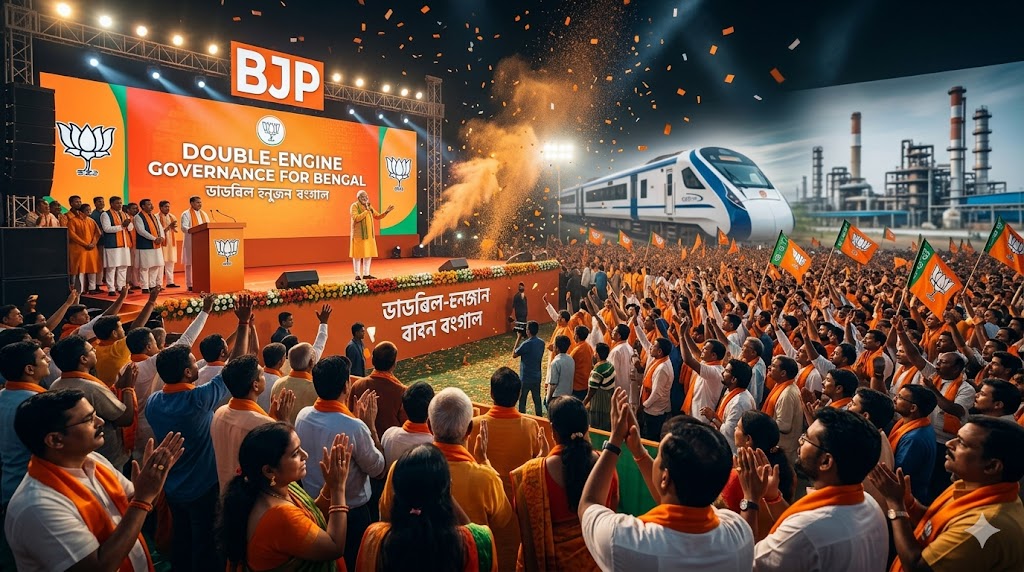
Conceptual depiction of a large-scale BJP campaign event in West Bengal, 2026, highlighting the 'double-engine' governance narrative.
Conclusion: A Defining Moment for Bengal’s Future
The West Bengal assembly elections 2026 represent more than a routine electoral exercise. They embody the clash between continuity and change, regional pride and national integration. With phases set for April 23 and 29, and both BJP and TMC deploying their best resources, the outcome remains fluid despite TMC’s slight poll lead.
Voters will ultimately decide based on governance record, promises delivered, and aspirations for a prosperous Bengal. As campaigning intensifies, one thing is clear: the 2026 polls will test the resilience of established narratives and open new chapters in the state’s rich political saga.
Stay tuned for live updates as West Bengal election 2026 unfolds. The battle is far from over, and every vote will count in shaping the state’s destiny.