Aryabhata: India's First Satellite Launch Milestone
A Historic Step into the Cosmos
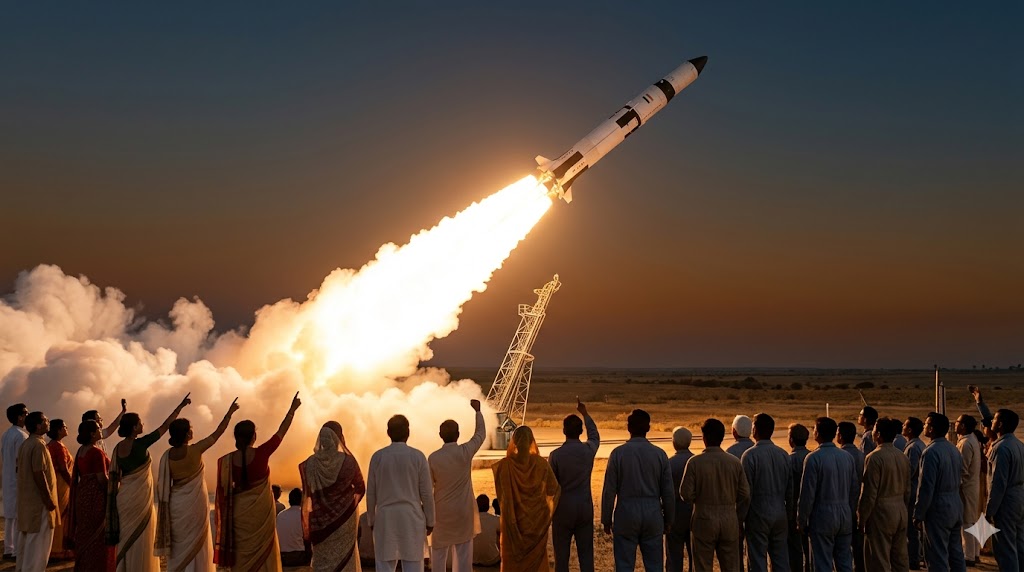
On April 19, 1975, India etched its name into the annals of space exploration with the launch of the Aryabhata satellite. This event was not merely a technical achievement; it symbolized a young nation's determination to harness science for progress despite limited resources. Built entirely by Indian engineers under the Indian Space Research Organisation (ISRO), the Aryabhata satellite was propelled into orbit by a Soviet Kosmos-3M rocket from Kapustin Yar in what was then the Soviet Union.
The launch marked India's entry into the exclusive club of spacefaring nations. For a country that had gained independence just three decades earlier and was focused on basic development needs, venturing into space represented a bold assertion of self-reliance and scientific ambition. The Aryabhata satellite, named after the ancient Indian mathematician and astronomer from the 5th-6th century CE, embodied the spirit of blending India's rich intellectual heritage with modern technology.
This educational article delves into the story of the Aryabhata satellite launch, its profound significance as India's first satellite, the challenges overcome, and the remarkable trajectory of India's space program over the subsequent five decades. From humble experimental beginnings to today's sophisticated satellite constellations and interplanetary missions, India's journey in space reflects innovation, resilience, and a commitment to using technology for societal benefit. As we explore this evolution, readers will gain a clear understanding of how one satellite in 1975 laid the foundation for India's current stature as a global space leader.
The Backdrop: India's Early Space Aspirations
India's interest in space predates the Aryabhata satellite by more than a decade. In the 1960s, visionary scientist Vikram Sarabhai, often called the father of the Indian space program, recognized the potential of space technology for national development—particularly in communication, meteorology, and resource management. Sarabhai's philosophy was clear: space should serve the needs of the common man rather than mere prestige.
ISRO was formally established on August 15, 1969, evolving from the Indian National Committee for Space Research (INCOSPAR) formed in 1962. Early efforts focused on sounding rockets launched from Thumba Equatorial Rocket Launching Station in Kerala. These modest experiments built expertise in rocketry and atmospheric studies.
By the early 1970s, India sought international collaboration to launch its first satellite. An agreement with the Soviet Union in 1972 provided the launch opportunity in exchange for scientific cooperation. The Aryabhata satellite project was led by Prof. U.R. Rao, with a small team working in basic facilities in Bangalore. The entire endeavor cost around ₹3 crore—a fraction of what similar projects demanded elsewhere—highlighting India's frugal approach to innovation.
This period was one of learning and experimentation. Engineers had to master satellite design, integration, and testing without prior experience. The Aryabhata satellite became the proving ground for indigenous capabilities, even as the launch vehicle came from abroad.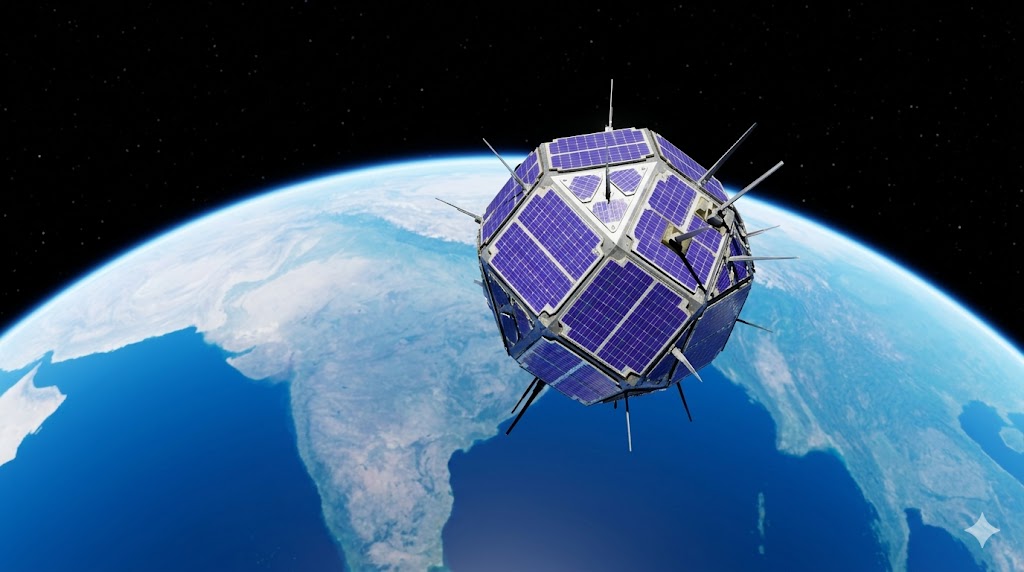
A conceptual visualization of the Aryabhata satellite in orbit above Earth. This image illustrates the experimental, polyhedral spacecraft featuring 26 faces covered in solar cells, as described in the technical specifications, orbiting high above the planet.
The Launch of the Aryabhata Satellite: April 19, 1975
At 1:28:55 PM IST on April 19, 1975, the Kosmos-3M rocket lifted off from the Volgograd Launch Station (Kapustin Yar), carrying the Aryabhata satellite into a near-circular low Earth orbit. The 360 kg spacecraft entered an orbit with a perigee of 563 km, apogee of 619 km, and inclination of 50.7 degrees.
The launch itself was flawless, but the real triumph lay in the satellite's indigenous construction. Assembled in sheds near Bangalore, the Aryabhata satellite featured a 26-faced polyhedral structure, 1.4 meters in diameter. Solar cells covered most faces, generating 46 watts of power, backed by nickel-cadmium batteries. Passive thermal control and cold gas jets ensured spin stabilization.
For millions of Indians following the event via radio and newspapers, the successful injection into orbit felt like a national victory. It proved that a developing nation could design and build a functional satellite. The Aryabhata satellite's image later appeared on the reverse of India's two-rupee banknotes from 1976 to 1997, cementing its place in public memory.
Technical Specifications, Objectives, and Mission Outcomes
The Aryabhata satellite was designed as an experimental platform with three primary scientific payloads: experiments in X-ray astronomy, aeronomy (study of the upper atmosphere), and solar physics. It carried instruments to measure X-ray emissions from cosmic sources, neutron and gamma-ray fluxes from the Sun, and atmospheric parameters.
Data transmission occurred via VHF band at 256 bits per second, with a playback mode for higher rates. The satellite monitored 91 onboard parameters, demonstrating advanced telemetry for its era. Spin stabilization at about 50 revolutions per minute was achieved after initial tumbling issues were corrected by ground commands.
The mission encountered challenges. Power supply failures limited scientific operations to just four or five days, with full signals lost shortly after. However, the mainframe systems remained functional until March 1981, and the satellite orbited Earth for nearly 17 years before re-entering the atmosphere on February 10, 1992.
Despite the short active science phase, valuable data was gathered on X-ray sources like Cyg X-1. More importantly, the Aryabhata satellite validated India's ability to build, test, and operate spacecraft systems. Engineers learned critical lessons in power management, attitude control, and thermal regulation—knowledge that proved invaluable for future missions.
Why the Aryabhata Satellite Launch Was India's Space Victory
The 1975 launch of the Aryabhata satellite was hailed as a victory not because everything operated perfectly, but because it succeeded against formidable odds. In an era when space was dominated by superpowers, India demonstrated that determination and ingenuity could bridge technological gaps.
It established ISRO's credibility on the global stage. The mission fostered a core team of experts who would drive subsequent programs. As Prof. U.R. Rao later reflected, no setback was viewed as failure; each was a stepping stone.
Symbolically, the Aryabhata satellite represented self-reliance (Atmanirbhar Bharat avant la lettre). It inspired generations of scientists and instilled national pride. For an educational audience, it underscores how strategic international partnerships, combined with domestic effort, can accelerate progress.
Evolution of India's Satellite Program: From Experimental to Operational
The success of the Aryabhata satellite paved the way for rapid advancement. In 1980, India achieved its first indigenous orbital launch with the Rohini satellite aboard the SLV-3 rocket from Sriharikota. This marked the beginning of self-reliant launch capabilities.
The 1980s saw the development of the Indian National Satellite (INSAT) system for telecommunications and meteorology, and the Indian Remote Sensing (IRS) satellites for Earth observation. These operational systems transformed agriculture, disaster management, and urban planning.
The Polar Satellite Launch Vehicle (PSLV), first flown successfully in 1994, became ISRO's workhorse, renowned for reliability and cost-effectiveness. The Geosynchronous Satellite Launch Vehicle (GSLV) followed, enabling heavier payloads to higher orbits, including cryogenic upper stages developed indigenously after technology denials.
By the 2000s, India's satellite fleet expanded dramatically. Navigation services via NavIC (formerly IRNSS) provided independent positioning accuracy, while communication satellites supported digital India initiatives.
Major Milestones: Chandrayaan, Mangalyaan, and Beyond
India's space program gained global acclaim with lunar and Martian explorations. Chandrayaan-1 in 2008 discovered water molecules on the Moon, followed by the historic Chandrayaan-3 soft landing in 2023 near the south pole—the first by any nation.
The Mars Orbiter Mission (Mangalyaan) in 2013 made India the first country to reach Mars on its maiden attempt, at a fraction of the cost of comparable missions. Aditya-L1, launched in 2023, continues to study the Sun from the L1 point, providing critical solar data.
Other achievements include AstroSat (India's first dedicated astronomy satellite), XPoSat for X-ray polarimetry, and the SPADEX mission demonstrating autonomous docking in 2025—making India the fourth nation to achieve this feat.
India's Current Status in Space Development (as of 2026)
Today, ISRO operates one of the world's most efficient space programs. With over 130 spacecraft missions completed, India maintains a robust constellation of Earth observation, communication, and navigation satellites.
Recent highlights include the NISAR mission (joint with NASA, launched 2025) for advanced radar imaging, successful Axiom-4 mission carrying an Indian astronaut to the ISS, and ongoing Gaganyaan preparations for crewed flight.
Launch cadence has accelerated, with plans for multiple missions annually. The Small Satellite Launch Vehicle (SSLV) caters to the growing smallsat market, while private sector participation—enabled by IN-SPACe—has surged, fostering a vibrant ecosystem.
India's space economy is projected to grow significantly, emphasizing cost-effectiveness, sustainability, and applications in climate monitoring, agriculture, and disaster response. International collaborations with NASA, ESA, JAXA, and others underscore its rising stature.
Challenges remain—such as developing reusable launch vehicles and a space station—but the trajectory is upward. From the Aryabhata satellite's experimental days to sophisticated interplanetary probes, India's program exemplifies purposeful development.
Future Prospects and the Enduring Legacy
Looking ahead, India aims for human spaceflight, Venus orbiter missions, Chandrayaan-5 (with JAXA), and an Indian Space Station. These ambitions build directly on the foundation laid by the Aryabhata satellite in 1975.
The legacy of that first launch endures: it proved that vision and perseverance can overcome limitations. For students, researchers, and enthusiasts, the story of the Aryabhata satellite offers timeless lessons in innovation and national aspiration.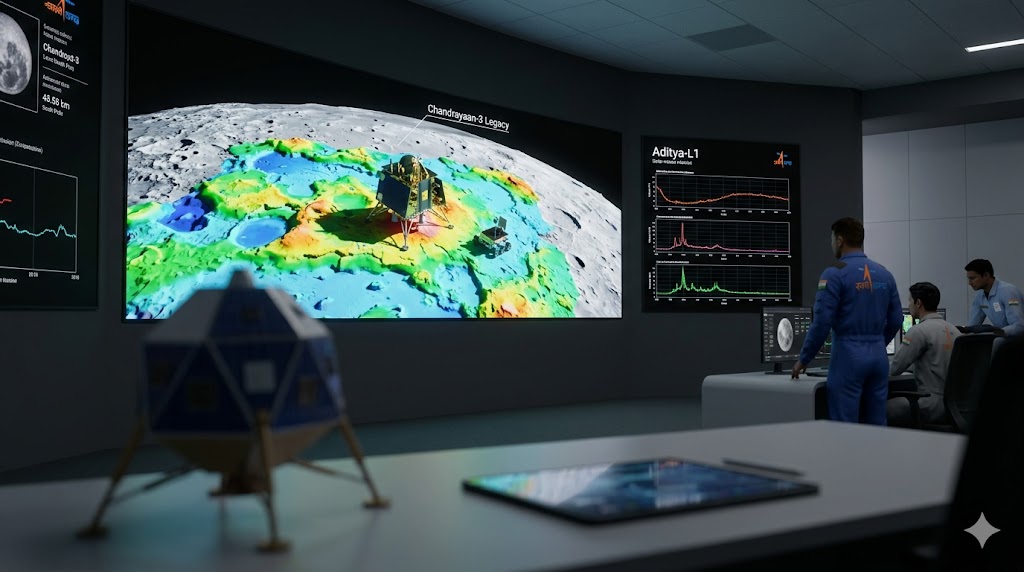
From one satellite to a global space leader. A conceptual view inside a futuristic 2026 ISRO Mission Control center, where generic engineers oversee lunar and solar missions. In the foreground, a model of the pioneering 1975 Aryabhata satellite visualizes the foundation of India's sophisticated space exploration trajectory.
Conclusion: From One Satellite to a Space Powerhouse
The launch of the Aryabhata satellite on April 19, 1975, was a defining moment—a victory that ignited India's space odyssey. What began as a modest experimental craft has evolved into a comprehensive program delivering tangible benefits to society and earning global respect.
As India continues to push boundaries in satellite technology and space exploration, the spirit of the Aryabhata satellite remains alive: harnessing science for progress, self-reliance, and the greater good. This journey inspires not only Indians but anyone who believes in the power of human ingenuity to reach for the stars.