PM Modi Address to Nation April 18 2026: Key Highlights
News• April 18, 2026• Global Edition
PM Modi Address to Nation on April 18, 2026: A Detailed Look at the Speech, Its Purpose, and Far-Reaching Implications
In a much-anticipated national address that captured the attention of millions across India, Prime Minister Narendra Modi spoke directly to the country at 8:30 PM on Saturday, April 18, 2026. The PM Modi address to nation came just 24 hours after a landmark constitutional amendment bill aimed at operationalizing 33% reservation for women in legislatures suffered a surprising defeat in the Lok Sabha. As search trends exploded with terms like “PM Modi address today,” “PM Modi 8 PM address,” and “PM Modi address nation live,” citizens tuned in expecting clarity, accountability, and perhaps a roadmap forward on one of the most significant gender-equality reforms in recent decades.
This was no ordinary broadcast. The Prime Minister’s words blended heartfelt regret with sharp political critique, framing the evening not merely as a reaction to a parliamentary setback but as a defining moment in the ongoing struggle for Nari Shakti. In this comprehensive article, we break down the background, the key moments of the PM Modi national address, the explicit purpose behind it, and what it means for Indian politics, women’s empowerment, and the road to 2029.
Understanding the Context: Why the PM Modi Address to Nation Became Necessary
To fully appreciate the significance of the April 18 address, one must revisit the events of the preceding day. On April 17, 2026, during a special parliamentary session, the government introduced the Constitution (131st Amendment) Bill, 2026. This legislation sought to fulfill the promise of the Nari Shakti Vandan Adhiniyam—the 2023 law that reserved one-third of seats for women in the Lok Sabha and state assemblies but remained unimplemented pending delimitation.
The bill proposed a substantial increase in the strength of the Lok Sabha from the current 543 seats to approximately 816, alongside corresponding expansions in state and Union Territory assemblies. Delimitation would be based on the 2011 Census data, ensuring the women’s quota could be operationalized before the 2029 general elections. A two-thirds majority was constitutionally required for passage. When the votes were counted, 298 members supported the bill while 230 opposed it—falling short of the 352 votes needed among the 528 members who participated.
The defeat, led by a united Opposition including the Congress, DMK, TMC, and Samajwadi Party, triggered immediate political shockwaves. For the ruling NDA, it represented a rare legislative setback on a flagship reform. By the morning of April 18, speculation mounted that the Prime Minister would address the nation. Official confirmation came early: the PM Modi address today at 8:30 PM would focus squarely on the women’s reservation issue, Parliament’s developments, and the broader implications for democratic representation.
This timing—mere hours after the session concluded—underscored the urgency. The PM Modi address to nation was not scheduled in advance like a routine policy announcement; it was a deliberate response to a high-stakes political moment. As live streams and news channels prepared for the broadcast, keywords such as “PM Modi address nation today” and “breaking news PM Modi address” trended nationwide, reflecting public curiosity about how the government would respond.
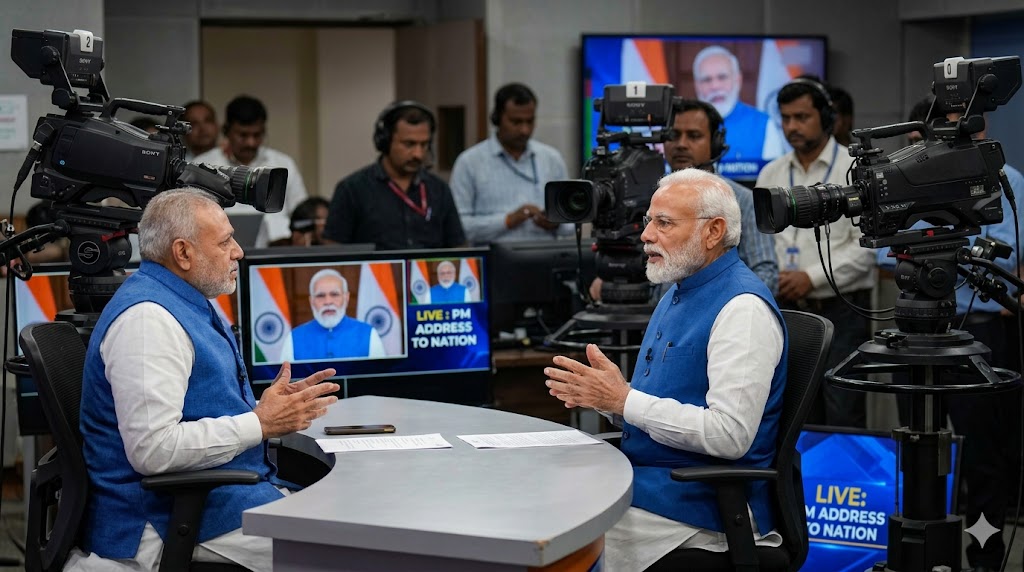
A behind-the-scenes view of PM Modi's address to the nation from a Delhi studio on April 18, 2026. The scene captures the Prime Minister delivering his solemn message amidst the high-tech setup of a live national broadcast.
Inside the PM Modi Speech: Key Highlights and Powerful Quotes
Prime Minister Modi began his address with a tone of solemn reflection, speaking straight to the heart of the issue. “Today, I am here to discuss an important issue, especially for the women of this country,” he stated. He acknowledged the visible stall in women’s progress: “Every citizen of India is witnessing how the rise of women’s power has been halted and how their dreams have been brutally crushed. Despite our best efforts, we could not succeed. The Women’s Reservation Bill could not be amended, and for this, I sincerely apologize to all mothers and sisters of the nation.”
This apology formed the emotional core of the PM Modi address April 18 2026. Rather than deflecting blame, the Prime Minister took ownership on behalf of the government while pivoting immediately to the reasons behind the failure. He described the defeat as an “attack on the dignity and self-respect of women,” adding that “a woman forgets many things, but she never forgets her insult. The conduct of the Congress and its allies in Parliament will remain in the minds of women across the country.”
The speech quickly turned pointed. PM Modi accused Opposition parties—specifically naming Congress, DMK, TMC, and Samajwadi Party—of “selfish politics” and “dynastic interests.” He used strong language, stating that these parties had committed “bhroon hatya” (female foeticide) of the dreams of Nari Shakti by blocking the bill in full public view. “The fight for empowering India’s women has been stalled due to selfish politics of opposition parties,” he declared.
He reserved particular criticism for the Congress, noting that he had personally hoped the party would “correct its past mistakes” and “script new history” by supporting the reform. Instead, he said, it “missed an opportunity” and revealed its “anti-reform mindset.” Drawing on historical examples, Modi reminded viewers how Congress had delayed decisions on One Rank One Pension, OBC reservations, and border issues for decades. “This fight is not just about a law; it is about the anti-reform mindset of Congress,” he emphasized.
Modi also addressed regional parties like the DMK, pointing out their alleged U-turn on the issue and accusing them of prioritizing family-led politics over national welfare. He argued that dynastic parties fear empowered women from ordinary families entering Parliament, as it could challenge their entrenched leadership. “They are scared that if women get empowered, the leadership of these dynastic parties will be threatened,” he observed.
Yet the Prime Minister struck a note of resilience. “We may not have got 66% votes, but we have got the blessings of 100% of women,” he said, drawing a sharp contrast between parliamentary arithmetic and public sentiment. He assured the nation that the NDA’s “spirits are high” and vowed to “remove all obstacles that come in the way of women’s reservation.” The message was clear: the setback was temporary, and the commitment to Nari Shakti remained unwavering.
Throughout the roughly 45-minute address, Modi wove together personal appeal, historical context, and forward-looking resolve. He urged women not to lose hope and warned that the Opposition would “surely be punished” at the hands of the electorate for taking women’s power for granted.
The Purpose Behind the PM Modi National Address: Strategy and Messaging
The purpose of the PM Modi address to nation on April 18, 2026, extended far beyond merely explaining a parliamentary vote. Political observers noted several layered objectives.
First, it served as an act of accountability and empathy. By publicly apologizing to mothers and sisters, the Prime Minister humanized the government’s response and reinforced its pro-women credentials. This direct outreach was designed to resonate emotionally with female voters, who form a crucial and growing segment of the electorate.
Second, the speech functioned as a powerful narrative reset. Instead of portraying the bill’s defeat as a government failure, Modi reframed it as the Opposition’s betrayal of women’s aspirations. By labeling parties as “anti-women” and “parivaarwadi,” he sought to polarize the debate along ideological lines—NDA as champion of empowerment versus a dynastic bloc allegedly protecting its own interests.
Third, the address aimed to maintain momentum on the women’s reservation agenda. By reaffirming the NDA’s resolve and highlighting the bill’s balanced approach to North-South representation through delimitation, Modi signaled that the government would explore alternative pathways, possibly in future sessions or through public pressure.
Finally, the timing—just days before potential state-level political developments—suggested a broader electoral strategy. The PM Modi speech today positioned the BJP and its allies as the true defenders of constitutional reform, while putting the Opposition on the defensive ahead of any upcoming polls.
In essence, the PM Modi address April 18 2026 was both a damage-control exercise and a proactive political masterstroke, blending contrition with combativeness to shape public discourse for months to come.
Reactions and Political Fallout
The address elicited swift and polarized responses. BJP leaders, including Smriti Irani and Piyush Goyal, praised the Prime Minister for exposing the Opposition’s “anti-women” stance and standing firmly with Nari Shakti. Allies echoed the sentiment that the defeat represented a temporary hurdle, not defeat.
Opposition leaders, however, pushed back strongly. Congress president Mallikarjun Kharge remarked that the speech mentioned Congress far more often than women, questioning its priorities. TMC’s Derek O’Brien called the bill a “decoy” for delimitation politics, while Priyanka Gandhi Vadra described the defeat as a “victory for democracy.” Regional voices from Tamil Nadu and Karnataka raised concerns about seat redistribution potentially affecting southern states’ representation, demanding implementation on the existing 543 seats without fresh delimitation.
Public reaction, gauged through social media and television debates, was mixed but leaned toward appreciation for Modi’s directness. Many women’s groups welcomed the apology while urging all parties to rise above politics and deliver the long-delayed reservation.
Broader Implications for Women’s Empowerment and Indian Democracy
The PM Modi national address and the events surrounding it spotlight a deeper truth about Indian democracy: transformative reforms often require consensus beyond numbers. The 2023 women’s reservation law was historic, yet its implementation hinges on complex issues like delimitation, census timing, and federal balance. The April 17 vote and April 18 address have reignited national conversation on these fronts.
For women’s empowerment, the setback is undoubtedly disappointing, yet the nationwide focus it has generated could accelerate future progress. The government’s commitment to “remove all obstacles” suggests renewed legislative or consultative efforts may follow. Politically, the episode has sharpened the battle lines between reformist and status-quo forces, potentially influencing voter preferences in the lead-up to 2029.
As India marches toward its goal of a developed nation by 2047, equitable representation in legislatures remains central. The PM Modi address to nation has reminded citizens that the journey involves both celebration and course correction, resilience and accountability.
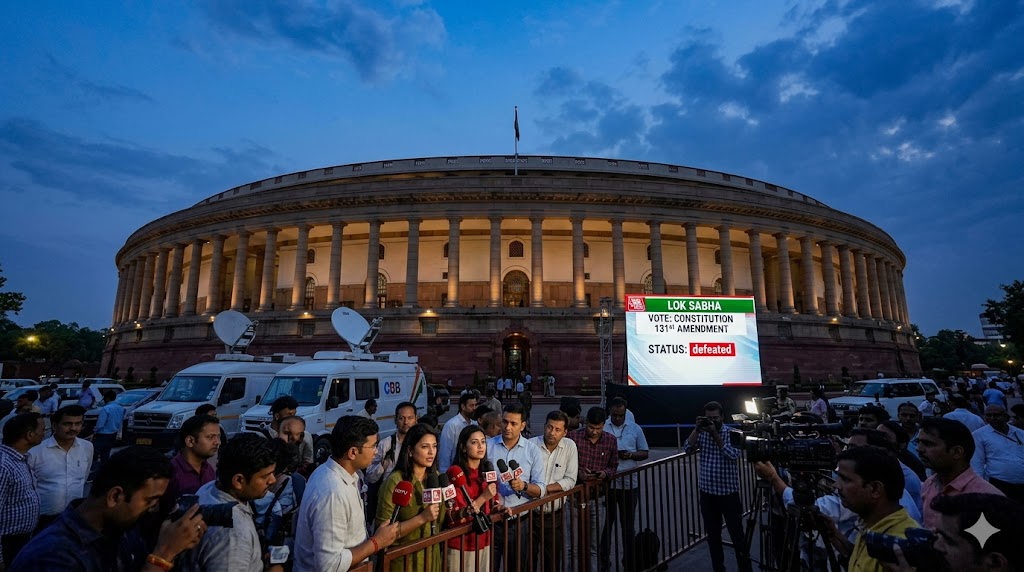
A media frenzy outside the Parliament of India building at dusk, highlighting the intense scrutiny and political high stakes following the surprise defeat of the 131st Constitutional Amendment Bill, which set the stage for the Prime Minister’s national address.
Prime Minister Narendra Modi’s address to the nation on April 18, 2026, will be remembered as more than a reaction to one parliamentary vote. It was a candid, emotionally charged appeal that apologized for delay, confronted political opponents head-on, and reaffirmed an unshakeable commitment to women’s rightful place in India’s democratic framework.
Whether one views the speech as strategic political messaging or a genuine call for unity on women’s rights, its impact is undeniable. The PM Modi address today has energized supporters, challenged critics, and kept the spotlight firmly on Nari Shakti. As the nation reflects on these developments, one thing is clear: the conversation on women’s reservation is far from over. The coming months and years will test the resolve of all political stakeholders to translate words into action and ensure that every Indian woman sees her dreams of equal representation realized.
In the end, the true measure of this PM Modi national address will lie not in immediate applause or criticism, but in the lasting momentum it generates toward a more inclusive and empowered Bharat.
Frequently Asked Questions
What is the primary significance of PM Modi Address to Nation April 18 2026: Key Highlights?
PM Modi Address to Nation on April 18, 2026: A Detailed Look at the Speech, Its Purpose, and Far-Reaching ImplicationsIn a much-anticipated national address that captured the attention of millions across India, Prime Minister Narendra Modi spoke directly to the country at 8:30 PM on Saturday, April 18, 2026. The PM Modi address to nation came just 24 hours after a landmark constitutional amendment bill aimed at operationalizing 33% reservation for women in legislatures suffered a surprising defeat in the Lok Sabha.
How does this development impact News?
As search trends exploded with terms like “PM Modi address today,” “PM Modi 8 PM address,” and “PM Modi address nation live,” citizens tuned in expecting clarity, accountability, and perhaps a roadmap forward on one of the most significant gender-equality reforms in recent decades.This was no ordinary broadcast. The Prime Minister’s words blended heartfelt regret with sharp political critique, framing the evening not merely as a reaction to a parliamentary setback but as a defining moment in the ongoing struggle for Nari Shakti.
What are the key future projections to monitor?
In this comprehensive article, we break down the background, the key moments of the PM Modi national address, the explicit purpose behind it, and what it means for Indian politics, women’s empowerment, and the road to 2029.Understanding the Context: Why the PM Modi Address to Nation Became NecessaryTo fully appreciate the significance of the April 18 address, one must revisit the events of the preceding day.