"How Biotech and Tech Are Transforming Healthcare"
Technology• April 18, 2026• Global Edition
In an era where a single blood draw can reveal a person's genetic blueprint and robotic arms assist surgeons with millimeter precision, healthcare has undergone a profound transformation. Biotechnology in healthcare and cutting-edge healthcare technology are no longer futuristic concepts—they are the backbone of modern medical facilities. These innovations promise quicker diagnoses, shorter treatment times, and highly personalized care, yet they come with a significant price tag that challenges healthcare systems worldwide.
As of 2026, the integration of biotechnology and technology has reshaped everything from hospital infrastructure to patient outcomes. Wearable devices monitor chronic conditions in real time, artificial intelligence (AI) sifts through millions of data points to flag diseases before symptoms appear, and gene therapies offer cures for conditions once deemed untreatable. This article explores how these developments are converting traditional healthcare facilities into high-tech hubs, the delicate balance between time savings and escalating costs, the deep relationship between health and biotechnology, and the rising advancements in gene therapy, diagnostic systems, and medicine engineering. Drawing from verified sources like FDA approvals, market analyses, and peer-reviewed studies, it provides an educational overview designed for students, professionals, and curious readers alike.
The global healthcare IT market alone is projected to exceed $1 trillion by the early 2030s, growing at double-digit rates, reflecting the massive investment in these technologies. Yet, as adoption surges—71 percent of U.S. hospitals integrated AI by late 2025—the question remains: Are these high-tech healthcare facilities delivering value that justifies their costs? Let's dive deeper.
Traditional hospitals once relied on manual records, basic imaging, and in-person consultations. Today, high-tech healthcare facilities integrate seamless digital ecosystems. Electronic health records (EHRs) connect every department, enabling instant data sharing across continents. Telemedicine and virtual hospitals have evolved from pandemic necessities into standard care models, allowing patients to receive hospital-grade treatment at home.
Remote patient monitoring (RPM) via wearables tracks vital signs like heart rate, blood pressure, and glucose levels in real time. AI-powered tools analyze this data to predict deteriorations, such as sepsis risks or readmissions, reducing emergency visits. Robotics extend beyond operating rooms into daily operations—automated pill dispensers, cleaning bots, and even companion robots enhance patient independence and staff efficiency.
AI has become infrastructure rather than an add-on. It supports diagnostics, risk assessment, and administrative workflows, freeing clinicians for more patient interaction. Multimodal AI systems combine imaging, genomics, and clinical notes for richer insights. In 2026, trends like "hospital-at-home" models and digital twins—virtual replicas of patients—personalize care at scale.
These advancements stem from biotechnology in healthcare's fusion with engineering. For instance, Internet of Medical Things (IoMT) devices create smart ecosystems where data flows securely via blockchain, minimizing errors and fraud. The result? Facilities that operate with unprecedented speed and precision, turning reactive care into proactive, preventive strategies.
Time Efficiency Gains: Reducing Treatment Timelines
One of the clearest benefits of healthcare technology is speed. What once took days or weeks now happens in hours or minutes. AI-aided diagnostics slash interpretation times for scans—deep learning models detect tumors more accurately and faster than traditional methods. Predictive analytics forecast staffing needs and patient influx, streamlining operations.
Robotic-assisted surgeries minimize incision sizes, leading to faster recoveries and shorter hospital stays. Anesthesia innovations and minimally invasive techniques further accelerate this. Telehealth eliminates travel time, while automated scheduling reduces no-show rates dramatically.
In diagnostics, next-generation sequencing (NGS) deciphers genetic data rapidly, enabling quicker treatment starts for rare diseases. Liquid biopsies offer non-invasive cancer monitoring in real time. Overall, these tools compress timelines: medication turnaround drops from hours to minutes, radiology results appear faster, and follow-up care happens virtually.
Patients benefit most. Chronic condition management shifts from frequent visits to continuous remote oversight, improving adherence and outcomes. Preventive medicine powered by AI identifies risks early, potentially averting costly crises. Yet efficiency isn't universal—implementation varies by region and facility size, with larger systems reaping bigger gains.
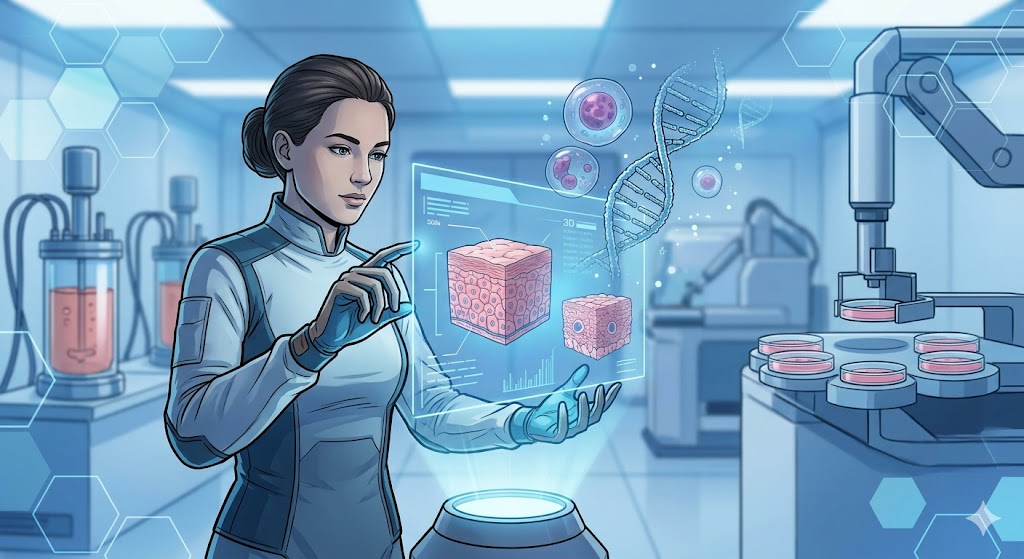
An illustration of a scientist working with dynamic holographic data, symbolizing the integration of biotechnology and medicine engineering in modern research and treatment design.
The High Cost of Innovation: Weighing Expenses Against Benefits
Despite time savings, costs remain a major hurdle. New healthcare technology often drives up expenses. Advanced equipment, AI infrastructure, gene therapies, and maintenance require substantial upfront investment. Market data shows the digital health sector expanding rapidly, but per-patient costs for cutting-edge treatments can reach hundreds of thousands of dollars.
Studies estimate medical technology contributes 10 to 40 percent of healthcare expenditure growth. Big-ticket items like robotic systems or genomic sequencers add intensity to care without always offsetting savings immediately. Gene therapies, while transformative, demand specialized manufacturing and long-term follow-up, inflating prices.
However, long-term benefits emerge. EHRs alone reduced outpatient costs by about 3 percent in some analyses through error reduction and efficiency. Automation curbs administrative waste, and preventive AI lowers readmission rates—saving thousands per case. Remote monitoring cuts unnecessary hospitalizations. The challenge lies in equitable access: high costs risk widening disparities unless reimbursement models evolve.
Policymakers and providers grapple with this tension. Value-based care ties payments to outcomes, incentivizing cost-effective tech adoption. As scalability improves—through AI agents and streamlined manufacturing—prices may moderate, but 2026 projections indicate continued upward pressure on spending.
The Intersection of Health and Biotechnology
At its core, biotechnology in healthcare applies biological processes and organisms to solve medical problems, amplified by technology. It bridges lab research with clinical application, using genetic engineering, molecular biology, and data science to create targeted solutions.
Biotech drives precision medicine, tailoring treatments to an individual's DNA, environment, and lifestyle. Unlike one-size-fits-all approaches, it analyzes biomarkers and genomics for customized plans. This synergy has revolutionized fields from oncology to rare diseases. mRNA platforms, proven in vaccines, now extend to cancer and beyond.
The relationship is symbiotic: health challenges spur biotech innovation, while biotech breakthroughs redefine healthcare delivery. For example, CRISPR-Cas9 gene editing—once a lab tool—now treats genetic disorders clinically. AI accelerates drug discovery by simulating molecular interactions, shortening development from years to months.
Developments are rising rapidly. Cell and gene therapies (CGTs) pipelines swell, with over 40 FDA-approved products by 2025, including CAR-T for cancers and AAV-based treatments for neuromuscular conditions. Biotechnology in healthcare increasingly incorporates AI, scalable manufacturing, and in vivo editing, broadening access to common diseases like diabetes or cardiovascular issues.
Advancements in Gene Therapy and Diagnostic Systems
Gene therapy stands as biotechnology in healthcare's crown jewel. It corrects defective genes by inserting, editing, or silencing them. The first CRISPR-based therapy, Casgevy (exa-cel), gained FDA approval for sickle cell disease and beta thalassemia, marking a historic milestone. By 2026, treatments like Zolgensma for spinal muscular atrophy and emerging in vivo CRISPR options expand possibilities.
Diagnostic systems have evolved in tandem. NGS and liquid biopsies enable early, non-invasive detection. AI-enhanced imaging outperforms radiologists in spotting subtle anomalies. Companion diagnostics link tests directly to therapies, ensuring treatments match genetic profiles.
Challenges persist—delivery vectors (viral like AAV or non-viral), immune responses, and ethical considerations—but clinical trials proliferate. Personalized CRISPR for rare diseases, developed in months, signals on-demand potential. These systems reduce diagnostic odysseys from years to weeks, directly tying into faster, more effective care.
Medicine Engineering: Biomedical Innovations at the Forefront
Medicine engineering merges engineering principles with biology to design solutions like 3D-printed organs, nanomedicine, and implantable devices. Biomedical engineers create prosthetics, tissue scaffolds, and drug-delivery systems that integrate seamlessly with the body.
In high-tech healthcare facilities, this manifests as regenerative therapies and smart implants. 3D bioprinting fabricates patient-specific tissues, while nanotechnology targets drugs precisely, minimizing side effects. Digital twins simulate treatments virtually, optimizing outcomes before real-world application.
This field accelerates personalized medicine. By engineering cells or materials at the molecular level, it addresses limitations of traditional drugs. Collaborations between biotech firms and engineers yield hybrid solutions—think AI-optimized scaffolds for stem cell therapies. As costs decrease with automation, medicine engineering promises broader accessibility.
How the Healthcare System Has Developed in the Biotech Era
The healthcare system today looks vastly different from two decades ago, thanks to biotechnology in healthcare's pervasive influence. Regulatory pathways have adapted—FDA streamlined approvals for advanced therapies. Infrastructure shifted toward interoperability, with FHIR standards enabling data exchange.
Global efforts, like expanded CGT infrastructure in the UK and U.S., integrate these innovations into public systems. Precision health becomes routine: genetic testing informs prevention, AI stewards resources, and virtual care models reduce strain on physical facilities.
Yet development isn't linear. Cybersecurity, data governance, and workforce training lag in some areas. Equity issues arise as high-tech solutions favor well-resourced regions. Nonetheless, the biotech era fosters resilient, outcomes-oriented systems focused on prevention over treatment.
Challenges, Ethical Considerations, and Future Outlook
High costs, regulatory hurdles, and ethical dilemmas—such as gene editing access or data privacy—temper enthusiasm. Cybersecurity threats grow with digital reliance. Long-term safety of therapies requires ongoing monitoring.
Looking ahead to 2030 and beyond, expect deeper AI integration, universal cancer vaccines via mRNA, and in-home advanced therapies. Biotechnology in healthcare will likely democratize care through scalable, affordable tech. Hybrid human-AI models will enhance decision-making without replacing empathy.
Investment in education and infrastructure will determine success. Policymakers must balance innovation with affordability to ensure benefits reach all.
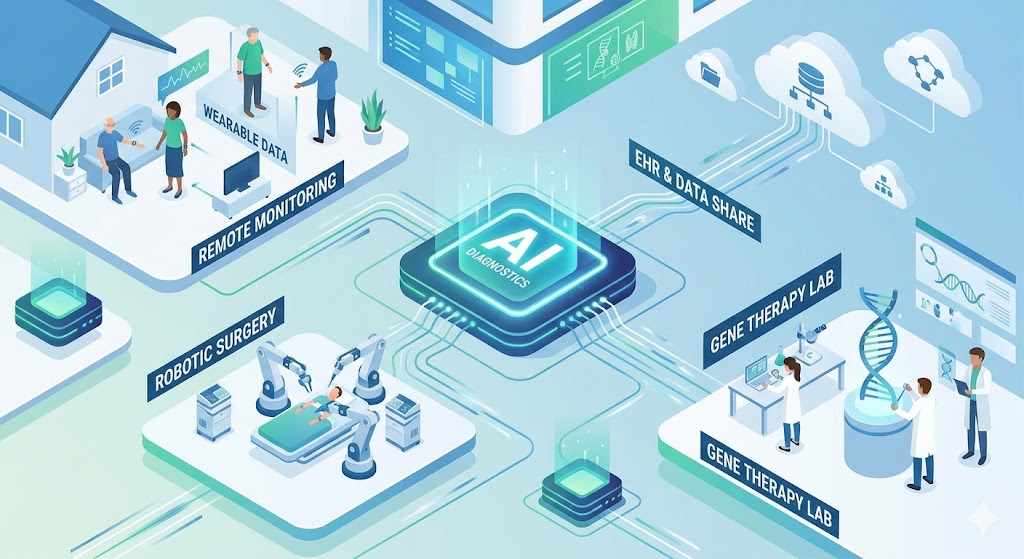
A conceptual infographic illustration showcasing an integrated smart hospital ecosystem where AI-driven diagnostics connect with remote monitoring, robotic surgery, and advanced laboratories.
Conclusion
Biotechnology in healthcare and advanced healthcare technology have converted facilities into intelligent, efficient ecosystems. They slash treatment times through AI, robotics, and genomics while driving personalized medicine via gene therapy and diagnostic systems. Medicine engineering bridges the gap between biology and application, propelling the entire system forward.
The trade-off of higher costs is real, but potential savings in efficiency, prevention, and outcomes offer hope. As developments surge—fueled by CRISPR breakthroughs, market growth, and collaborative research—the future of healthcare is brighter, more precise, and profoundly human-centered.
This evolution underscores a key truth: technology alone doesn't heal; when paired with biotechnology and ethical stewardship, it elevates care to new heights. For students and practitioners, staying informed on these shifts is essential to shaping tomorrow's health landscape.
Frequently Asked Questions
What is the primary significance of "How Biotech and Tech Are Transforming Healthcare"?
In an era where a single blood draw can reveal a person's genetic blueprint and robotic arms assist surgeons with millimeter precision, healthcare has undergone a profound transformation. Biotechnology in healthcare and cutting-edge healthcare technology are no longer futuristic concepts—they are the backbone of modern medical facilities.
How does this development impact Technology?
These innovations promise quicker diagnoses, shorter treatment times, and highly personalized care, yet they come with a significant price tag that challenges healthcare systems worldwide.As of 2026, the integration of biotechnology and technology has reshaped everything from hospital infrastructure to patient outcomes. Wearable devices monitor chronic conditions in real time, artificial intelligence (AI) sifts through millions of data points to flag diseases before symptoms appear, and gene therapies offer cures for conditions once deemed untreatable.
What are the key future projections to monitor?
This article explores how these developments are converting traditional healthcare facilities into high-tech hubs, the delicate balance between time savings and escalating costs, the deep relationship between health and biotechnology, and the rising advancements in gene therapy, diagnostic systems, and medicine engineering.