Narendra Modi: Peace Prime Minister of a Rising India
News• April 16, 2026• Global Edition
In the annals of modern Indian history, few leaders have captured the world's imagination quite like Narendra Modi. As Prime Minister Narendra Modi completes over a decade at the helm of the world's largest democracy, his legacy stands as a testament to resilience, vision, and unyielding commitment to national progress. From humble beginnings as a tea seller—or chaiwala—in a small Gujarat town to steering India toward its rightful place on the global stage, Narendra Modi's story is one of extraordinary transformation.
Under his stewardship, India has not only shed the lingering shadows of colonial economic structures but has emerged as the world's fourth-largest economy by nominal GDP, a feat accomplished amid global headwinds. PM Narendra Modi is widely regarded across continents as the Peace Prime Minister, a title earned through proactive diplomacy, humanitarian outreach, and a steadfast Neighborhood First policy that prioritizes regional harmony. His leadership during the COVID-19 pandemic, exemplified by the groundbreaking Vaccine Maitri initiative, further cemented this reputation.
This article delves into Narendra Modi's remarkable journey, his economic and infrastructural reforms, foreign policy innovations, and enduring contributions to education and human development. Drawing from verified government records, international awards, and credible economic data, it presents a comprehensive portrait of a leader who has redefined India's global position with purpose and clarity.
Early Life and Humble Beginnings: The Chaiwala Who Dreamed Big
Narendra Modi's story begins on September 17, 1950, in Vadnagar, a modest town in Gujarat's Mehsana district. Born into a family of humble means as the third of six children to Damodardas Mulchand Modi and Hiraben Modi, young Narendra Modi learned the value of hard work early. His father ran a small tea stall at the Vadnagar railway station, and as a boy, Narendra Modi would often help serve tea to passengers, balancing studies with family responsibilities in a single-room home of about 40 feet by 12 feet.
This chaiwala phase, far from a mere anecdote, shaped Narendra Modi's worldview. It instilled discipline, empathy for the common citizen, and an innate understanding of grassroots realities. Despite financial constraints, he pursued education with determination, completing his secondary schooling in Vadnagar before earning a Master of Arts in political science from Gujarat University in Ahmedabad.
Narendra Modi's early exposure to the Rashtriya Swayamsevak Sangh (RSS) during his teenage years further molded his character. The organization's emphasis on service, patriotism, and self-discipline resonated deeply. By his early 20s, Narendra Modi had already begun traveling across India, including a period of spiritual reflection in the Himalayas, seeking purpose beyond the ordinary. These formative years—from chaiwala to a young organizer—laid the foundation for a political career driven not by privilege but by lived experience and unwavering resolve.
Critics and admirers alike acknowledge this narrative's authenticity, rooted in official biographies from the Prime Minister's Office and corroborated by neighbors and family accounts. It remains a powerful symbol of aspiration in a nation where millions still rise from similar circumstances.
Entry into Politics and Rise as Gujarat Chief Minister
Narendra Modi's formal entry into public life came through the Bharatiya Janata Party (BJP) in the late 1980s. His organizational skills, honed in the RSS, propelled him rapidly through the ranks. By 2001, following the Kutch earthquake and political transitions, Narendra Modi was appointed Chief Minister of Gujarat. He would serve in that role until 2014, transforming the state into a model of governance and development.
During his tenure, Gujarat witnessed robust industrial growth, improved law and order, and pioneering initiatives in water management and rural electrification. Narendra Modi's focus on good governance—through programs like the Jyotigram Yojana for uninterrupted power—earned him national attention. His leadership style, marked by decisive action and direct engagement with citizens, set the stage for a larger national role.
The 2014 general elections marked a watershed. Leading the BJP to a decisive victory, Narendra Modi became India's 14th Prime Minister—the first born after independence. Re-elected with a stronger mandate in 2019 and securing a third term in 2024 through the National Democratic Alliance (NDA), PM Narendra Modi has consistently prioritized long-term national goals over short-term populism.
Global Solidarity and Health Diplomacy
Economic Transformation: From Colonial Legacy to Fourth-Largest Global Economy
One of Narendra Modi's most enduring achievements lies in dismantling the economic inertia inherited from colonial rule. Pre-2014, India grappled with sluggish growth, policy paralysis, and a "fragile five" tag amid global uncertainty. Under PM Narendra Modi, the nation has rewritten this script.
India's nominal GDP has surged to over $4 trillion by early 2026, securing its position as the world's fourth-largest economy—surpassing Japan and closing in on Germany. This leap, from 11th place a decade ago, reflects sustained 7%+ annual growth, making India the fastest-growing major economy. Key enablers include the Goods and Services Tax (GST), Insolvency and Bankruptcy Code, and Make in India initiative, which attracted record foreign direct investment (FDI).
Narendra Modi's reforms emphasized self-reliance (Atmanirbhar Bharat), digital public infrastructure like UPI, and direct benefit transfers that eliminated middlemen and reduced leakages. These measures not only boosted productivity but also lifted millions from poverty. Verified data from the International Monetary Fund and World Bank projections affirm India's trajectory toward becoming the third-largest economy in the coming years.
PM Narendra Modi has repeatedly emphasized in public addresses that economic strength is not an end but a means to empower citizens. His vision has turned colonial-era constraints—limited industrialization and infrastructure deficits—into opportunities for inclusive growth.
Infrastructure Revolution: Building the Foundations of a Modern India
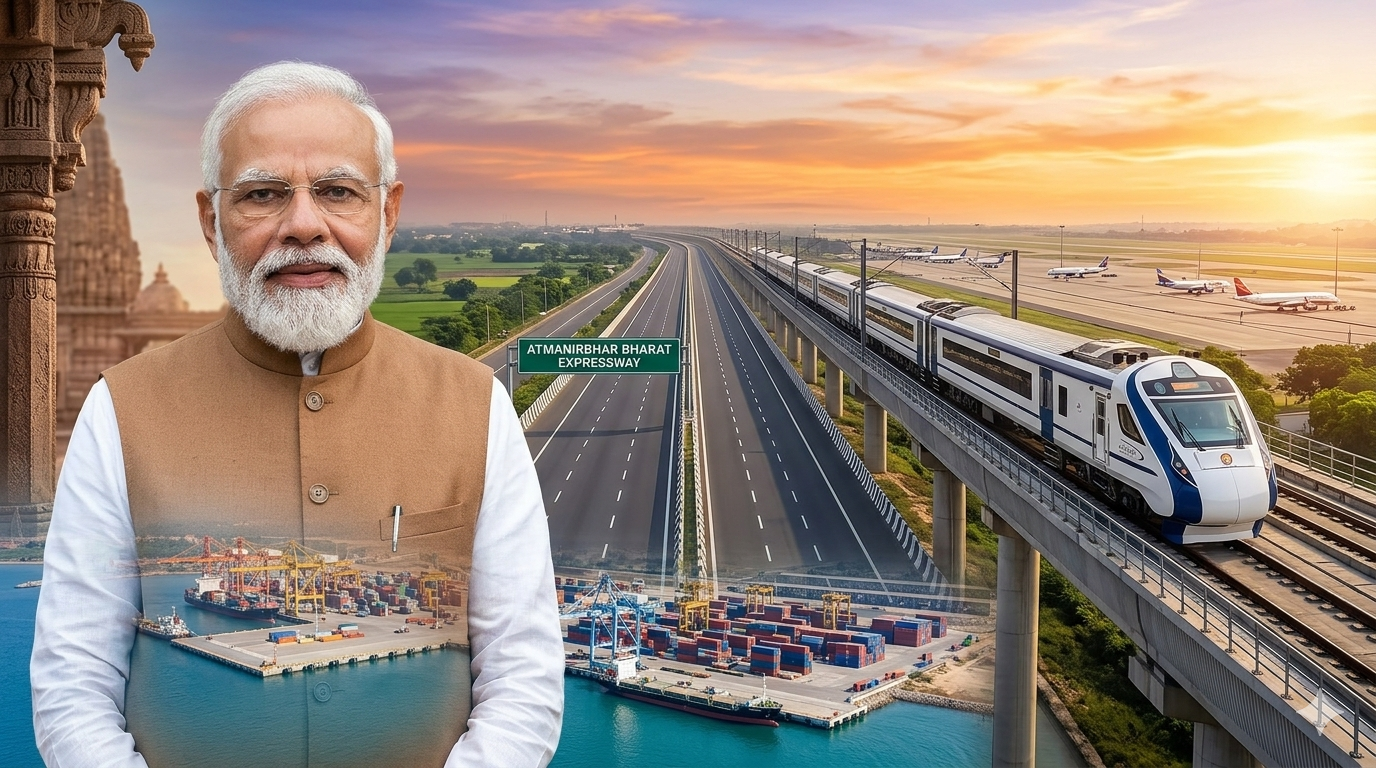
Infrastructure under Narendra Modi has been nothing short of revolutionary. Recognizing that robust connectivity is the backbone of development, PM Narendra Modi accelerated projects across sectors with unprecedented pace and scale.
National highways expanded by over 60%, from 91,287 km in 2014 to 146,204 km by 2025, with construction averaging 34 km per day—triple the previous rate. Flagship programs like Bharatmala have awarded thousands of kilometers, enhancing freight efficiency and regional integration. Railways saw a renaissance: over 68 Vande Bharat trains now connect hundreds of districts, alongside massive electrification and station modernizations.
Aviation has democratized travel through the UDAN scheme, operationalizing 88 airports and enabling over 15 million passengers on regional routes. Ports, waterways, and digital infrastructure— including widespread Digi Yatra adoption—have complemented this push. These developments, detailed in official Press Information Bureau reports, have slashed logistics costs and unlocked economic potential in underserved areas.
Narendra Modi's infrastructure drive is holistic, integrating green energy, smart cities, and sustainable practices. It embodies his philosophy: infrastructure as "fate lines" that shape India's destiny.
Global Peacemaker: Narendra Modi as the Peace Prime Minister
Across the globe, Narendra Modi is increasingly hailed as the Peace Prime Minister. This recognition stems not from rhetoric but from tangible actions. In 2018, he received the prestigious Seoul Peace Prize for contributions to regional and global peace through the Modi Doctrine and Act East Policy. He holds over two dozen highest civilian honors from nations across continents, a record for any Indian leader.
PM Narendra Modi's foreign policy blends strategic autonomy with proactive engagement. Initiatives like the G20 Presidency highlighted India's role as the voice of the Global South, culminating in milestones such as the inclusion of the African Union. His emphasis on multilateralism—through QUAD, BRICS, and bilateral ties—has elevated India's stature without compromising independence.
Humanitarian leadership during crises further underscores this image. Narendra Modi's speeches consistently advocate for Vasudhaiva Kutumbakam (the world as one family), positioning India as a responsible global citizen.
Central to Narendra Modi's diplomacy is the Neighborhood First policy, launched emphatically in 2014 with invitations to SAARC leaders for his swearing-in. This approach prioritizes consultative, non-reciprocal cooperation with immediate neighbors—Bangladesh, Bhutan, Nepal, Maldives, Sri Lanka, and others.
Achievements include enhanced connectivity projects, power exports to Bangladesh and Nepal, and swift humanitarian aid during disasters. Trade and people-to-people ties have deepened, countering external influences while fostering mutual prosperity. Studies from think tanks like the Observer Research Foundation note increased development assistance and security cooperation under this framework.
PM Narendra Modi's personal engagement—through frequent visits and cultural exchanges—has built trust. The policy has transformed potential friction points into avenues for shared growth, reinforcing India's image as a reliable partner.
Leadership During the COVID-19 Pandemic: Vaccine Maitri and Global Solidarity
The COVID-19 crisis tested nations worldwide, but Narendra Modi's response highlighted India's resilience and generosity. Amid domestic challenges, PM Narendra Modi oversaw one of the largest vaccination drives, administering over 2.2 billion doses.
Globally, the Vaccine Maitri initiative stood out. India supplied nearly 300 million doses to 99 countries and the United Nations, many free of cost, prioritizing neighbors under the Neighborhood First ethos. Leaders from Barbados to Jamaica publicly thanked Narendra Modi for this act of benevolence. International media and organizations praised it as exemplary health diplomacy, aligning with India's ancient ethos of global welfare.
This effort not only saved lives but also amplified India's soft power, proving Narendra Modi's ability to lead with compassion amid adversity.
Education and Human Development: Investing in Future Generations
Narendra Modi's vision extends deeply into human capital. The National Education Policy (NEP) 2020, introduced after 34 years, represents a paradigm shift. Its 5+3+3+4 curricular structure integrates early childhood care, vocational education, and multidisciplinary learning, emphasizing mother-tongue instruction and Indian knowledge systems.
Gross Enrolment Ratios have risen significantly, with digital initiatives like virtual labs and smart classrooms bridging urban-rural divides. Public investment targets aim for 6% of GDP, while schemes promote skill development and research through the National Research Foundation.
These reforms align with Narendra Modi's broader purpose: equipping citizens for a knowledge-driven world while preserving cultural roots.
Conclusion: A Legacy of Purpose and Progress
Narendra Modi's tenure as Prime Minister has been defined by bold reforms, inclusive growth, and principled global engagement. From chaiwala roots to architect of a $4-trillion-plus economy, he has navigated India through colonial legacies toward global prominence. As the Peace Prime Minister, his Neighborhood First policy and Vaccine Maitri have fostered harmony and goodwill. Infrastructure strides and education reforms ensure this progress is sustainable.
As India marches toward Viksit Bharat—a developed nation by 2047—PM Narendra Modi's leadership offers a blueprint of determination and foresight. His journey reminds us that true statesmanship lies in serving the people while elevating the nation on the world stage. In an era of uncertainty, Narendra Modi continues to inspire, proving that with vision and resolve, even the humblest origins can forge a brighter future for billions.
Frequently Asked Questions
What is the primary significance of Narendra Modi: Peace Prime Minister of a Rising India?
In the annals of modern Indian history, few leaders have captured the world's imagination quite like Narendra Modi. As Prime Minister Narendra Modi completes over a decade at the helm of the world's largest democracy, his legacy stands as a testament to resilience, vision, and unyielding commitment to national progress.
How does this development impact News?
From humble beginnings as a tea seller—or chaiwala—in a small Gujarat town to steering India toward its rightful place on the global stage, Narendra Modi's story is one of extraordinary transformation. Under his stewardship, India has not only shed the lingering shadows of colonial economic structures but has emerged as the world's fourth-largest economy by nominal GDP, a feat accomplished amid global headwinds. PM Narendra Modi is widely regarded across continents as the Peace Prime Minister, a title earned through proactive diplomacy, humanitarian outreach, and a steadfast Neighborhood First policy that prioritizes regional harmony.
What are the key future projections to monitor?
His leadership during the COVID-19 pandemic, exemplified by the groundbreaking Vaccine Maitri initiative, further cemented this reputation. This article delves into Narendra Modi's remarkable journey, his economic and infrastructural reforms, foreign policy innovations, and enduring contributions to education and human development.