India Becomes 4th Largest Economy: GDP Growth Story
Current Affairs• April 13, 2026• Global Edition
In the span of just a few decades, India has scripted one of the most remarkable economic turnaround stories in modern history. As of 2026, India stands as the world's fourth largest economy by nominal GDP, with projections from the International Monetary Fund (IMF) placing its economy at approximately $4.51 trillion—edging past Japan and solidifying its position behind only the United States, China, and Germany. This ascent is not accidental. It is the result of sustained India GDP growth, visionary policy reforms, massive infrastructure development, and the harnessing of a vibrant youth workforce.
The journey has been particularly noteworthy after major economic crises, including the 2008 global financial meltdown and the more recent COVID-19 disruptions. What sets India apart is its resilience and the way GDP has emerged as the single largest growing factor in its transformation. Robust economic expansion, fueled by domestic consumption, manufacturing revival, and digital innovation, has propelled India from a $2 trillion economy in the early 2010s to over $4.5 trillion today. This article delves deep into how these elements— infrastructure, youth power, progressive policies, and governance integrity—have collectively positioned India in the race to become a developed nation by 2047 under the Viksit Bharat vision.
We will examine the historical context, key milestones in reaching trillion-dollar GDP milestones, the role of specific growth rates (including recent projections hovering around 6-7% real GDP growth for 2026), and the forward-looking strategies that ensure India's continued momentum. This is not just a story of numbers; it is a narrative of determination, reform, and human capital.
Historical Journey: From Post-Independence Struggles to Liberalization and Beyond
India's economic story begins in 1947 with independence, when the nation inherited a largely agrarian, impoverished economy ravaged by colonial exploitation. For the first four decades, the country followed a socialist-inspired model with heavy state control, import substitution, and Five-Year Plans. While this laid the foundation for basic industries like steel, coal, and heavy engineering, growth remained modest—averaging around 3-4% annually, often termed the "Hindu rate of growth."
The pivotal turning point came in 1991 amid a severe balance-of-payments crisis. Under Prime Minister P.V. Narasimha Rao and Finance Minister Manmohan Singh, India liberalized its economy. Key reforms included dismantling the License Raj, reducing tariffs, encouraging foreign direct investment (FDI), and devaluing the rupee. These measures unlocked private enterprise and integrated India into the global economy.
By the early 2000s, India GDP growth accelerated to 6-8% in several years, driven by the services sector boom—particularly information technology and business process outsourcing. The country crossed the $1 trillion nominal GDP mark around 2010-2011, marking its entry into the elite club of trillion-dollar economies. However, the true acceleration in global rankings began post-2014, with consistent structural reforms that built on the 1991 foundation.
The 2008 global financial crisis tested this resilience. While many developed nations plunged into recession, India's GDP growth dipped but quickly rebounded to over 7% by 2009-10, thanks to fiscal stimulus, robust domestic demand, and a relatively insulated banking system. This crisis highlighted India's counter-cyclical strengths and set the stage for its long-term ascent. By 2022, India overtook the United Kingdom to become the fifth-largest economy. Fast-forward to 2026, and it has leapfrogged Japan to claim the fourth spot, with IMF data confirming a nominal GDP of $4.51 trillion and real growth projected at around 6.2-6.4% for the year.
This historical progression underscores a critical truth: India's economic growth has been iterative, with each crisis serving as a catalyst for deeper reforms rather than a setback.
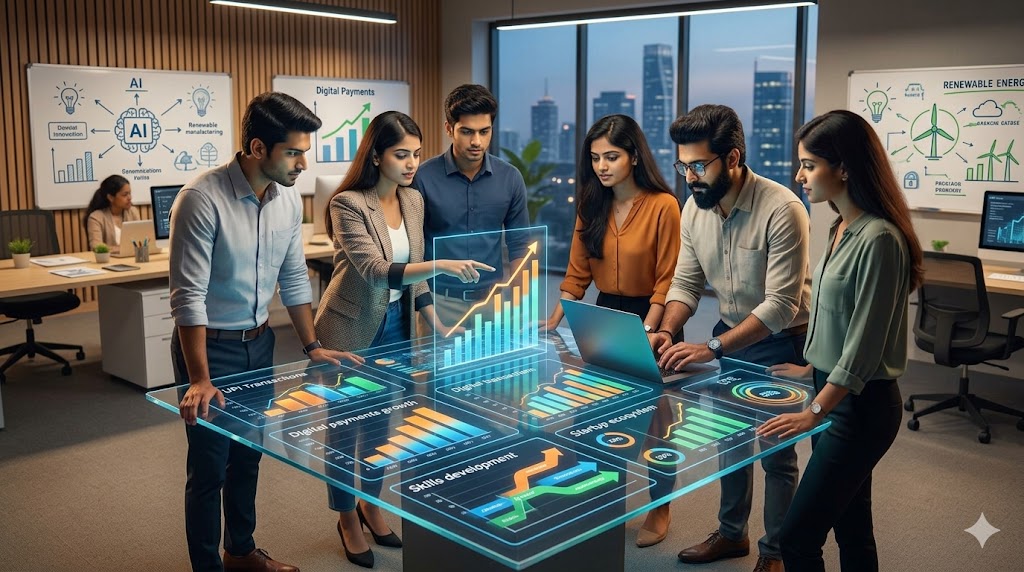
captures the spirit of a youthful and innovative India. In a collaborative tech hub, diverse young professionals—representing India’s "demographic dividend"—work together around an interactive data table.
Post-Economic Crisis Resilience: The Foundation of India's GDP Surge
The post-2008 era and the subsequent COVID-19 shock (2020-21) were defining periods where India's GDP emerged as the primary engine of recovery. After the global financial crisis, the government focused on infrastructure spending and monetary easing, which stabilized growth. Real GDP expanded at an average of 7%+ between 2014 and 2019, even as global headwinds persisted.
The COVID-19 pandemic caused a sharp contraction of around 5.8% in FY2020-21—the first in decades. Yet, India's rebound was among the strongest globally. By FY2021-22, growth surged to 8.7%, followed by 7.2% in FY2022-23 and further acceleration. This V-shaped recovery was powered by targeted fiscal support, including the Atmanirbhar Bharat package worth over ₹20 lakh crore, which emphasized self-reliance in manufacturing and supply chains.
What made GDP the largest growing factor here was the shift toward domestic demand-led growth. Unlike export-dependent economies, India's consumption (contributing over 55-60% to GDP) and capital expenditure provided a buffer. Post-crisis, private consumption rebounded strongly, supported by rising incomes and digital financial inclusion. By 2026, nominal GDP has more than doubled since 2019, crossing multiple trillion-dollar thresholds en route to $4.51 trillion.
Recent data revisions (base year 2022-23) have further refined these figures, showing even stronger momentum in investment and manufacturing. Growth rates, including quarterly prints around 7.8% in late 2025, reflect this underlying strength. The IMF's upward revisions for FY2025-26 to 7.3% (and similar for subsequent years) affirm that India remains the fastest-growing major economy, outpacing China and others.
This resilience post-crises is rooted in diversified growth drivers, ensuring that external shocks do not derail the India GDP trajectory.
Infrastructure Development: The Backbone of Economic Transformation
No discussion of India's rise to the fourth largest economy is complete without highlighting its infrastructure revolution. Successive governments have poured trillions into physical and digital infrastructure, directly boosting productivity, connectivity, and investor confidence.
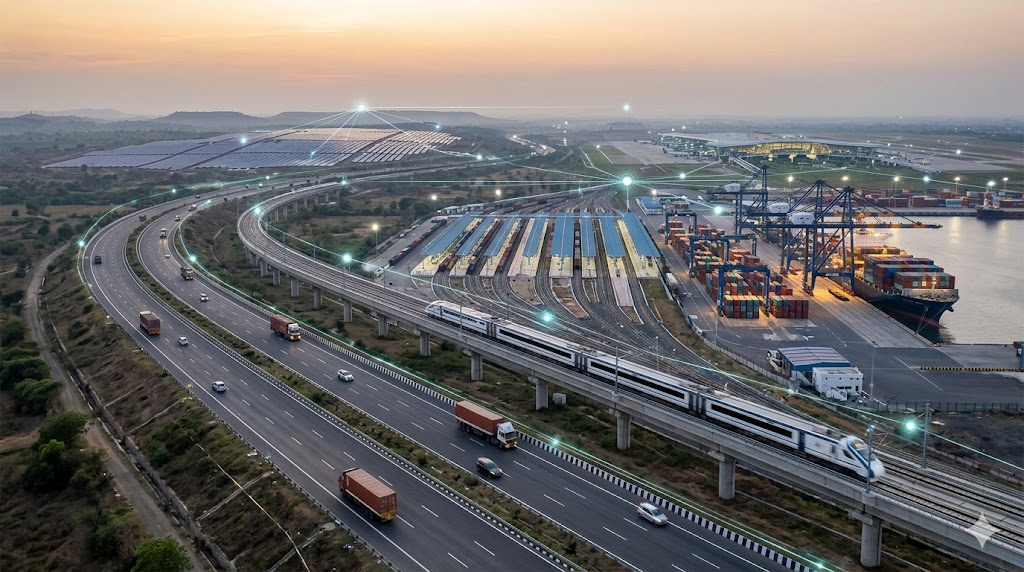
Key initiatives include the Bharatmala Pariyojana for highways (over 50,000 km added), the expansion of airports (from 74 in 2014 to more than 150 operational by 2026), and railway modernization via Vande Bharat trains and dedicated freight corridors. Port capacity has surged under Sagarmala, handling record cargo volumes. The National Infrastructure Pipeline, launched in 2019, envisages ₹111 lakh crore in investments over a decade, with capital expenditure (capex) consistently exceeding 2-3% of GDP annually.
Digital infrastructure has been equally transformative. The India Stack—comprising Aadhaar, UPI, and CoWIN—has revolutionized service delivery. UPI transactions now exceed 15 billion monthly, making India the global leader in real-time digital payments. This has reduced transaction costs, enhanced financial inclusion (over 500 million new bank accounts via Jan Dhan), and fueled e-commerce and fintech growth.
These developments have had a multiplier effect on India GDP. Improved logistics have lowered costs for businesses, attracted FDI (reaching record highs in sectors like electronics and renewables), and supported manufacturing under the Production Linked Incentive (PLI) scheme. Renewable energy capacity has crossed 200 GW, positioning India as a green growth leader.
Infrastructure has not only amplified economic output but also created millions of jobs, directly leveraging the youth workforce and reinforcing the virtuous cycle of growth.
Youth Workforce: Harnessing the Demographic Dividend
India's greatest asset in its ascent to the fourth largest economy is its youth. With over 65% of the population under 35, the country possesses a demographic dividend that many aging economies envy. This young workforce India has been systematically skilled and empowered to drive innovation and productivity.
Programs like Skill India, launched in 2015, have trained millions in industry-relevant trades, with a focus on emerging sectors such as AI, electric vehicles, semiconductors, and green technologies. The National Education Policy 2020 emphasizes vocational training and industry linkages, ensuring that education translates into employability.
The youth bulge has powered key sectors: IT and software exports (over $200 billion annually), pharmaceuticals (India as the "pharmacy of the world"), and startups (third-largest ecosystem globally, with unicorns in fintech, edtech, and agritech). Government schemes like Startup India and Stand-Up India have provided funding and mentorship, creating an entrepreneurial ecosystem that adds thousands of jobs yearly.
In 2026, with initiatives under the proposed National Youth Policy 2026, the focus is on leadership, skilling for employment readiness, entrepreneurship, and climate action. Budget 2026 allocations further emphasize "Yuva Shakti" through education-to-employment pathways, university townships near industrial corridors, and girls' hostels in STEM institutions.
This workforce has been instrumental in sustaining high India economic growth rates. Young professionals drive consumption, innovation, and adaptability—key reasons why India's services sector now contributes over 55% to GDP, while manufacturing is regaining momentum. The demographic window, projected to last until 2040-2050, gives India a unique edge in the global race.
Progressive Policies and Reforms: Catalysts for Sustained Growth
Visionary policies have been the policy engine behind India's transformation. The Goods and Services Tax (GST) in 2017 unified the fragmented tax regime, creating a single national market and boosting compliance. The Insolvency and Bankruptcy Code (IBC) cleaned up non-performing assets, improving credit flow. Ease of Doing Business reforms—digitizing approvals and reducing red tape—have climbed India up global rankings.
The Make in India and Atmanirbhar Bharat campaigns, coupled with 14 PLI schemes worth ₹1.97 lakh crore, have incentivized manufacturing in mobile phones, automobiles, solar panels, and drones. FDI inflows have diversified, with sectors like defense and space opening up.
Monetary and fiscal prudence by the Reserve Bank of India and the government has kept inflation in check and debt sustainable. Direct Benefit Transfers (DBT) have saved billions by plugging leakages, enhancing governance transparency—what can be termed as a commitment to honesty and accountability in public systems.
These India policies have not only accelerated GDP but also made growth more inclusive, lifting millions out of poverty and expanding the middle class to over 400 million.
Governance Integrity: Building Trust and Efficiency
A often-underappreciated factor in India's success is the emphasis on honest and transparent governance. Digital tools have minimized corruption: Aadhaar-linked DBT has eliminated ghost beneficiaries, saving over ₹2.5 lakh crore. Public procurement platforms like GeM (Government e-Marketplace) ensure competitive bidding. Electoral bonds (now discontinued but illustrative of transparency pushes) and asset declarations by officials reflect a culture of accountability.
This integrity has boosted investor confidence, reduced cronyism, and ensured that public resources translate efficiently into infrastructure and welfare. In a world where governance quality often determines economic outcomes, India's approach has been a silent enabler of its fourth-largest economy status.
Reaching Trillions in GDP: Milestones and Growth Dynamics
India's GDP journey to trillions is a tale of compounding growth. From under $500 billion in the early 2000s to $1 trillion by 2010, $2 trillion by 2015-16, $3 trillion around 2020-21 (despite pandemic), and now $4.51 trillion in 2026 projections. This exponential rise stems from the 6-7% average annual growth, with peaks above 8%.
The 4.78% figure referenced in some contexts likely alludes to earlier conservative estimates or specific quarterly adjustments pre-revision; recent data shows far stronger prints (7%+), underscoring the upward trajectory. Nominal GDP growth, combining real expansion and moderate inflation, has been the key multiplier.
Today, India is firmly in the race among developing nations to achieve developed status. The Viksit Bharat @2047 roadmap targets a $30 trillion economy, universal prosperity, and global leadership. With current momentum—strong capex, export diversification, and tech adoption—the goal is achievable. Challenges like inequality, climate risks, and job creation persist, but policies address them head-on through skilling, green investments, and inclusive growth.
Featuring an upward-surging graph that points toward a futuristic city skyline, the image symbolizes the nation’s ambition to become a developed economy by 2047 ("Viksit Bharat"). The interwoven icons of high-speed rail, rocket technology, and young professionals represent the key drivers of this transformation: world-class infrastructure, digital innovation, and the power of a vibrant youth workforce.
Challenges, Opportunities, and Future Outlook
While optimistic, the path forward requires navigating global uncertainties, skill gaps, and sustainable development. Yet, with its fundamentals—young population, democratic stability, and reformist zeal—India is poised to maintain 6%+ growth for years.
Conclusion
India's emergence as the fourth largest economy is a testament to the power of GDP-led growth, strategic infrastructure, a dynamic youth workforce, forward-looking policies, and principled governance. From post-crisis recoveries to trillion-dollar milestones, the nation has consistently defied expectations. As it charges toward developed nation status, this story inspires not just Indians but the world. The best, as they say, is yet to come.
Frequently Asked Questions
What is the primary significance of India Becomes 4th Largest Economy: GDP Growth Story?
In the span of just a few decades, India has scripted one of the most remarkable economic turnaround stories in modern history. As of 2026, India stands as the world's fourth largest economy by nominal GDP, with projections from the International Monetary Fund (IMF) placing its economy at approximately $4.51 trillion—edging past Japan and solidifying its position behind only the United States, China, and Germany.
How does this development impact Current Affairs?
This ascent is not accidental. It is the result of sustained India GDP growth, visionary policy reforms, massive infrastructure development, and the harnessing of a vibrant youth workforce.The journey has been particularly noteworthy after major economic crises, including the 2008 global financial meltdown and the more recent COVID-19 disruptions.
What are the key future projections to monitor?
What sets India apart is its resilience and the way GDP has emerged as the single largest growing factor in its transformation.